
BLOG
7 Key Differences Between Padel Courts and Tennis Courts
Recent Articles
Table of Contents
Introduction
Padel has become one of the fastest-growing racket sports globally. Unlike tennis, which has a long-established infrastructure and professional circuits, padel is emerging as a highly social, fast-paced, and strategic sport. Its popularity is especially evident in Europe and Latin America, with growing interest in North America and Asia.
Although padel shares some similarities with tennis—such as using a net, a ball, and racket-like equipment—the differences are fundamental. Understanding these differences is essential for players, coaches, sports facility managers, and investors considering the construction of new courts.
This article explores 7 key differences between padel courts and tennis courts, explains why these courts are not interchangeable, and provides guidance on building dedicated padel courts. It includes detailed technical comparisons, player experience insights, construction considerations, and long-term maintenance advice.
1. Court Dimensions and Size Differences Between Padel Courts and Tennis Courts
The first major difference lies in the court size, which significantly influences gameplay, player movement, and facility planning.
Padel Court Size
- A standard padel court measures 20 meters long and 10 meters wide.
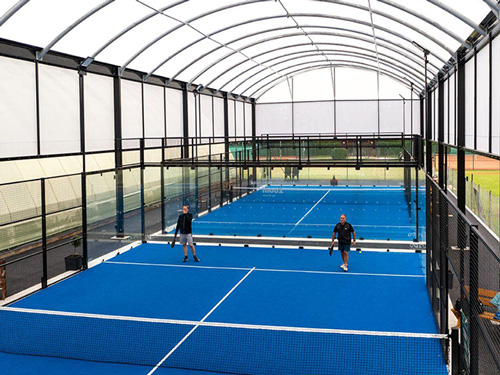
- The court is fully enclosed with walls or glass panels, forming an integral part of the game.
- Smaller size results in more rapid rallies, increased interaction between players, and enhanced strategic play.
Tennis Court Size
- Tennis courts measure 23.77 meters long and 8.23 meters wide for singles and 10.97 meters for doubles.
- Open space without walls allows for higher-velocity shots and longer rallies.
Implications for Facility Design
- Padel courts require smaller footprints, making them suitable for urban environments, rooftop installations, and compact sports complexes.
- Tennis courts require larger space, including surrounding buffer zones for safety and spectator areas.
- Attempting to play padel on a tennis court compromises safety and reduces the core gameplay experience.
Player Experience
- Padel players experience constant engagement due to shorter distances and wall rebounds.
- Tennis players must cover more ground and rely on endurance and precision over longer strokes.
2. Wall Integration and Gameplay Mechanics

A defining feature of padel is the use of walls, which differentiates its gameplay dramatically from tennis.
Padel Court Walls
- Courts are enclosed with walls made of glass or metal mesh.
- Balls can rebound off walls, creating dynamic angles and requiring advanced anticipation.
- Walls allow extended rallies even in a small court space, enhancing strategy and teamwork.
Tennis Court Walls
- Tennis courts are open; balls leaving the perimeter are considered out.
- Perimeter fences exist for safety but are not part of active gameplay.
Tactical Differences
- In padel, players often use wall rebounds for trick shots and defensive positioning.
- Tennis relies on shot placement and footwork to control space; wall rebounds are absent.
3. Net Height, Surface, and Ball Dynamics
Padel and tennis differ in net height, playing surfaces, and ball behavior, which impact play style and equipment requirements.
Net Height
- Padel nets: 88 cm at the center, 92 cm at the sides.
- Tennis nets: 91.4 cm at the center, tensioned to handle higher-speed serves.
Playing Surfaces
- Padel: artificial turf, synthetic surfaces, or carpet designed for traction and low-impact play.
- Tennis: hard courts, clay, grass; each affects ball bounce and player stamina.
Ball Differences
- Padel balls are slightly less pressurized, resulting in slower bounce and enhanced control in smaller courts.
- Tennis balls are designed for higher-speed rallies on larger courts.
Gameplay Consequences
- Using a tennis ball on a padel court creates a mismatch, causing excessive bounce and reduced control.
- Padel balls on tennis courts result in shorter rallies and underutilized player movement.
4. Equipment and Player Interaction

Padel and tennis equipment is not interchangeable, affecting both training and match performance.
Padel Equipment
- Solid, perforated padel rackets provide control in smaller courts.
- Doubles play is standard, emphasizing teamwork and wall tactics.
Tennis Equipment
- Strung rackets allow for powerful serves and high-velocity groundstrokes.
- Singles and doubles formats both emphasize endurance and precision over larger areas.
Player Training
- Padel focuses on reaction speed, positioning, and cooperative strategy.
- Tennis emphasizes serve mechanics, court coverage, and shot variety.
5. Construction and Safety Considerations
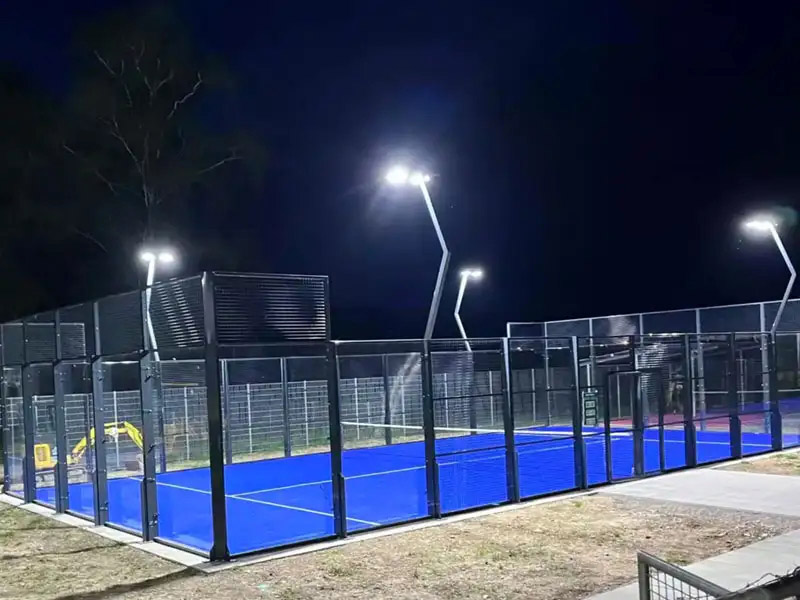
Dedicated padel courts are designed for structural safety and durability.
Foundation and Materials
- Concrete foundations, drainage systems, and synthetic turf installation ensure stability.
- Wall materials must withstand impact from high-speed balls and players.
Safety Factors
- Enclosed walls prevent balls from escaping and reduce risk to spectators.
- Proper spacing and surface design minimize injuries from slips or falls.
Maintenance
- Regular inspection of walls, turf, and netting is essential.
- Tennis courts require less wall maintenance but more surface upkeep for clay or grass.
Table: Detailed Comparison of Padel Courts and Tennis Courts
| Feature | Padel Courts | Tennis Courts | Impact on Play |
|---|---|---|---|
| Court Size | 20m x 10m | 23.77m x 8.23m | Smaller padel courts encourage fast rallies |
| Walls | Enclosed, integral to game | Open, fences only | Wall rebounds affect strategy and skills |
| Net Height | 88-92 cm | 91.4 cm | Slightly lower net affects serve and volley |
| Surface | Artificial turf, synthetic | Hard, clay, grass | Surface affects ball bounce and traction |
| Equipment | Solid, perforated rackets | Strung rackets | Equipment not interchangeable |
| Ball | Low pressure, smaller bounce | Standard pressurized ball | Incompatible for cross-play |
| Player Format | Doubles | Singles/Doubles | Strategy and movement differ |
| Construction | Compact, urban-friendly | Larger footprint | Space and cost considerations |
| Maintenance | Turf/wall inspection | Surface and net repair | Tailored upkeep required |
This table shows that padel and tennis courts are fundamentally different, reinforcing the need for dedicated padel court construction.
6. Advantages of Building a Dedicated Padel Court
Building a padel court offers multiple strategic advantages:
- Compact footprint allows installation in limited spaces
- Wall-integrated design enables authentic gameplay
- Dedicated courts improve player safety and reduce equipment conflicts
- Professional-grade setup suitable for tournaments or clubs
- High engagement for community and recreational programs
Facilities investing in padel courts gain higher utilization rates and cater to a growing audience seeking a modern, fast-paced sport.
7. Player Experience and Tactical Differences
From a gameplay perspective, padel courts promote:
- Constant engagement due to smaller size
- Teamwork and cooperative strategy in doubles
- Tactical use of walls for extended rallies
- Reduced physical strain while enhancing reaction and precision skills
Tennis courts promote:
- High-speed rallies over longer distances
- Emphasis on endurance and court coverage
- Technical mastery of serves and groundstrokes
- Individual performance focus
The differences highlight that tennis courts cannot replace padel courts without compromising safety, strategy, and overall enjoyment.
Conclusion
Understanding the 7 key differences between padel courts and tennis courts clearly demonstrates why dedicated padel court construction is essential. Differences in size, walls, net height, surface, equipment, and gameplay make shared or adapted use impractical.
For players, coaches, and facility managers, building a dedicated padel court ensures safety, professional-grade play, and long-term enjoyment, while enabling communities to engage with this growing sport effectively. Investing in a dedicated padel court is not just about providing a playing area—it’s about creating an authentic experience that cannot be replicated on a tennis court.
FAQ
1. Can I play padel on a tennis court?
No, differences in court size, walls, net height, and ball dynamics make it impractical.
2. What are the standard padel court dimensions?
20 meters long and 10 meters wide, fully enclosed with walls or glass panels.
3. Are padel balls compatible with tennis?
No, padel balls are lower pressure and designed for smaller courts.
4. Why are walls important in padel?
Walls allow strategic rebounds, extending rallies and shaping gameplay dynamics.
5. What are the advantages of a dedicated padel court?
Enhanced safety, professional-grade play, accurate gameplay, and long-term durability.