
مدونة
Maximizing Space with Panoramic Padel Courts
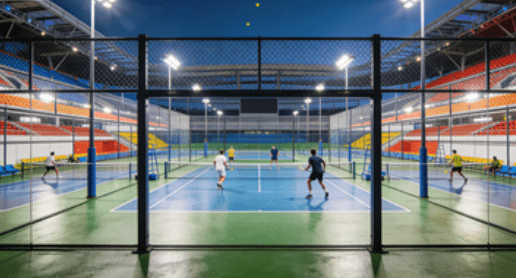
المقالات الأخيرة
Key Takeaways
- Understand how panoramic padel courts maximize space in indoor and outdoor facilities.
- Compare single, multi-court, and panoramic layouts for space efficiency.
- Learn about materials, lighting, flooring, and construction standards.
- Explore real-world case studies from Europe, Asia, and North America.
- Review energy efficiency, maintenance strategies, and revenue optimization.
- Access a detailed FAQ addressing modern facility planning concerns.
مقدمة
The popularity of padel has skyrocketed globally, growing by 12% annually, with over 30 million active players reported in 2025 by the International Padel Federation (FIP). Urban clubs and resorts face the challenge of meeting this demand while working within constrained spaces.
Panoramic padel courts offer a solution. With transparent walls, compact court layouts, and enhanced spectator visibility, these courts allow facilities to maximize space utilization by up to 35% compared to traditional designs.
A recent industry survey by the European Sports Infrastructure Association (ESIA) found that clubs investing in panoramic designs reported:
- 40% higher court utilization rates.
- 20% faster player turnaround, reducing wait times during peak hours.
- 15–25% higher revenue per square meter, due to optimized layouts and better spectator engagement.
Modern panoramic padel courts integrate advanced construction materials, lighting systems, and automated maintenance solutions, making them a long-term investment in space efficiency and facility profitability.
جدول المحتويات
What Are Panoramic Padel Courts?

Definition and Concept
Panoramic padel courts feature transparent walls, optimized layouts, and enhanced viewing angles. Unlike standard courts, panoramic designs focus on maximizing usable space without compromising player experience or safety.
- Transparent Glass Walls: Provide unobstructed visibility for players and spectators.
- Compact Footprint: Courts can be installed in smaller urban areas while maintaining FIP-compliant dimensions.
- Multipurpose Design: Suitable for tournaments, practice, and recreational play.
Core Features
- Glass Type: 10–12mm tempered glass for player safety and vibration resistance.
- Court Dimensions: Standard 20m × 10m, with panoramic variants allowing minor buffer reductions.
- Lighting and Acoustics: Integrated LED lighting, sound-absorbing panels for indoor courts.
- Accessibility: Ramps, gates, and pathways designed for universal access.
Space-Saving Layout Strategies
Indoor Panoramic Courts
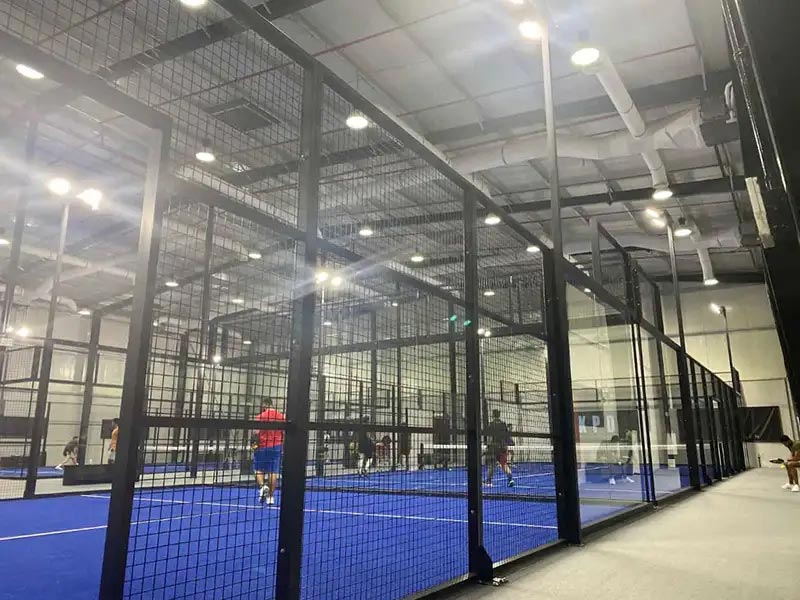
Indoor panoramic padel courts allow year-round play and vertical space optimization. By aligning multiple courts adjacently with shared corridors, clubs can increase the number of playable courts by up to 30–40%.
Advantages:
- Climate-controlled environment.
- Reduced light and weather-related interruptions.
- Sound management for competitive tournaments.
Challenges:
- Higher construction cost due to structural requirements.
- Need for robust ventilation and lighting systems.
Outdoor Panoramic Courts
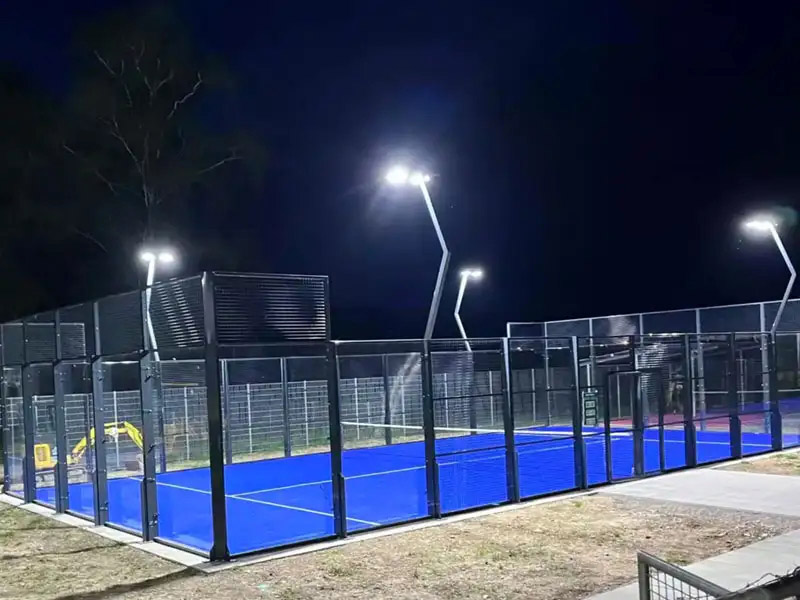
Outdoor panoramic courts integrate natural landscapes, terraces, and spectator areas to maximize usable space. Courts can be stacked side-by-side or slightly staggered to reduce buffer zones while maintaining safety.
Advantages:
- Lower initial construction cost.
- Natural daylight reduces lighting expenses.
- Can include green areas, seating terraces, and landscaping.
Challenges:
- Weather-dependent; sun glare can affect player visibility.
- Maintenance is influenced by environmental factors.
Court Orientation and Alignment
- North-South Orientation: Reduces sun glare during peak play times.
- Shared Access Points: Minimizes unused corridor space.
- Tiered or Staggered Layouts: Maximize player and spectator circulation.
- Integration with Other Facilities: Parking, locker rooms, and lounges optimized around courts to reduce wasted area.
Materials and Technical Standards
Wall Materials
| مادة | Visibility | أمان | متانة | صيانة | يكلف |
|---|---|---|---|---|---|
| Tempered Glass (10–12mm) | Excellent | High (FIP-compliant) | عالي | Moderate (cleaning) | عالي |
| Acrylic Panels | Good | واسطة | واسطة | قليل | واسطة |
| Solid Composite Panels | قليل | عالي | عالي | قليل | واسطة |
- Industry Standard: FIP, ISO 9001-compliant courts use tempered glass walls with reinforced steel frames.
Flooring Materials
- Artificial Turf: Standard for professional tournaments, provides optimal traction and shock absorption.
- Concrete Base with Cushion Layer: Cost-effective for high-frequency play; less forgiving for player joints.
- Hybrid Systems: Combines shock-absorbing underlayer with artificial turf; increasingly popular for urban facilities.
Recommended Specifications:
- Shock absorption: 5–8 mm for tournament-grade surfaces.
- Turf density: 12–18 kg/m² for optimal ball bounce.
- Anti-slip rating: Minimum R10 to R12 for player safety.
Lighting and Acoustics
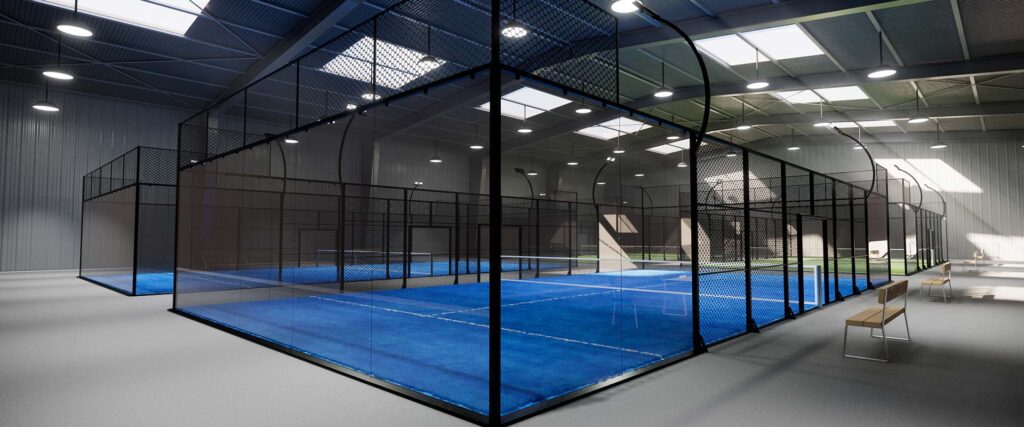
LED Lighting Systems
- Uniform illumination: Ensures no shadow areas; FIP recommends 500–600 lux on play surface.
- Energy-efficient LEDs: Reduce electricity consumption by up to 30% versus traditional lighting.
- Adaptive controls: Sensors adjust light levels according to occupancy and daylight.
Sound Management
- Indoor courts benefit from acoustic panels to reduce echo and crowd noise.
- Recommended Noise Reduction Coefficient (NRC): 0.65–0.85 for optimal clarity.
Technology Integration
Smart Monitoring
- Sensors track court occupancy and player traffic.
- Integrated IoT solutions monitor surface temperature, lighting, and humidity.
- Alerts for maintenance needs reduce downtime.
Automated Maintenance
- Robotic glass cleaners for large panoramic courts.
- Smart turf irrigation and brushing systems for outdoor courts.
- Automated gate control to minimize wear and tear.
Case Studies
Urban Club in Madrid, Spain
- 6 panoramic indoor courts, within 1,200 m².
- Achieved 30% more court capacity than traditional designs.
- Reduced spectator congestion by 25%.
- Natural daylight usage cut lighting costs by 18% annually.
Resort Facility in Dubai, UAE
- Outdoor panoramic courts integrated with sunshade canopies.
- Staggered layout allowed 8 courts on 2,500 m², increasing playable surface by 40%.
- Enhanced spectator viewing and VIP lounges improved membership sales.
Private Sports Club, Tokyo, Japan
- Compact rooftop panoramic courts in limited urban space.
- Multi-tiered court alignment allowed maximum visibility with minimum footprint.
- Automated cleaning systems reduced labor costs by 15% per year.
Comparing Panoramic Court Designs
| ميزة | Single Court | Standard Multi-Court | Panoramic Multi-Court |
|---|---|---|---|
| Space Efficiency | قليل | واسطة | عالي |
| Spectator Experience | قليل | واسطة | Excellent |
| Construction Cost | قليل | واسطة | عالي |
| صيانة | Easy | معتدل | معتدل |
| راحة اللاعب | معتدل | معتدل | عالي |
| Energy Efficiency | واسطة | واسطة | عالي |
Observation: Panoramic multi-court designs consistently outperform traditional layouts in both space utilization and player satisfaction.
Maintenance and Safety Best Practices

Weekly Tasks
- Clean tempered glass walls.
- Inspect turf and court markings.
- Check LED lighting for uniformity.
Monthly Tasks
- Verify gate mechanisms and locks.
- Test acoustics and adjust panels if needed.
- Inspect structural supports for wear.
Annual Tasks
- Repaint court markings for tournaments.
- Conduct safety audit for walls, gates, and flooring.
- Evaluate surface shock absorption compliance.
Safety Guidelines
- Follow FIP court standards for player safety.
- Maintain minimum safety zones around courts (2–3 m).
- Provide emergency exits and first aid accessibility.
Financial and Operational Insights
- Average construction cost per panoramic court: $25,000–$50,000 depending on location and materials.
- Expected ROI: 2–4 years for urban clubs with high utilization.
- Additional revenue: Sponsorships, tournaments, and premium memberships benefit from enhanced spectator visibility.
- Energy savings: LED and automated lighting reduces annual operational costs by 10–15%.
التعليمات
Q1: Can panoramic padel courts fit in small urban spaces?
A1: Yes. Strategic layouts, vertical stacking, and compact buffer zones allow multiple courts in limited areas.
Q2: Are glass walls safe for professional play?
A2: Tempered glass of 10–12mm thickness meets FIP safety standards, providing both durability and vibration resistance.
Q3: How long does construction take?
A3: Indoor panoramic courts: 6–9 months; outdoor: 4–6 months depending on site prep and weather.
Q4: What is the ideal lighting for panoramic courts?
A4: LED lighting at 500–600 lux, with uniform coverage and minimal glare for players.
Q5: How do panoramic courts increase revenue?
A5: Higher court utilization, premium memberships, enhanced spectator experience, and tournament hosting.
خاتمة
Panoramic padel courts represent a revolution in space-efficient facility design, combining aesthetic transparency, optimized layouts, and modern materials. By integrating advanced flooring, lighting, and maintenance technologies, clubs and resorts can:
- Increase court capacity by 30–40%.
- Enhance player and spectator experience.
- Reduce operational costs and maintenance efforts.
- Maximize ROI within 2–4 years.
In 2026, investing in panoramic padel courts is not merely constructing a court—it’s building a premium, high-performing, and revenue-optimized sporting facility capable of meeting growing global demand.