
مدونة
Padel Courts Design for Clubs: Smart Planning for Profit
المقالات الأخيرة
Padel is no longer a niche sport — it’s a global phenomenon. With over 50,000 courts and more than 25 million players worldwide, padel is expanding faster than almost any racket sport, driven by strong social appeal and demand from clubs, communities, and fitness facilities.
For club owners and investors, understanding padel courts design is not just about building a place to play — it’s about creating an environment that optimizes performance, player experience, operational efficiency and long-term profitability.
Key Takeaways Club Owners Should Know
- Sport & Design Overview: How padel court dimensions and components affect game quality
- Material & Structural Standards: From turf to glass walls — what really matters
- Indoor vs Outdoor Solutions: Pros, cons, and cost implications
- Regional Design Trends: How geography shapes club profitability
- Budget & ROI Metrics: Typical construction investment and how to forecast returns
- Club Player Experience: Design features that boost retention and membership value
- Real Problems to Avoid: Common pitfalls that cost money and reputation
- Expert FAQs speakers answer real operational questions
جدول المحتويات
Why Quality Padel Courts Design Sets Winning Clubs Apart
Padel’s explosive growth reflects its broad demographic appeal — kids to seniors, competitive players to social groups. Unlike traditional racket sports, padel’s format emphasizes double play, shorter court dimensions, and rebound usage of walls, which makes the design of the court central to true gameplay quality.
For clubs, good padel courts design:
- Improves safety and comfort
- Maximizes scheduling capacity
- Reduces long-term maintenance
- Supports hosting events and leagues
Simply put, design decisions directly influence membership satisfaction and the club’s revenue potential.
Official Court Standards: The Basics Every Club Must Know
Standard Court Dimensions
According to international padel regulations, the official playing court area must measure 20 meters long by 10 meters wide for doubles play — this is the universal standard used in clubs globally.
Additional zones outside this area — necessary for player movement and safety — typically add several meters around each court.
Why it matters:
A tightly constrained court benefits competitive play but offers less room for coaching, spectators, and circulation. Balancing official standards with practical club needs is a core part of padel courts design.
Material & Structural Components: What Defines Court Quality
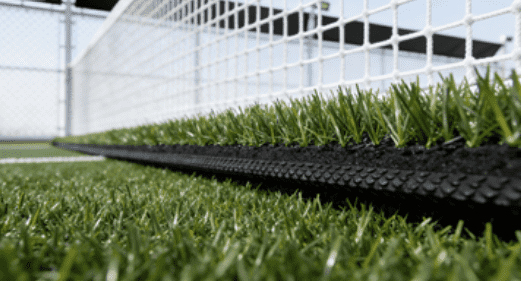
Court Surface & Turf
The playing surface — usually artificial turf with a sand or rubber infill — affects ball bounce, speed, and injury risk. Premium turfs typically have:
- 10–15 mm pile height
- Yarn density tuned for consistent rebound
- Silica sand infill to stabilize the grass layer and improve ball control
Lower quality turf can wear unevenly, reduce ball consistency, and increase maintenance costs. For club use — where frequency is high — investing in mid-to-high-grade artificial turf is recommended.
Padel Courts Design Essentials — Key Technical Specs
Here’s a summary of technical components that any club project should consider:
| Component | Typical Specification | Why It Matters |
|---|---|---|
| حجم الملعب | 20m × 10m (internal) | Official regulation size |
| Glass Wall Thickness | 10–12mm tempered glass | Safety + rebound control |
| Steel Structure | Hot-dip galvanized + powder coat | Corrosion resistance |
| عشب صناعي | 10–15mm pile height | Playability and ball response |
| إضاءة | 300–500 lux (club level) | Player visibility + safety |
| Drainage & Base | Slight slope + channels | For outdoor courts, prevents pooling |
Note: Standards may vary slightly by region and level of play (recreational vs elite tournaments), but these provide a reliable baseline for club designers and planners.
Indoor vs Outdoor Padel Courts Design — Strategic Differences
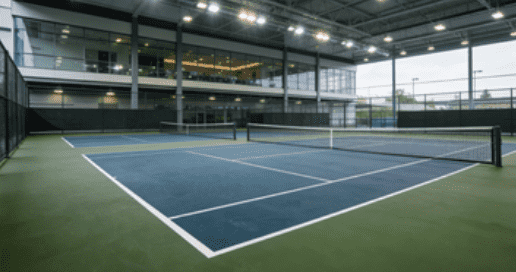
Indoor Designs: Consistent, Premium, All-Weather
Indoor padel courts design provides:
- Year-round play regardless of weather
- Controlled lighting and climate
- Better acoustics with appropriate wall treatments
Indoor courts are often more expensive upfront because they require:
- Building or leasing covered spaces
- HVAC or climate control systems
- Enhanced lighting systems
However, indoor courts can justify premium pricing and membership packages due to their all-season utility.
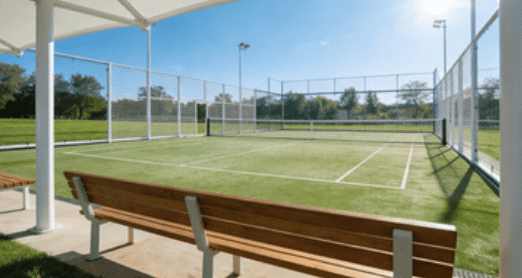
Outdoor Designs: Cost-Effective & Expandable
Outdoor padel courts design suits clubs with:
- Open land use
- Seasonal peak periods
- Multi-sport facilities
Outdoors, issues to address include:
- Water drainage and surface slope
- Wind effects on play
- Stronger foundations
A club with outdoor designs typically has lower initial build costs, but must invest in weather-resistant materials and stronger drainage systems.
Cost Structure & Financial Planning: A Practical View
Understanding costs is essential for budgeting and ROI planning. Based on industry benchmarks:
Approximate Cost Breakdown (USD per Court)
| غرض | Typical Cost Range |
|---|---|
| Site prep & foundation | $3,000–$15,000 |
| Surface & turf | $4,000–$12,000 |
| Glass walls & fencing | $6,000–$20,000 |
| Lighting systems | $3,000–$10,000 |
| Professional installation | Varies ($5,000–$15,000) |
| Total Estimated per Outdoor Court | $33,000–$77,000+ |
⚠️ Note: Indoor courts or covered installations can cost significantly more, often $100,000+ per court with structural roofing and utilities.
These figures help clubs forecast expenses and plan phased builds if space or financing is limited.
How Design Impacts Club Revenue & Player Experience
A thoughtfully designed padel facility affects:
- Membership subscriptions
- Hourly court rentals
- Event hosting opportunities
Many clubs charge tiered pricing based on peak/non-peak hours. Musings from players and club operators on real-world pricing show how utilization affects membership economics.
Example Pricing Models
- Off-Peak (Daytime): Lower rates attract casual users
- Prime Time (Evenings, Weekends): Higher rates boost revenue
- Membership Packages: Subscription pricing increases retention
Good design — including clear circulation areas, comfortable social zones، و coaching spaces — makes clubs more attractive, increasing court utilization and revenues.
Planning for More Than Just the Court
Ancillary Spaces That Boost Value
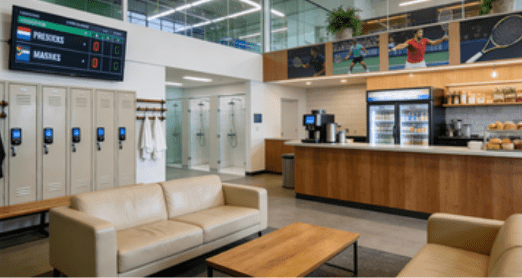
Successful clubs often include:
- Comfortable shielding from wind/glare
- Spectator seating and social areas
- Locker rooms and shower facilities
- Pro shop or equipment rental zones
- Café or lounge spaces
These enhancements turn padel facilities into membership destinations, not just sports sites.
Pitfalls & Missteps Clubs Should Avoid
Cutting Corners on Materials
Cheaper fencing or turf may reduce upfront costs but often increases long-term maintenance and reduces playing quality.
Ignoring Local Codes and Permits
Failing to align with local building codes or safety requirements can delay projects and cause compliance issues. Design teams must factor these in early.
Undersizing Ancillary Areas
Too-small circulation spaces, cramped entrances, or lack of viewing areas negatively impact user experience.
Regional Focus in Padel Courts Design: How Location Shapes Profit
Padel is a global sport, but padel courts design varies significantly by region. Climate conditions, player habits, land costs, and business models all influence how clubs design courts—and how they generate profit.
Understanding these regional priorities helps club owners adopt proven strategies instead of relying on one-size-fits-all solutions.
Southern Europe: Spain & Italy
Focus: Player Experience + High Court Density
Spain, the birthplace of padel, emphasizes fast gameplay, social interaction, and high utilization. Clubs often prioritize compact layouts that maximize the number of courts per square meter.
In Italy, padel courts design frequently integrates cafés, lounges, and spectator areas to extend customer stay time.
Profit Advantage:
- High court turnover rates
- Strong membership retention
- Additional revenue from food, events, and leagues
Northern Europe: Sweden & Germany
Focus: Indoor Padel Courts Design & Premium Positioning
Cold climates and long winters make indoor padel courts design essential. Facilities often feature insulated structures, controlled lighting, and energy-efficient systems.
Northern European clubs typically position padel as a premium indoor sport, offering higher pricing tiers and structured training programs.
Profit Advantage:
- Year-round revenue stability
- Higher hourly court prices
- Corporate bookings and training packages
Middle East: UAE & Saudi Arabia
Focus: Climate Control & Luxury Design
In hot regions, padel courts design centers on fully indoor or semi-indoor solutions, with strong ventilation and cooling systems. Design aesthetics often play a major role, with panoramic glass courts and upscale finishes.
Padel clubs here often target high-income users and branded experiences.
Profit Advantage:
- Premium pricing acceptance
- Sponsorship and brand partnerships
- Strong social and VIP event demand
North America: United States & Canada
Focus: Multi-Sport Integration & Scalability
In North America, padel is often introduced within existing sports complexes. Padel courts design emphasizes modular construction and flexible layouts that coexist with tennis, pickleball, or fitness spaces.
Education and visibility are key, so designs often include spectator-friendly layouts and coaching areas.
Profit Advantage:
- Shared infrastructure reduces costs
- Cross-selling between sports
- Scalable expansion as demand grows
Latin America: Mexico & Argentina
Focus: Cost-Efficient Outdoor Design
Latin American clubs often favor outdoor padel courts design with durable materials and simplified structures. Space availability allows wider layouts and community-focused facilities.
Padel here is social and competitive, with frequent tournaments and leagues.
Profit Advantage:
- Lower construction costs
- High community engagement
- Strong tournament-driven revenue
Comparing Regional Design Priorities
| Region | Design Priority | Typical Court Type | Main Profit Driver |
|---|---|---|---|
| Southern Europe | Density & social flow | Outdoor / Mixed | High utilization |
| شمال أوروبا | Climate control | داخلي | Premium pricing |
| الشرق الأوسط | Luxury & cooling | داخلي | High-end users |
| أمريكا الشمالية | Flexibility | وحدات | Cross-sport traffic |
| أمريكا اللاتينية | Cost efficiency | في الهواء الطلق | Community volume |
How Clubs Can Apply Global Best Practices Locally
Adapt, Don’t Copy
Successful padel courts design takes inspiration from global models but adapts to local climate, land costs, and user behavior.
Match Design to Pricing Strategy
Premium indoor designs support higher hourly rates, while outdoor community-focused designs rely on volume and events.
Design for Your Target Audience
A competitive training club requires different layouts than a social, lifestyle-oriented padel venue.
Key Takeaway for Club Investors
Global experience shows that padel courts design directly influences how a club makes money. Whether through premium pricing, high court density, or multi-sport integration, design choices should always align with the club’s regional market and revenue model.
By learning from international design trends, clubs can reduce trial-and-error costs and accelerate profitability.
Expert Industry Insights
Global Sports Trends Authority analysts project padel market growth with a projected revenue exceeding $500 million by 2027.
Industry leaders emphasize the importance of integrating padel courts design with club business strategy, not just construction specs.
خاتمة
Designing padel courts for clubs goes far beyond marking lines and laying turf. It involves strategic planning that balances technical standards, player experience, operational efficiency and business goals.
By incorporating:
- Accurate dimensions and compliance standards
- High-quality materials
- Thoughtful layout planning
- Revenue-enhancing ancillary features
clubs can unlock both sporting excellence and commercial success.
التعليمات
How much space should a club allocate per court?
For one court, aside from the 20m × 10m play area, clubs typically allocate about 231 m² or more to include sidelines, buffer zones, and room for movement.
What lighting levels are best for club play?
- 300–500 lux for club/tournament play is standard
- 500+ lux recommended for broadcast and elite training conditions
Are indoor courts worth the extra cost?
Indoor designs offer year-round usability and premium pricing, often leading to better ROI in markets with seasonal weather.
Should a club prioritize glass wall quality?
Yes. Glass quality impacts bounce consistency, safety, and aesthetics — all essential to padel courts design excellence.
How many courts does a typical padel club have?
Clubs often start with 2–4 courts and may expand based on demand. Scalable designs facilitate this growth.