
Ratgeber
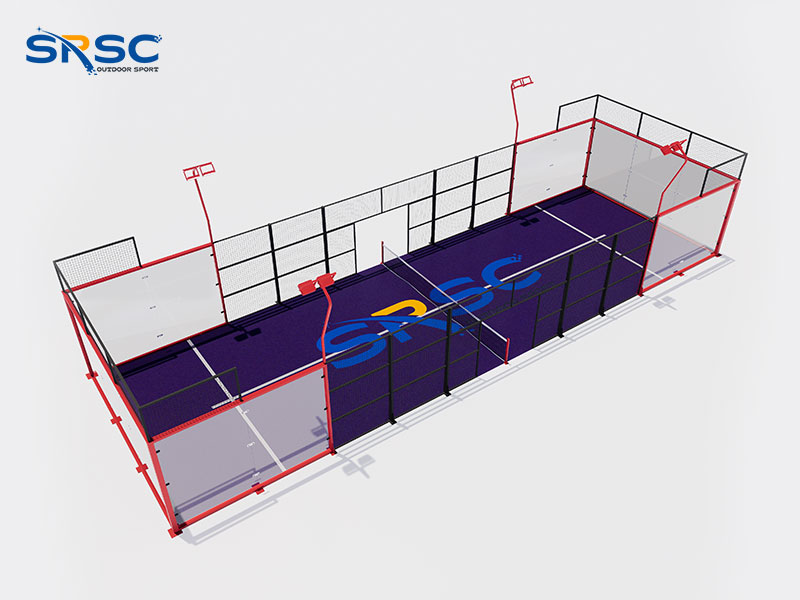
4 Critical Dimensions in Singles Padel Court Size
Aktuelle Artikel
Inhaltsverzeichnis
Einführung
Padel has exploded in popularity over the last decade, transforming from a regional sport into one played worldwide. Although doubles padel remains the most common format, singles padel is gaining traction among competitive players and training academies due to its emphasis on speed, precision, and strategic play.
Yet, one fundamental aspect often overlooked by new players, court builders, academies, and even some regional federations is the singles padel court size. At first glance, it may seem that a padel court is just a rectangle with a net in the middle. But in reality, every centimeter of that rectangle influences how the game is played—from the depth of the baseline to the height of the net, from the service box dimensions to the placement of boundary lines.
Inaccurate court dimensions can affect ball bounce, footwork patterns, rally length, and even player safety. As Dr. Laura Sánchez, a sports biomechanist with the International Padel Federation (FIP), states:
“Precision in court dimensions is not merely aesthetic—players adapt their movement and shot selection based on spatial constraints. A mismatch of as little as 2 centimeters in net height or boundary width can subtly alter performance dynamics in competitive play.”
This article is a comprehensive dive into the four critical dimensions that define an official and optimized singles padel court size. Whether you are a facility manager, a coach, or a passionate player seeking deeper understanding, this guide will walk you through each dimension—what it is, why it matters, how to measure it correctly, and what common mistakes to avoid.
Court Length: The Backbone of Proper Singles Padel Court Size
Any discussion about a padel court begins with its length. This is the front-to-back measurement of the court surface, and it directly impacts how points are played.
Official Standard and Why It Matters
The officially recognized singles padel court size for length is:
- 20 meters
This exact measurement is endorsed by the International Padel Federation (FIP) and is consistent with professional tournament standards across Europe and Latin America. Length influences rally tempo and player movement patterns dramatically. A longer court increases the demand on players’ endurance, whereas a shorter court compresses rallies, reduces reaction time, and may diminish the strategic richness of the game.
Movement Patterns and Biomechanics
Biomechanical studies conducted by several sports science departments show that players cover between 3–5 kilometers per hour in average movement during singles rallies—a pace intimately tied to court dimensions. When a court exceeds the standard length, players must generate greater forward and backward momentum, increasing physiological strain over long matches.
Precision Tools for Measurement
Accurate measurement of the court length should employ tools such as:
- Laser range finders (±0.01 meter accuracy)
- Certified surveyor measuring tapes
- GPS-based measurement systems for outdoor courts
Repeat measurements at multiple points help ensure the court is correctly aligned and meets the standard for singles padel court size.
Court Width: Balancing Strategic Play and Physical Demand

While length dictates depth, the width of a singles padel court determines how players engage laterally with the game. It defines the space available for sidestepping, reach shots, and wide-angle play.
Official Standard Width
The recognized standard for singles padel court width is:
- 6 meters
Maintaining this width ensures that players can fully utilize lateral movement strategies without feeling constrained. Too narrow a court traps movement and can make baseline rallies feel “boxed-in.” Too wide, and the court becomes difficult to defend, especially for players who rely on quick, short lateral bursts.
Spatial Perception and Tactical Play
Jonathan Pérez, a certified professional coach with over 15 years of experience coaching elite padel players, notes:
“Width defines angles. In singles play, especially, the difference between 5.8 meters and 6 meters can transform an otherwise reachable volley into a scoring shot due to how players pivot and position.”
Coaches often put portable markers on the court during practice to reinforce spatial awareness, especially for beginners learning to read lateral movement.
Net Height: A Small Measurement With Big Effects
The net is arguably the most influential yet understated feature of a singles padel court size. Its height affects serve mechanics, volley timing, and defensive lobs.
Official Net Height Standard
For singles padel court size, the recognized net height is:
- 0.88 meters at the center
- 0.92 meters at the posts (maximum tolerance)
These values are consistent with FIP regulations and professional tournament requirements.
Why a Few Centimeters Matter
Even a small deviation in net height can significantly influence gameplay. A low net encourages more aggressive volleying and reduces the margin for error on passing shots. A high net inhibits offensive plays and can frustrate players during competitive matches.
Studies on rebound physics show that an increase of just 2 centimeters in net height can reduce ball clearance probability by up to 7% for intermediate players.
Tips for Net Calibration
Ensuring proper net height includes:
- Using a certified net tension gauge
- Verifying height at morning and afternoon (temperature influences sag)
- Checking net height after players warm up guides or conduct practice sessions
Service Box Dimensions: Precision Defines Fair Play
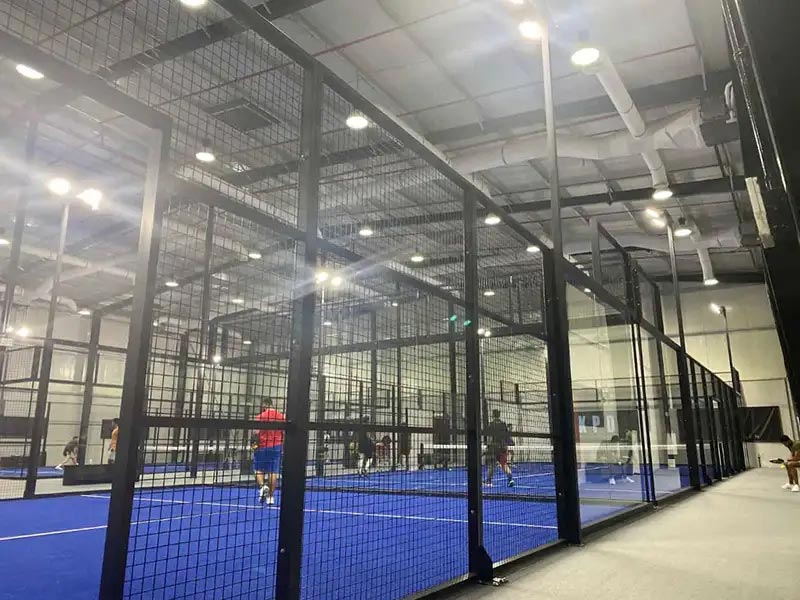
While the baseline and sidelines define the court’s border, the service boxes determine where the serve must land—critical in competitive singles play.
Standard Service Box Size
The official service box dimensions for singles padel court size are:
- 4.0 meters (depth)
- 3.0 meters (width)
These dimensions form a rectangle within each side of the court and dictate the area where the ball must land during a serve.
Strategic Implications
Service boxes influence serve placement strategies. A doorstop-shaped angle within these dimensions creates tactical openings for players to attack immediately after serving.
Coach Pérez adds:
“Many players underestimate how accurate serves within the service box can dictate the pace of a match. It’s not just about power—it’s about placement within the allowed area.”
Avoiding Measurement Pitfalls
Measurement should include:
- Verification of corner angles (should be 90 degrees)
- Repeated checks during line painting
- Use of chalk or laser guides for accurate alignment
Middle of Article: Official Singles Padel Court Size Reference Table
Below is a concise and accurate summary of core dimensions that define singles padel court size:
| Dimension | Standard Measurement | Tolerance | Practical Notes |
|---|---|---|---|
| Court Length | 20 meters | ±0.05 meter | Proper length enables consistent rally depth |
| Court Width | 6 meters | ±0.05 meter | Controls lateral space for movement |
| Net Height (Center) | 0.88 meters | ±0.02 meter | Central clearance for serves and volleys |
| Net Height (Posts) | 0.92 meters | ±0.02 meter | Maximum allowed height near posts |
| Service Box Dimensions | 4 m × 3 m | ±0.02 meter | Defines valid serve landing area |
| Court Surface Flatness | Flat, no slope | N/A | Ensures even bounce across court |
| Boundary Line Width | 5 cm | ±1 mm | Standard width for clear visual performance |
Court Surface: More Than Just a Flat Floor
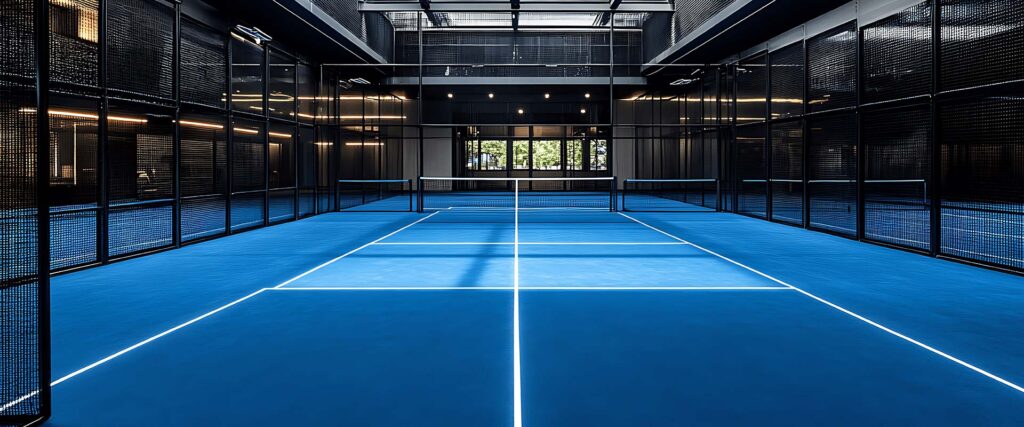
Court surface isn’t a dimension in the sense of length or width, but it significantly impacts how singles padel court size works in practice.
Surface Material Choices
Common padel court surfaces include:
- Artificial turf with sand infill
- Concrete with acrylic paint
- Rubberized polymer coatings
- Modular padel court tiles
Each surface interacts differently with ball bounce and player traction. For example, artificial turf with 12–14 mm sand infill is widely used due to consistent bounce and minimal slide during play.
Flatness and Evenness
Surface flatness is essential. Any slope greater than 1:500 (0.2%) can alter ball trajectories and interfere with rally consistency. For outdoor installations, drainage systems and subfloor leveling must be engineered to preserve flatness year-round.
Sports surface engineers often recommend a laser screed finish during subfloor preparation to ensure accuracy within 1–2 millimeters across a court’s entire surface.
Lighting and Visibility: The Invisible Dimension
Proper lighting isn’t a physical dimension of the court, but it is a measured environment requirement that influences how singles padel court size is perceived and played.
Recommended Illumination Levels
According to indoor sports facility guidelines:
- 300–500 lux is recommended for recreational play
- 500–1000 lux is recommended for competitive and broadcast matches
Illumination uniformity (ratio of minimum to average lux) should be at least 0.6 to avoid shadows that can affect depth perception.
Ball visibility improves when lighting is evenly distributed from both sides of the court, minimizing glare.
Environmental Factors That Influence Singles Padel Court Size Implementation
A technically perfect court can be compromised by environmental conditions.
Temperature and Humidity
Temperature shifts affect net tension and surface traction. High humidity can soften surface grip, while extremes in temperature can alter surface hardness.
Experts recommend climate-controlled environments for indoor courts to maintain consistent playability year-round.
Abschluss
Understanding and respecting the official singles padel court size goes beyond simply meeting regulations—it enhances the quality of play, player safety, and strategic depth. From precise measurements of length and width to meticulous net height calibration and service box placement, every dimension contributes to how the game feels, flows, and unfolds.
When courts are built to official standards, players can focus on skills, tactics, and performance rather than compensating for poor dimensions or surface anomalies. Adoption of accurate measurement tools, consultation with certified builders, and ongoing maintenance ensures courts remain true to the intended design.
A properly dimensioned padel court is not just a playing surface—it is a stage for competitive excellence, training progression, and memorable matches.
Häufig gestellte Fragen
Q1: Why is it important to follow the precise singles padel court size?
A1: Following official dimensions preserves fair play, consistent ball behavior, and predictable movement patterns. It allows players to develop skills in environments that align with competitive standards.
Q2: Can a recreational court differ from the official singles padel court size?
A2: Yes, minor modifications can be made for space constraints, but significant deviations can affect game quality and player expectations.
Q3: How do you ensure net height remains accurate mid-season?
A3: Regular checks with a net gauge and adjustments using tensioning systems help maintain the correct net height throughout the season.
Q4: Is the court surface choice as important as the dimensions?
A4: Absolutely. A consistent surface material ensures reliable bounce and traction, which complements the dimensional precision of a well-measured court.
Q5: Who defines the official singles padel court size?
A5: The Internationaler Padel-Verband (FIP) and regional federations provide standards adopted globally for both amateur and professional play.