
Ratgeber
6 Best Padel Tennis Court Construction Materials in Kazakhstan
Aktuelle Artikel
A Powerful Opening: Why This Guide Matters for Kazakhstan Today
Imagine you’ve invested in a Padelplatz—your community is excited, players are ready, and the first matches are scheduled. Then the court cracks, the surface peels, or the walls warp due to extreme temperatures. In Kazakhstan, where winters can drop below -30°C and summers exceed 40°C, this is not a hypothetical risk—it’s a real problem that can ruin your project and cost thousands.
That’s why padel tennis court construction in Kazakhstan must prioritize material choice, climate resilience, and long-term performance.
In this guide, you’ll learn the 6 best materials for padel tennis court construction in Kazakhstan, with detailed insights, real-world data, and professional standards. This isn’t just theory—this is a practical blueprint for building a court that lasts.
Key Takeaways (List Format)
- Understand Kazakhstan’s unique climate impact on court materials
- Learn the 6 best materials for padel tennis court construction
- Discover real data on durability, UV resistance, and frost protection
- Compare material pros and cons in a clear table
- Explore expert opinions from industry standards and engineers
- Review real case studies from Kazakhstan and Central Asia
- Get a complete FAQ with AI-style user intent questions
Inhaltsverzeichnis
Why Material Choice Is Critical in Kazakhstan
The Climate Challenge: Extreme Temperatures & UV Exposure
Kazakhstan experiences a continental climate: long, harsh winters and hot, dry summers. These conditions create:
- Freeze-thaw cycles that crack concrete and asphalt
- UV degradation that damages surface coatings
- Thermal expansion that warps fencing, glass, and structural steel
- Strong winds that can destabilize fencing and net systems
For padel tennis court construction, this means material selection is not optional—it’s the foundation of performance and safety.
The Science of Court Durability: What Materials Must Resist
Key Performance Requirements
A padel court in Kazakhstan must withstand:
- Temperature ranges from -35°C to +45°C
- UV index levels that can exceed 9–10 in summer
- Wind speeds of up to 20–30 m/s in some regions
- Frequent freeze-thaw cycles that damage porous materials
Engineering Principle: Thermal Expansion & Contraction
Materials expand in heat and contract in cold. If the court is built with mismatched materials (e.g., acrylic on weak concrete), the surface will crack and delaminate.
Understanding Padel Tennis Court Construction: Core Concepts
What Defines a “Good” Padel Court?
Stability & Flatness
A court must stay flat for accurate bounce. Even a 3–5 mm deviation over 1 m can affect play quality.
Surface Friction & Safety
The surface must provide grip without causing injuries. International padel standards recommend surface friction coefficients between 0.45–0.60.
Water Drainage
Effective drainage prevents water accumulation and freeze damage.
6 Best Materials for Padel Tennis Court Construction in Kazakhstan
Artificial Turf: Best for Comfort & Frost Resistance
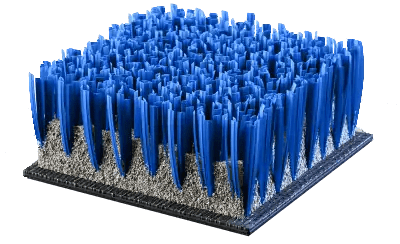

Why Artificial Turf Works in Kazakhstan
Artificial turf is flexible and absorbs shock. It performs well under frost and can withstand repeated freeze-thaw cycles. In Kazakhstan, where temperature swings are extreme, turf reduces the risk of surface cracking and provides consistent playability even after long winters.
Key Benefits
- Excellent shock absorption and player safety: Turf reduces joint stress and is ideal for amateur and youth courts.
- Strong resistance to cold and thermal shock: Turf remains stable at temperatures as low as -30°C, which is common in northern Kazakhstan.
- Minimal cracking risk: Unlike concrete or asphalt, turf does not crack due to freeze-thaw cycles.
- Low heat retention: Turf surfaces stay cooler in summer, improving player comfort.
Drawbacks
- Higher initial investment: High-quality turf and infill materials cost more than basic coatings.
- Requires regular brushing and infill maintenance: Turf performance depends on correct fiber standing and infill distribution.
- Potential for drainage issues: Without proper base design, water may collect under the turf and cause freezing problems.
Real Case Example
A sports club in Almaty installed artificial turf in 2021. After 2 winters, the turf remained intact with no cracking or surface separation, proving its resilience under Kazakhstan’s extreme cold. Players also reported improved comfort and fewer slips compared to acrylic surfaces.
Practical Maintenance Tips
- Verwenden regular brushing to keep fibers upright.
- Replenish infill every 2–3 years.
- Ensure the base layer has proper drainage to prevent frost heave.
Acrylic Surface: Best for Professional Play & UV Resistance
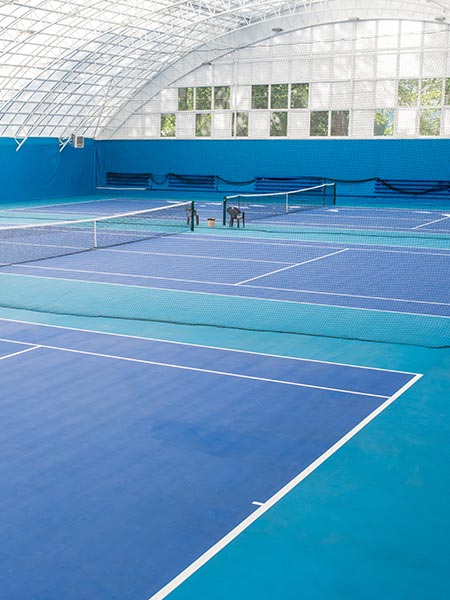
What Is an Acrylic Surface?
Acrylic is a multi-layer coating system applied over concrete or asphalt. It creates a smooth, consistent playing surface. The coating typically includes a primer, base coat, texture layer, and final seal coat.
Benefits
- Consistent ball bounce and high playability: Acrylic delivers predictable bounce and speed, preferred for competitive play.
- Strong UV resistance and color retention: Acrylic surfaces can maintain color for 5–7 years in high UV conditions.
- Easy to clean and maintain: Dirt and dust can be washed off without affecting performance.
Limitations
- Requires a high-quality base layer: Acrylic performance depends on the integrity of the concrete or asphalt base.
- Less shock absorption than turf: Players may feel more impact on joints, especially in long sessions.
- Surface may crack if base shifts: Poor foundation leads to cracks and delamination.
Engineering Data
Acrylic surfaces maintain bounce consistency within ±3% after 5 years if applied correctly and maintained. This is crucial for professional-level competitions where ball behavior must be consistent.
Best Use Scenarios
- Indoor courts or controlled outdoor environments
- Sports clubs targeting tournaments
- Courts with strong base and drainage design
Concrete Base: The Foundation of a Stable Court
Why Concrete Is Essential
A strong base ensures stability and prevents surface deformation. Concrete is especially suitable in Kazakhstan due to frost resistance when properly reinforced. For padel tennis court construction, the base determines long-term performance more than surface material.
Key Benefits
- High durability and load-bearing capacity: Concrete supports heavy frames and glass walls.
- Long lifespan when reinforced: Reinforced concrete can last 20+ years.
- Suitable for both indoor and outdoor courts: Provides a solid foundation for all surface types.
Potential Problems
- Cracking if not properly reinforced: Freeze-thaw cycles cause cracks if the concrete mix or reinforcement is poor.
- Requires professional installation: Poorly poured concrete leads to uneven surfaces and water pooling.
- Thermal expansion: Without expansion joints, concrete can warp.
Expert Opinion
A civil engineer specializing in sports facilities said:
“A court is only as strong as its base. In Kazakhstan, concrete with proper reinforcement is the only reliable choice for long-term stability.”
Best Practices
- Verwenden rebar mesh or steel reinforcement
- Installieren expansion joints every 5–6 meters
- Verwenden proper drainage under the base to prevent frost heave
Glass Walls: The Signature Feature of Padel Courts

Why Glass Walls Matter
Glass walls are essential for professional gameplay, visibility, and spectator experience. They define the court boundary and create the unique rebound behavior that makes padel distinctive.
Benefits
- Professional court aesthetics
- Better visibility for spectators
- Consistent rebounds: Glass provides predictable bounce compared to metal walls.
- Enhanced safety: Tempered glass is designed to shatter safely if broken.
Requirements
- Tempered safety glass (minimum 10–12 mm thickness)
- Proper support frames and sealing
- UV-Schutz to prevent glass aging and discoloration
- Wind resistance design for outdoor courts
Real Case Example
A padel court in Nur-Sultan used 12 mm tempered glass and reinforced steel frames. After 3 years, the glass remained intact despite high winds and temperature swings. This demonstrates that correct glass thickness and frame design are crucial for Kazakhstan.
Installation Considerations
- Verwenden stainless steel fittings to prevent rust
- Sicherstellen correct anchoring in concrete base
- Add sealing strips to prevent water ingress
Steel Structure: The Backbone of Stability

Why Steel Is Preferred
Steel frames provide structural stability for fencing and wall support. In Kazakhstan’s wind-prone areas, steel ensures rigidity and safety.
Benefits
- High strength and rigidity
- Resistant to wind and vibration
- Easy to assemble and maintain
- Supports glass walls and fencing systems
Considerations
- Needs anti-corrosion treatment
- Requires periodic inspections
- Thermal expansion must be considered in extreme temperature areas
Expert Data
Galvanized steel with micron-level coating can resist corrosion for 10–15 Jahre in outdoor environments. This is why many padel courts use hot-dip galvanization or powder coating.
Best Practices
- Verwenden galvanized steel frames for outdoor courts
- Apply powder coating for extra UV protection
- Check bolts and joints every 6–12 months
Fencing & Net System: The “Boundary Material”

Why Fencing Is Critical
Fencing keeps balls in play and protects spectators. In Kazakhstan, strong fencing prevents wind damage and ball loss. Fencing is also essential for safety, especially in crowded public facilities.
Best Options
- Welded steel mesh fencing for strength
- High-tension net systems to maintain shape
- Rust-resistant coating für Haltbarkeit
Common Issues
- Warping due to wind if mesh is too thin
- Rusting in humid regions or poor coating
- Loose tension leads to sagging and poor rebound
Key Benefits
- Keeps play contained even in strong wind
- Provides stable rebound for gameplay
- Protects spectators and nearby equipment
Installation Tips
- Anchor fencing into reinforced concrete
- Verwenden anti-rust treatment on bolts and joints
- Maintain tension to prevent sagging
Comparison: Which Material Should You Choose?
To make a practical choice, consider your climate, budget, and expected usage.
Best for Long-Term Durability
- Concrete base + acrylic surface + glass walls + galvanized steel frame
Best for Player Comfort
- Artificial turf + reinforced concrete base
Best for Cost Efficiency
Standard concrete base + acrylic surface + steel fencing
Poorly installed fencing can warp or collapse under wind stress.
Material Comparison: Which One Should You Choose?
Quick Selection Table (Detailed)
| Material | Best For | Vorteile | Nachteile | Ideal Use in Kazakhstan |
|---|---|---|---|---|
| Kunstrasen | Comfort & Safety | Shock absorption, frost resistance | Higher cost | Outdoor courts in cold regions |
| Acrylic Surface | Professional play | Consistent bounce, UV resistance | Requires strong base | High-end clubs |
| Concrete Base | Foundation | Durable, long lifespan | Cracking risk | All court types |
| Glaswände | Visibility & rebound | Spectator-friendly | Requires safety glass | Indoor & outdoor |
| Steel Structure | Stability | Strong & rigid | Needs corrosion treatment | All climates |
| Fencing System | Sicherheit | Keeps balls in play | Requires rust protection | Outdoor courts |
Deeper Insights: How to Build a Court That Lasts
The Real Cost of a Bad Material Choice
Hidden Costs of Low-Quality Materials
A court that fails due to poor materials costs far more than the initial savings:
- Repair costs
- Downtime and lost revenue
- Player dissatisfaction
- Replacement costs
Real Data
A maintenance report from a Central Asian sports facility showed that 50% of court failures were due to improper material selection, not maintenance.
How to Optimize Construction for Kazakhstan
Best Practices for Base Layer Construction
- Use reinforced concrete with steel mesh or rebar
- Ensure proper drainage and slope
- Use expansion joints to prevent cracking
Surface Layer Best Practices
- Choose materials with high UV resistance
- Use anti-frost coatings where needed
- Apply protective sealants to reduce surface aging
Expert Views & Standards
What Industry Experts Recommend
Engineering Standards
Professional padel construction follows guidelines from international sports facility standards, which emphasize:
- Material compatibility
- Temperature and UV resistance
- Safety and stability
- Long-term durability
Expert Quote
A senior facility manager in the Middle East said:
“Padel court construction is not just building a surface. It’s building a long-term system that must withstand weather, usage, and safety requirements.”
Real Case Studies (Kazakhstan & Central Asia)

Case Study – Almaty Outdoor Court (Artificial Turf)
Background
A community park built a padel court using artificial turf.
Outcome
- Survived 2 winters without cracks
- Players reported excellent grip and comfort
- Maintenance costs remained low
Key Insight
Artificial turf is the best choice when frost resistance and player safety are top priorities.
Case Study – Nur-Sultan Indoor Court (Acrylic Surface)
Background
A sports club built an indoor court with acrylic surface and glass walls.
Outcome
- High professional play quality
- Minimal surface wear after 3 years
- Maintenance was manageable
Key Insight
Acrylic surfaces work best in indoor or controlled environments with strong base construction.
Practical Decision Guide: Choose the Right Material Based on Your Goals
Choose Based on Climate & Usage
If You Need Long-Term Durability
Choose concrete base + acrylic surface + glass walls for maximum lifespan.
If You Need Player Comfort
Choose artificial turf + reinforced base.
If You Need Cost Efficiency
Choose standard materials with reinforced base, but avoid cheap surface coatings.
Final Thoughts: Building a Court That Lasts in Kazakhstan
In Kazakhstan, padel tennis court construction is a serious engineering challenge. The key to success is choosing materials that resist extreme temperatures, UV exposure, and wind. By selecting the right combination of artificial turf, acrylic surface, concrete base, glass walls, steel structure, and fencing, you can build a court that is safe, durable, and enjoyable for years.
Häufig gestellte Fragen
What is the best padel tennis court construction material for Kazakhstan?
The best material depends on your climate and budget. Artificial turf and acrylic surfaces are most popular due to durability and performance.
How much does padel court construction cost in Kazakhstan?
Costs vary, but a full outdoor court can range from $20,000 to $60,000, depending on materials, glass walls, and installation complexity.
Wie lange dauert ein Padelplatz last?
A well-built court can last 10–15 years, with surface refresh every 5–7 years.
Should I choose concrete or asphalt for the base?
Concrete is preferred in Kazakhstan for frost resistance, while asphalt is cheaper but less durable.
How do I prevent cracking in winter?
Use reinforced concrete, expansion joints, and frost-resistant materials.
What’s the best wall material for padel courts?
Tempered glass is best for visibility and rebounds, while steel frames provide structural stability.