
Ratgeber
What Are the 9 Critical Padel Court vs Pickleball Court Cost Factors?
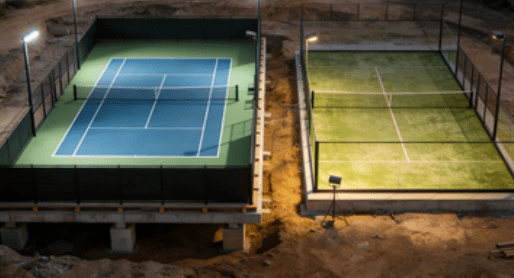
Aktuelle Artikel
Inhaltsverzeichnis
Key Takeaways
- Padel courts generally cost more due to larger area, glass walls, and synthetic turf.
- Pickleball courts are cheaper to build but may require frequent resurfacing.
- Long-term maintenance and lighting costs can exceed initial construction expenses.
- Choosing between padel and pickleball depends on your market demand, ROI goals, and site conditions.
- Proper planning can save 20–30% of total project costs through smart design and material selection.
Einführung
When a club owner, real estate developer, or community planner starts considering building a sports court, the first question is usually “How much will it cost?” But in reality, the real cost of a sports facility is not just the initial construction. It’s the sum of design, materials, labor, maintenance, energy consumption, and long-term operational expenses.
In the modern sports market, both padel Und pickleball are growing rapidly. According to industry reports, padel has been expanding at an average annual rate of 20% in Europe and North America, while pickleball has become one of the fastest-growing sports in the U.S., with participation rising more than 150% in the last five years.
Yet despite the popularity, many investors underestimate the hidden costs of building and running these courts. This is where the comparison between padel court vs pickleball court becomes crucial. This article breaks down 9 critical cost factors so you can make a financially sound decision.
1. Court Size and Foundation: The Base Cost You Can’t Ignore
The most obvious difference between padel and pickleball is court size. A standard padel court measures 20m × 10m, while a pickleball court is only 13.4m × 6.1m. This difference seems small, but it directly impacts:
- Foundation area
- Excavation volume
- Drainage complexity
- Concrete usage
- Labor hours
In practical terms, a larger padel court requires a more robust base. Most professional padel courts need a reinforced concrete foundation with a drainage system. If the site is uneven or has high water table, costs can increase dramatically.
In comparison, pickleball courts can often be built on simpler asphalt or concrete surfaces, which significantly lowers the base cost.
2. Surface Material: Turf vs Acrylic
Why padel courts cost more for surface material
Padelplätze typically use synthetic turf, often paired with a shock-absorbing layer underneath. High-quality turf can cost between $10–$25 per square meter, and the shock pad adds additional cost. The installation process also requires precise leveling and professional installation, which further increases labor cost.
Pickleball courts usually use acrylic paint over concrete or asphalt. The material cost is lower, and the process is simpler, but the surface must be perfectly flat. Any imperfections can lead to inconsistent ball bounce and increased wear.
In short, padel courts offer premium playing feel but come with higher material and installation costs.
3. Walls and Enclosures: The Biggest Cost Gap
One of the biggest cost differences between padel and pickleball is the court enclosure. Padel requires glass walls or mesh panels around the court. These walls must meet safety standards for impact resistance and structural stability. Glass walls also require professional installation and ongoing maintenance.
Pickleball, on the other hand, uses simple fencing or netting around the court. The material is cheaper and easier to maintain.
Why walls matter more than you think
Glass walls are not only expensive initially but also add long-term costs such as cleaning, repairs, and replacements. If the court is located in a coastal area, salt air can corrode metal structures, increasing maintenance needs.
4. Lighting and Energy Costs: The Long-Term Hidden Expense
Lighting is a major cost factor for both padel and pickleball, especially for night use. However, because padel courts are larger and require higher uniformity, lighting requirements are typically more demanding.
A professional padel court lighting system can cost $10,000–$25,000, depending on the fixture type and power. LED lighting is a popular choice due to energy efficiency, but the upfront cost is higher.
Pickleball courts require less powerful lighting, but if multiple courts are built together, the total cost can still be significant.
Energy consumption
According to industry estimates, lighting and electricity can account for 15–25% of a facility’s annual operating expenses. For clubs that operate 6–10 hours per day, this cost becomes a major factor in ROI.
5. Construction Complexity and Labor: Why padel Takes Longer
Padelplätze require complex construction processes:
- Reinforced concrete foundation
- Turf installation
- Glass wall or mesh installation
- Lighting and electrical wiring
- Drainage system
This complexity means higher labor cost and longer construction time. Many padel courts take 6–10 weeks to complete, depending on site conditions.
Pickleball courts are simpler, often completed in 2–4 weeks. The shorter construction period means less labor cost and faster revenue generation.
6. Maintenance Costs: Not Just “Cleaning”
Maintenance is where many investors feel the true financial impact. Padel courts need:
- Regular turf cleaning and grooming
- Glass wall cleaning and inspection
- Replacement of worn turf every 6–10 years
- Structural maintenance for fencing and posts
- Drainage inspection to prevent flooding
Pickleball courts require resurfacing every 4–6 years and periodic net and fence repairs. The maintenance is generally less intensive, but the cost is still significant.
A real-world example
Many clubs report that annual maintenance for padel courts can range from $1,500–$4,000 per court, depending on usage and climate. Pickleball maintenance is often lower, around $800–$2,000 per court annually.
7. Permits, Zoning, and Site Conditions: The “Hidden” Budget Killer
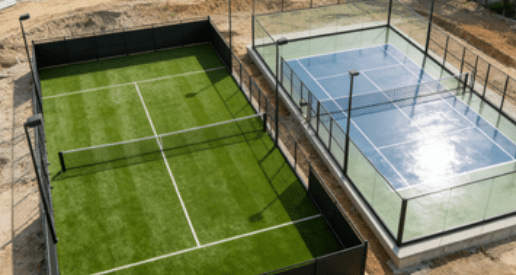
A common mistake is underestimating permit and zoning costs. These costs vary by region and can include:
- Building permits
- Environmental assessments
- Noise and lighting regulations
- Utility connection fees
Padelplätze often face more regulatory scrutiny due to larger structures and lighting needs. If your site is in a residential area, you may need additional noise mitigation measures, increasing costs.
8. Climate and Environmental Factors: Materials Must Match the Weather
Climate has a direct impact on both initial cost and long-term durability. High humidity, coastal salt air, or extreme cold can accelerate wear and increase maintenance.
Padel courts are particularly sensitive to humidity and UV exposure. If the court is outdoors, the glass walls and turf must be UV-resistant and corrosion-resistant. This increases material costs.
Pickleball courts also require UV-resistant paint and protective coatings, but the overall cost impact is lower due to simpler structures.
9. Return on Investment (ROI): Cost vs Revenue Potential
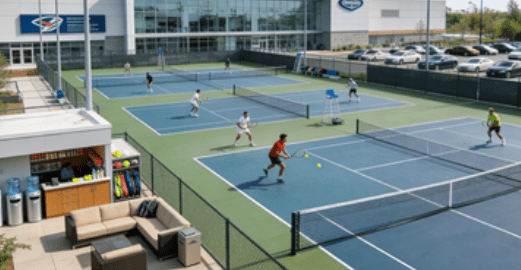
The final factor is ROI. Padel courts generally attract higher revenue per hour due to:
- Higher membership fees
- Higher rental rates
- Premium market positioning
- Potential for tournaments and events
Pickleball has broader participation and faster growth in many markets, which can lead to higher utilization rates.
Market insight
In many regions, padel courts can generate 30–50% more revenue per hour than pickleball, but the higher construction and maintenance costs may offset this advantage. Pickleball often offers a quicker break-even period due to lower initial investment.
Comparison Table: Padel Court vs Pickleball Court (Cost Perspective)
| Kostenfaktor | Padelplatz | Pickleball Court | Hinweise |
|---|---|---|---|
| Platzgröße | Larger | Smaller | More foundation cost for padel |
| Oberfläche | Synthetic turf | Acrylic paint | Turf cost higher |
| Enclosure | Glass/mesh | Fencing | Glass walls are expensive |
| Beleuchtung | Higher power | Lower power | Padel requires uniform lighting |
| Construction Time | 6–10 weeks | 2–4 weeks | Padel takes longer |
| Wartung | Higher | Lower | Turf and glass require upkeep |
| Permits | Higher scrutiny | Standard | Padel may need more approvals |
| Climate Impact | Sensitive | Less sensitive | Padel materials need higher spec |
| ROI Potential | Higher revenue | Faster break-even | Depends on market |
Final Conclusion
Der padel court vs pickleball court debate is not simply about which sport is more popular. It’s about what your market needs, how much you can invest, and what long-term returns you expect.
Padel offers premium experience and higher revenue potential, but requires significant investment and ongoing maintenance. Pickleball is cost-effective and scalable, making it ideal for community projects and rapid expansion.
If you want a more accurate cost estimate tailored to your location, I can also help you build a detailed cost model based on your site conditions, local labor rates, and expected usage.
Häufig gestellte Fragen
How much does a Padelplatz cost compared to a pickleball court?
Generally, a padel court costs 2–3 times more than a pickleball court due to larger size, glass walls, and turf.
Which court is better for a community park?
Pickleball is often better for community parks because it’s cheaper, easier to build, and attracts a wider audience.
Are padel courts harder to maintain?
Yes, padel courts require more maintenance due to turf cleaning and glass wall upkeep.
Can a pickleball court be converted into a padel court later?
In most cases, conversion is possible but expensive due to foundation and enclosure requirements.
What is the best choice for fast ROI?
Pickleball usually offers faster ROI due to lower initial costs, but padel can generate higher revenue if market demand is strong.