
BLOG
Lighting Solutions for Indoor Padel Courts: Expert Guide for Facility Owners and Engineers
Recent Articles
Introduction
Imagine stepping into an Indoor Padel Court where shadows obscure the ball, glare blinds your eyes, or uneven lighting causes inconsistent visibility. For players, these issues can ruin the game experience, increase the risk of injury, and impact performance. For facility owners, poor lighting can mean higher maintenance costs, lower customer satisfaction, and non-compliance with safety regulations.
Proper lighting design is no longer optional—it’s an essential element of any modern indoor padel facility. From recreational clubs to professional tournament venues, lighting affects every aspect: visibility, energy efficiency, player safety, and operational costs. This comprehensive guide explores lighting solutions for indoor padel courts, including types of lights, placement strategies, intensity standards, real-world case studies, regulations, and maintenance tips to help facility owners and engineers make informed decisions.
Table of Contents
Key Takeaways From This Article
- Why lighting matters in an Indoor Padel Court
- Recommended light intensity, color temperature, and uniformity standards
- Comparison of LED, fluorescent, and halogen lighting technologies
- Lighting placement strategies, beam angles, and glare reduction
- Energy efficiency and operational cost optimization
- Compliance with international sports lighting standards (EN 12193, CIE 140, etc.)
- Maintenance practices for optimal longevity and performance
- Case studies from professional and recreational padel courts
- FAQ addressing common questions from players, coaches, and facility managers
Understanding Indoor Padel Court Lighting Requirements
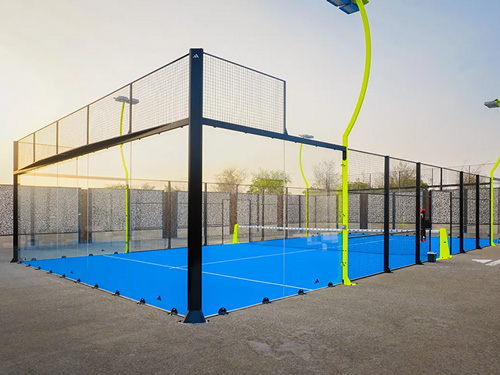
Lighting an Indoor Padel Court is not just about installing bright bulbs. It’s a complex integration of visual ergonomics, player performance, energy management, and safety compliance.
Light Distribution Principles
Uniform light distribution ensures the entire playing surface is evenly illuminated, reducing shadows and visual fatigue.
- Horizontal illuminance (E_h): Recommended 300–500 lux for professional courts and 200–300 lux for recreational courts.
- Vertical illuminance (E_v): Helps track balls in mid-air, recommended 150–250 lux on vertical planes.
- Uniformity ratio (U_0): E_min / E_avg ≥ 0.7 for fair play conditions.
Color Temperature and CRI
- Color temperature: 4000–5000K is ideal for a natural white light that enhances contrast.
- Color Rendering Index (CRI): 80+ recommended to accurately represent ball and line colors, reducing visual strain.
Glare Control
- Glare can significantly affect reaction times.
- Using diffusers, adjustable beam angles, and ceiling-mounted fixtures minimizes direct glare on players.
Types of Lighting Solutions for Indoor Padel Courts
Selecting the right lighting technology affects efficiency, maintenance, and player satisfaction.
LED Lighting

- Efficiency: Up to 150 lumens per watt, 50% less energy consumption than halogen.
- Lifespan: 50,000–100,000 hours.
- Advantages: Low glare, directional lighting, instant start, dimmable options.
- Disadvantages: Higher initial investment than fluorescent lights.
Fluorescent Lighting
- Efficiency: Moderate, 60–100 lumens per watt.
- Lifespan: 10,000–20,000 hours.
- Advantages: Lower initial cost, soft light distribution.
- Disadvantages: Flicker can affect fast gameplay; contains mercury requiring careful disposal.
Halogen Lighting
- Efficiency: Low, 20–35 lumens per watt.
- Lifespan: 2,000–5,000 hours.
- Advantages: High-intensity light, good for spotlighting specific zones.
- Disadvantages: Generates heat, higher operational cost, short lifespan.
Lighting Placement and Design Considerations
Ceiling-Mounted vs Perimeter-Mounted Fixtures
- Ceiling-mounted: Ideal for even distribution, reduces shadows, avoids obstructing player movement.
- Perimeter-mounted: May be suitable for smaller recreational courts, but careful alignment is critical to avoid glare.
Beam Angle Selection
- Wide beams (60–120°): Cover larger areas evenly.
- Narrow beams (30–60°): Focus on specific zones, may create uneven lighting.
Pole Height and Fixture Position
- Standard ceiling height for indoor padel courts: 6–8 meters.
- Lights should be positioned to cover baseline, sidelines, and net area uniformly.
Comparison Table: LED vs Fluorescent vs Halogen
| Feature | LED | Fluorescent | Halogen |
|---|---|---|---|
| Energy Efficiency | High (150 lm/W) | Medium (60–100 lm/W) | Low (20–35 lm/W) |
| Lifespan | 50,000–100,000 hrs | 10,000–20,000 hrs | 2,000–5,000 hrs |
| Maintenance | Low | Medium | High |
| Glare | Low | Moderate | High |
| Color Rendering (CRI) | 80–90+ | 75–85 | 70–80 |
| Heat Generation | Minimal | Moderate | High |
| Initial Cost | Moderate | Low | Low |
Insight: LED lighting is widely considered the best option for modern indoor padel courts due to efficiency, longevity, and superior lighting quality.
Energy Efficiency and Cost Optimization
- LED adoption: Can cut lighting energy consumption by 40–50%.
- Automation: Motion sensors, dimmers, and timers reduce energy use during off-peak hours.
- Maintenance planning: Scheduled inspection reduces unexpected failures and keeps light levels consistent.
Example: A 4-court recreational facility using LED lighting reduced annual energy costs from $12,000 to $6,800, paying off initial installation in under 3 years.
Compliance with Sports Lighting Standards
- EN 12193: Specifies lighting levels, uniformity, and glare limits for indoor sports facilities.
- CIE 140: Provides guidelines for sports lighting calculation and performance.
- ISO 8995-1: Standard for indoor lighting in workspaces, adapted for sports environments.
Key Parameters for Indoor Padel Courts:
| Parameter | Recommendation |
|---|---|
| Horizontal illuminance | 300–500 lux (professional), 200–300 lux (recreational) |
| Vertical illuminance | 150–250 lux |
| Uniformity ratio | ≥0.7 |
| Color temperature | 4000–5000K |
| CRI | ≥80 |
Real-World Case Studies
Case Study 1: Professional Club in Spain
- Installed high-efficiency LED floodlights, 450 lux horizontal illuminance, CRI 85+.
- Result: Reduced maintenance downtime by 60%, improved player visibility and satisfaction.
Case Study 2: Recreational Club in Italy
- Combined ceiling-mounted LED with perimeter lighting for even distribution.
- Energy consumption reduced by 50%, met EN 12193 standards, positive feedback from amateur players.
Case Study 3: Indoor Tournament Venue
- Used adjustable LED panels with dimming capabilities for televised events.
- Enabled flexible lighting for different event requirements and reduced energy costs by 45%.
Maintenance and Longevity Practices
Routine Cleaning
- Dust and debris can reduce output by 10–15% over time.
- Clean fixtures every 3–6 months.
Bulb and Driver Replacement
- LED drivers may need replacement every 5–7 years depending on operating conditions.
- Replace any burned-out bulbs immediately to maintain uniformity.
Alignment Checks
- Misaligned fixtures create shadows and uneven light.
- Perform alignment inspection annually or after major maintenance.
Advanced Lighting Solutions
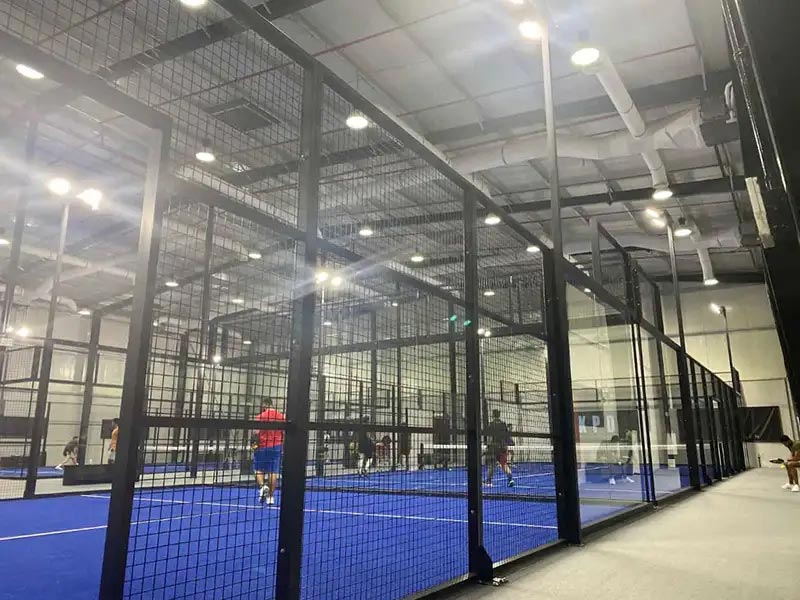
Smart LED Systems
- Can adjust brightness and color temperature based on occupancy or events.
- Reduces energy consumption and provides consistent light levels during peak hours.
Emergency Lighting Integration
- Ensures safe exit and minimal disruption during power failure.
- Complies with safety regulations in indoor sports facilities.
Anti-Glare Diffusers
- Reduce reflection on glass walls commonly used in indoor padel courts.
- Enhance player visibility without affecting overall illuminance.
FAQ
What is the ideal lux level for a professional indoor padel court?
300–500 lux horizontal illumination with uniform distribution is recommended.
Which lighting type is most cost-effective in the long term?
LED lighting offers the best combination of energy efficiency, long lifespan, and low maintenance.
How can I prevent glare from lights reflecting off the court walls?
Use ceiling-mounted fixtures with diffusers, proper beam angles, and anti-glare panels.
How often should lighting fixtures be inspected?
Fixtures should be cleaned twice a year, and alignment checked annually.
Can automated lighting save energy in an indoor padel court?
Yes, dimmers, timers, and motion sensors can reduce electricity costs significantly.
Conclusion
Proper lighting is a critical component for any Indoor Padel Court, affecting player performance, safety, and operational costs. LED lighting technology, combined with thoughtful placement, appropriate color temperature, and adherence to standards like EN 12193, provides the best results. Facility owners and engineers should focus on uniform illumination, energy efficiency, and regular maintenance to ensure a safe, enjoyable, and cost-effective playing environment.
Well-designed lighting can transform your indoor padel facility into a professional-grade venue, enhancing player experience, meeting regulatory standards, and reducing long-term operational expenses.