
مدونة
Hardwood Sports Flooring: Single vs Double Keel Systems
المقالات الأخيرة
جدول المحتويات
Key points covered in this guide:
- What makes Hardwood Sports Flooring different from ordinary wood flooring
- How single-layer and double-layer keel systems compare
- What primary-secondary and 45-degree keel structures are designed to achieve
- Why maple surface boards, elastic pads, and sports coatings matter
- Which flooring structure suits schools, training halls, and professional arenas
- How subfloor moisture, flatness, and floor height affect installation
- Which performance indicators buyers should request
- How to inspect, maintain, and refinish a sports wood floor
Choosing أرضيات رياضية من الخشب الصلب involves more than selecting an attractive maple surface.
The visible wood boards represent only the upper layer of a complete performance system. Below them may be plywood panels, pine keels, elastic pads, moisture-control layers, fasteners, ventilation spaces, and a carefully prepared concrete base.
Each component influences how the floor responds when players run, jump, stop, land, and change direction.
A school gym may need a cost-effective and durable single-layer system. A professional basketball arena may require a more advanced structure with improved load distribution, controlled deformation, and strong shock absorption.
This guide explains how facility owners, contractors, architects, and international buyers can compare the main Hardwood Sports Flooring systems before ordering.
What Is Hardwood Sports Flooring?
Hardwood Sports Flooring is an engineered floor designed specifically for indoor athletic use.
Unlike decorative residential wood flooring, a sports floor must support:
- Repeated player impact
- Running and sudden stopping
- Ball rebound
- Equipment movement
- Temporary seating
- Mobile basketball backstops
- Cleaning and refinishing
- Long-term dimensional stability
The complete system normally includes several layers.
Typical Sports Floor Layers
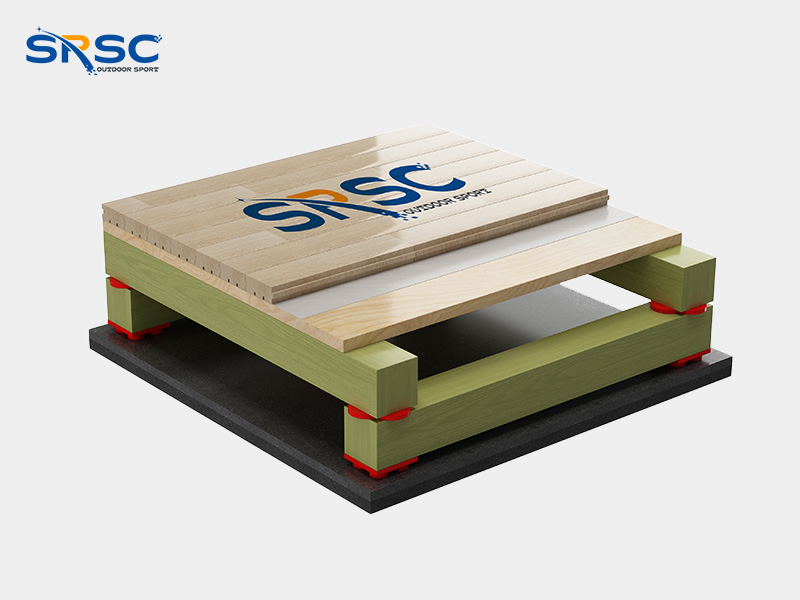
A traditional keel-supported system may contain:
- Finished hardwood surface boards
- Structural plywood or load-distribution panels
- Primary or secondary timber keels
- Elastic rubber pads
- Moisture-control membrane
- Prepared concrete subfloor
The exact arrangement differs between single-layer, double-layer, panelized, and skew-laid systems.
Concept: Area-Elastic Sports Floor
An area-elastic floor distributes impact across a wider section of the surface instead of allowing only one small point to deform.
This type of response is commonly used in professional wooden sports flooring because it can combine stability with player comfort.
Why the Support Structure Matters
Two floors may use the same maple surface but perform differently because their underlying support systems are not the same.
The keel structure influences:
- Shock absorption
- Vertical deformation
- Load distribution
- Floor stability
- System thickness
- Installation time
- Material cost
- Long-term maintenance
A more complex structure is not automatically required for every project. Buyers should select the system according to the facility’s competition level, usage intensity, subfloor condition, budget, and expected service life.
Compare the Main Hardwood Sports Flooring Systems
| Flooring System | Structural Design | Main Advantage | Suitable Facility |
|---|---|---|---|
| Single-layer keel | One direction of timber keels | Economical and straightforward | Schools and community gyms |
| Panelized single-layer keel | Single keel with structural panel layer | Improved load distribution | Training centres and multi-sport halls |
| Double-layer keel | Two cross-laid timber layers | Strong stability and shock absorption | Commercial and competition venues |
| Primary-secondary keel | Main and secondary support structure | Balanced vertical and horizontal performance | High-traffic sports facilities |
| 45-degree skew keel | Cross supports installed diagonally | Enhanced multi-directional load distribution | Arenas and premium projects |
| Portable wood floor | Preassembled removable panels | Fast event conversion | Temporary courts and multi-use arenas |
Single-Layer Keel Hardwood Sports Flooring
A single-layer system uses one series of timber supports installed across the concrete base.
Elastic pads may be positioned beneath the keels to create cushioning and separate the timber from the subfloor.
Main Advantages
A single-layer system can provide:
- Lower material use
- Simpler installation
- Reduced floor build-up
- Easier component identification
- Controlled project cost
- Suitable performance for general athletic use
ال SRSC Basic Hardwood Sports Flooring uses a single-layer pine keel structure with elastic pads and a North American maple surface finished with sports lacquer. SRSC positions the system for school gyms, community sports halls, and training centres.
Main Limitations
Compared with a more complex double-layer structure, a basic single-layer floor may provide less load distribution across the full surface.
Its final performance depends heavily on:
- Keel spacing
- Timber quality
- Pad arrangement
- Subfloor flatness
- Surface-board installation
- Moisture control
Best Applications
A single-layer system may be suitable for:
- School gymnasiums
- Community courts
- Recreational basketball halls
- Badminton facilities
- Training rooms
- Budget-controlled renovations
Panelized Single-Layer Keel Structure
A panelized system adds a load-distribution layer above the timber supports.
This panel can help spread local forces before they reach the keels and elastic pads.
Why Add a Panel Layer?
A structural panel may improve:
- Surface stability
- Fastener support
- Load distribution
- Board alignment
- Resistance to local deformation
ال SRSC Classic Hardwood Sports Flooring combines a maple surface, single-layer keel framework, shock-absorption components, and a panelized support structure for indoor basketball courts, training facilities, and recreational venues.
Single Keel vs Panelized Single Keel
| Comparison | Basic Single Keel | Panelized Single Keel |
| Structural layers | Fewer | Additional distribution layer |
| Installation complexity | Lower | معتدل |
| Floor stability | Practical | Generally improved |
| Material cost | Lower | Higher |
| Suitable traffic | Light to medium | Medium to high |
| Typical use | Schools and community gyms | Clubs and training halls |
Double-Layer Keel Hardwood Sports Flooring
A double-layer system uses two timber support layers installed across one another.
The upper and lower keels create a deeper structural network that can distribute forces in more than one direction.
Main Benefits
A properly designed double-layer system may provide:
- Greater floor stability
- Improved load distribution
- Strong shock absorption
- Better support under high traffic
- Reduced local movement
- More consistent athletic response
ال SRSC Shock-Absorbing Hardwood Sports Flooring uses a cross-laid double pine keel structure, elastic pads, a North American maple surface, and a low-gloss sports finish. The product is presented for school gyms, training halls, sports centres, and multi-purpose basketball venues.
Construction Considerations
A double-layer floor normally requires:
- More structural depth
- Additional timber
- More installation time
- Careful cross-layer alignment
- Coordinated door and threshold heights
- Sufficient subfloor-to-finished-floor allowance
The architect should include the complete floor build-up in the building design before doors, stairs, wall finishes, and sports equipment are installed.
Best Applications
Double-layer Hardwood Sports Flooring can be considered for:
- Professional basketball halls
- University gymnasiums
- Commercial sports centres
- High-use training venues
- Competition courts
- Multi-purpose indoor arenas
Primary-Secondary Keel Structure
A primary-secondary system uses main load-bearing keels together with secondary cross-supports.
The structure is designed to balance vertical elasticity with horizontal stability.
How It Differs From a Basic Double Layer
A generic double-layer system may simply use two continuous cross-laid keel layers.
A primary-secondary design can use a more deliberately engineered arrangement in which the main and supporting members perform different roles.
ال SRSC Professional Hardwood Sports Flooring uses primary and secondary pine keels, elastic pads, and a maple sports surface. SRSC describes the system as suitable for high-traffic basketball courts, school gyms, training facilities, and multi-sport halls.
Potential Advantages
This structure can support:
- Balanced load transfer
- Controlled vertical response
- Strong lateral stability
- Repeated commercial use
- Heavy sports equipment
- Long-term structural integrity
Concept: Load Distribution
Load distribution describes how forces from a player, mobile hoop, temporary stand, or maintenance machine spread through the floor.
A well-designed system prevents one small area from receiving an excessive share of the load.
45-Degree Skew Keel Structure
A skew-laid system positions selected support members diagonally instead of placing every layer parallel or perpendicular to the court.
Why Use a 45-Degree Layout?
The diagonal arrangement may help distribute loads across several directions and reduce dependence on one straight support path.
Potential advantages include:
- Multi-directional stability
- Improved resistance to deformation
- Strong load distribution
- Premium structural performance
- Suitability for demanding venues
ال SRSC 45° Hardwood Sports Flooring uses a double-layer pine keel system installed at a 45-degree angle, elastic rubber pads, and a North American maple surface. Its published system thickness is typically around 120–130 mm, subject to project customization.
Project Considerations
A 45-degree structure may require:
- Greater material preparation
- More detailed cutting
- Accurate setting-out
- Skilled installation
- Higher labour input
- Careful perimeter finishing
It is normally more suitable for projects that prioritize premium performance and long-term use over the lowest initial cost.
Single vs Double Keel Hardwood Sports Flooring
| Decision Factor | Single-Layer Keel | Double-Layer Keel |
| Initial investment | Lower | Higher |
| Structural depth | Lower | Higher |
| Installation time | Shorter | Longer |
| Load distribution | Basic to moderate | Stronger |
| Shock-absorption potential | Suitable for general use | Suitable for demanding use |
| Heavy equipment support | Requires careful specification | Greater structural flexibility |
| School gym use | Highly suitable | Suitable when budget allows |
| Professional competition | Requires performance verification | Commonly preferred |
| Renovation with limited height | Easier to accommodate | May create threshold issues |
| Long-term intensive use | Project-dependent | Strong option |
Which Is Better?
Neither structure is universally better.
The right option depends on the facility.
A community gym operating several hours per day may not need the deepest premium system. A professional arena carrying mobile backstops, event equipment, and intensive daily training may benefit from a more advanced double-layer structure.
Evaluate the Hardwood Surface Material
The support structure is important, but the visible wood must also meet athletic and maintenance requirements.
Maple Hardwood
Maple is widely used for indoor basketball floors because it provides:
- A dense and durable surface
- Clear line visibility
- A professional light appearance
- Suitable sanding and refinishing potential
- Consistent surface texture
SRSC’s current hardwood sports flooring products specify North American maple surfaces across its single-layer, double-layer, primary-secondary, and 45-degree systems.
Board Grade
Ask the supplier to define:
- Wood species
- Visual grade
- Board thickness
- Board width
- Board length distribution
- Moisture content
- Tongue-and-groove profile
- Manufacturing tolerance
A description such as “premium maple” is not sufficient for comparing technical quotations.
Alternative Wood Species
Depending on the market and project, sports surfaces may also use:
- Beech
- البلوط
- البتولا
- Hevea
- Engineered hardwood
The buyer should compare hardness, dimensional stability, colour consistency, supply availability, refinishing potential, and certification requirements.
Review the Sports Floor Finish
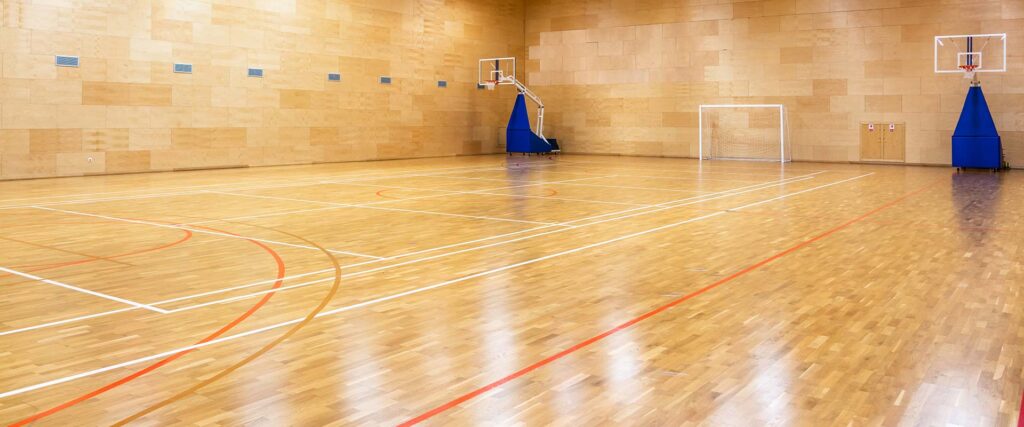
The floor coating affects traction, wear, appearance, cleaning, and line adhesion.
Required Finish Characteristics
A suitable sports coating should provide:
- Controlled slip resistance
- Wear resistance
- Consistent gloss
- Clear court markings
- Easy cleaning
- Compatibility with refinishing
- Resistance to normal sports use
SRSC’s listed hardwood systems use Swedish Bona sports lacquer or sports coating on the maple surface.
Avoid Excessive Gloss
A highly reflective floor may create glare under sports lighting and camera systems.
Professional venues often favour a controlled matte or low-gloss appearance.
Court Stickers and Temporary Branding
Temporary logos and court stickers should maintain suitable slip and surface performance.
FIBA includes wooden flooring, flooring coatings, maintenance products, and court stickers within its equipment approval programme. Buyers planning competition venues can verify exact approved products through the official FIBA Approved Equipment directory.
Check Important Sports Flooring Performance Indicators
A serious sports floor quotation should include measurable performance information.
امتصاص الصدمات
Shock absorption indicates how the flooring system reduces impact transmitted back to the athlete.
It is affected by:
- Elastic-pad material
- Pad spacing
- Keel arrangement
- Panel layers
- Surface-board stiffness
- Complete system assembly
Vertical Deformation
Vertical deformation measures how much the floor moves under load.
Too little movement may create a hard and uncomfortable surface. Excessive movement may feel unstable or affect equipment.
Ball Rebound
Basketball performance depends on predictable ball response.
The surface finish, board structure, subfloor stability, and system installation can all influence rebound consistency.
Slip Resistance
The floor must provide enough grip for movement while still allowing controlled turning and stopping.
Excessive grip can be as problematic as a slippery surface.
Rolling Load
Sports floors may need to support:
- Mobile basketball hoops
- Retractable seating
- Cleaning machines
- Equipment carts
- Temporary staging
- Event flooring
Rolling-load performance should be discussed when heavy mobile equipment will cross the floor regularly.
Do Not Compare One Test Result Alone
A floor with high shock absorption but poor ball rebound may not suit basketball.
Buyers should compare the complete performance profile rather than selecting one impressive number.
Confirm the Required Court Area
The inner FIBA basketball playing court measures 28 × 15 metres. FIBA’s venue guidance also calls for a boundary area of at least 2 metres around the playing court, creating a minimum total court area of 32 × 19 metres for that layout.
Flooring Area Is Larger Than the Playing Lines
The Hardwood Sports Flooring order may also need to cover:
- Team bench areas
- Scorer’s table
- Run-off zones
- Equipment positions
- Warm-up areas
- Retractable seating zones
- Additional multi-sport markings
Allow for Cutting and Selection
The order quantity may include allowances for:
- Perimeter cuts
- Board selection
- Columns
- Access panels
- Future repairs
- Installation waste
The final quantity should be calculated from the approved architectural layout rather than only the basketball court dimensions.
Inspect the Concrete Subfloor
Even the best Hardwood Sports Flooring system can perform poorly over an unsuitable concrete base.
Subfloor Flatness
The concrete should meet the flatness requirements defined by the flooring supplier and project specification.
An uneven base may cause:
- Variable pad contact
- Unstable keels
- Noise
- Floor movement
- Uneven finished levels
- Installation delays
Moisture
Concrete moisture can affect:
- Timber dimensions
- Adhesives
- Membranes
- Coatings
- Indoor humidity
The contractor should test the slab using the agreed method before the wood is delivered or installed.
Surface Condition
Check for:
- Cracks
- Dust
- Oil
- Loose concrete
- Standing water
- High and low areas
- Construction debris
- Unfinished service openings
Concept: Moisture Control Layer
A moisture-control layer separates the timber system from moisture migrating through or remaining within the concrete slab.
It should be selected and installed according to the site conditions and flooring-system design.
Control Indoor Temperature and Humidity
Wood naturally responds to changes in environmental moisture.
Excessive humidity can cause expansion, while very dry conditions may create shrinkage or gaps.
Before Installation
The building should normally be:
- Enclosed
- Weather-tight
- Dry
- Clean
- Equipped with operating environmental controls
- Free from major wet construction work
During Operation
The facility should maintain an environment suitable for the installed wood species and flooring system.
Sudden seasonal changes can affect the surface even when the original installation was correct.
Acclimation
The flooring supplier should provide instructions covering:
- Delivery timing
- Package opening
- Storage position
- Acclimation duration
- Building temperature
- Relative humidity
- Wood moisture testing
Do not use a generic acclimation period for every climate and product.
Coordinate the Floor With Basketball Backstops
Mobile and floor-fixed basketball systems can place concentrated loads on the surface.
FIBA’s venue guidance notes that court flooring should be capable of carrying mobile or floor-fixed backboard support structures without degrading the equipment’s performance. Mobile units should also distribute their weight across a suitable contact area to reduce the risk of floor damage.
Information the Flooring Supplier Needs
Provide:
- Backstop model
- Total equipment weight
- Wheel quantity
- Wheel dimensions
- Playing-position contact points
- Movement route
- Storage location
- Floor-anchor requirements
Protect the Movement Route
Heavy mobile hoops should follow a defined route.
The facility may use:
- Floor-protection panels
- Wider wheels
- Controlled movement procedures
- Staff supervision
- Approved storage supports
ال SRSC Basketball Stand range can be coordinated with the selected floor structure during project planning.
Plan Floor Openings and Embedded Equipment
Indoor courts may require penetrations or access points for:
- Volleyball posts
- Badminton posts
- Floor-fixed basketball equipment
- Gymnastics anchors
- Electrical boxes
- Scoreboard connections
- Retractable seating
- Dividing curtains
Coordinate Before Installation
Every floor sleeve or anchor should appear on the approved drawing.
Late drilling can damage:
- Surface boards
- Keels
- Panels
- Elastic pads
- Moisture barriers
- Electrical services
Use Finished Covers
When equipment is removed, the opening should receive a suitable flush cover that does not create a trip point or interfere with ball movement.
Plan Court Lines, Colours, and Logos
Basketball Court Markings
Line positions should follow the rules applying to the intended competition.
FIBA’s venue guidance specifies 50 mm court lines for its basketball layouts.
Multi-Sport Lines
A shared gym may include markings for:
- Basketball
- Volleyball
- Badminton
- Handball
- Futsal
- Pickleball
Too many similar colours can reduce clarity.
Create a line schedule identifying the sport, colour, width, and priority.
Logos
Logos may be painted beneath a final coat or applied using approved removable materials.
Check:
- Slip performance
- Gloss
- Adhesion
- Colour
- Removal method
- Refinishing compatibility
Hardwood Sports Flooring Installation Process

Step 1: Site Inspection
Verify the slab, moisture, floor elevation, access, storage, and environmental conditions.
Step 2: Material Delivery
Check product names, quantities, board grades, keels, panels, pads, membranes, coatings, and accessories.
Step 3: Acclimation
Condition the wood according to the approved project procedure.
Step 4: Moisture Protection
Install the specified vapour or moisture-control layer.
Step 5: Elastic Pads and Keels
Set out the supports at the required spacing and elevation.
Step 6: Structural Panels
Install load-distribution panels where included in the system.
Step 7: Hardwood Surface
Lay and fasten the tongue-and-groove boards according to the approved direction and expansion details.
Step 8: Sanding and Finishing
Prepare the surface and apply the specified sports coating.
Step 9: Court Markings
Install lines, zones, and approved logos.
Step 10: Performance and Handover Inspection
Check flatness, finish, lines, gaps, movement, equipment interfaces, and documentation.
Hardwood Sports Flooring Procurement Checklist
| Specification Area | Buyer Should Confirm |
| Wood species | Maple or approved alternative |
| Board grade | Visual and technical classification |
| Board dimensions | Thickness, width, and length |
| Keel system | Single, double, primary-secondary, or skew |
| Timber specification | Species, grade, moisture, dimensions |
| Elastic pads | Material, size, spacing, and hardness |
| Structural panels | Type, thickness, and arrangement |
| System height | Complete finished build-up |
| Moisture layer | Product and installation method |
| Sports coating | Brand, layers, gloss, and maintenance |
| أداء | Shock absorption, deformation, rebound, and slip |
| Certifications | Exact product and current supporting documents |
| Installation | Supplier team or approved local contractor |
| Warranty | Materials, finish, installation, and exclusions |
| صيانة | Cleaning, inspection, recoating, and refinishing |
Inspect the Floor Before Handover
Visual Inspection
Check for:
- Uneven colour
- Coating defects
- Visible sanding marks
- Open joints
- Damaged boards
- Incorrect lines
- Loose access covers
- Debris under the finish
Dimensional Inspection
Verify:
- Court dimensions
- Line widths
- Floor elevation
- Perimeter gaps
- Equipment positions
- Door and threshold transitions
Operational Inspection
Test:
- Ball response
- Player traction
- Floor noise
- Mobile hoop movement
- Retractable seating
- Volleyball sleeves
- Cleaning access
Document the Installed System
Keep:
- Product specifications
- Layout drawings
- Moisture records
- Installation photographs
- Performance reports
- Coating information
- Spare-board details
- Warranty documents
- Maintenance instructions
Maintain Hardwood Sports Flooring
Daily Cleaning
Remove dust and abrasive particles using an approved dry-cleaning method.
Avoid uncontrolled water use.
Spill Response
Clean spills promptly using products compatible with the sports coating.
Water should not remain around joints, floor sleeves, walls, or equipment anchors.
Protective Rules
Avoid:
- Outdoor shoes
- Sand and grit
- Unprotected heavy equipment
- Adhesive tape not approved for the finish
- Sharp furniture legs
- Chemical cleaners
- Excessive wet mopping
Periodic Recoating
A maintenance coat can renew the surface before complete sanding is required.
The timing depends on:
- Usage
- Cleaning
- Footwear
- Events
- Coating type
- Surface wear
Full Refinishing
When the coating and upper wood surface are significantly worn, the floor may require professional sanding, repainting, and refinishing.
The operator should confirm how many sanding cycles the selected surface board can support.
Common Hardwood Sports Flooring Buying Mistakes
Selecting Only by Wood Species
The supporting structure and elastic system are equally important.
Choosing the Most Complex Keel System Automatically
A premium structure may not provide sufficient additional value for a lightly used community gym.
Ignoring the Finished Floor Height
A deeper system can conflict with doors, stairs, wall padding, seating, and equipment.
Installing Before the Building Is Dry
Uncontrolled moisture can affect timber stability and coating quality.
Accepting General Certification Claims
Verify the exact flooring model, certificate, scope, and current approval status.
Failing to Coordinate Mobile Equipment
Heavy basketball backstops and seating systems may damage an unsuitable floor.
Using Ordinary Wood-Floor Cleaner
Residential cleaning products may change sports-floor slip or gloss performance.
Delaying Maintenance Until Bare Wood Appears
Early recoating is generally easier than repairing deeply worn boards.
خاتمة
Hardwood Sports Flooring should be selected as a complete performance system rather than a decorative wood surface.
Single-layer keel systems can provide a practical and economical solution for schools and community facilities. Panelized single-layer floors offer improved load distribution, while double-layer and primary-secondary systems provide greater structural depth for high-use venues. A 45-degree skew structure can support premium projects requiring advanced multi-directional stability.
Before ordering, buyers should confirm the wood species, keel design, elastic pads, structural panels, system height, subfloor requirements, sports coating, performance data, equipment loads, installation method, certification documents, and maintenance plan.
SRSC provides basic single-layer, panelized, double-layer, primary-secondary, and 45-degree Hardwood Sports Flooring systems. Buyers can explore the complete Sports Flooring System range, compare the أرضيات رياضية أساسية من الخشب الصلب with the Professional Primary-Secondary Keel System، أو contact SRSC with the venue dimensions, intended sports, competition level, subfloor condition, and installation schedule.
التعليمات
Is single-layer or double-layer Hardwood Sports Flooring better?
Single-layer systems are economical and suitable for many schools and community gyms. Double-layer systems can provide stronger load distribution and are often selected for demanding commercial or professional venues.
What wood is best for a basketball court?
Maple is commonly used because of its density, appearance, durability, and refinishing potential. The complete system design remains as important as the wood species.
How thick is a hardwood sports floor system?
The total thickness depends on the surface board, panels, keels, pads, and moisture layer. Some advanced systems can exceed 100 mm, while simpler structures may be lower.
Does a sports wood floor need shock absorption?
A professional athletic surface should provide performance appropriate to its intended sports and competition level. The required values should be defined in the project specification.
Can Hardwood Sports Flooring be installed over an existing concrete slab?
Yes, when the slab is stable, dry, sufficiently flat, clean, and suitable for the selected system.
How much area is needed for a FIBA basketball floor?
FIBA’s venue guidance identifies a 28 × 15 metre inner court and a surrounding boundary area that produces a minimum total court area of 32 × 19 metres.
Can mobile basketball hoops damage the wood floor?
They can when loads are concentrated or movement procedures are unsuitable. The hoop and flooring systems should be coordinated during design.
How often should a hardwood sports floor be refinished?
The interval depends on usage, maintenance, coating, footwear, events, and surface condition. Operators should inspect the finish regularly rather than use one universal schedule.
How can buyers verify FIBA approval?
Use FIBA’s official approved-equipment directory and confirm the exact manufacturer, product model, approval category, and validity.