
مدونة
Padel Court Mesh Fence Guide for Commercial Buyers
المقالات الأخيرة
جدول المحتويات
Key points covered in this guide:
- What role a Padel Court Mesh Fence plays during matches
- How mesh opening size and wire diameter affect court performance
- What current FIP rules say about metallic fencing
- How welded mesh differs from twisted or chain-link fencing
- Why mesh panels, steel frames, posts, and foundations must be compatible
- How galvanizing and powder coating help protect outdoor fencing
- What buyers should inspect before shipment and installation
- How to prevent sharp edges, loose panels, corrosion, and uneven ball rebound
A Padel Court Mesh Fence is more than a perimeter barrier. It forms part of the playing enclosure, keeps the ball inside the court, allows spectator visibility, and influences how the ball responds when it contacts the fence.
The mesh system must also tolerate repeated ball impact, player contact, outdoor exposure, cleaning, and long-term vibration. Poorly manufactured or incorrectly installed panels can create sharp edges, abnormal ball rebound, visible deformation, rattling, corrosion, or gaps around the structure.
Commercial buyers should therefore evaluate the complete fencing system, including the wire, mesh opening, panel frame, welds, surface treatment, fasteners, gates, support posts, packaging, and installation procedure.
What Is a Padel Court Mesh Fence?
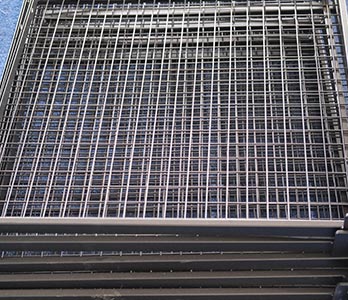
The mesh fence is the metallic enclosure installed around the areas not covered by glass or another approved wall material.
Depending on the court design, it may be installed:
- Above the back-wall glass
- Along the side enclosure
- Beside player entrances
- Between structural posts
- Around lighting supports
- Within gate frames
The current International Padel Federation rules require the court to be fully enclosed. They also define how metallic fencing completes the side and end enclosures and require the fence to remain flat and vertical.
Mesh as Part of the Playing Area
During a rally, the ball may contact the metallic fencing after bouncing on the playing surface.
The mesh must therefore provide a suitable level of tension and maintain its shape. A loose, heavily deformed, or poorly connected panel may produce inconsistent rebounds.
Mesh as a Protective Enclosure
The fence prevents balls from leaving the court during normal play.
It also separates players from spectators, walkways, electrical equipment, landscaping, and neighbouring courts.
Concept: Functional Enclosure
A functional enclosure combines ball containment, player protection, visibility, structural stability, and suitable rebound behaviour.
A fence that only looks strong may still be unsuitable when it has unsafe welds, excessive gaps, unstable panels, or incompatible connections.
What Do FIP Rules Say About Metallic Fencing?
Buyers developing competition or professionally operated facilities should check the latest official documents before confirming a court specification.
The current FIP rules state that metallic-fence openings should have a diagonal measurement of no less than 5 cm and no more than 7.08 cm. They recommend wire thickness between 2 mm and 3 mm, with a maximum of 4 mm, together with sufficient tension to allow the ball to rebound.
Welded-Fence Requirements
When welded fencing is used, the welded points should be protected on both sides to reduce the risk of cuts and scratches.
For non-interlaced square mesh, the rules specify that parallel threads should face the inside of the court and vertical threads should face the outside.
Twisted-Fence Requirements
When twisted mesh is used, the twisting mechanism should be placed outside the playing enclosure and protected appropriately.
Joins and seams should not have sharp or pointed edges.
Keep the Upper Fence Area Clear
When the metallic fence is fixed to a frame, its upper area should remain free from unrelated items such as electrical boxes, cables, and lighting devices.
This helps maintain a clear enclosure and reduces unnecessary contact hazards.
Buyers can review the latest regulations through the official FIP documents page.
Compare Common Padel Court Mesh Types
Several metallic-fence constructions may be available, but they do not provide the same appearance, rigidity, or maintenance requirements.
| Mesh Type | Main Characteristic | Possible Advantage | Main Buyer Check |
|---|---|---|---|
| Welded square mesh | Wires welded at intersections | Flat appearance and stable openings | Weld protection and panel rigidity |
| Welded rhomboid mesh | Diagonal opening pattern | Can meet approved enclosure geometry | Opening dimensions and weld quality |
| Twisted mesh | Interwoven wire construction | Flexible and widely available | External twist protection and tension |
| Framed modular mesh | Mesh welded inside a steel frame | Easier panel identification and replacement | Frame dimensions and connections |
| Unframed mesh | Mesh tensioned directly between posts | Reduced frame material | Tension control and edge finishing |
Welded Square Mesh
Welded square mesh is common in modern commercial Padel Court systems.
Its regular grid supports clear visibility and allows the panels to be manufactured as repeatable modules.
Twisted or Chain-Link Mesh
Twisted mesh is more flexible than a rigid welded panel.
It requires suitable tensioning and careful protection of the twist and edge areas.
Framed Mesh Panels
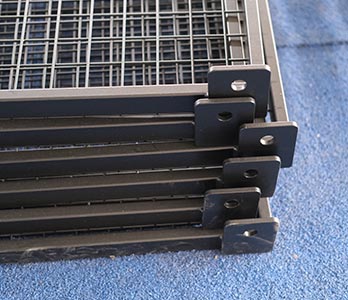
A framed panel combines welded wire with a surrounding steel-tube frame.
This design can simplify factory production, transport identification, installation, and future replacement.
Concept: Panel Modularity
Panel modularity means the enclosure is divided into repeatable sections that can be manufactured, labelled, shipped, installed, and replaced individually.
Modular construction can reduce repair complexity when one section is damaged.
Select the Correct Mesh Opening Size
Mesh opening size influences ball containment, visibility, weight, air movement, and rebound.
Openings That Are Too Large
Oversized openings may:
- Fail to contain the ball correctly
- Create unsuitable ball behaviour
- Increase the risk of contact around the openings
- Conflict with competition requirements
- Reduce the visual consistency of the enclosure
Openings That Are Too Small
Very small openings may:
- Increase steel weight
- Increase wind resistance
- Reduce visibility
- Require more welding
- Increase coating complexity
- Raise the purchase price
Why 50 × 50 mm Mesh Is Common
A 50 × 50 mm square grid creates a diagonal opening of approximately 70.7 mm, placing it close to the upper end of the opening range specified in the current FIP rules.
SRSC’s current panoramic, classic, super panoramic, single, and roofed product information lists a 50 × 50 mm grid manufactured from 4 mm steel wire.
Buyers should still confirm that the complete supplied system meets the applicable requirements for their project.
Compare Padel Court Mesh Wire Diameters
Wire diameter is frequently used as a simple purchasing comparison, but it should not be evaluated alone.
Thinner Wire
A thinner wire may reduce:
- Panel weight
- Raw-material use
- Shipping weight
- Welding demand
However, the completed fence must still maintain suitable tension, shape, and impact resistance.
Thicker Wire
A thicker wire may improve panel rigidity and resistance to local deformation.
It may also increase:
- Panel weight
- Frame load
- Welding heat
- Coating requirements
- Handling difficulty
- Price
Is 4 mm Wire Suitable?
The current FIP rules allow a maximum wire thickness of 4 mm.
SRSC’s current Padel Court specifications use 4 mm high-strength steel wire with 50 × 50 mm openings for several court models.
A buyer should evaluate this wire together with:
- Mesh panel size
- Frame profile
- Weld pattern
- Steel grade
- Surface treatment
- Post spacing
- Installation connections
Do Not Compare Wire Weight Alone
A heavy panel can still perform poorly when it has incomplete welds, weak frames, unsuitable fasteners, or incorrect installation.
The complete enclosure system matters more than one material number.
Evaluate the Mesh Panel Frame
The wire grid is normally supported by a surrounding steel frame or court structure.
Common Frame Information
Ask the supplier to state:
- Frame width and height
- Tube dimensions
- Wall thickness
- Steel grade
- Weld arrangement
- Drainage holes
- Surface treatment
- Connection-hole positions
- Panel weight
SRSC’s current RR01, RR02, RR03, RR04, and RR05 product descriptions list 1 × 2 metre framed sections produced with 50 × 30 × 2 mm galvanized steel tubes.
Panel Size and Installation
Smaller modular panels may be easier to:
- Pack
- Lift
- Align
- Replace
- Store
- Identify
Larger panels reduce the number of joints but can be more difficult to transport and handle.
Frame Straightness
A distorted frame can create:
- Uneven gaps
- Difficult bolt alignment
- Rattling
- Poor gate operation
- Visible enclosure waves
- Incorrect ball response
Panels should be inspected for straightness before coating and again before packaging.
Check Weld Quality and Player-Side Safety
The mesh contains many welded intersections, making welding quality a major purchasing consideration.
Visual Weld Inspection
Check for:
- Missing welds
- Incomplete fusion
- Excessive spatter
- Sharp projections
- Burned wire
- Cracking
- Uneven intersections
- Detached wires
Protect Both Sides
FIP rules specifically require welded points to be protected on both sides against cuts and scratches.
Factory inspection should therefore include both the player-facing and external sides of every panel.
Finish Cut Wire Ends
Wire ends near:
- Gates
- Corners
- Panel joints
- Upper edges
- Repair areas
should not remain exposed or sharp.
Concept: Contact-Safe Finish
A contact-safe finish reduces the chance that normal player movement or maintenance work will involve exposed wire ends, welding projections, sharp seams, or rough edges.
It does not replace correct supervision and maintenance, but it is an essential manufacturing requirement.
Galvanized vs Powder-Coated Mesh
Metallic fencing may be galvanized, powder coated, or protected through a combined system.
Galvanized Mesh
A zinc-based coating helps protect the underlying steel from corrosion.
Buyers should confirm:
- Galvanizing method
- Treatment before or after welding
- Coating consistency
- Weld coverage
- Cut-edge repair
- Inspection procedure
Powder-Coated Mesh
Powder coating provides colour and an additional protective finish.
Common choices include:
- أسود
- أخضر
- أزرق
- Grey
- Custom brand colours
Combined Protective System
A galvanized-and-powder-coated system can provide zinc protection together with a coloured external finish.
SRSC’s current court pages describe galvanized mesh frames and a combined zinc and plastic-powder surface treatment for outdoor use.
Compare the Complete Coating Process
| Coating Question | Why It Matters |
| Is the wire galvanized before welding? | Weld areas may need additional treatment |
| Is the completed panel galvanized? | Complete fabrication may receive broader coverage |
| Is powder coating applied afterward? | Adds colour and another protective layer |
| How are damaged areas repaired? | Installation scratches need an approved method |
| Is the coating suitable for coastal use? | Salt exposure may require enhanced protection |
| Are colour samples available? | Reduces appearance disputes |
Consider Climate and Corrosion Exposure
The same fencing specification may require different maintenance in different locations.
Inland Outdoor Sites
Even inland courts experience:
- Rain
- Condensation
- Sunlight
- Cleaning products
- Soil contamination
- Temperature changes
Coastal Locations
Salt exposure can increase corrosion risk around:
- Welds
- Panel edges
- Fasteners
- Base connections
- Scratched coating
- Gate hinges
Coastal buyers should request a project-specific corrosion-protection and maintenance plan.
Indoor Sites
Indoor installation reduces direct rain exposure but does not eliminate corrosion.
Humidity, condensation, swimming pools, coastal air, and poor ventilation can still affect metallic components.
Industrial Environments
Factories and industrial parks may expose mesh panels to:
- Chemical vapour
- Dust
- Exhaust
- Aggressive cleaning products
- Process moisture
The supplier should understand the installation environment before finalizing the surface treatment.
Coordinate Mesh With the Court Posts
Mesh panels need stable, accurately positioned structural posts.
Connection Details
Confirm:
- Bolt size
- Bolt grade
- Washer arrangement
- Brackets
- Slots
- Hole spacing
- Protective caps
- Isolation materials
- Tightening procedure
Avoid Forced Installation
Installers should not pull a distorted panel into position using excessive bolt force.
Forced assembly may create:
- Residual stress
- Uneven panel surfaces
- Damaged coating
- Misaligned gates
- Loose connections later
Check the Steel Frame First
Before mesh installation, verify:
- Post spacing
- Vertical alignment
- Foundation level
- Anchor positions
- Structural stability
- Glass openings
The mesh should complete an already aligned structure rather than correct civil or steel-frame errors.
Coordinate Mesh With Court Gates
The player entrance is one of the highest-use areas of the enclosure.
Gate-Related Mesh Details
Inspect:
- Wire termination
- Hinge connections
- Latch position
- Frame clearance
- Opening direction
- Ground clearance
- Handle protection
- Access-control hardware
Prevent Snagging Points
Clothing, equipment, fingers, or racket straps should not easily catch on exposed wires, screws, or sharp gate components.
Check Alignment Under Repeated Use
A gate that operates correctly during installation may loosen after thousands of opening cycles.
The maintenance plan should include hinge, latch, fastener, frame, and mesh inspections.
How Mesh Affects Ball Rebound
Unlike glass, metallic fencing does not produce the same smooth and uniform rebound.
However, the panel should remain sufficiently tensioned and stable for predictable play.
Loose Mesh
Loose or poorly connected mesh may:
- Absorb too much ball energy
- Produce inconsistent rebound
- Rattle
- Move during contact
- Develop local deformation
Overly Rigid or Damaged Areas
Localized stiff areas can form around:
- Heavy repair plates
- Excessive welding
- Deformed frames
- Added signs
- Improvised supports
These changes may affect how the ball behaves compared with the rest of the enclosure.
Keep the Playing Face Consistent
On square welded mesh, the specified wire orientation should be followed so that the playing face remains consistent.
Consider Visibility and Branding
The mesh should provide suitable visibility for players, spectators, cameras, and staff.
Dark Mesh Colours
Black and dark green are common because they may visually recede behind the action.
The best choice depends on:
- Turf colour
- Background
- إضاءة
- Branding
- Building finishes
- Camera positions
Advertising Panels
Banners and solid advertising boards can:
- Block visibility
- Increase wind load
- Change rebound
- Cover damage
- Interfere with access
- Trap moisture
Obtain technical approval before attaching large solid materials to the mesh.
Logo Placement
Small signs may be attached in approved non-playing areas.
They should not create sharp edges, loose fasteners, or visual interference.
Inspect Mesh Before Shipment
Factory inspection should occur before the panels are packed.
Mesh Inspection Checklist
| Inspection Item | What to Check |
| Grid dimensions | Match the approved specification |
| Wire diameter | Consistent with the order |
| Panel size | Fits the structural layout |
| Frame tubes | Correct dimensions and thickness |
| Welds | Complete and protected |
| Wire ends | No sharp projections |
| Flatness | Panel is not twisted or bowed |
| Connection holes | Correct position and diameter |
| Coating | Continuous and visually consistent |
| Colour | Matches the approved sample |
| Labels | Identify court and panel position |
| Quantity | Matches the packing list |
Request Inspection Records
Possible records include:
- Dimensional reports
- Material certificates
- Coating checks
- Panel photographs
- Packing photographs
- Quantity checklist
- Third-party inspection report
The required documents should be agreed upon before production.
Package Mesh Panels Correctly
Mesh panels can bend, scratch, or rub against each other during transportation.
Packaging Priorities
Suitable packaging should protect against:
- Panel deformation
- Coating abrasion
- Forklift impact
- Water exposure
- Lost fasteners
- Mixed court sets
- Sharp edges
Use Panel Separators
Protective separators can reduce direct metal-to-metal contact.
Corners and connection brackets may require additional padding.
Label Multi-Court Orders
Each package should state:
- Project name
- Court number
- Panel group
- Package number
- Quantity
- وزن
- Installation sequence where useful
This reduces sorting time at the construction site.
Inspect Mesh at Delivery
The buyer should inspect packages before installation.
Delivery Checks
Look for:
- Bent frames
- Broken welds
- Scratched coatings
- Missing labels
- Wet packaging
- Forklift damage
- Missing fasteners
- Incorrect quantities
- Panels mixed between models
Document Transport Damage
Photograph:
- Container condition
- Seal number
- Package positions
- Damaged packaging
- Affected panels
- Labels
- Unloading process
Transport damage may follow a different claim process from manufacturing defects.
Store Panels Safely
Mesh panels should remain:
- Supported
- Dry
- Separated by court
- Protected from vehicles
- Away from unstable stacking
- Accessible in installation order
Install the Mesh Fence Correctly
Installation quality affects long-term panel performance.
Confirm the Structure Is Ready
Before installation, verify:
- Foundation acceptance
- Post alignment
- Correct panel positions
- Available fasteners
- Safe lifting access
- Approved drawings
Follow the Panel Sequence
Panel numbers should match the installation drawing.
Do not assume all panels are interchangeable, especially around corners, gates, lighting posts, and stepped sections.
Protect the Coating
Use lifting methods and tools that avoid scratching the finished surface.
Where damage occurs, use the approved coating-repair procedure promptly.
Complete a Final Safety Inspection
Before opening the court, inspect the player-facing enclosure for:
- Sharp edges
- Loose bolts
- Open gaps
- Exposed threads
- Weld projections
- Unprotected seams
- Unstable panels
- Gate interference
Maintain a Padel Court Mesh Fence
Metal fencing requires regular visual and physical inspection.
Routine Maintenance Areas
Check:
- Weld intersections
- Panel connections
- Frame straightness
- Coating damage
- Corrosion
- Gate mesh
- Upper panel edges
- Base connections
- Advertising attachments
- Ball-impact zones
Clean the Mesh
Remove:
- Dust
- Salt deposits
- Leaves
- Soil
- Bird residue
- Chemical contamination
Use cleaning products compatible with the coating system.
Repair Coating Damage
Small scratches should be cleaned and repaired according to the supplier’s approved method.
Decorative paint alone may not reproduce the original corrosion-protection system.
Replace Severely Damaged Panels
Replacement may be preferable when a panel has:
- Extensive broken welds
- Serious deformation
- Sharp exposed wire
- Advanced corrosion
- Cracked frame welds
- Repeated connection failure
Keep the original panel drawings and part numbers to simplify future orders.
Common Padel Court Mesh Fence Mistakes
Comparing Only Wire Diameter
The frame, welds, coating, openings, connections, and installation are equally important.
Using General Construction Mesh
Ordinary fencing may not provide the required opening size, finish, tension, or ball response.
Leaving Weld Points Unprotected
Exposed welds can create unnecessary contact hazards.
Attaching Solid Banners Without Review
Large banners may increase wind load and change court performance.
Forcing Bent Panels Into Position
Forced installation can create stress and poor alignment.
Ignoring Small Coating Scratches
Local damage can develop into more serious corrosion, especially in coastal environments.
Losing Panel Identification
Replacement becomes harder when the operator cannot identify the court model or panel position.
خاتمة
A Padel Court Mesh Fence should be evaluated as a complete manufactured and installed system.
Buyers need to compare the mesh opening, wire diameter, frame profile, welding quality, surface treatment, player-side finish, post connections, gate details, packaging, installation, and future spare-part availability.
The most important specification is not simply the thickest wire or heaviest panel. The fence must remain flat, vertical, secure, corrosion-resistant, contact-safe, and compatible with the court structure and applicable playing requirements.
SRSC’s current Padel Court systems use modular galvanized mesh frames with 50 × 50 mm openings and 4 mm steel wire across several court models. Buyers can explore the complete Padel Court collection, compare the ملعب بادل بانورامي و ملعب بادل كلاسيكي, review the Padel Court Steel Structure Guide، أو contact SRSC with the project location, court quantity, mesh specification, preferred colour, and delivery requirements.
التعليمات
What mesh size is used for a Padel Court?
A 50 × 50 mm square welded grid is common in commercial systems. The current FIP rules require the diagonal opening to fall between 5 cm and 7.08 cm.
How thick should the mesh wire be?
The current FIP rules recommend wire between 2 mm and 3 mm and allow a maximum of 4 mm. The complete panel design and tension must also support suitable ball rebound.
Does SRSC use 4 mm wire?
SRSC’s current classic, panoramic, super panoramic, single, and roofed court pages list 4 mm steel wire with 50 × 50 mm mesh openings.
Is welded mesh better than chain-link mesh?
Welded mesh provides a flat modular panel and regular openings, while twisted mesh offers more flexibility. Both require correct dimensions, protection, tension, and installation.
Should Padel Court mesh be galvanized?
Galvanizing is commonly used for corrosion protection, especially on outdoor courts. The required system depends on the location, climate, coating specification, and maintenance plan.
Can damaged mesh be repaired?
Minor coating or connection problems may be repairable. Panels with major deformation, broken welds, sharp edges, or advanced corrosion may require replacement.
Can advertising be attached to the fence?
Only after checking visibility, wind load, rebound, access, fasteners, and structural suitability.
What should buyers inspect before shipping?
Inspect the grid size, wire diameter, panel dimensions, frame tubes, welds, sharp edges, holes, coating, labels, quantities, and packaging.
How often should the fence be inspected?
Inspection frequency depends on usage, environment, court location, and supplier recommendations. High-use and coastal courts may require more frequent checks.