
مدونة
Padel Court Noise Reduction: A Guide for Outdoor Projects
المقالات الأخيرة
جدول المحتويات
Padel Court Noise Reduction is becoming an increasingly important consideration when planning an Outdoor Padel Court near homes, hotels, schools, residential developments, or other noise-sensitive areas.
Padel is naturally an active sport. Sound can come from racket impacts, ball contact with glass and mesh, players communicating, spectators, gates, and surrounding activity. In a remote sports complex, these sounds may cause few concerns. In a quiet residential environment, however, the same court may require much more careful planning.
For B2B buyers, developers, sports clubs, architects, and facility operators, noise should therefore be considered before selecting the court location and structure.
Key Takeaways
- Padel court noise should be considered during site planning rather than after installation.
- Ball impacts, player voices, glass walls, mesh, and court structures can all contribute to perceived sound.
- Distance from nearby residences is one of the most important planning factors.
- Acoustic barriers work best when their height, location, continuity, and materials are professionally designed.
- Trees and landscaping can improve visual screening but should not automatically be treated as sufficient acoustic barriers.
- Operating hours can be as important as physical noise-control measures.
- Multiple courts may require more careful assessment than a single court.
- Buyers should consider a professional noise assessment for sensitive commercial or residential projects.
Why Does an Outdoor Padel Court Create Noise?
أن ملعب بادل خارجي is an enclosed racket-sports facility where the surrounding glass and mesh are intentionally used during play.
This creates a different acoustic environment from many open sports courts.
Racket and Ball Impact
The repeated contact between the racket and ball produces short, impulsive sounds.
These sounds occur frequently during active rallies and can become noticeable when the surrounding environment is otherwise quiet.
Ball Contact with Glass
Glass walls are an essential part of padel.
When the ball rebounds from tempered glass, the impact creates another distinct source of sound.
Why Glass Sound Can Be Noticeable
Glass is a hard and reflective material.
Rather than absorbing much of the sound energy, it can reflect sound into the surrounding environment depending on court geometry and site conditions.
Ball Contact with Mesh
Metal mesh panels can also generate impact noise when struck by the ball.
Loose components, poorly fitted panels, or vibrating connections may make these sounds more noticeable.
Player Voices
Padel is highly social.
Players communicate during rallies, celebrate points, call scores, and sometimes shout during competitive play.
Human Noise Matters Too
A noise-control plan that focuses exclusively on racket and ball impacts may overlook an important source of sound.
For busy commercial clubs, player and spectator activity should also be included when evaluating the surrounding environment.
Why Padel Court Noise Reduction Matters for B2B Buyers
Noise is not simply a comfort issue.
For commercial projects, it can affect site selection, planning approval, operating hours, neighbor relationships, and future expansion.
Planning Risk
A project located close to homes may be asked to demonstrate that sports activity will not create unacceptable noise impacts.
Requirements differ between countries and local authorities.
Plan Before You Build
Acoustic assessment is usually easier and less expensive during project design than after courts have already been installed.
Changing court orientation or location on a site plan may cost very little before construction.
Adding large acoustic structures afterward can be significantly more complicated.
Operating Restrictions
A facility may attract more attention when courts operate early in the morning or late at night.
Even when daytime activity is acceptable, evening use can become more sensitive because background noise levels may be lower.
Neighbor Relations
Commercial operators depend on stable long-term operations.
Repeated complaints can create unnecessary conflict between a padel club and surrounding property owners.
Noise Reduction as Risk Management
Good Padel Court Noise Reduction is therefore not only about creating a quieter facility.
It is also about reducing operational and planning risks over the entire project lifecycle.
Where Does Padel Court Noise Come From?
Before choosing a mitigation method, buyers should understand the sources.
| Noise Source | Typical Character | Possible Management Approach |
|---|---|---|
| Racket impact | Short, repeated impact | Distance, barriers, site design |
| Ball hitting glass | Sharp impact | Court placement, barriers |
| Ball hitting mesh | Metallic impact | Stable structure and maintenance |
| Player voices | Variable human noise | Operating policies and distance |
| Spectators | Continuous/occasional | Seating location and management |
| Gates | Mechanical impact | Maintenance and soft-close details |
| Lighting/equipment | Usually low | Equipment selection |
| Parking/activity | Vehicle and visitor noise | Site circulation planning |
Court Noise Is a Combination
There is rarely one single source responsible for the entire acoustic impact.
A realistic assessment should consider how different sources combine during typical and peak operating conditions.
Start Padel Court Noise Reduction with Site Selection
The cheapest acoustic solution is often good site planning.
Distance from Residential Properties
Increasing separation between the ملعب بادل خارجي and nearby homes can substantially reduce potential conflict.
Sound generally becomes weaker as distance from the source increases, although actual propagation also depends on terrain, barriers, reflections, and environmental conditions.
Use Existing Buildings as Screening
Clubhouses, changing facilities, storage buildings, parking structures, or other suitable site features may help screen courts from sensitive directions.
Think About Court Position First
Consider two possible layouts:
Layout A: Court → Residential Property
Layout B: Court → Clubhouse → Residential Property
The second configuration may provide better physical screening before additional acoustic measures are considered.
Avoid the Most Sensitive Boundary
When a site has several possible court locations, place the courts away from the boundary closest to residential gardens, bedrooms, hotels, hospitals, or other sensitive uses where practical.
Does Court Orientation Affect Noise?
Court orientation is normally discussed in relation to sunlight and playability, but it can also form part of acoustic planning.
Glass Wall Direction
Large glass surfaces may influence how sound reflects around the site.
The relationship between glass walls, nearby buildings, terrain, and receivers should therefore be evaluated.
Open Areas
Sound may travel differently across an open car park, field, or body of water than through a densely built environment.
Do Not Guess
Acoustics is site-specific.
A court layout that works well at one club should not automatically be copied for another location with different surroundings.
What Is a Padel Court Noise Assessment?
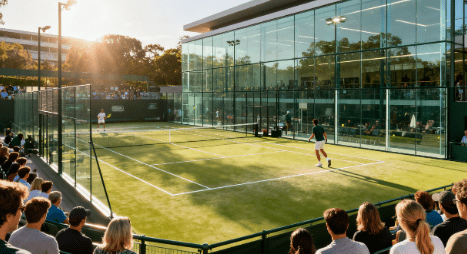
A professional noise assessment evaluates the existing acoustic environment and predicts or measures the potential impact of the proposed facility.
Background Noise Survey
Acoustic consultants may measure existing sound conditions around the project site.
This provides context for evaluating how noticeable new sports activity may become.
Sensitive Receivers
A receiver is a location where sound impact is evaluated.
Examples include:
- Residential houses
- Apartments
- Hotels
- Schools
- Hospitals
- Gardens
- Outdoor amenity areas
Noise Prediction
Specialist acoustic software may be used to model how sound travels from the courts to surrounding locations.
Multiple Courts Should Be Considered
A four-court commercial facility should not automatically be evaluated as though only one court will operate.
Peak conditions may involve several courts running simultaneously.
Single Court vs Multiple Courts
The number of courts influences both business capacity and acoustic planning.
| Project Type | Noise Planning Complexity | Typical Application |
| 1 court | Lower | Hotel, school, private facility |
| 2 courts | معتدل | Small commercial club |
| 3–4 courts | Higher | Dedicated padel club |
| 5+ courts | Detailed assessment recommended | Large commercial center |
One Court
A single ملعب بادل خارجي may be easier to position farther away from sensitive boundaries.
Multiple Courts
With multiple courts, more players can be active simultaneously.
Parking, spectators, waiting players, and social areas may also add to total facility noise.
Expansion Planning
Commercial buyers should consider future expansion before selecting the first court location.
Leaving space for additional courts in the wrong direction may create acoustic problems later.
Acoustic Barriers for Padel Court Noise Reduction
Acoustic barriers can be useful when courts must be positioned near sensitive areas.
However, their effectiveness depends heavily on design.
What Is an Acoustic Barrier?
An acoustic barrier is a solid structure positioned between a noise source and receiver to obstruct the direct sound path.
It may be made from engineered panels, dense fencing systems, walls, or other suitable materials.
ارتفاع
A barrier needs sufficient height to interrupt the line between important noise sources and the receiver.
Taller Is Not Automatically Better
Increasing barrier height can improve performance in some situations, but height should be determined using acoustic modelling and local planning requirements.
Very tall barriers may also introduce structural, wind-load, appearance, and permitting considerations.
Continuity
Large gaps can reduce barrier effectiveness.
Gates, openings, drainage points, and construction joints therefore require careful detailing.
Location
A barrier may work differently when placed close to the court compared with a position closer to the receiver.
Professional acoustic design can determine the most useful location.
Acoustic Barrier vs Standard Fence
These products serve different purposes.
Standard Sports Fence
A conventional mesh fence provides:
- Ball containment
- Security
- Visibility
- Boundary control
However, open mesh allows most airborne sound to pass through.
Acoustic Barrier
A properly designed acoustic barrier is usually solid or incorporates specialist acoustic materials.
| ميزة | Mesh Fence | Acoustic Barrier |
| Ball containment | Excellent | Design-dependent |
| Visibility | عالي | Lower |
| Airflow | عالي | Lower |
| Sound blocking | محدود | Purpose-designed |
| Wind loading | Lower | Often higher |
| Structural requirements | معيار | May require additional engineering |
Important Structural Consideration
A solid acoustic barrier receives significantly more wind pressure than open mesh.
Do not simply attach solid panels to an existing padel frame without structural review.
Can Trees Reduce Padel Court Noise?
Landscaping is useful, but buyers should understand its limitations.
Visual Screening
Trees, hedges, and shrubs can make a padel facility feel less intrusive from surrounding properties.
Visual separation may improve the overall relationship between a sports facility and its neighbors.
Psychological Benefit
When the source is hidden, perceived disturbance may sometimes feel reduced.
But Vegetation Is Not a Guaranteed Acoustic Barrier
A narrow line of trees should not be treated as a substitute for a properly designed solid acoustic barrier.
For noise-sensitive projects, landscaping is better considered part of the overall site strategy rather than the only mitigation measure.
Can the Court Structure Be Made Quieter?
Structural quality can influence unnecessary vibration and rattling.
Stable Mesh Panels
Mesh should be securely installed according to the court design.
Loose sections may vibrate or create additional metallic noise during impacts.
Gates and Doors
Entrance gates should operate smoothly without excessive rattling or slamming.
Small Maintenance Issue, Large Impression
A noisy gate may produce relatively little total acoustic energy, but repeated metallic impacts can be particularly noticeable to nearby users and residents.
Fasteners and Connections
Bolts and structural connections should be inspected periodically.
Loose components can generate vibration that is not part of normal game noise.
Does Tempered Glass Thickness Reduce Noise?
Buyers should be careful with this assumption.
سمك الزجاج
Glass thickness is primarily selected according to structural, safety, impact, and court-design requirements.
It should not automatically be considered an acoustic solution.
Installation Matters
Correctly supported glass panels help avoid unnecessary movement and vibration.
Do Not Choose Glass by Noise Alone
Padel glass should first satisfy the appropriate court, safety, and structural requirements.
Noise mitigation should be evaluated as part of the entire site rather than solved by changing a single component.
SRSC offers court systems using 12 mm tempered glass, galvanized steel structures, mesh, artificial turf, and LED lighting for commercial padel installations.
Outdoor vs Indoor Padel Court Noise
An indoor facility and an Outdoor Padel Court present different acoustic challenges.
ملعب خارجي
Sound can travel directly toward surrounding properties.
Site distance, terrain, buildings, barriers, and operating hours become important.
ملعب داخلي
A building enclosure provides an additional boundary, but noise can still travel through roofs, walls, doors, ventilation openings, and structural elements.
| Factor | ملعب خارجي | ملعب داخلي |
| Direct sound propagation | Higher potential | Building provides enclosure |
| Weather exposure | عالي | قليل |
| Acoustic barrier options | Site-dependent | Building treatment possible |
| Ventilation noise path | Low relevance | Important |
| Neighbor sensitivity | Site-dependent | Building location-dependent |
| Structural reverberation | Lower enclosure effect | Can be significant indoors |
Is Indoor Always Quieter?
Not automatically.
An inadequately designed lightweight building may still transmit noticeable sound outside.
The correct solution depends on the project.
Open Court vs Roofed Outdoor Padel Court
Roofed courts are becoming popular because they can extend usable hours during rain and strong sun.
However, acoustic behavior should also be considered.
Open Outdoor Padel Court
Sound can escape freely upward.
Roofed Court
A roof can change how sound reflects within and around the playing area.
Roof Material Matters
Hard roof surfaces may reflect sound differently from acoustic construction systems.
Where noise sensitivity is high, acoustic design should be coordinated with roof and structural design from the beginning.
Operating Hours as a Noise Reduction Tool
Not every solution requires construction.
Operational management can be highly effective.
Daytime Operation
Daytime background activity is often greater than late-evening activity.
Courts may therefore be less noticeable during busy daytime periods.
Evening Operation
Late-evening play can become more sensitive because nearby residents may expect quieter surroundings.
Commercial Balance
Extended opening hours can increase court revenue.
However, operating as late as possible is not necessarily the best long-term commercial strategy when the facility is surrounded by residential properties.
Court Booking Strategy
Operators can also consider how courts are scheduled.
High-Sensitivity Periods
During quieter periods, operators may reduce the number of courts operating simultaneously where appropriate.
Events
Tournaments can produce additional sound from spectators, announcements, celebrations, and increased parking activity.
Events Need Separate Planning
A normal four-player booking and a tournament final do not create the same site conditions.
Commercial clubs should include major events in their operational planning.
Lighting and Noise Planning Work Together
Lighting and noise are separate environmental issues, but both influence operating hours.
Extended Night Use
Professional LED lighting makes evening padel possible.
However, later use can create both lighting and noise considerations for neighboring properties.
Site Layout
Lighting poles, acoustic barriers, landscaping, access paths, and drainage should all be coordinated during the design stage.
Avoid Retrofitting Everything
Trying to add acoustic barriers after lighting poles, drainage channels, landscaping, and spectator areas have already been installed can make mitigation more expensive.
Padel Court Noise Reduction for Residential Projects
Residential developments present one of the most sensitive applications.
Apartment Developments
Padel can be an attractive amenity for premium residential communities.
However, placing a court directly beneath residential balconies or bedroom windows may create avoidable issues.
Gated Communities
Distance, landscaping, controlled hours, and appropriate orientation can help integrate the facility into the development.
Amenity Should Remain an Amenity
A sports facility intended to increase property value should not become a recurring source of disputes between residents.
Noise planning therefore supports both user experience and development quality.
Padel Court Noise Reduction for Hotels and Resorts
Hotels present different considerations.
Guest Rooms
The court should ideally be separated from noise-sensitive accommodation areas.
Activity Zones
Positioning padel near pools, gyms, recreation areas, parking, or other active spaces may be more appropriate than placing it beside quiet accommodation zones.
Operating Hours
Hotel guests may sleep at different times because of international travel.
Resort Zoning
A useful planning principle is to group active facilities together.
Active zone: padel, pool, gym, recreation.
Quiet zone: guestrooms, villas, spa, relaxation areas.
Noise Planning for Schools and Sports Clubs
Schools and existing sports clubs may already have active acoustic environments.
Existing Sports Context
Placing a padel court beside existing tennis courts or playing fields may be more appropriate than introducing it beside the quietest site boundary.
Community Use
Schools planning evening community rentals should consider how operating conditions change after normal school hours.
Daytime and Evening Can Be Different
A location surrounded by school activity at 2:00 p.m. may become extremely quiet at 9:00 p.m.
This difference should be considered during planning.
Noise Reduction vs Padel Court Cost
Noise mitigation can increase initial project cost.
However, buyers should compare that cost with potential future risks.
Low Initial Cost
A developer may choose the easiest available court location and omit acoustic evaluation.
Lifecycle Cost
Future costs could potentially include:
- Additional barriers
- Relocation of facilities
- Restricted operating hours
- Professional assessments
- Planning modifications
- Lost bookings
- Neighbor disputes
Prevention Can Be Cheaper
The best Padel Court Noise Reduction measure may simply be moving the proposed court location during the design stage.
That decision can cost almost nothing before construction and become extremely expensive afterward.
What Should Buyers Send the Court Supplier?
The manufacturer cannot design around site conditions it does not know.
Provide as much project information as possible.
Project Location
Include the city and country.
Site Plan
Show:
- Court location
- Property boundaries
- Nearby buildings
- Residential areas
- Access roads
- Parking
- Existing sports facilities
Number of Courts
Specify current and possible future court quantities.
نوع المحكمة
Clarify whether you need:
- ملعب بادل كلاسيكي
- ملعب بادل بانورامي
- ملعب بادل خارجي مسقوف
- ملعب بادل فردي
Mention Noise-Sensitive Neighbors
Tell the supplier when the project is close to homes, hotels, hospitals, schools, or other sensitive properties.
This allows structural and layout discussions to consider possible acoustic barriers or modifications earlier.
Padel Court Noise Planning Checklist
Use this checklist during project planning.
| غرض | Buyer Question |
| Site location | How close are sensitive properties? |
| Background environment | Is the area already active or very quiet? |
| Number of courts | How many could operate together? |
| Court position | Can it be moved farther away? |
| Orientation | Where are glass walls facing? |
| Existing buildings | Can they provide screening? |
| Acoustic assessment | Is professional modelling needed? |
| Barrier | Is a solid acoustic barrier appropriate? |
| Wind loading | Can the barrier structure handle wind? |
| Operating hours | When will the club open and close? |
| إضاءة | Will evening use increase sensitivity? |
| Expansion | Where will future courts be added? |
| صيانة | Are gates and mesh kept secure? |
Common Padel Court Noise Reduction Mistakes
Thinking About Noise After Installation
This removes many of the cheapest mitigation options.
Assuming Trees Will Solve Everything
Landscaping helps visually but should not automatically replace professional acoustic mitigation.
Adding Solid Panels Without Structural Review
Solid panels substantially change wind loading compared with open mesh.
Acoustic and Structural Design Must Work Together
A barrier that reduces sound but creates an unsafe structural condition is not an acceptable solution.
Ignoring Player Noise
Ball impacts are only part of the acoustic environment.
Forgetting Future Courts
A site may work with one court but become more sensitive after three additional courts are installed.
Setting Operating Hours Too Late
Commercial opening hours should form part of the planning strategy rather than being decided only after construction.
Questions to Ask Before Buying an Outdoor Padel Court
Is the site close to houses?
Measure actual distances rather than relying on visual impressions.
Could the court be moved?
Even modest layout changes may improve separation from sensitive boundaries.
Will I need an acoustic barrier?
This should be determined according to site-specific acoustic conditions.
Can the court structure support additional screening?
Do not assume that acoustic panels can simply be attached to standard fencing.
Will several courts operate simultaneously?
Model the realistic commercial operating condition rather than only the quietest scenario.
What are the planned opening hours?
Late evening operation deserves particular attention in residential areas.
خاتمة
Padel Court Noise Reduction should begin before an Outdoor Padel Court is ordered, not after neighbors start complaining.
For B2B developers, sports clubs, resorts, hotels, schools, residential communities, and commercial padel operators, the most effective acoustic strategy normally starts with site selection. Increasing distance from sensitive properties, using existing buildings as screening, selecting an appropriate court location, planning operating hours, and allowing space for professionally designed acoustic barriers can all reduce future risk.
Court quality also matters. Stable mesh, properly installed tempered glass, secure structural connections, well-maintained gates, and professional foundations help prevent unnecessary rattling and vibration.
Most importantly, buyers should avoid searching for one universal “quiet padel court” specification. Noise performance depends on the complete project environment.
Before finalizing an Outdoor Padel Court project, ask one simple question:
“How will this facility affect the people who live or work around it when all courts are operating?”
Answering that question during design can make the project easier to approve, easier to operate, and more sustainable over the long term.
التعليمات
Are Outdoor Padel Courts noisy?
Padel creates audible impacts from rackets, balls, glass, and mesh together with player voices.
Whether this becomes a significant issue depends on distance, surrounding background sound, court quantity, site layout, operating hours, barriers, and local requirements.
How far should a padel court be from houses?
There is no universal distance that guarantees an acceptable result.
The appropriate separation depends on local planning requirements, background noise, number of courts, terrain, barriers, court orientation, and operating conditions.
A professional noise assessment is preferable for sensitive sites.
Do acoustic barriers work around padel courts?
Properly designed barriers can reduce sound reaching nearby receivers.
Their performance depends on height, position, continuity, materials, court geometry, and the relationship between the sound source and receiver.
Can I put acoustic panels directly on a padel court fence?
Not without checking the structure.
Solid panels can dramatically increase wind loading compared with open mesh, so additional structural engineering may be necessary.
Do trees reduce Outdoor Padel Court noise?
Landscaping provides useful visual screening and may contribute to the overall site design, but ordinary rows of trees should not automatically be treated as professional acoustic barriers.
Is panoramic glass louder than a classic court?
Noise performance cannot reliably be determined only from whether a court is panoramic or classic.
Glass area, steel framing, mesh, installation quality, surrounding surfaces, site geometry, and distance all influence the acoustic result.
Can changing operating hours reduce noise complaints?
Yes.
Restricting activity during particularly sensitive periods can form part of a noise-management strategy, especially for courts close to residential properties.
Should I get a noise assessment before buying a padel court?
For a remote sports site, it may not always be necessary.
For residential, hotel, mixed-use, rooftop, urban, or planning-sensitive projects, early acoustic advice can help reduce risk and identify practical mitigation before construction.
Does a roof reduce padel court noise?
Not automatically.
Roof structures change how sound reflects and escapes from the playing area. Their acoustic effect depends on roof design, materials, walls, openings, and the surrounding environment.
What is the best way to reduce Outdoor Padel Court noise?
There is no single solution.
The most effective approach usually combines:
good site selection + sufficient distance + appropriate orientation + screening + structural quality + sensible operating hours + professional acoustic assessment when needed.