
Ratgeber
Outdoor Padel Court Drainage: Design Guide for Buyers
Aktuelle Artikel
Inhaltsverzeichnis
Rainwater can quickly expose weaknesses in an outdoor sports facility. Standing water, slow surface drying, displaced infill sand, algae growth, and foundation movement are often symptoms of an incomplete drainage design.
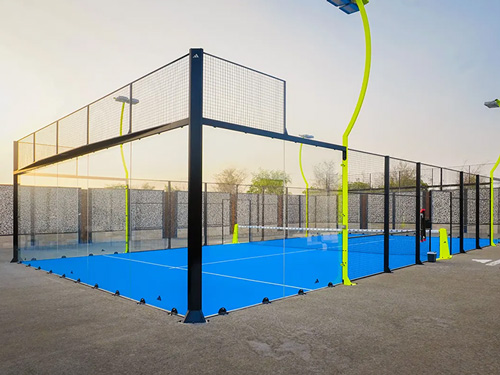
For buyers, drainage should be discussed before the court is manufactured—not after installation. This guide explains how to evaluate drainage when planning an Padelplatz im Freien for a club, resort, school, residential community, or commercial sports center.
Key points in this guide:
- Evaluate local rainfall and ground conditions before selecting a drainage system.
- Coordinate the foundation slope, turf permeability, and perimeter channels.
- Prevent water from collecting near steel anchors and electrical components.
- Compare surface, perimeter, and subsurface drainage methods.
- Ask suppliers and contractors to define their responsibilities in writing.
- Inspect the complete drainage path before accepting the project.
Why Outdoor Padel Court Drainage Matters
A padel court is surrounded by glass walls, steel mesh, posts, and entrance structures. These elements can restrict natural water movement if drainage is not incorporated into the foundation and surrounding landscape.
Poor drainage does more than interrupt play. It may increase cleaning requirements, accelerate corrosion, affect turf stability, and create slippery areas around entrances.
Playing Availability
Commercial clubs depend on consistent court bookings. A surface that stays wet for hours after rainfall can reduce daily operating time and cause cancellations.
Fast drainage helps the playing area return to service sooner. Actual drying time will still depend on rainfall intensity, temperature, sunlight, humidity, wind, and turf condition.
Player Safety
Puddles and contaminated surfaces can reduce grip. Water around gates and circulation areas may also create slip hazards for players and staff.
Drainage should therefore cover the entire facility, not only the internal playing rectangle.
Long-Term Structural Protection
Persistent moisture around base plates, anchors, bolts, and steel posts can contribute to corrosion. Water entering cracks may also affect the foundation in regions with freezing temperatures or unstable soil.
A coordinated drainage design protects both the playing surface and the supporting structure.
Assess the Site Before Designing Drainage
Drainage requirements vary between projects. A court on flat clay soil in a tropical region needs a different solution from one built on a sloped, free-draining site with moderate rainfall.
Local Rainfall
Ask a local civil engineer to review rainfall intensity, storm frequency, and expected peak water volume. Annual rainfall alone is not enough because a short, intense storm can overwhelm undersized channels.
Design Storm
A design storm is the rainfall event used to calculate drainage capacity. The appropriate design period should be determined according to local regulations, flood risk, project importance, and acceptable operational downtime.
Soil Permeability
Sandy soil normally allows water to pass through more quickly than clay. However, infiltration should never be assumed without a site assessment.
Low-permeability ground may require collection pipes or a positive discharge route. Otherwise, water can remain beneath or around the slab even when the surface looks dry.
Existing Site Levels
Survey the site to understand where water currently flows. Installing a court across a natural drainage path can redirect runoff toward neighboring buildings, parking areas, or adjacent courts.
A level survey should identify high points, low points, finished floor elevations, entrances, and the proposed discharge location.
Groundwater Conditions
A high water table can create pressure beneath the foundation or keep the sub-base constantly wet. Subsurface drainage may be necessary where groundwater is seasonal or close to the finished level.
Understand the Complete Drainage Path
Effective Outdoor Padel Court drainage is a connected system. Water must move from the turf through or across the foundation, into channels or pipes, and finally to a safe discharge point.
A drainage system is incomplete if any stage has insufficient capacity.
Step 1: Water Leaves the Turf
Artificial turf should allow rainfall to pass through its backing or move toward designed drainage points. Fiber type, backing permeability, infill condition, and maintenance all influence this process.
Step 2: Water Crosses the Base
The base may use a controlled surface gradient, a permeable construction, or a combination of both. The selected method must remain compatible with court-level tolerances and ball performance.
Step 3: Water Enters the Drainage System
Perimeter channels, slot drains, grated drains, catch basins, or subsurface pipes collect water. These components should remain accessible for inspection and cleaning.
Step 4: Water Reaches a Legal Outlet
Collected water may discharge into a stormwater system, infiltration area, storage tank, or another approved destination. Local authorities may restrict discharge volume, connection points, or water quality.
Compare Outdoor Padel Court Drainage Systems
No single method is suitable for every location. Many successful projects combine two or more drainage approaches.
| Drainage method | How it works | Main advantage | Key limitation |
|---|---|---|---|
| Surface drainage | A slight base gradient directs water toward drains | Simple water movement | Requires accurate construction |
| Perimeter channels | Drains collect water around the court boundary | Easy to inspect and clean | Can block if poorly maintained |
| Permeable base | Water passes vertically through the base | Can reduce visible runoff | Depends on soil and sub-base design |
| Subsurface pipes | Perforated pipes collect water below ground | Helps control underground moisture | Harder to inspect after construction |
| Catch basins | Basins collect water before discharge | Useful at low points | Requires debris removal |
| Storage or reuse system | Water is collected for controlled reuse | Supports water management goals | Adds tanks, filters, and pumps |
Surface Drainage
Surface drainage uses a carefully constructed gradient to move water toward a channel or collection point. It can be effective when the finished levels are accurate and the drainage outlet has sufficient capacity.
The slope must be subtle enough to preserve a consistent playing surface. Buyers should request project-specific tolerances instead of giving the concrete contractor a general instruction to “make the court drain.”
Perimeter Channels
Channels can collect water from the court and adjacent paved areas. Removable grates make cleaning easier, but their openings and position should not create hazards near player access routes.
The channel should also be strong enough for expected pedestrian, maintenance, or vehicle loads.
Permeable Base Systems
A permeable base allows water to pass through the playing surface and supporting layers. This solution can work well where the subgrade accepts water and the construction layers remain stable.
It is less suitable when the soil drains poorly or groundwater conditions are unfavorable unless additional collection and discharge measures are installed.
Subsurface Drainage
Perforated pipes installed beneath or beside the foundation can manage groundwater and water passing through permeable layers. Pipes need correct gradients, filter materials, inspection points, and protected outlets.
A subsurface system should be designed by a qualified local professional because repair can be disruptive after the court is completed.
Coordinate the Turf and Foundation
The turf and base should be specified as one playing-surface system. A highly permeable turf cannot compensate for an uneven slab, and a well-designed base cannot drain efficiently if the turf backing becomes blocked.
Buyers can review available padel court systems and turf options when preparing the project specification.
Turf Permeability
Ask the supplier for information about the turf backing, drainage openings, UV resistance, pile construction, and recommended sand infill. Verify that the product is intended for outdoor use.
Infill Sand Distribution
Infill supports the fibers and influences playing characteristics. Excessive, contaminated, or compacted sand may slow drainage and cause inconsistent surface conditions.
Grooming Requirements
Regular brushing redistributes sand and lifts the turf fibers. Maintenance frequency should reflect court traffic, weather, surrounding vegetation, and turf type.
Foundation Accuracy
Small depressions can become permanent puddle locations. Before turf installation, the contractor should inspect the base using agreed level tolerances and test the drainage behavior.
Defects are much easier to correct before the turf and court structure are installed.
Plan Drainage Around the Court
Water may enter the project from more than the playing surface. Roofs, walkways, landscaped areas, retaining walls, and neighboring land can all contribute runoff.
External Runoff
The surrounding landscape should direct water away from the court. Where the site sits below adjacent ground, an interceptor drain may be needed before runoff reaches the enclosure.
Entrance Areas
Court entrances experience frequent foot traffic and often include small level transitions. These areas need positive drainage so water does not collect at the gate or flow onto the turf.
Multiple-Court Facilities
A club with several courts produces a much larger drainage load than a single residential installation. Avoid routing water from one court across another.
Shared channels and main pipes should be sized for the combined catchment area.
Spectator and Social Areas
Seating, pathways, cafés, and waiting zones also create runoff. Their drainage should be coordinated with the court system to prevent water from crossing player routes.
Drainage for Roofed Padel Courts
A roof reduces direct rainfall on the playing surface, but it concentrates water along gutters and downpipes. This can produce a much larger flow at individual discharge points.
SRSC offers a roofed Outdoor Padel Court for projects requiring additional weather protection.
Roof Gutters
Gutters should be sized for local rainfall intensity and kept accessible for cleaning. Overflow routes are also important in case debris blocks the normal outlet.
Downpipe Locations
Downpipes should not obstruct entrances, maintenance paths, or spectator views. Water must discharge into a suitable pipe or channel rather than directly beside the foundation.
Wind-Driven Rain
A roof does not make an open-sided court completely dry. Wind can carry rain through the sides, so the playing surface and perimeter still require drainage.
Protect Steel and Electrical Components
Water should be prevented from collecting around structural anchors, base plates, cable entries, lighting controls, and electrical cabinets.
Anchor and Base-Plate Areas
Concrete around structural bases should not form small basins. Protective coatings, appropriate sealing details, and regular inspections help reduce corrosion risk.
Do not cover corroding steel with new paint without first identifying and treating the cause.
Lighting Circuits
Outdoor lighting requires properly rated fixtures, cables, junction boxes, and protective devices. Electrical design and installation should be completed according to local regulations.
Underground Conduits
Cable conduits need sealed entries and an appropriate arrangement to prevent water accumulation. Ask the electrical contractor how underground boxes and connection points will be drained or protected.
Common Outdoor Padel Court Drainage Mistakes
Many drainage problems result from unclear responsibility between the court supplier, foundation contractor, landscape contractor, and local engineer.
Designing Drainage After the Foundation
Drain locations, gradients, and discharge points should be defined before concrete work. Adding channels after the slab is finished may increase cost and create awkward transitions.
Relying Only on Turf Drainage
Perforated turf backing only moves water to the layer below it. The foundation and sub-base must still collect and remove that water.
Using an Insufficient Outlet
A wide channel offers little benefit when it connects to an undersized or blocked discharge pipe. Capacity should be checked across the complete system.
Ignoring Surrounding Surfaces
A court may drain correctly but still flood because parking areas or slopes direct additional water toward it. The calculation should include every surface contributing runoff.
No Maintenance Access
Hidden drains without inspection points are difficult to diagnose and clean. Include accessible grates, catch basins, cleanouts, and observation points where appropriate.
Drainage Checklist for Buyers
Use the following table during planning, construction, and final inspection.
| Artikel | Question to confirm | Responsible party |
|---|---|---|
| Rainfall data | What rainfall intensity is used for the design? | Local engineer |
| Site levels | Where does water enter and leave the site? | Surveyor or civil contractor |
| Soil | Is infiltration suitable for this location? | Geotechnical consultant |
| Foundation | What gradient and level tolerance are required? | Court supplier and contractor |
| Turf | Is the turf permeable and weather-resistant? | Court supplier |
| Channels | Are the drains correctly sized and accessible? | Drainage designer |
| Outlet | Is discharge approved and protected from backup? | Local engineer |
| Roof water | Where do gutters and downpipes discharge? | Roof or court supplier |
| Electrical system | Are connections protected from water? | Licensed electrician |
| Wartung | Who will clean channels and inspect outlets? | Facility operator |
Questions to Ask Your Padel Court Supplier
The court supplier should provide information that allows the local design team to coordinate drainage with the equipment.
Ask these practical questions:
- What foundation type is recommended for this court model?
- Can you provide anchor and base-layout drawings before construction?
- What finished-level tolerance does the turf system require?
- How does water pass through the proposed artificial turf?
- Does the court structure obstruct perimeter drainage?
- Are base plates and fasteners suitable for frequent moisture exposure?
- Where should electrical conduits enter the structure?
- Does a roofed model include gutters and downpipes?
- Which drainage tasks belong to the local contractor?
- What maintenance is required after heavy rain?
SRSC provides project design, product supply, installation assistance, and after-sales services. Buyers can review the company’s sports facility project services oder contact the SRSC team with site information.
Test Drainage Before Project Handover
Visual inspection alone cannot confirm performance. The system should be tested before final acceptance, ideally before project teams and equipment leave the site.
Surface Water Test
Apply water to different sections of the playing area and observe its movement. Check for puddles, slow-draining areas, displaced infill, and water collecting around gates or posts.
Channel and Outlet Test
Confirm that water passes through channels, catch basins, pipes, and the final outlet without overflowing or backing up. Inspect connections for leakage or blockages.
Post-Rain Inspection
If possible, inspect the court after natural rainfall. Record wet areas and compare their drying times instead of relying on memory.
Handover Records
Keep photographs, test results, drainage drawings, pipe locations, cleaning instructions, and contractor contacts. These records make future maintenance and troubleshooting more efficient.
Outdoor Padel Court Drainage Maintenance
Even a correctly designed system requires regular maintenance. Leaves, sand, dust, litter, and organic material can gradually reduce capacity.
Routine Cleaning
Remove debris from the turf, gates, channels, and grates. The frequency should increase during leaf-fall seasons, storms, or nearby construction work.
Turf Care
Brush the surface and redistribute infill according to the turf supplier’s instructions. Deep cleaning may be required when fine contamination blocks the backing or compacts the sand.
Seasonal Inspection
Inspect the court before rainy or freezing seasons. Look for damaged grates, blocked outlets, settlement, cracked concrete, corrosion, loose seals, and uneven turf.
After Severe Weather
Check the structure and drainage after extreme rainfall, flooding, storms, or freezing conditions. Prompt repairs can prevent a small defect from becoming a larger operational problem.
Häufig gestellte Fragen
Does an Outdoor Padel Court need drainage?
Yes. Rainwater must be removed from the turf, foundation, surrounding areas, and structural bases. The drainage method depends on rainfall, soil, site levels, foundation design, and local regulations.
How much slope should an outdoor padel court have?
There is no universal slope that should be applied without considering the selected court system and local requirements. The supplier, civil engineer, and foundation contractor should agree on a gradient that drains water without compromising playing quality.
Can water drain directly through artificial turf?
Many outdoor turf systems allow water to pass through their backing. However, the base and sub-base must then transport that water to an appropriate outlet.
Why does water remain on my padel court after rain?
Possible causes include low areas in the foundation, compacted infill, blocked turf backing, clogged drains, insufficient gradients, undersized pipes, or a backed-up outlet. The complete drainage route should be inspected.
Is a permeable concrete base better?
A permeable base can work well where soil and groundwater conditions are suitable. It is not automatically better for every site, and it may still require subsurface collection or controlled discharge.
Does a covered court still need surface drainage?
Yes. Wind-driven rain can enter through the sides, and water may also reach the court during cleaning. Roof gutters and downpipes create additional drainage requirements.
Who should design the drainage system?
The court supplier should provide equipment and foundation requirements. A qualified local civil or drainage professional should adapt these details to rainfall, soil, groundwater, regulations, and the available stormwater outlet.
How often should court drains be cleaned?
Cleaning frequency depends on surrounding vegetation, sand movement, traffic, and weather. Operators should inspect visible drains regularly and clean them before rainy seasons and after severe storms.
Can drainage be added after installation?
Additional drainage can sometimes be installed, but corrective work may require cutting concrete, lifting turf, or modifying surrounding surfaces. Planning the system before construction is usually more economical.
Abschluss
Reliable drainage begins with site assessment and continues through foundation construction, turf installation, perimeter design, and final discharge. Each part must have enough capacity to keep water moving without damaging the playing surface or court structure.
Before purchasing an Outdoor Padel Court, ask the supplier and local contractor to clearly define levels, gradients, drainage components, outlets, testing, and maintenance responsibilities. A coordinated system can reduce court closures, protect the investment, and provide a safer playing environment throughout the year.