
Ratgeber
Portable Sports Flooring Buying Guide for Basketball Venues
Aktuelle Artikel
Inhaltsverzeichnis
Key points covered in this guide:
- What Portable Sports Flooring is and how it differs from permanent flooring
- When a removable basketball floor is more practical than a fixed system
- How tongue-and-groove and modular interlock systems compare
- Why maple surfaces, sports coatings, and understructures matter
- How to evaluate shock absorption, ball rebound, slip resistance, and rolling loads
- What to inspect before installation on an existing venue floor
- How to calculate modules, storage space, transport requirements, and installation labour
- What buyers should verify about FIBA approval, testing, warranties, and replacement parts
A Portable Sports Flooring system allows a venue to install a professional playing surface without permanently fixing the complete floor to the building.
It can be assembled for basketball games, volleyball events, training camps, tournaments, exhibitions, and temporary sports projects. After the event, the flooring can be dismantled, packed, transported, or stored so the venue can return to another use.
This flexibility makes removable sports flooring attractive to arenas, convention centres, universities, event operators, professional clubs, and multi-purpose gymnasiums.
However, a portable floor must do more than connect quickly. It must remain flat, stable, safe, and consistent while supporting players, basketball backstops, officials, maintenance equipment, temporary seating, and repeated installation cycles.
What Is Portable Sports Flooring?
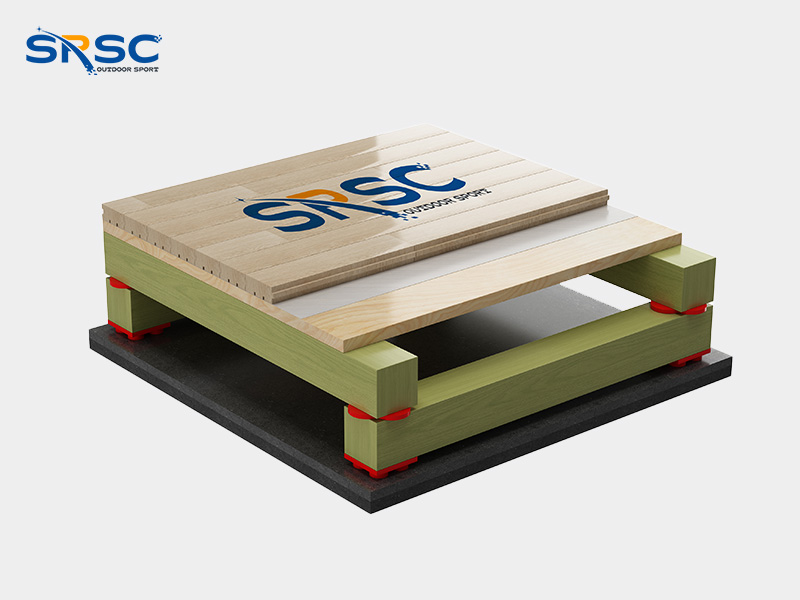
Portable Sports Flooring is a modular athletic surface assembled from factory-prepared panels or sections.
The modules usually combine several components:
- Hardwood playing surface
- Structural backing
- Connection system
- Shock-absorption components
- Protective underside
- Sports coating
- Court lines or printed graphics
- Numbered installation layout
Unlike a permanently installed keel system, the modules can be removed without demolishing the complete sports floor.
SRSC currently lists two products in its portable flooring category: Tongue and Groove Flooring Und CourtMaster-Verriegelungsbodenbelag. Both use modular wooden construction intended to simplify installation and dismantling.
Portable Floor vs Temporary Surface Cover
A temporary surface cover protects an existing floor during exhibitions, concerts, or non-sporting events.
A Portable Sports Flooring system creates the actual athletic playing surface.
The two products serve different purposes:
| Product Type | Main Purpose |
|---|---|
| Portable sports floor | Creates a performance surface for sport |
| Floor protection cover | Protects the existing surface from traffic or equipment |
| Synthetic event tile | Creates a removable plastic sports surface |
| Permanent hardwood floor | Remains installed as the venue’s main athletic floor |
Concept: Modular Flooring
Modular flooring divides a large playing surface into transportable sections.
Each section must connect accurately with neighbouring panels so the complete court behaves as one stable floor.
When Should a Venue Choose Portable Sports Flooring?
A removable system is particularly useful when a venue has several operating functions.
Multi-Purpose Arenas
An arena may host:
- Basketball
- Volleyball
- Concerts
- Exhibitions
- Conferences
- Graduation ceremonies
- Combat-sport events
- Community activities
A portable floor allows the operator to remove the premium hardwood surface before activities that could damage or contaminate it.
Convention and Exhibition Centres
Some cities do not have a dedicated professional basketball arena but do have a large convention hall.
A removable sports floor can help convert that hall into a temporary competition venue when the building provides suitable:
- Maße
- Structural floor capacity
- Ceiling height
- Beleuchtung
- Seating
- Emergency access
- Environmental control
Temporary Tournaments
Portable flooring can support:
- Regional competitions
- Touring events
- International tournaments
- University championships
- Promotional games
- Temporary training camps
Existing Venues With Unsuitable Base Floors
A building may have concrete, vinyl, stone, or another surface that does not provide the required basketball characteristics.
A modular wooden system can create a dedicated playing surface above the existing base, subject to proper structural and dimensional review.
Portable vs Permanent Hardwood Sports Flooring
Portable and permanent floors can both use hardwood surfaces, but their structures and operational priorities differ.
| Decision Factor | Portable Sports Flooring | Permanent Hardwood Flooring |
| Installation | Repeated assembly and removal | One principal installation |
| Connection | Modular locking system | Boards, panels, keels, and fasteners |
| Storage | Required when not in use | Not required |
| Transport | May be moved between venues | Normally remains in one building |
| Subfloor access | Available after removal | More difficult |
| Event conversion | Strong advantage | Floor needs protection |
| Wartung | Includes joints and modules | Includes fixed floor structure |
| Initial planning | Flooring plus logistics | Flooring plus building integration |
| Venue type | Arenas and temporary events | Dedicated gyms and sports halls |
| Damage repair | Individual modules may be replaced | Local board repair or refinishing |
Is Portable Flooring Less Professional?
Not necessarily.
The performance depends on the complete system, installation quality, product testing, subfloor, panel condition, and approval level—not simply whether the floor can be removed.
FIBA’s current equipment approval programme includes wooden flooring as a defined equipment category. For competitions requiring approved equipment, buyers must verify the exact manufacturer and product model rather than relying on a general statement that a floor is “FIBA standard.”
Compare Tongue-and-Groove and Interlock Systems

The connection design determines how quickly panels can be assembled and how securely they remain aligned.
Tongue-and-Groove Flooring
A tongue-and-groove system uses a projecting tongue on one edge and a matching channel on the neighbouring panel.
When correctly manufactured, this connection can support:
- Accurate alignment
- Reduced vertical movement
- Tight surface joints
- Repeatable assembly
- Efficient dismantling
Der SRSC Tongue and Groove Flooring uses modular panels designed to connect without adhesives or nails. Its published product information identifies North American maple and a Bona sports finish as principal surface materials.
CourtMaster-Verriegelungsbodenbelag
An interlock system uses a prepared connection that secures adjacent modules into one floor assembly.
Der SRSC CourtMaster Interlock Flooring uses an optimised single-layer support structure combined with modular tongue-and-groove assembly. SRSC positions the system for professional gymnasiums, university arenas, training centres, and other high-use venues.
Connection-System Comparison
| Comparison Area | Tongue-and-Groove System | Reinforced Interlock System |
| Basic connection | Tongue enters matching groove | Engineered modular locking connection |
| Assembly priority | Speed and repeatable alignment | Stability and repeated heavy use |
| Typical venue | Events and multi-purpose halls | Arenas and intensive-use facilities |
| Structural design | Product-specific modular backing | Reinforced support structure |
| Replacement | Individual panels can be identified | Individual modules can be replaced |
| Main inspection point | Joint wear and alignment | Joint wear, locks, and structural backing |
The final choice should be based on the actual panel construction, testing, frequency of removal, installation team, storage method, and intended competition level.
Evaluate the Hardwood Surface
A portable system still needs a professional playing surface.
Maple Sports Flooring
Maple is frequently selected for indoor basketball surfaces because it combines a uniform appearance with hardness, wear resistance, and refinishing potential.
SRSC’s portable flooring products use North American maple on the playing surface.
Ask for the Exact Wood Specification
The quotation should identify:
- Wood species
- Board grade
- Surface thickness
- Board width
- Moisture content
- Grain selection
- Manufacturing tolerance
- Replacement matching policy
A phrase such as “high-quality maple” is not enough for comparing two suppliers.
Surface-Board Thickness
The wear layer must be thick enough for the intended service life and future refinishing strategy.
Buyers should ask:
- How many sanding cycles are expected?
- Can one damaged board be replaced inside a module?
- Can the module be refinished locally?
- Will replacement panels match the original floor height?
Inspect the Sports Coating
The coating affects traction, abrasion resistance, cleaning, gloss, line adhesion, and appearance.
SRSC lists Swedish Bona sports finish on both its Tongue and Groove Flooring and CourtMaster Interlock Flooring products.
Important Coating Properties
A sports coating should provide:
- Controlled slip resistance
- Resistance to athletic footwear
- Compatibility with court markings
- Suitable ball response
- Cleanability
- Low or controlled gloss
- Recoating potential
Avoid Excessive Gloss
A highly reflective surface can produce glare under arena lighting and television cameras.
The approved finish should create a consistent appearance across every module.
Check Module-to-Module Colour
When modules are refinished at different times, small variations in gloss or colour may become visible.
A numbered maintenance record can help operators refinish related sections together.
Understand the Understructure
The hardwood surface is only one part of the system.
The understructure may include:
- Plywood
- Timber supports
- Composite panels
- Elastic pads
- Rubber layers
- Protective membranes
- Connection hardware
Stability
The understructure should prevent excessive movement at module edges.
Players should not feel one panel rising or moving differently from the next.
Stoßdämpfung
Resilient pads or engineered layers can reduce the impact transmitted back to athletes during running and landing.
The performance should remain reasonably consistent across:
- Panel centres
- Panel edges
- Joints
- Court markings
- Replaced modules
Vertical Deformation
The floor needs controlled movement under load.
Too little movement can create a hard surface, while excessive deformation can reduce stability and affect equipment.
Concept: Performance Uniformity
Performance uniformity means that athletes experience similar traction, cushioning, rebound, and stability across the complete playing area.
A strong centre panel does not compensate for weak joints or unstable perimeter sections.
Request Measurable Performance Data
Buyers should not rely only on claims such as “professional quality” or “excellent shock absorption.”
Performance Areas to Review
Request test information for:
- Shock absorption
- Vertical deformation
- Ball rebound
- Slip resistance
- Rolling load
- Surface abrasion
- Joint strength
- Dimensional stability
- Resistance to concentrated loads
Test the Complete System
A test result for the maple board alone does not describe the complete portable floor.
The submitted product should represent:
- Oberfläche
- Coating
- Structural backing
- Resilient layer
- Connections
- Installation method
FIBA’s approval programme requires submitted equipment to satisfy the applicable equipment requirements and identifies wooden flooring as a product category subject to testing and approval procedures.
Verify FIBA Approval Correctly

“FIBA approved,” “FIBA certified,” and “designed to FIBA dimensions” are not interchangeable claims.
Ask for the Exact Model
The certificate should identify:
- Manufacturer
- Product model
- Flooring category
- Approval level
- Validity period
- Certificate number
Match the Delivered Construction
Confirm that the delivered floor uses the same:
- Oberflächenmaterial
- Topcoat
- Understructure
- Pads
- Connections
- Module dimensions
FIBA’s current approval regulations require applicants to identify the wooden-flooring model, construction materials, and topcoats. The regulations also state that certain FIBA competitions may use only equipment approved for the applicable competition level.
Do Not Apply One Certificate to Every Product
Approval for one flooring system does not automatically prove that another floor from the same supplier has the same status.
Verify the exact system proposed in the quotation.
Inspect the Existing Venue Floor
Portable flooring is installed over another structural surface, so the base condition remains important.
Flatness
The existing floor should be sufficiently flat for the modular system.
Low or high areas can cause:
- Panel rocking
- Open joints
- Noise
- Uneven ball response
- Locking difficulty
- Local damage
Cleanliness
The base should be free from:
- Dust
- Stones
- Screws
- Cable ties
- Glas
- Oil
- Standing water
- Adhesive residue
A small hard object beneath a module can create a raised point or damage the protective underside.
Moisture
The venue should be dry before installation.
Moisture can affect:
- Wood dimensions
- Panel backing
- Coatings
- Existing floors
- Storage cases
- Metal hardware
Structural Capacity
The building floor must support the combined loads of:
- Portable flooring
- Basketball backstops
- Players
- Officials
- Seating
- Scoreboards
- Installation equipment
- Maintenance machines
A structural professional should review unusual or temporary venues.
Control Temperature and Humidity
Wood expands and contracts as environmental moisture changes.
Before Installation
The venue should be:
- Enclosed
- Weather-tight
- Environmentally controlled
- Free from wet construction
- Clean
- Ready for sports use
Acclimation
The supplier should define:
- Delivery timing
- Packaging removal
- Stacking method
- Temperature range
- Relative-humidity range
- Acclimation period
- Moisture-testing method
Touring Floors
A floor transported between climates may move from:
- Cold warehouse to warm arena
- Dry region to humid region
- Air-conditioned venue to unconditioned storage
The operating plan should allow controlled acclimation rather than immediate installation after arrival.
Calculate the Required Flooring Quantity
The order area is normally larger than the marked playing rectangle.
Include the Complete Sports Zone
Allow for:
- Playing court
- Run-off area
- Team bench area
- Scorer’s table
- Backstop positions
- Media positions
- Perimeter branding
- Warm-up sections where required
Preliminary Module Formula
Total required floor area ÷ usable area per module = preliminary module quantity
Then add allowances for:
- Perimeter panels
- Special cuts
- Court graphics
- Spare modules
- Replacement stock
- Access covers
Order Spare Modules
Spare stock is useful because future production may differ slightly in:
- Wood colour
- Grain
- Coating
- Module height
- Connection design
A practical spare-parts plan should include both surface panels and connection hardware.
Plan the Panel Layout
A complete installation should follow a numbered plan.
Number Every Module
Panel identification can show:
- Row
- Column
- Court zone
- Installation sequence
- Storage case
- Orientation
Start From a Verified Reference Line
Do not begin installation from an uneven wall.
Use a surveyed centre line or approved court reference.
Stagger Joints Where Designed
The module pattern should follow the manufacturer’s layout.
Changing the joint pattern may affect:
- Stability
- Surface alignment
- Court lines
- Installation time
- Warranty
Complete the Perimeter
The edge system may use:
- Retaining sections
- Ramps
- Transition pieces
- Mechanical locks
- Protective borders
The perimeter should not create a trip point.
Coordinate Basketball Backstops
Portable basketball systems and portable flooring are often used in the same arena.
Confirm Equipment Loads
Provide the flooring supplier with:
- Backstop weight
- Wheel dimensions
- Contact points
- Gegengewicht
- Movement route
- Playing position
- Storage position
Protect the Surface During Movement
Heavy basketball hoops may require:
- Floor-protection panels
- Defined movement routes
- Suitable wheel materials
- Trained staff
- Controlled turning
Floor Anchors
Where a backstop requires floor anchoring, the anchor position must be coordinated with:
- Flooring modules
- Base floor
- Access covers
- Court markings
- Building services
Der SRSC Basketball Stand range can be reviewed together with the flooring layout during venue planning.
Plan Installation Labour and Equipment
A “quick-install” floor still requires trained workers and a controlled process.
Installation Team
The required team size depends on:
- Court area
- Module dimensions
- Panel weight
- Connection design
- Venue access
- Installation deadline
Handling Equipment
The project may require:
- Panel carts
- Pallet trucks
- Forklifts
- Suction tools
- Lifting straps
- Cleaning equipment
- Alignment tools
Protect Workers
Modules should not be carried using unsafe lifting methods.
The installation plan should address:
- Manual-handling limits
- Team lifts
- Gloves
- Clear routes
- Stacking stability
- Work-zone separation
Estimate Setup and Breakdown Time
The supplier should provide a realistic method statement rather than an optimistic marketing estimate.
Time Factors
Installation duration depends on:
- Crew experience
- Number of workers
- Panel size
- Venue access
- Base-floor preparation
- Court graphics
- Perimeter pieces
- Basketball equipment
- Inspection requirements
Conduct a Trial Installation
Before an important event, complete a trial setup to confirm:
- Panel sequence
- Labour requirement
- Missing parts
- Storage order
- Line alignment
- Connection condition
- Total conversion time
The SRSC Tongue and Groove Flooring is designed for assembly and dismantling without adhesives or nails, while the CourtMaster system combines modular assembly with a reinforced support structure.
Design Suitable Storage
Poor storage can damage a portable floor even when the product is not being used.
Storage Environment
The storage space should remain:
- Dry
- Clean
- Ventilated
- Environmentally controlled where required
- Protected from roof leaks
- Protected from vehicle impact
Use Purpose-Built Carts or Cases
Storage systems can help:
- Keep panels vertical or flat as specified
- Protect edges
- Identify module numbers
- Reduce handling
- Simplify transport
- Prevent mixed rows
Do Not Store Directly on a Damp Floor
Use raised supports or approved carts.
Avoid uncontrolled contact with concrete moisture.
Check Storage Height and Door Access
Confirm:
- Case dimensions
- Turning radius
- Door width
- Elevator capacity
- Loading-dock height
- Storage-room clear height
Prepare for International Shipping
Portable wooden floors can represent a large shipment with many numbered pieces.
Request a Packing Plan
The supplier should provide:
- Package number
- Panel numbers
- Maße
- Gross weight
- Net weight
- Storage sequence
- Container location
Protect Critical Components
Packaging should protect:
- Hardwood surface
- Module corners
- Tongues
- Grooves
- Locks
- Court markings
- Protective underside
Control Moisture
International freight can expose wood products to humidity and condensation.
Packaging may include:
- Moisture barriers
- Desiccants
- Protective wrapping
- Ventilation strategy
- Moisture indicators
Inspect at Delivery
Record:
- Container condition
- Package count
- Water exposure
- Edge damage
- Broken crates
- Connection damage
- Surface scratches
Inspect the Floor Before Play
Installation Inspection
Check that:
- Every panel is in the correct position
- Joints are tight
- No edges are raised
- The perimeter is secure
- Court lines align
- Surface gloss is consistent
- Access covers are flush
Operational Inspection
Test:
- Ball rebound
- Player traction
- Panel movement
- Floor noise
- Basketball hoop movement
- Scorer’s-table positions
- Team-bench areas
Record Problems by Module Number
Module identification allows the maintenance team to locate and track repeated issues.
Maintain Portable Sports Flooring
After Each Event
Inspect for:
- Surface scratches
- Loose connections
- Damaged edges
- Contamination
- Moisture
- Coating wear
- Marking damage
Clean Before Storage
Do not pack panels while they are:
- Wet
- Dusty
- Contaminated
- Covered with tape residue
- Exposed to cleaning chemicals
Inspect Connections
Repeated assembly can wear tongues, grooves, locks, and fasteners.
Damaged connection parts should be repaired before the next event.
Recoat and Refinish
The maintenance strategy may include:
- Periodic cleaning
- Local coating repair
- Full recoating
- Court-line renewal
- Sanding and refinishing
All modules should remain at a consistent finished height after repair.
Portable Sports Flooring Procurement Checklist
| Specification Area | Buyer Should Confirm |
| Intended sport | Basketball, volleyball, or multi-sport |
| Competition level | Training, institutional, or approved event |
| Wood surface | Species, grade, thickness, and moisture |
| Connection system | Tongue-and-groove or modular interlock |
| Understructure | Materials, pads, and structural backing |
| Sports finish | Brand, gloss, slip, and refinishing |
| Leistung | Shock absorption, deformation, rebound, and rolling load |
| Module dimensions | Length, width, height, and weight |
| Installation | Crew size, tools, and expected sequence |
| Storage | Carts, cases, area, and environment |
| Shipping | Package plan and container requirements |
| Approval | Exact product model and validity |
| Spare parts | Modules, locks, edging, and coating |
| Warranty | Surface, structure, connections, and installation |
| Documentation | Drawings, manuals, tests, and maintenance guide |
Common Portable Sports Flooring Buying Mistakes
Comparing Only the Surface Wood
The connection and understructure determine whether the complete court remains stable.
Assuming Portable Means Lightweight
Professional wooden modules may still require several trained workers and handling equipment.
Ignoring Storage Costs
Carts, space, environmental control, and internal transport affect lifecycle cost.
Ordering Without Spare Panels
Matching replacement modules may become difficult after several years.
Installing Over an Uneven Base
The portable floor cannot automatically correct every problem in the existing venue.
Failing to Verify Approval
Check the exact flooring model rather than accepting a general company certificate.
Dragging Modules
Dragging can damage edges, surfaces, and connection parts.
Packing a Wet Floor
Trapped moisture can damage wood, coatings, storage cases, and hardware.
Abschluss
Portable Sports Flooring gives arenas and event operators the flexibility to create a professional hardwood court without permanently dedicating the building to one sport.
The strongest system is not simply the one that installs fastest. Buyers must evaluate the maple surface, sports coating, module structure, connection design, shock absorption, ball rebound, slip resistance, rolling load, base-floor requirements, storage, transport, approval status, spare parts, and maintenance process.
Tongue-and-groove systems can provide straightforward assembly and removal for temporary events. Reinforced interlock systems can offer additional structural stability for venues with frequent or intensive use.
SRSC offers Tongue and Groove Flooring Und CourtMaster-Verriegelungsbodenbelag within its Tragbares Sportbodensystem range. Buyers can also explore the complete Sportbodensystem oder contact SRSC with the venue dimensions, event schedule, competition level, installation frequency, storage conditions, and shipping destination.
Häufig gestellte Fragen
What is Portable Sports Flooring?
It is a modular athletic floor that can be assembled for games or events and dismantled for storage or transport.
Is portable basketball flooring made from real wood?
Professional systems can use real hardwood surfaces. SRSC’s current portable products use North American maple with a sports finish.
Is portable flooring suitable for professional basketball?
It can be, provided the exact system meets the required performance and approval conditions for the intended competition.
How long does it take to install a portable court?
The time depends on module size, crew experience, venue access, base preparation, and perimeter design. Buyers should request a project-specific method statement and conduct a trial installation.
Does Portable Sports Flooring need adhesive?
Not always. SRSC’s Tongue and Groove Flooring is designed for modular assembly without adhesives or nails.
Can the flooring be installed over concrete?
Potentially, provided the concrete is dry, clean, stable, sufficiently flat, and suitable for the selected system.
How should portable wooden flooring be stored?
Store it in a clean, dry, controlled area using approved carts, racks, or cases that protect surfaces, edges, and connection systems.
Can damaged modules be replaced?
Modular systems can allow individual sections to be replaced, but replacement dimensions, height, colour, connection design, and coating must match.
How do I verify FIBA approval?
Confirm the manufacturer, exact model, flooring category, approval level, and validity through current FIBA documentation. FIBA’s approval programme treats wooden flooring as a distinct equipment category.
What information should I send to the supplier?
Provide the venue plan, intended sports, competition level, total floor area, base-floor condition, storage space, installation frequency, basketball equipment loads, delivery location, and target event date.