
Ratgeber
Wrestling Mats Buying Guide: Roll vs Modular Systems

Aktuelle Artikel
Inhaltsverzeichnis
Key points covered in this guide:
- How Wrestling Mats differ from Judo and general-purpose exercise mats
- What mat dimensions are required for professional wrestling competitions
- How roll mats compare with modular panel systems
- Why foam density, thickness, firmness, and recovery must be evaluated together
- Which surface texture provides the right balance of grip and movement
- How tape, hook-and-loop, and perimeter systems control mat separation
- What buyers should check before shipping and installation
- How to clean, inspect, store, and replace wrestling surfaces
Professional Ringermatten must provide a stable, uniform surface for standing attacks, takedowns, throws, rolling movements, escapes, and groundwork.
The mat should absorb impact without feeling excessively soft. Its surface should provide enough grip for controlled footwork while still allowing athletes to rotate, slide, and complete technical movements without excessive skin friction.
The requirements for a school practice room may differ significantly from those of an international competition venue. Training facilities may prioritize quick installation, storage, and cost control, while event organizers may need approved dimensions, exact colour zones, printed markings, transport carts, and repeatable installation procedures.
This guide explains how schools, wrestling clubs, sports centres, distributors, contractors, and tournament organizers can select the right Wrestling Mats for their projects.
What Are Wrestling Mats?
Wrestling Mats are shock-absorbing sports surfaces designed for freestyle, Greco-Roman, scholastic, and other forms of wrestling.
A complete mat system may include:
- Foam core
- PVC or vinyl top surface
- Anti-slip underside
- Reinforced edges
- Tape or hook-and-loop connections
- Printed wrestling circles
- Protection area
- Perimeter restraint
- Storage and transport system
Der SRSC Wrestling Mats use a high-density foam core with a durable PVC or PU surface. SRSC offers customizable sizes, colours, and modular or foldable configurations for schools, gyms, training centres, and competition projects.
Wrestling Mat vs Ordinary Gym Mat
An ordinary exercise mat is generally intended for stretching, floor exercises, or individual fitness activities.
A wrestling surface must support continuous movement between standing and ground positions across a much larger connected area.
| Comparison Area | Ringermatten | General Exercise Mats |
|---|---|---|
| Main activity | Takedowns, throws, groundwork | Stretching and basic exercise |
| Installed area | Large connected competition or training zone | Individual mat |
| Surface friction | Controlled for fast movement | Often softer or more adhesive |
| Impact demand | Repeated body impact | Low to moderate |
| Seams | Must remain secure during movement | Usually not connected |
| Markings | Competition circles and zones | Normally none |
| Wartung | Shared high-frequency use | Often personal use |
| Competition suitability | Requires exact verification | Generally unsuitable |
Concept: Complete Mat System
A Wrestling Mat system includes more than the foam surface.
Its performance also depends on the subfloor, seams, perimeter, markings, installation method, cleaning process, and condition of every section.
Understand Official Wrestling Mat Dimensions
Competition organizers should confirm the latest rules of the federation governing the event.
The current United World Wrestling rules specify a UWW-approved mat with a 9-metre-diameter wrestling area surrounded by a 1.5-metre protection border of the same thickness for the Olympic Games, championships, and cups. The central wrestling surface has a diameter of 7 metres, surrounded by a 1-metre-wide orange passivity zone.
Main Competition Zones
A professional mat layout includes:
- Central circle: 1 metre in diameter
- Central wrestling surface: 7 metres in diameter
- Passivity zone: 1 metre wide
- Complete wrestling area: 9 metres in diameter
- Protection border: 1.5 metres around the wrestling area
The overall installed mat is commonly arranged within a 12 × 12 metre area. UWW’s 2026 field-of-play drawings use 12-metre competition mat modules in multi-mat layouts.
Training Room Dimensions
A training facility does not always need to reproduce a full championship layout for every practice group.
However, the available area should provide enough room for:
- Technical movement
- Takedowns
- Groundwork
- Instructor circulation
- Separation between groups
- Safe distance from walls
- Emergency access
Multi-Mat Competition Layout
When several competition mats are installed in one venue, planners must coordinate:
- Separation between mats
- Referee tables
- Medical access
- Scoreboards
- Coaches’ positions
- Athlete entrances
- Camera locations
- Cleaning personnel
The current UWW rules state that multiple mats should have at least 1 metre between them, while official event layouts may require significantly more space for operations, media, officials, and presentation equipment.
Roll Wrestling Mats vs Modular Wrestling Mats
One of the most important procurement decisions is whether to use roll sections or modular panels.
Roll Wrestling Mats
Roll mats use long sections of lightweight foam that can be rolled out across the floor.
The surface may be:
- Permanently bonded to the foam
- Connected with tape
- Joined with hook-and-loop strips
- Covered by a separate competition canvas
Der SRSC XPE Material Roll Mats are available with XPE foam, PVC or carpet surfaces, thicknesses from 2.5 to 5 centimetres, and densities of 33 or 40 kg/m³. Connection options include tape and hook-and-loop systems.
Modular Wrestling Mats
Modular systems use separate square or rectangular panels.
Possible advantages include:
- Easy local replacement
- Flexible room dimensions
- Smaller handling units
- Simple colour zoning
- Convenient access beneath selected sections
Possible limitations include:
- More seams
- Longer layout time
- Greater risk of panel movement
- More pieces to label and store
Roll vs Modular Comparison
| Decision Factor | Roll Mats | Modular Mats |
| Installation speed | Generally faster | Depends on panel quantity |
| Number of seams | Lower | Higher |
| Storage | Compact rolled sections | Flat stacked panels |
| Local replacement | Larger section may be affected | Individual panels can be replaced |
| Transport handling | Long and sometimes heavy rolls | Smaller individual pieces |
| Custom room shapes | Requires cutting or prepared rolls | Easier to configure |
| Competition graphics | Can be printed across sections | Requires precise panel alignment |
| Joint control | Tape or hook-and-loop | Interlock, tape, or perimeter pressure |
| Permanent training room | Suitable | Suitable |
| Touring events | Strong option | More labour intensive |
Which System Is Better?
Roll mats are often practical for temporary tournaments and multi-purpose facilities because they can be installed and removed efficiently.
Modular panels may suit permanent schools and clubs that value individual replacement and flexible room configurations.
The correct choice depends on installation frequency, storage access, mat weight, staff numbers, venue dimensions, connection method, and competition requirements.
Evaluate Mat Thickness
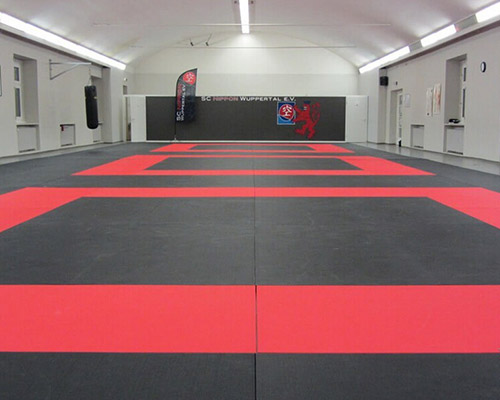
Thickness affects impact response, finished floor height, storage volume, weight, and transition details.
Common Thickness Options
Wrestling and martial arts roll systems may be available in thicknesses such as:
- 25 mm
- 30 mm
- 40 mm
- 50 mm
SRSC’s current XPE roll-mat product is listed in 2.5, 3, 4, and 5-centimetre configurations. These are supplier product options rather than universal requirements for every wrestling event.
Thinner Mats
Potential advantages include:
- Lower storage volume
- Reduced weight
- Easier transportation
- Lower transition height
- Potentially lower cost
The product must still provide the required impact performance for the intended user group.
Thicker Mats
A thicker foam layer may provide more space for energy absorption.
However, excessive softness can create:
- Unstable footwork
- Slow movement
- Greater joint separation
- Deep wheel marks
- Difficult cart movement
- Poor recovery after impact
Thickness Is Not a Safety Rating
A thicker mat is not automatically safer.
Foam material, firmness, density, internal construction, recovery, subfloor, and cover tension all influence the finished result.
Understand Foam Density and Firmness
Density and firmness are related but should not be treated as identical specifications.
Foam Density
Density measures the mass of foam within a defined volume.
It may influence:
- Product weight
- Structural consistency
- Compression resistance
- Haltbarkeit
- Shipping cost
SRSC lists 33 kg/m³ and 40 kg/m³ options for its XPE roll mats. Those figures apply to that specific product construction and should not be compared directly with unrelated PU, EVA, or rebonded-foam systems.
Foam Firmness
Firmness describes how resistant the surface feels when a user stands, moves, or lands on it.
A wrestling floor should remain stable enough for explosive footwork while still providing controlled cushioning during takedowns.
Compression Recovery
After impact, the foam should return toward its original shape.
Poor recovery can create:
- Permanent low areas
- Uneven seams
- Different movement conditions
- Reduced impact absorption
- Visible waves
Layered Foam Systems
Some products combine foam layers with different characteristics.
For example:
- Firmer upper layer for stability
- More resilient lower layer for impact reduction
- Protective backing for subfloor contact
Buyers should request test results for the complete finished mat rather than separate marketing data for one foam layer.
Choose the Right Surface Material
The upper surface affects grip, skin contact, cleaning, graphics, and durability.
PVC Mesh Cloth
SRSC’s Wrestling Mats are available with environmentally conscious thickened PVC mesh cloth. The material is designed to create a durable, water-resistant, cleanable surface for intensive training and event use.
PU Surface
Polyurethane-based covers may also be used on selected wrestling systems.
Buyers should compare:
- Abrasion resistance
- Flexibility
- Seam construction
- Cleaning compatibility
- Colour stability
- Repair method
- Printed-graphic adhesion
Smooth but Non-Abrasive Finish
The current UWW rules require mats to have a smooth, uniform, non-abrasive surface and emphasize cleaning and disinfection before wrestling sessions.
The surface must balance:
- Foot grip
- Controlled sliding
- Rotational movement
- Groundwork
- Skin comfort
- Cleaning
Avoid Excessive Texture
A highly textured surface may increase skin abrasion during:
- Slides
- Escapes
- Turns
- Rolling movements
- Takedown finishes
Avoid an Overly Slippery Surface
Sweat, dust, cleaning residue, or an unsuitable finish can reduce traction.
The maintenance team should use only supplier-approved cleaning products.
Compare Tape and Hook-and-Loop Connections

The seams between roll sections must remain closed during active use.
Mat Tape
Specialized mat tape is applied over the upper seam.
Potential advantages include:
- Simple installation
- No embedded connection parts
- Easy replacement
- Wide availability
Possible limitations include:
- Adhesive residue
- Consumable cost
- Lifting edges
- Surface-finish compatibility
- Labour during every setup
Hook-and-Loop Connection
Hook-and-loop strips may connect adjacent rolls from below or along prepared edges.
Potential advantages include:
- Reusable installation
- No visible top tape in some systems
- Faster repeated setup
- Reduced adhesive residue
Possible limitations include:
- Dirt accumulation
- Alignment requirements
- Wear
- Reduced grip when damaged
- More specialized replacement parts
Separate Wrestling Cover
Some traditional systems use foam sections covered by one large tensioned wrestling canvas.
This can reduce visible joints but introduces additional requirements for:
- Cover tension
- Perimeter fixing
- Cleaning
- Storage
- Graphic alignment
- Wrinkle control
Concept: Seam Stability
Seam stability is the ability of connected mat sections to remain level, closed, and secure during movement.
An impact-absorbing foam core cannot compensate for a seam that repeatedly opens during use.
Plan Competition Markings Correctly
Professional Wrestling Mats require accurate circles, zones, colours, and logos.
Central Circle
The central circle identifies the starting area in the middle of the mat.
Under the current UWW rules, it has an inside diameter of 1 metre and a surrounding band 10 centimetres wide.
Central Wrestling Surface
The main internal wrestling area has a diameter of 7 metres.
Passivity Zone
The orange passivity band is 1 metre wide and forms part of the 9-metre wrestling area.
Protection Area
The outer protection area extends 1.5 metres beyond the wrestling circle.
Its colour should contrast with the main mat area for applicable competitions.
Custom Logos
Schools, clubs, sponsors, and event organizers may request:
- Centre logos
- Federation marks
- Club branding
- Sponsor graphics
- Event names
- City identification
Before production, approve:
- Artwork size
- Colour values
- Logo position
- Printing method
- Surface friction
- Replacement-panel matching
Plan the Room Around the Wrestling Mat
The mat should not be treated as the only space requirement.
Keep Hard Objects Away
Provide separation from:
- Walls
- Columns
- Scoreboards
- Benches
- Storage cabinets
- Doors
- Glass partitions
- Electrical equipment
Protect Nearby Walls
Permanent training rooms may need wall padding around selected areas.
The padding should not create hard gaps at the floor transition.
Organize Athlete Circulation
Separate routes can be planned for:
- Athletes
- Coaches
- Officials
- Medical staff
- Spectators
- Cleaning teams
Control Shoes and Dirt
Establish a transition between external footwear and the mat area.
This helps reduce:
- Grit
- Moisture
- Floor damage
- Cleaning demand
- Surface contamination
Inspect the Subfloor Before Installation
A wrestling surface will reproduce or react to problems in the base floor.
Flatness
High and low areas can cause:
- Mat rocking
- Open seams
- Uneven softness
- Wrinkles
- Movement under load
Cleanliness
Remove:
- Screws
- Stones
- Cable ties
- Sand
- Glas
- Tape residue
- Oil
- Dust
A small sharp object can damage the mat underside or create a hard pressure point.
Moisture
The subfloor should be dry before installation.
Trapped moisture may cause:
- Odour
- Mould
- Discoloration
- Adhesive problems
- Damage to nearby timber floors
Existing Sports Floors
When Wrestling Mats are placed over hardwood sports flooring, the project should confirm:
- Surface compatibility
- Anti-slip underside
- Floor protection
- Moisture control
- Tape compatibility
- Rolling and storage procedures
Calculate Mat Quantity and Spare Material
Roll-Mat Calculation
For roll systems, identify:
- Overall mat width
- Overall mat length
- Roll width
- Roll length
- Connection allowance
- Cutting allowance
- Printed-zone arrangement
Modular-Panel Calculation
For modular mats:
Total required area ÷ usable area per panel = preliminary panel quantity
Then include:
- Perimeter pieces
- Colour zones
- Special graphics
- Replacement stock
- Installation waste
Order Spare Sections
Spare material should match:
- Foam thickness
- Foam density
- Surface texture
- Colour
- Connection method
- Printed markings
Future batches may have slight differences in colour or texture.
Plan Packaging and International Shipping

Wrestling surfaces occupy significant container volume.
Request a Packing List
The supplier should identify:
- Package number
- Product dimensions
- Gross weight
- Net weight
- Colour
- Mat-zone position
- Roll or panel number
Protect the Surface
Packaging should prevent:
- Abrasion
- Punctures
- Moisture
- Crushing
- Colour transfer
- Edge damage
- Contamination
Avoid Excessive Compression
Heavy packages should not remain stacked on foam beyond the approved storage method.
Prolonged uncontrolled pressure may affect recovery or create temporary deformation.
Label the Installation Sequence
For printed competition mats, each roll or panel should have a clear position code.
This can reduce installation mistakes and help operators return sections to the correct storage location.
Install Wrestling Mats Step by Step
Step 1: Prepare the Venue
Clean and dry the subfloor and remove all hard objects.
Step 2: Mark the Reference Lines
Identify the mat centre, outside dimensions, and first installation edge.
Step 3: Position the First Section
Place the first roll or panel accurately because later sections will follow it.
Step 4: Align the Graphics
Check the:
- Central circle
- Wrestling surface
- Passivity zone
- Protection area
- Sponsor logos
Step 5: Close the Seams
Apply the specified tape, hook-and-loop system, interlock, or perimeter restraint.
Step 6: Inspect the Perimeter
Confirm there are no:
- Raised edges
- Hard gaps
- Loose corners
- Unprotected floor transitions
Step 7: Conduct a Trial Session
Before an event, allow trained personnel to test movement, traction, seam stability, and overall surface condition.
Cleaning and Hygiene Requirements
Wrestling is a close-contact activity, so hygiene management must be part of normal operation.
The current UWW rules state that the mat should be cleaned and disinfected before every wrestling session.
Routine Cleaning Process
A practical process may include:
- Remove loose dirt
- Vacuum or dry-clean the surface
- Apply a compatible cleaner or disinfectant
- Use controlled moisture
- Remove remaining liquid
- Allow the mat to dry completely
Use Compatible Chemicals
Avoid unapproved:
- Solvents
- Oils
- Abrasive powders
- Strong bleaching agents
- High-residue cleaners
They may affect the printed graphics, surface friction, colour, or cover material.
Clean the Underside
For permanent installations, periodically inspect beneath the mats for:
- Moisture
- Dust
- Mould
- Insects
- Adhesive residue
- Subfloor damage
Provide Mat-Side Hygiene Controls
Facilities may also provide:
- Hand-cleaning stations
- Shoe-control areas
- Covered waste bins
- Cleaning logs
- Separate cleaning equipment
- Immediate spill response
Inspect Wrestling Mats Regularly
Frequent Visual Inspection
Check for:
- Open seams
- Tears
- Punctures
- Raised edges
- Slippery areas
- Wrinkles
- Permanent compression
- Loose graphics
High-Wear Areas
Wear may be concentrated around:
- Central circles
- Starting positions
- Repeated drilling areas
- Entrances
- Mat edges
- Coach positions
Connection Inspection
Tape, hook-and-loop strips, and panel locks should be checked before every major session.
Replacement Criteria
A section may require replacement when it has:
- Exposed foam
- Large tears
- Permanent low spots
- Uncontrolled movement
- Damaged connection edges
- Unremovable contamination
- Significant loss of impact performance
Wrestling Mat Procurement Checklist
| Specification Area | Buyer Should Confirm |
| Intended use | School, training, club, or competition |
| Wrestling style | Freestyle, Greco-Roman, scholastic, or multi-use |
| System type | Roll, modular, or covered foam |
| Overall dimensions | Training or regulation layout |
| Foam material | XPE, EVA, PU, or layered system |
| Dicke | Suitable for intended use |
| Dichte | Product-specific value and test method |
| Firmness | Stable under standing movement |
| Oberflächenmaterial | PVC, PU, vinyl, or approved alternative |
| Surface texture | Uniform and non-abrasive |
| Connection | Tape, hook-and-loop, interlock, or frame |
| Markings | Correct circles, zones, colours, and logos |
| Subfloor | Flat, clean, dry, and compatible |
| Testing | Exact finished product reports |
| Approval | Required federation status where applicable |
| Packaging | Moisture and edge protection |
| Spare material | Matching sections and connection supplies |
| Wartung | Cleaning, inspection, and repair instructions |
Common Wrestling Mat Buying Mistakes
Selecting Only by Density
Density does not explain the complete impact response or surface stability.
Assuming Thicker Always Means Better
Excessive softness may make standing attacks and fast movement more difficult.
Ignoring Seam Design
Even strong foam can become unsafe when sections separate during use.
Ordering Only the Central Circle
The full wrestling and protection areas must be included.
Using General Exercise Mats
Products designed for yoga or basic exercise may not support repeated wrestling impact.
Accepting “Professional Standard” Without Evidence
Request the exact product specification, test report, and approval information.
Using Household Tape
Ordinary tape may lift, leave residue, damage graphics, or provide insufficient seam strength.
Storing Mats While Wet
Moisture trapped inside rolled or stacked materials can create odour and surface damage.
Failing to Order Spare Material
Matching the colour and connection system several years later may be difficult.
Abschluss
Wrestling Mats should be purchased as complete competition or training systems rather than as simple foam flooring.
Buyers should evaluate the intended wrestling style, overall dimensions, foam material, thickness, density, firmness, compression recovery, surface friction, seam method, competition markings, subfloor, test documentation, packaging, installation, hygiene, storage, and replacement plan.
Roll mats can provide efficient installation and storage for temporary events and multi-purpose venues. Modular panels can offer flexible layouts and convenient local replacement for permanent schools and training centres.
SRSC supplies customizable Ringermatten Und Rollmatten aus XPE-Material for schools, clubs, training centres, and event projects. Buyers can also explore the complete Sports Mats range, compare Judomatten, oder contact SRSC with the room dimensions, wrestling style, intended competition level, preferred mat system, colour layout, and delivery destination.
Häufig gestellte Fragen
What size is an official Wrestling Mat?
The current UWW rules specify a 9-metre-diameter wrestling area with a 1.5-metre protection border. Official layouts commonly use an overall 12 × 12 metre mat module.
How thick should Wrestling Mats be?
The correct thickness depends on foam type, firmness, performance, user level, competition requirements, and subfloor. Thickness should not be selected without reviewing the complete system.
Are roll mats suitable for wrestling competitions?
They can be suitable when the exact system, dimensions, markings, connections, performance, and approval status meet the event requirements.
Are roll mats easier to install than modular mats?
Roll systems often use fewer sections and seams, which can reduce setup time. Their larger sections may still require trained staff and suitable storage carts.
What is the best foam for Wrestling Mats?
XPE, EVA, PU, and layered systems can all be used. The finished mat’s impact performance, stability, durability, and test documentation matter more than the material name alone.
How are wrestling mat rolls connected?
Common methods include specialized top tape, hook-and-loop connections, or a separate tensioned cover.
Can Wrestling Mats be placed over hardwood flooring?
Potentially, provided the underside, tape, moisture, loads, and movement procedures are compatible with the hardwood finish.
How often should wrestling surfaces be cleaned?
The current UWW rules require cleaning and disinfection before each wrestling session. Facilities should also follow local hygiene requirements and the mat manufacturer’s instructions.
Can a Wrestling Mat be customized with a logo?
Yes. Buyers can specify centre graphics, club logos, sponsor marks, colours, and competition zones, subject to applicable event rules.
Does SRSC supply custom Wrestling Mats?
SRSC offers high-density Wrestling Mats with PVC or PU surfaces, customizable sizes and colours, and modular or foldable configurations. Its XPE roll mats are also available with different thicknesses, densities, surfaces, and connection methods.