
BLOG
Laminated Tempered Glass for Padel Court Standards
Recent Articles
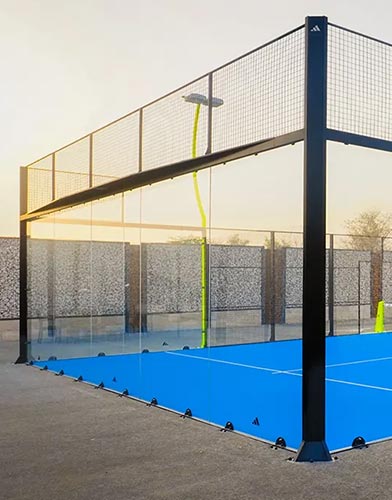
Padel is one of the fastest-growing sports worldwide, expanding rapidly across Europe, the Middle East, and Latin America. According to the Playtomic Global Padel Report 2025, the number of padel courts has been increasing at a rate of over 18% annually, with more than 85% of new courts using glass wall systems as a structural component.
In this context, material selection is no longer a design preference—it is a critical engineering decision that directly impacts safety, durability, and commercial value. Among all materials, laminated tempered glass has become the global benchmark for professional padel court construction due to its superior impact resistance and controlled breakage behavior.
Table of Contents
Key Takeaways
- Padel court glass must comply with EN 12150, EN 14449, and ASTM standards
- Laminated tempered glass is the global safety benchmark for sports courts
- Thickness, interlayer type, and installation design determine performance
- Wind load, impact resistance, and UV stability are critical engineering factors
- Proper system design can extend service life beyond 20 years
- Incorrect glass selection may increase maintenance costs by 30–60%
Understanding Padel Court Glass Standards
Padel court systems are not decorative installations—they are structural sports environments where glass acts as both a boundary and an impact surface. This makes material selection extremely important.
The use of laminated tempered glass ensures:
- Controlled fracture behavior under impact
- High mechanical strength for repeated ball strikes
- Long-term structural stability in outdoor conditions
- Compliance with international sports safety regulations
Modern sports infrastructure projects treat glass as a load-bearing safety component rather than a passive enclosure material.
Global Standards for Laminated Tempered Glass in Padel Courts
European Standards (EN System)
EN 12150 – Tempered Glass Standard
This standard defines heat-treated glass requirements, including fragmentation behavior and mechanical strength. When broken, the glass must disintegrate into small, blunt fragments to reduce injury risk.
EN 14449 – Laminated Glass Safety Standard
This standard regulates interlayer adhesion, post-breakage integrity, and impact resistance. It ensures that glass remains bonded even after breakage.
U.S. Standards (ASTM System)
- ASTM C1048: Specification for heat-treated flat glass
- ASTM C1172: Specification for laminated architectural glass
These standards ensure consistent structural performance under dynamic loads and environmental exposure.
International Federation of Padel (FIP) Guidelines
According to FIP technical construction recommendations:
- Minimum glass thickness: 10 mm tempered or laminated tempered glass
- Maximum allowable deflection: < 20 mm under load conditions
- Impact resistance requirement: withstand ball speeds exceeding 120 km/h
- Minimum service life expectation: 15–25 years
Engineering Requirements of Laminated Tempered Glass
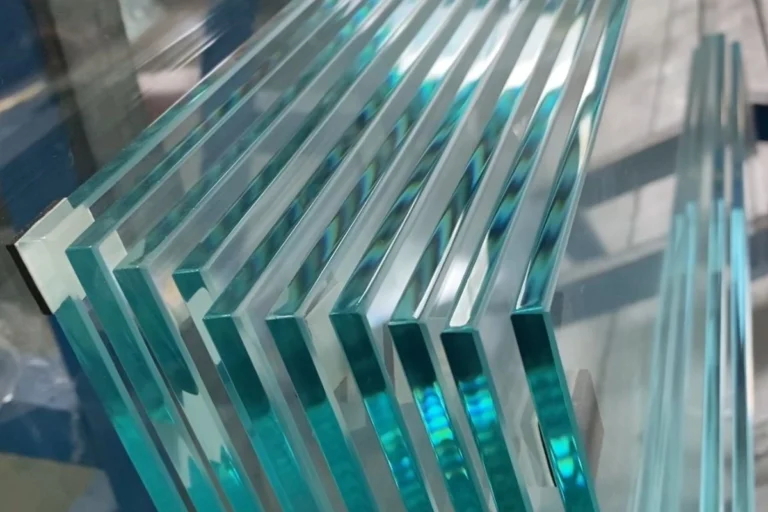
Structural Load Resistance Concept
Padel court glass must resist multiple types of stress simultaneously:
- Ball impact force (up to 250–300 N per strike)
- Player collision force during gameplay
- Wind pressure (typically 1.0–1.8 kPa depending on location)
The laminated structure distributes energy across layers, significantly reducing the probability of catastrophic failure.
Interlayer Technology Concept
The interlayer is a critical component of laminated tempered glass systems.
- PVB (Polyvinyl Butyral): Standard safety interlayer with good adhesion and flexibility
- SGP (SentryGlas Plus): High-performance structural interlayer with superior rigidity
SGP interlayers offer up to 5 times higher tear resistance and significantly better load-bearing capacity compared to traditional PVB, making them ideal for premium outdoor padel courts.
Optical Performance Concept
High transparency is essential for professional sports visibility.
- Light transmission rate: typically ≥ 88%
- Low optical distortion for player tracking
- Enhanced spectator viewing experience
This ensures both functional performance and commercial value for sports facilities.
Acoustic Performance Concept
Laminated structures provide natural sound insulation.
- Noise reduction: up to 30–35 dB depending on configuration
- Reduces impact noise from ball strikes
- Improves urban installation suitability
This is especially important for courts located near residential or commercial zones.
Laminated Tempered Glass vs Other Glass Types
| Glass Type | Safety Level | Impact Resistance | Breakage Behavior | Suitability for Padel Courts |
|---|---|---|---|---|
| Laminated Tempered Glass | Very High | Very High | Fragments remain bonded | Recommended standard |
| Single Tempered Glass | Medium | High | Fully shatters | Not recommended |
| Annealed Glass | Low | Low | Sharp dangerous shards | Not suitable |
This comparison clearly shows why laminated tempered glass dominates modern padel court construction standards.
Structural Design Considerations for Padel Courts
Wind Load Engineering Concept
Outdoor courts must resist wind loads that vary by region:
- Europe: 0.8–1.2 kPa
- Coastal regions: up to 1.8 kPa
- High-altitude zones: variable dynamic pressure
Proper anchoring systems and frame stiffness are required to ensure stability.
Frame Compatibility Concept
Glass panels must be integrated with:
- Aluminum alloy frames (common in modern courts)
- Hot-dip galvanized steel structures (high durability applications)
Improper frame design can create stress concentration points, leading to premature failure.
Thermal Expansion Concept
Temperature variation can cause stress in glass panels.
- Expansion coefficient of glass: ~9 × 10⁻⁶ /°C
- Outdoor temperature range impact: -20°C to +50°C
Laminated tempered glass reduces thermal stress concentration through layered energy distribution.
Installation Standards and Best Practices

Panel Alignment Requirements
- Vertical tolerance: typically < 2 mm deviation
- Gap uniformity between panels must be consistent
- Misalignment increases fracture risk under dynamic load
Sealant System Requirements
High-performance silicone sealants are used for:
- Vibration absorption
- Waterproofing
- Thermal expansion compensation
Structural-grade silicones extend system lifespan significantly.
Safety Fixing Systems
Common installation systems include:
- Clamp fixing systems
- Bolted frame systems
- Hidden structural support systems
Each system must comply with mechanical load distribution requirements.
Maintenance and Lifecycle Performance
Cleaning and Surface Maintenance
Regular cleaning ensures:
- Optical clarity
- Scratch prevention
- Long-term aesthetic performance
Anti-glare coatings are often used in premium installations.
Expected Service Life
Under proper installation and maintenance:
- Standard systems: 15–20 years
- High-end SGP systems: 20–25+ years
Environmental exposure and usage frequency significantly affect lifespan.
Real-World Case Studies
Case Study 1: Spain Urban Padel Facility
A Barcelona-based sports facility upgraded 12 courts using laminated tempered glass with SGP interlayers.
Results after 3 years:
- 40% reduction in maintenance costs
- Zero structural glass failures
- Improved player safety rating
Case Study 2: Middle East Outdoor Club
A desert climate installation faced extreme temperature fluctuations (up to 45°C daily variation).
Results:
- No thermal cracking incidents
- 22% improvement in structural stability vs previous design
- Extended maintenance intervals
Industry Trends and Market Insights
Rapid Global Expansion
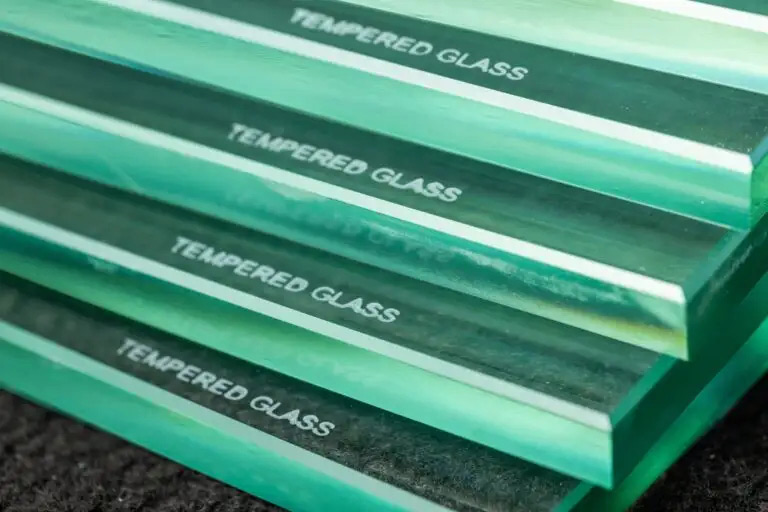
The padel industry is experiencing one of the fastest growth rates in the global sports infrastructure sector. According to multiple sports facility market reports, global padel court installations are expected to exceed 70,000+ courts by 2027, driven by increasing participation rates and commercial investment in club-based sports facilities.
Europe remains the dominant market, accounting for more than 60% of total global installations, with countries such as Spain, Italy, and Sweden leading in both court density and professional league development. Spain alone has over 20,000+ active courts, making it the world’s largest padel market.
Meanwhile, the Asia-Pacific region is emerging as a high-growth zone, recording an estimated 20% compound annual growth rate (CAGR). Countries like China, the UAE, and Singapore are rapidly investing in sports infrastructure, particularly premium outdoor and indoor padel clubs targeting urban recreational demand.
This expansion directly increases demand for high-performance structural materials such as laminated tempered glass, which is essential for ensuring safety, durability, and international certification compliance in modern court construction.
Material Innovation Trends
SGP Interlayer Adoption in Premium Courts
One of the most significant material advancements in padel court construction is the increasing adoption of SGP (SentryGlas Plus) interlayers. Compared to traditional PVB interlayers, SGP offers:
- Up to 5x higher tear resistance
- Significantly improved structural rigidity
- Better performance under high wind load conditions
As a result, premium sports facilities and tournament-level courts are increasingly specifying SGP-based laminated tempered glass systems, especially in outdoor environments exposed to extreme weather conditions.
Anti-Reflective Coatings in Urban Installations
Urban padel courts are often affected by artificial lighting and surrounding building reflections. To address this, anti-reflective (AR) coatings are becoming a standard feature in modern installations.
Key benefits include:
- Improved visibility for players during night matches
- Reduced glare from LED lighting systems
- Enhanced spectator viewing experience
- Better broadcast-quality visual clarity for televised events
This trend is particularly strong in metropolitan areas where padel courts are integrated into multi-sport commercial complexes.
Smart Monitoring Systems in Court Structures
The integration of digital technology into sports infrastructure is another emerging trend. Modern padel courts are increasingly being equipped with smart monitoring systems that track structural and environmental performance.
These systems can include:
- Real-time vibration and stress sensors on glass panels
- Wind load monitoring for outdoor installations
- Temperature and humidity tracking for material performance analysis
- Predictive maintenance alerts for structural components
By combining these technologies with laminated tempered glass systems, facility operators can significantly improve safety management, reduce maintenance costs, and extend overall service life.
FAQ
What is the best glass for padel courts?
Laminated tempered glass is the industry standard due to its safety performance, durability, and controlled breakage behavior.
Why is laminated tempered glass required in padel courts?
It prevents dangerous shard dispersion and ensures structural integrity after impact or breakage.
What thickness is used for padel court glass?
Most professional courts use 10 mm to 12 mm laminated tempered glass, depending on design requirements.
Is laminated tempered glass expensive?
Yes, but it offers significantly lower lifecycle cost due to reduced maintenance and higher durability.
Can laminated tempered glass withstand strong impact?
Yes. It is designed to withstand repeated high-speed ball impacts and occasional player contact.
Conclusion
Laminated tempered glass is the global standard for padel court construction due to its unmatched combination of safety, durability, and structural performance.
With compliance to EN 12150, EN 14449, and ASTM standards, it ensures long-term reliability under dynamic sports conditions.
As padel continues its rapid global expansion, high-performance glass systems will remain a core engineering requirement for professional court design, safety certification, and commercial success.