
BLOG
Padel Court Gate Design Guide for Commercial Projects
Recent Articles
Table of Contents
Key points covered in this guide:
- How official access dimensions affect Padel Court Gate Design
- When to choose one entrance or two entrances on each side
- How courts with doors compare with open-access courts
- Why gate handles, hinges, gaps, and sharp edges require careful inspection
- How entrances affect out-of-court play and tournament planning
- What public and accessible facilities should consider
- How gate frames connect with mesh panels, posts, and foundations
- Which gate details buyers should confirm before production
A Padel Court Gate Design may appear to be a small part of the complete court, but it directly affects player access, match flow, emergency movement, maintenance, equipment transport, and long-term customer experience.
A poorly planned entrance may create narrow circulation, protruding hardware, uneven ground, difficult gate operation, or conflicts with out-of-court play. Commercial venues also need gates that can tolerate frequent opening, closing, cleaning, and access-control use.
For these reasons, buyers should confirm the entrance arrangement while selecting the court model—not after the steel frame and foundation have already been manufactured.
What Is a Padel Court Gate?
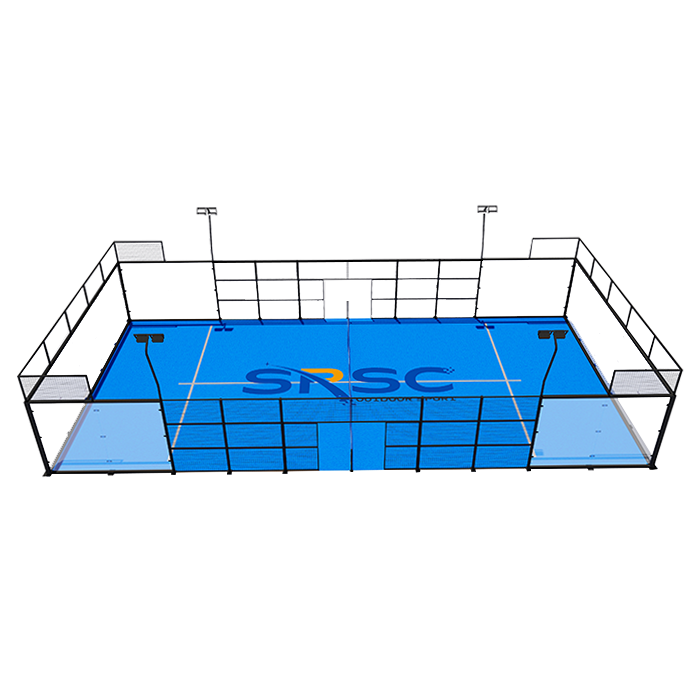
A Padel Court gate is the access opening positioned in the side enclosure near the centre line.
Depending on the design, the opening may include:
- A hinged door
- Two separate doors
- An open entrance without a door
- A reinforced lower beam
- Protective padding
- Smart access hardware
- External handles
- Locks or latches
- Integrated mesh panels
The entrance must remain compatible with the steel frame, metallic fence, playing-surface edge, net-post area, and external circulation space.
Gate vs Open Entrance
A court with a gate uses a moving door panel to control access.
An open-access court leaves the entrance unobstructed during play. The official rules allow access openings with or without doors, provided that the court layout and entrance dimensions meet the applicable requirements.
Concept: Access Configuration
Access configuration describes the number, dimensions, positions, and opening method of the court entrances.
It should be selected according to competition plans, security, customer flow, accessibility, site layout, and operational control.
What Are the Official Padel Court Access Dimensions?
The current FIP Rules of Padel state that access openings may be positioned on both lateral sides or only one side, and they should be symmetrical with the centre of the court. A court may have one or two access openings on each selected side.
One Entrance on Each Side
When there is one lateral access on each side, the opening must fall within the following range:
- Minimum: 1.05 m wide × 2.00 m high
- Maximum: 2.20 m wide × 2.20 m high
Two Entrances on Each Side
When two access openings are used on each side, each opening must fall within this range:
- Minimum: 0.72 m wide × 2.00 m high
- Maximum: 1.10 m wide × 2.20 m high
These dimensions should be checked against the latest official rules and any additional competition, accessibility, or local construction requirements applying to the project.
Gate Configuration Comparison
| Entrance Configuration | Main Advantage | Main Limitation | Suitable Project |
|---|---|---|---|
| One wide entrance per side | Easier equipment and maintenance access | Larger moving panel if a door is installed | Hotels, schools, private clubs |
| Two entrances per side | Supports fast player movement and out-of-court play | More frames, fittings, and inspection points | Tournament and competition courts |
| One-sided access | Simplifies circulation in restricted sites | Less flexible movement | Selected private or indoor courts |
| Open entrance | No door movement during play | Less access control | Supervised clubs and events |
| Hinged gate | Better security and operating control | Requires hinge and latch maintenance | Commercial and unattended venues |
One Entrance or Two Entrances?
The correct choice depends on how the court will be used.
One Wide Entrance
A single entrance on each side can provide convenient access for:
- Players
- Wheelchairs
- Cleaning equipment
- Turf-maintenance tools
- Replacement nets
- Event equipment
It also reduces the number of hinges, latches, and moving parts.
However, a wide hinged panel can be heavier and may require a stronger gate frame, reliable hinge arrangement, and sufficient external clearance.
Two Separate Entrances
Two openings on each side are commonly associated with courts prepared for out-of-court play.
Players can leave the enclosure through the opening closest to the ball without needing to cross around a large central gate panel.
Operational Consideration
Two separate gates create additional components that require inspection.
The operator must monitor more hinges, handles, mesh edges, protective pads, latches, and frame connections than with one entrance.
Padel Court With Doors vs Without Doors
Both configurations can work when correctly designed.
Padel Court With Doors
A door can help the operator:
- Control unauthorized entry
- Protect the court outside business hours
- Connect the court to a smart-access system
- Manage paid bookings
- Reduce unsupervised junior access
- Keep equipment inside selected areas
A door may be useful for residential communities, hotels, private clubs, schools, and facilities operating without a permanent reception desk.
Open-Access Padel Court
An open entrance removes the need for players to operate a door during a match.
It can also reduce the risk that a partially open door interferes with player movement.
The FIP rules explain that when an open court uses a metallic beam or duct on the floor at the entrance, that element is treated as part of the fence frame. When no floor element is installed, the vertical projection of the frame defines the internal court edge.
Which Option Is Better?
| Decision Factor | Door System | Open Entrance |
| Access control | Stronger | Limited |
| Player movement | Door must remain correctly positioned | No moving panel |
| Maintenance | Hinges and latches require inspection | Fewer moving components |
| Out-of-court play | Requires suitable opening arrangement | Often easier to manage |
| Unattended operation | More suitable | May require external security |
| Equipment transport | Depends on clear opening width | Generally convenient |
| Smart access | Easier to integrate | Usually controlled outside the court |
A commercial venue may use court gates together with external building access, reception control, or perimeter fencing rather than relying on the playing enclosure as the only security barrier.
Design the Gate to Open Safely
The opening direction and hardware position should prevent unnecessary interference with players.
Keep Handles Outside the Playing Area
The current FIP rules state that where doors are installed, their handles should be located on the outside and should not project into the interior playing area.
This helps reduce the risk of contact with:
- Handles
- Locks
- Latch plates
- Protruding screws
- Access-control devices
Avoid Interior Projections
The player-facing side should be checked for:
- Exposed bolt threads
- Sharp mesh ends
- Hinge pins
- Raised brackets
- Lock bodies
- Door closers
- Electrical wires
- Uncovered fixing plates
A component that appears small during installation may become significant when a player runs toward the side opening.
Confirm Door Swing Clearance
A hinged gate should not collide with:
- Glass panels
- Mesh frames
- Lighting posts
- Benches
- Walls
- Landscaping
- Adjacent courts
- Emergency routes
The project drawing should show the complete swing arc, not only the closed position.
Concept: Clear Opening
The clear opening is the usable width and height remaining after accounting for frames, hinges, stops, handles, access hardware, and the actual door position.
A nominal gate width may be larger than the space players can use.
Plan for Out-of-Court Play
Out-of-court play allows players to leave the enclosure through the side entrances and return the ball from the external safety zone.
This feature affects the entrance quantity, external space, protective padding, lighting positions, and surrounding circulation.
Required External Safety Space
For authorized out-of-court play, the current FIP rules require two access points on each side. They also specify an obstacle-free external area at least 3 m wide—4 m is recommended—4 m long on each side, and at least 3 m high.
Protective Padding
The relevant entrance sides, upper areas, and net-post zones should receive firmly fixed impact protection with a minimum thickness of 2 cm under the current FIP rules. The padding should reduce contact risk without projecting excessively into the playing space.
Common External Obstacles
Do not place the following inside the planned safety zone:
- Lighting poles
- Benches
- Advertising stands
- Planters
- Drain covers
- Storage boxes
- Building columns
- Loose cables
- Level changes
- Unprotected court frames
Tournament Planning
A club may not require out-of-court play for every recreational booking.
However, a venue planning tournaments should decide this before completing foundations, adjacent courts, seating, and external walkways.
Accessibility and Public Court Entrances
Public facilities need to consider more than the minimum playing-rule dimensions.
The current FIP rules state that public installations must also comply with applicable access standards and architectural requirements for people with disabilities.
Review the Complete Route
Accessible planning should cover the route from:
- Parking
- Drop-off areas
- Reception
- Changing rooms
- Toilets
- Spectator areas
- Court entrance
A wide gate provides limited benefit when the route includes steps, narrow corridors, loose gravel, or difficult thresholds.
Threshold Design
The entrance should avoid an uncontrolled raised edge between:
- External paving
- Court foundation
- Artificial turf
- Lower frame
- Drainage channel
Where a structural member crosses the floor, its dimensions and protection should be reviewed for the intended users and applicable local requirements.
Gate Operating Force
A door that is technically wide enough may still be difficult to use when it is:
- Too heavy
- Poorly aligned
- Fitted with a strong uncontrolled closer
- Equipped with a difficult latch
- Obstructed by uneven paving
Accessibility should be evaluated through the complete operating system rather than opening width alone.
Coordinate the Gate With the Mesh Fence
The gate is normally integrated into the metallic-fence system.
Gate-Frame Specification
Ask the supplier to confirm:
- Frame-tube dimensions
- Wall thickness
- Steel grade
- Mesh opening
- Wire diameter
- Hinge arrangement
- Latch type
- Coating system
- Clear opening
- Door weight
Mesh Orientation
The player-facing gate mesh should follow the same safety and finish principles as the rest of the enclosure.
Check both sides for:
- Protected welds
- Smooth wire ends
- Continuous coating
- Flat panels
- Secure mesh-to-frame connections
Avoid Gate Deformation
A weak or distorted frame may cause:
- Latch misalignment
- Scraping against the ground
- Uneven panel gaps
- Difficult closing
- Repeated hinge loosening
- Visible movement
The gate frame should be inspected before coating and again before shipment.
Coordinate the Gate With the Steel Posts
A correctly manufactured gate will not operate properly when the supporting posts are misaligned.
Post Alignment
Before installing the door, verify:
- Post spacing
- Verticality
- Base-plate level
- Anchor position
- Frame opening
- Diagonal measurements
- Adjacent mesh alignment
Hinge-Side Support
The hinge-side post carries the weight and repeated movement of the door.
Its structural design, welds, base plate, and anchors should match the gate load and court configuration.
Latch-Side Clearance
The latch-side gap should permit reliable closing without creating an excessive opening.
Temperature movement, coating thickness, installation tolerance, and long-term frame movement should be considered.
Select Suitable Gate Hardware
Hardware should tolerate frequent commercial use and the project environment.
Hinges
Buyers should confirm:
- Hinge material
- Pin diameter
- Bearing or bush arrangement
- Corrosion protection
- Adjustment method
- Lubrication requirements
- Replacement procedure
Adjustable hinges can simplify alignment, but adjustment hardware should remain secure after commissioning.
Latches and Locks
Possible systems include:
- Manual latch
- Key lock
- Combination lock
- Magnetic access
- Electronic strike
- Smart-booking access
- External padlock provision
The system should match the venue’s supervision and booking model.
Door Stops
A door stop can prevent the gate from striking glass, posts, or nearby structures.
It should not create a trip hazard or obstruct the out-of-court safety zone.
Automatic Closers
Automatic closing may support security, but the closing speed and force should not surprise players.
The closer should be positioned outside the playing area and protected from weather where required.
Smart Access and Booking Integration
Commercial facilities increasingly connect gate access with booking systems.
Possible Smart-Access Functions
A system may provide:
- Time-limited access codes
- Mobile entry
- Membership identification
- Booking verification
- Remote opening
- Entry records
- Staff override
Protect the Electrical Components
Outdoor equipment should be selected for the installation environment.
The design should consider:
- Rain
- Condensation
- Dust
- Cable protection
- Power failure
- Emergency opening
- Network interruption
- Manual override
Do Not Mount Hardware Inside the Court
Access readers, electrical boxes, cables, and control units should be positioned where they do not create player-side projections or interfere with the metallic enclosure.
Gate Coating and Corrosion Protection
The gate contains moving joints and frequently touched surfaces, making coating selection important.
Galvanized Steel
Galvanizing can provide zinc-based corrosion protection for the gate frame and mesh.
The buyer should inspect:
- Weld coverage
- Drainage holes
- Hinge areas
- Cut edges
- Internal hollow sections
- Repair points
Powder-Coated Finish
Powder coating provides colour and an additional external finish.
Common options include:
- Black
- Green
- Blue
- Grey
- Custom brand colours
High-Risk Areas
Corrosion commonly begins around:
- Hinges
- Latches
- Scratches
- Welds
- Lower frame edges
- Base plates
- Fasteners
- Areas touched frequently
Coastal and high-humidity projects may require more frequent cleaning and inspection.
Gate Design for Different Padel Court Types
Classic Padel Court
A Classic Padel Court has more visible structural posts, which can simplify integration of framed gates and mesh sections.
It may suit schools, community facilities, and commercial clubs prioritizing practical operation.
Panoramic Padel Court
A Panoramic Padel Court creates clearer viewing areas around the enclosure.
Gate frames should maintain the clean visual appearance without compromising structural support or access safety.
Indoor Padel Court
An indoor court may connect to internal circulation, reception control, or fire routes.
Buyers can compare suitable models through the Indoor Padel Court category. SRSC currently presents panoramic, super panoramic, classic, and single configurations within this category.
Outdoor and Roofed Courts
Outdoor gates need appropriate protection against water, corrosion, dust, and temperature changes.
A roofed court may improve weather protection, but wind-driven rain and outdoor humidity can still reach the entrance.
Factory Inspection Checklist for Padel Court Gates
The gate should be tested before packaging.
| Inspection Item | What to Confirm |
| Overall dimensions | Match the approved drawing |
| Clear opening | Meets the selected configuration |
| Frame straightness | No visible twist or bow |
| Mesh | Correct opening and wire specification |
| Welds | Complete, smooth, and protected |
| Hinges | Aligned and securely connected |
| Door movement | Opens and closes without binding |
| Latch | Engages consistently |
| Handle position | Outside and non-protruding internally |
| Gaps | Consistent around the frame |
| Coating | Complete and visually acceptable |
| Labels | Match court and installation position |
| Hardware quantity | All parts are packed and identified |
Trial Assembly
Where practical, the supplier can temporarily assemble the gate with its supporting frame or use a checking fixture.
This helps verify hole positions, clearances, hinge alignment, and latch engagement before shipping.
Record the Gate Orientation
Left-hand and right-hand gates may not be interchangeable.
The packaging label should identify:
- Court number
- Side
- Gate position
- Opening direction
- Hardware box
Packaging and Shipping Gate Components
Gate frames can be damaged when they are packed underneath heavy steel components.
Protect Moving Hardware
Hinges, handles, locks, and latches may require separate protection or packaging.
Hardware should not move freely inside the container.
Prevent Frame Distortion
Use suitable supports and separators so the gate remains flat during transportation.
Do not use the door frame as a lifting point unless it has been designed for that purpose.
Keep Hardware Together
A labelled gate-hardware box may include:
- Hinges
- Pins
- Latches
- Handles
- Stops
- Bolts
- Washers
- Caps
- Access-control brackets
Missing small parts can prevent the court from opening even when all major structural components arrive.
Install and Commission the Gate
Check the Foundation and Frame First
Before hanging the door, confirm that the structural opening matches the approved dimensions.
Do not use the door to pull misaligned posts together.
Adjust the Hinges
The installer should set:
- Vertical position
- Side clearance
- Ground clearance
- Closing alignment
- Latch position
The gate should remain stable in normal operating positions.
Test Repeated Operation
Open and close the door several times.
Check for:
- Scraping
- Sudden movement
- Unusual noise
- Latch failure
- Frame vibration
- Loose fasteners
- Excessive force
Inspect the Player Side
Before handover, ensure that the interior side has no protruding handles, sharp edges, exposed threads, or unprotected hardware.
Maintain Padel Court Gates
Gates are high-use components and should be included in routine inspections.
Daily or Frequent Checks
Staff can look for:
- Door left open
- Obvious misalignment
- Loose handles
- Sharp damage
- Obstructed entrances
- Failed access control
Periodic Technical Checks
Inspect:
- Hinges
- Pins
- Bushes
- Latches
- Frame welds
- Mesh connections
- Fasteners
- Coating
- Base plates
- Supporting posts
Record Repeated Adjustment
A gate that repeatedly moves out of alignment may indicate:
- Loose anchors
- Foundation movement
- Bent frame
- Worn hinges
- Impact damage
- Incorrect installation
Continually adjusting the latch may not solve the underlying problem.
Common Padel Court Gate Design Mistakes
Choosing the Gate After the Foundation Is Complete
Entrance configuration affects posts, frames, circulation, and external safety areas.
Installing Handles Inside the Court
Interior projections can interfere with player movement and conflict with official access guidance.
Ignoring the Clear Opening
The usable width may be smaller than the nominal frame dimension.
Using Lightweight Residential Hardware
Commercial courts may require more durable hinges, latches, and fasteners.
Blocking Out-of-Court Safety Areas
Benches, lights, signs, and landscaping should not occupy the required external space.
Forcing a Misaligned Door to Close
The cause should be identified before modifying the frame or latch.
Forgetting Accessibility
Gate width alone does not create an accessible route.
Failing to Order Spare Hardware
A small missing hinge pin or latch can keep the court unavailable.
Conclusion
Padel Court Gate Design should be confirmed as part of the complete structure, not treated as an accessory selected at the end of the project.
Buyers should compare the number of access points, opening dimensions, door or open-entry configuration, handle position, hinges, clearances, mesh frame, protective padding, accessibility, and external safety areas.
The selected entrance must also coordinate with the foundation, steel posts, net position, lighting, drainage, smart-access system, and customer circulation. Accurate drawings and factory testing can prevent expensive adjustments during installation.
SRSC supplies classic, panoramic, super panoramic, indoor, outdoor, single, and roofed court configurations. Buyers can explore the complete Padel Court product range, review the Padel Court Dimensions Guide, learn about project and installation services, or contact SRSC with the selected court model, gate configuration, access requirements, court quantity, and project location. SRSC describes its business as covering Padel Court design, production, installation, customization, and related project support.
FAQ
How wide should a Padel Court gate be?
With one access per side, the opening should be between 1.05 × 2.00 m and 2.20 × 2.20 m. With two accesses per side, each opening should be between 0.72 × 2.00 m and 1.10 × 2.20 m under the current FIP rules.
Does a Padel Court need doors?
No. Official access arrangements may use openings with or without doors. The suitable choice depends on security, operations, competition plans, and the site.
Where should the door handle be installed?
When a door is used, the current FIP rules state that the handle should be outside and should not project into the interior.
Are two entrances required for out-of-court play?
Yes. Authorized out-of-court play requires two access points on each side together with the specified external safety area.
Should a commercial club use open or lockable gates?
A supervised tournament venue may favour open access during matches. An unattended or membership-based club may benefit from lockable or smart-access gates.
Can a smart lock be added after installation?
It may be possible, but cable routes, brackets, emergency release, weather protection, and player-side projections should be planned before manufacturing where possible.
Why does a Padel Court gate stop closing correctly?
Possible causes include hinge wear, loose fasteners, foundation movement, frame deformation, impact damage, or supporting-post misalignment.
What gate details should be included in the quotation?
The quotation should identify the clear opening, frame specification, mesh, hinges, latch, handle, coating, opening direction, access-control preparation, packaging, and spare hardware.