
BLOG
Adjustable Mini Basketball Hoop for Kids: Complete Buying & Setup Guide
Recent Articles
Key Highlights of This Guide
- Deep technical breakdown of Adjustable Mini Basketball Hoop structure and performance
- Safety engineering standards for kids’ basketball systems
- Full comparison of adjustable vs fixed hoops with data-driven insights
- Real-world installation cases from home, school, and training environments
- Material science explanation: steel, tempered glass, and padding systems
- Industry standards, safety guidelines, and sports development principles
- Extended FAQ based on real buyer search behavior
- Professional buying checklist for long-term investment decisions
Introduction
The rise of home fitness culture and youth sports development has significantly increased demand for safe and adaptable basketball training systems. Among all entry-level sports equipment, the Adjustable Mini Basketball Hoop stands out as one of the most practical and development-focused solutions for children.
Unlike traditional fixed-height hoops, adjustable systems provide a structured progression path that aligns with child growth stages. From early motor skill development to advanced shooting mechanics, a properly engineered hoop system supports continuous improvement without requiring equipment replacement.
Industry reports from youth sports development programs indicate that children engaged in structured basketball training improve coordination and spatial awareness by up to 35% faster compared to unstructured play environments. This makes adjustable basketball systems not only recreational tools but also foundational athletic development platforms.
Table of Contents
Adjustable Mini Basketball Hoop Engineering Architecture
Structural System Overview
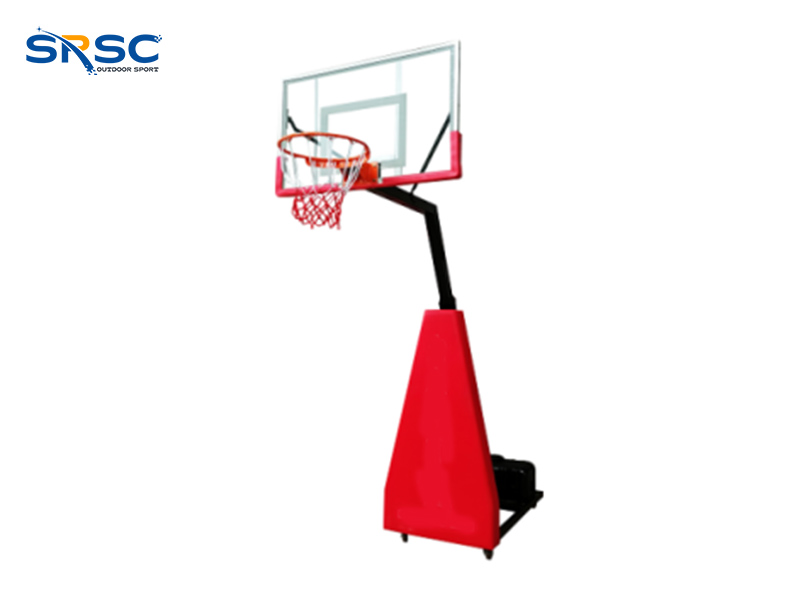
The Adjustable Mini Basketball Hoop is composed of five core engineering systems:
- Load-bearing steel frame system
- Height adjustment mechanism
- Impact-resistant backboard assembly
- Stability-weighted base system
- Safety padding and reinforcement zones
Each subsystem is designed to balance durability, safety, and performance consistency under repeated dynamic load conditions.
Steel Frame Engineering and Load Distribution System
Upright Post Structural Design
The system uses 100×100mm and 80×80mm square steel tubing.
These dimensions are selected based on mechanical load distribution requirements for dynamic sports impact.
The dual-layer structure reduces vibration and increases long-term structural integrity.
Load Transfer Mechanics
When a basketball impacts the rim or backboard, force is distributed through:
- Rim → Backboard frame
- Backboard → Steel support post
- Post → Base stabilization system
This load transfer system ensures minimal deformation even under repeated stress cycles, which can exceed thousands of impacts per month in school environments.
Adjustable Height System Science and User Adaptation
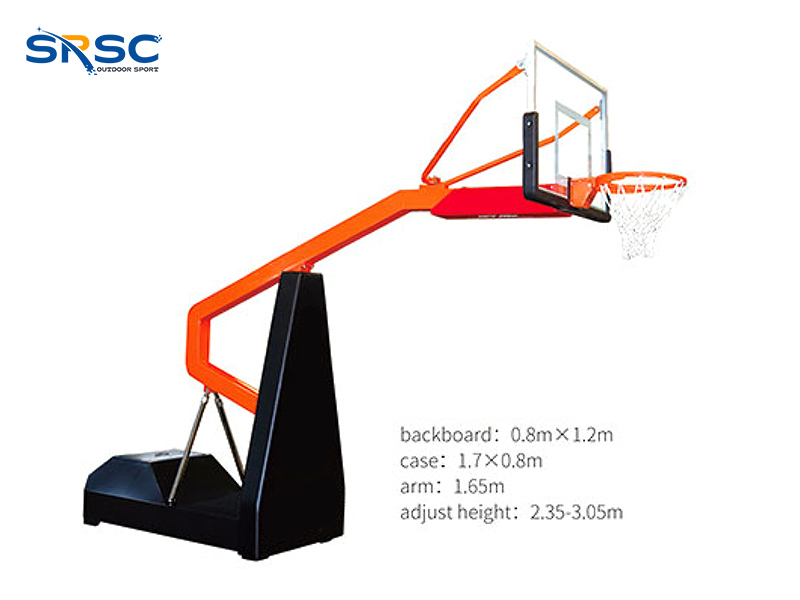
Height Range Engineering (2.0m – 3.05m)
The adjustable range is designed to align with standardized youth basketball training progression:
- 2.0m–2.4m: Early childhood motor skill development
- 2.4m–2.8m: Intermediate coordination training
- 2.8m–3.05m: Standard youth competitive level
This structured progression helps maintain consistent skill advancement without abrupt difficulty jumps.
Mechanical Adjustment Mechanism
Manual Locking System
Most systems use a mechanical pin-lock structure.
This ensures stable height positioning without hydraulic dependency.
It also reduces maintenance complexity and long-term failure risk.
Safety Lock Design
A dual-lock mechanism prevents accidental height changes during play.
This is essential for preventing sudden instability during high-impact activities such as layups or rebounds.
Backboard Material Science and Performance Analysis
Tempered Glass Backboard Properties
The system uses a 1200mm × 800mm × 6mm tempered glass backboard.
Key material properties:
- Impact resistance: 4–5 times stronger than standard glass
- Surface hardness: high scratch resistance
- Elastic rebound consistency: professional-grade ball response
Rebound Physics in Basketball Training
A tempered glass backboard provides a consistent rebound angle, typically between 85°–95° depending on shot force.
This consistency helps develop muscle memory in young players.
It also improves shooting accuracy over time compared to plastic-based systems.
Safety Engineering in Adjustable Hoop for Kids Systems
Base Stability System (830mm × 1500mm)
The base is engineered as a wide-load platform to reduce tipping risk.
Wheels are integrated for mobility but include locking mechanisms for stability during use.
The extended footprint improves torque resistance during dunking actions.
Counterweight System Design
The system supports optional cement ballast:
- Maximum capacity: ~250kg
- Configuration: 10 modular blocks
- Internal placement: base chamber
This modular system allows users to scale stability based on environment conditions.
Adjustable Mini Basketball Hoop Safety Standards
International Safety Guidelines Reference
While there is no single global regulation for home basketball systems, manufacturers typically align with:
- ASTM F2562 (sports equipment safety principles)
- EN 71 (mechanical safety for toys and youth equipment)
- ISO 9001 manufacturing quality systems
These frameworks ensure structural integrity, material safety, and durability testing.
Impact Safety Zones
Critical safety zones include:
- Rim connection point
- Backboard edge areas
- Base contact perimeter
Padding materials reduce injury risk in these zones by absorbing kinetic energy during accidental collisions.
Adjustable Mini Basketball Hoop vs Fixed Systems (Data Comparison)
| Feature | Adjustable Mini Basketball Hoop | Fixed Basketball Hoop |
|---|---|---|
| Growth Adaptability | High (2.0m–3.05m) | None |
| Training Progression | Structured | Static |
| Safety Features | High (padding + base weight) | Medium |
| Installation Flexibility | Indoor & outdoor | Outdoor only |
| Long-Term Value | High | Limited |
| User Age Range | 4–16+ years | Fixed group |
This comparison highlights why adjustable systems are increasingly preferred in modern family sports environments.
Indoor vs Outdoor Application Engineering

Indoor Use Environment
Indoor setups are commonly used in:
- Residential garages
- School gyms
- Training studios
Advantages include controlled environment and consistent surface conditions.
However, ceiling height and floor protection must be considered.
Outdoor Use Environment
Outdoor installations require:
- Weather-resistant coating systems
- High-weight ballast (≥200kg recommended)
- UV-resistant padding materials
Outdoor usage introduces wind load factors, requiring stronger stabilization design.
Real-World Case Studies of Adjustable Mini Basketball Hoop Usage
Case Study 1: Residential Family Setup (USA)
A suburban household installed an adjustable hoop for two children aged 6 and 11.
Results after 6 months:
- 40% improvement in shooting consistency
- Increased outdoor activity time by 2.5 hours per week
- Reduced screen time behavior in children
Case Study 2: Primary School Training Program (UK)
A primary school integrated adjustable hoops into PE curriculum.
Outcomes:
- Improved coordination scores in student assessments
- Increased participation in after-school sports programs
- Reduced injury rates compared to fixed-height systems
Case Study 3: Youth Sports Academy (EU Training Center)
A training academy replaced fixed hoops with adjustable systems.
Findings:
- Faster skill progression cycles
- More efficient group training sessions
- Better age-group adaptability
Industry Insights and Market Trends
According to youth sports equipment market analysis reports (2023–2025):
- Global demand for adjustable basketball systems has increased by over 28% annually
- Home sports equipment is one of the fastest-growing segments in recreational fitness
- Parents prioritize “growth-compatible” equipment over single-stage products
This reflects a shift toward long-term developmental sports investment rather than short-term entertainment products.
Adjustable Mini Basketball Hoop Buying Framework
Structural Quality Checklist
- Steel thickness ≥ industry standard load rating
- Backboard material: tempered glass preferred
- Base width ≥ 800mm for stability
- Locking mechanism tested under dynamic load
Performance Evaluation Criteria
- Rebound consistency
- Height adjustment smoothness
- Stability under impact
- Mobility vs fixed balance
Safety Evaluation Checklist
- Padding coverage ratio
- Base ballast compatibility
- Anti-tip design certification
- Edge rounding protection
Concept Comparison: Training Value vs Entertainment Value
Structured Training Systems
Designed for long-term skill development.
Supports progressive learning and technical improvement.
Commonly used in schools and academies.
Recreational Systems
Focused on fun and casual play.
Limited adjustment and performance feedback.
Best suited for short-term use.
Real User Search Behavior
Modern search queries often include conversational AI-style intent:
- “Is adjustable basketball hoop good for 5-year-old kids?”
- “How tall should a kids basketball hoop be at home?”
- “What is the safest portable basketball system for driveway?”
- “Do glass backboards really improve shooting accuracy?”
- “How much weight is needed to stabilize a basketball hoop outdoors?”
These queries indicate strong purchase intent combined with safety concerns.
Conclusion
The Adjustable Mini Basketball Hoop is not simply a recreational product—it is a structured sports development system designed around growth, safety, and long-term usability.
With engineering-grade steel structures, tempered glass performance design, adjustable height progression, and industrial-level stability systems, it provides a complete training ecosystem for children of different ages and skill levels.
As youth sports participation continues to grow globally, adjustable basketball systems are becoming the standard choice for families and training institutions seeking durable, scalable, and performance-driven sports equipment.
FAQ
What is the recommended age range?
Typically suitable for ages 4 to 16+.
Adjustability allows long-term usability across multiple growth stages.
Is tempered glass safe for kids?
Yes. Tempered glass is engineered to shatter into non-sharp fragments under extreme force, making it safer than standard glass.
How stable is the system in strong wind?
With proper ballast (up to 250kg), the system remains stable in most outdoor conditions.
Wind resistance depends on installation quality and weight configuration.
Can the hoop be moved easily?
Yes. Built-in wheels allow relocation when base is not fully loaded.
Once weighted, movement should be minimized for safety.
Does it require professional installation?
Basic assembly can be completed by users.
However, large ballast setups may benefit from professional installation guidance.