
مدونة
Padel Court Specifications Checklist: What Buyers Should Verify Before Ordering
المقالات الأخيرة
جدول المحتويات
Key points covered in this guide:
- The standard Padel Court dimensions buyers should verify
- How panoramic, super panoramic, classic, and roofed courts differ
- What to check about tempered glass thickness and panel quantity
- Which steel specifications matter beyond post dimensions
- How straight and textured artificial turf affect play
- What LED lighting specifications should appear in a quotation
- Why foundation, drainage, wind load, and anchors must be confirmed before production
- Which accessories are actually included in a complete court package
- How to review packaging, shipping, installation, and spare parts
- What should be inspected before the final balance payment
Buying a ملعب البادل is different from buying a simple piece of sports equipment.
A complete court is an integrated structure made from tempered glass, galvanized steel, mesh fencing, artificial turf, lighting, fasteners, gates, anchors, electrical components, and numerous installation accessories. The court also depends on a properly prepared concrete base, drainage system, structural design, and accurate site dimensions.
For commercial clubs, schools, hotels, resorts, residential developments, distributors, and sports contractors, comparing quotations only by the final price can therefore be misleading.
Two suppliers may both quote a “20 × 10 m Padel Court,” while providing very different glass thicknesses, steel profiles, coatings, turf systems, lighting fixtures, packaging, engineering support, and installation documentation.
A professional buyer should convert the quotation into a detailed technical checklist before approving production.
1. Verify the Standard Padel Court Dimensions
The first specification to confirm is the internal playing area.
Under the current FIP Rules of Padel, the standard court measures 10 metres wide by 20 metres long internally, with a tolerance of 0.5%. The court is divided into two equal sides by the net.
Internal Dimensions vs Overall Construction Dimensions
The 20 × 10 m measurement refers to the internal playing space.
The total construction footprint can be larger because of:
- Steel columns
- Base plates
- Lighting posts
- Roof supports
- External walkways
- Drainage channels
- Spectator areas
- Out-of-court play zones
A buyer should therefore ask for both:
Internal playing dimensions:
20 × 10 m
Overall installation footprint:
Supplier-specific and project-specific
Do Not Prepare the Concrete From the 20 × 10 m Number Alone
Before civil construction begins, request an approved foundation drawing showing:
- Court centre lines
- Post positions
- Gate positions
- Base plates
- Anchor locations
- Lighting posts
- Electrical conduits
- Drainage
- Finished floor elevations
This prevents the civil contractor from creating a slab that is technically large enough but incompatible with the actual court structure.
2. Select the Correct Padel Court Type
A buyer should determine the court structure before comparing detailed specifications.
Common configurations include:
- ملعب بادل كلاسيكي
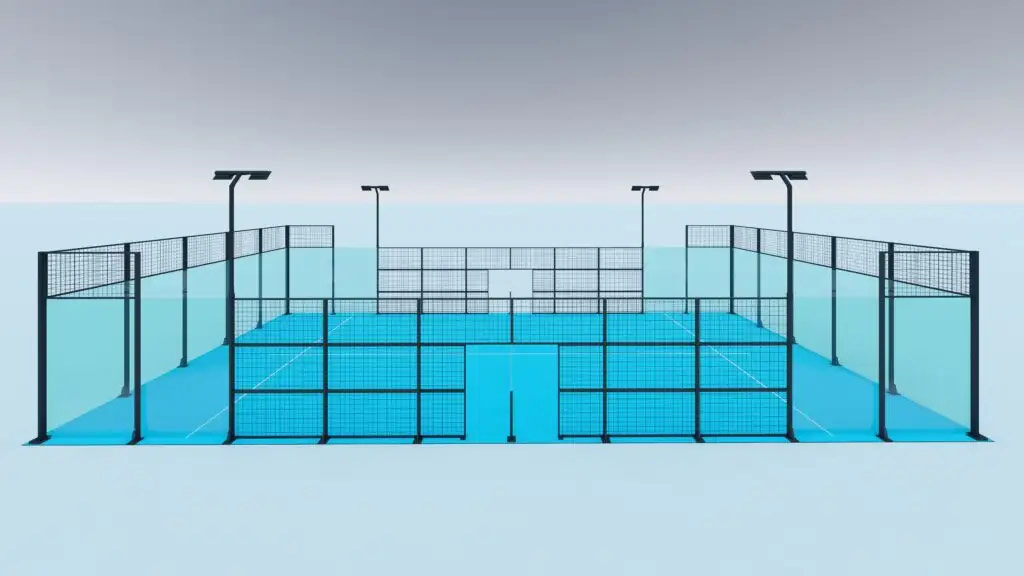
- ملعب بادل بانورامي
- ملعب بادل بانورامي فائق
- ملعب بادل فردي
- Roofed Padel Court
- ملعب بادل داخلي
ملعب بادل كلاسيكي
A classic design uses more visible steel posts around the glass enclosure.
Potential advantages include:
- Strong structural framing
- Straightforward manufacturing
- Easier replacement of selected components
- Practical configuration for schools and training centres
ملعب بادل بانورامي
A panoramic design reduces visible structural obstruction around key glass sections.
It may be preferred for:
- Commercial clubs
- Hotels
- Premium sports centres
- Tournament facilities
- Spectator-focused venues
SRSC’s current RR01 Panoramic model uses a 20 × 10 m layout, hot-dip galvanized steel, 100 × 100 × 3 mm posts, eighteen 12 mm tempered-glass panels, approximately 200 m² of artificial turf, and eight LED fixtures.
ملعب بادل بانورامي فائق
A super panoramic design further reduces visual framing.
This can improve:
- Spectator sightlines
- Photography
- Livestreaming
- Premium club appearance
- Sponsor visibility
However, reduced visible framing increases the importance of proper structural engineering and foundation coordination.
Roofed Padel Court
A roofed system adds overhead weather protection.
It also introduces additional engineering requirements for:
- Wind uplift
- roof dead load
- drainage
- roof columns
- foundations
- إضاءة
- corrosion protection
SRSC currently offers the RR05 as a roofed outdoor model intended to provide greater weather protection while maintaining a panoramic-style playing environment.
3. Check the Tempered Glass Specification
Glass is one of the most important and most expensive components of a Padel Court.
Do not accept a quotation that says only:
“Tempered Glass Included.”
The specification should include:
- سماكة
- Panel dimensions
- Panel quantity
- Tempering standard
- Edge treatment
- Hole positions
- Packaging
- Replacement availability
10 mm vs 12 mm Glass
Commercial courts may be supplied with different glass thicknesses depending on design and intended use.
A buyer should evaluate:
- Structural design
- wind conditions
- court model
- playing level
- local requirements
- supplier engineering
For SRSC’s RR01 Panoramic model, the current product specification uses 12 mm tempered glass, with eighteen panels measuring 2 × 3 m.
Why Panel Quantity Matters
A complete quotation should clearly state how many glass panels are supplied.
This allows the buyer to check:
- Crate quantity
- replacement planning
- shipping volume
- unloading equipment
- spare-glass strategy
Glass Edge Quality
Inspect:
- Polished edges
- corners
- holes
- scratches
- chips
- surface defects
Tempered glass cannot normally be modified after tempering, so an incorrect hole pattern generally requires replacement rather than site drilling.
4. Review the Steel Structure in Detail
A statement such as “galvanized steel structure” is not enough.
The buyer should request:
- Steel profile dimensions
- Wall thickness
- Steel grade
- Welding method
- Galvanizing method
- Zinc coating
- Powder coating
- Coating colour
- Base-plate dimensions
- Mesh specification
- Structural drawings
Main Post Dimensions
SRSC currently lists 100 × 100 × 3 mm steel posts for its RR01 Panoramic Padel Court.
However, buyers should not compare suppliers only by this single number.
The complete structure also includes:
- Upper beams
- side posts
- mesh frames
- corner members
- gate frames
- lighting columns
- base plates
- bracing
Steel Thickness Must Be Verified
A larger profile with very thin walls may perform differently from a smaller but better-engineered section.
Request actual dimensions rather than relying on descriptions such as:
- Heavy duty
- premium steel
- professional frame
- reinforced structure
Welding Quality
Factory inspection should check:
- Continuous welds where specified
- weld penetration
- grinding
- distortion
- sharp edges
- slag
- uncoated weld areas
Poor welding can affect both appearance and structural performance.
5. Understand Galvanizing and Powder Coating
Outdoor steel requires more than decorative paint.
SRSC’s RR01 currently lists hot-dip galvanized steel together with zinc coating and plastic powder coating as part of its corrosion-protection system.
Hot-Dip Galvanizing
Hot-dip galvanizing creates a zinc coating on the steel.
It can help protect:
- Posts
- frames
- base plates
- mesh structures
- hidden steel surfaces
طلاء المسحوق
Powder coating provides:
- Colour
- additional barrier protection
- smoother appearance
- branding flexibility
Duplex Protection
Combining zinc protection with a powder-coated finish can provide stronger outdoor durability than a decorative topcoat alone.
Ask How Fabrication Is Sequenced
Buyers should confirm whether major cutting, welding, and drilling are completed before the final protective coating.
Unprotected fabrication performed after galvanizing can leave vulnerable areas.
6. Check the Mesh Fence Specification
The metallic enclosure is part of the playing surface because balls rebound from it.
The current FIP rules require the enclosure material to allow consistent ball rebound and specify that framed metallic fencing should remain aligned with the internal wall surface. The upper part should remain free of unrelated cables, electrical boxes, and lighting devices.
Ask for Mesh Details
Confirm:
- Wire diameter
- Opening size
- panel dimensions
- frame dimensions
- welding
- galvanizing
- powder coating
- fixing method
Mesh Should Not Have Sharp Projections
Inspect for:
- Welding points
- cut wires
- bolt ends
- damaged coating
- exposed fasteners
Any component accessible to players should be smooth and properly finished.
7. Compare Padel Court Turf Carefully
Artificial turf has a direct impact on:
- Ball speed
- ball bounce
- player grip
- maintenance
- visual appearance
- sand movement
SRSC currently offers straight and textured/curled turf options for its Padel Court systems. Its RR01 specification describes a 12 mm textured PE monofilament system with a high-density construction and multi-layer backing.
العشب المستقيم
Straight monofilament turf can provide:
- Faster ball movement
- traditional playing characteristics
- visible fibre direction
- dynamic competitive play
It may require more regular brushing and sand redistribution.
Textured Turf
Textured or curled turf can provide:
- Greater fibre stability
- controlled ball speed
- reduced visible sand movement
- dense appearance
It may appeal to commercial clubs serving mixed player levels.
Turf Specification Checklist
Ask for:
- Fibre material
- pile height
- stitch density
- gauge
- backing
- roll width
- UV resistance
- colour
- drainage capability
- silica-sand requirement
- warranty
Do Not Compare Turf Only by Weight
Two turf products with similar weight can have different:
- fibres
- backing
- كثافة
- pile construction
- playing speed
Always compare the complete specification.
8. Confirm the Silica Sand Requirement
Artificial padel turf typically uses silica or quartz sand infill.
The sand helps:
- Stabilize the surface
- support fibres
- influence ball speed
- control traction
- add weight to the turf
Request a Defined Sand Specification
Confirm:
- Grain size
- required quantity
- cleanliness
- moisture condition
- local supply compatibility
Is Sand Included?
International court quotations may exclude the sand because shipping heavy mineral material over long distances is inefficient.
The buyer should determine whether:
- Supplier provides sand
- Installer purchases locally
- Court price excludes infill
This should be clarified before calculating the final project cost.
9. Verify the LED Lighting Package
A complete Padel Court commonly includes integrated lighting.
SRSC’s current RR01 specification lists eight 200W LED fixtures, while its detailed lighting description identifies outdoor-rated fixtures and 60° or 90° beam options.
Lighting Specification Checklist
Request:
- Fixture quantity
- wattage
- lumen output
- beam angle
- colour temperature
- colour rendering
- IP rating
- driver brand
- input voltage
- surge protection
- mounting height
- warranty
Lighting Performance Matters More Than Wattage
Two 200W fixtures can produce different court lighting because of:
- optical efficiency
- beam distribution
- mounting position
- driver quality
- fixture angle
Current FIP Lighting Guidance
FIP competition guidance includes minimum horizontal illumination and uniformity levels according to the level of use. Current FIP material also specifies at least 1,000 lux of vertical illumination for television broadcasts, with requirements potentially increasing depending on camera conditions.
A commercial buyer should therefore specify the actual project goal:
- Recreational club
- training facility
- competition
- broadcast court
10. Check the Required Free Height
Vertical clearance is particularly important for indoor courts.
The current FIP rules require at least 6 metres of unobstructed height throughout the court and recommend at least 8 metres for new facilities.
Check More Than the Roof Height
Possible low obstructions include:
- Roof beams
- HVAC ducts
- sprinklers
- lights
- signs
- cable trays
- acoustic panels
A building with an 8.5 m roof may still provide insufficient playing clearance if a structural beam is only 5.8 m above the finished turf.
Measure From the Finished Turf
Concrete levelling, turf, and other surface layers can reduce the final clear height.
11. Review the Foundation Requirements Before Ordering
The Padel Court manufacturer and local civil engineer should coordinate before concrete work begins.
Foundation Information to Request
Ask for:
- Overall concrete area
- slab thickness
- perimeter beam dimensions
- post foundations
- reinforcement
- concrete strength
- anchor layout
- drainage slope
- finished floor tolerance
Do Not Copy a Foundation From Another Project
Foundation requirements can change with:
- Soil
- wind
- court model
- roof structure
- local code
- أسمنت
- drainage
Surface Flatness
The current FIP rules specify that differences in internal surface level should remain below 3 mm when checked with a 3 m straightedge.
An uneven base can affect:
- Turf
- drainage
- glass alignment
- steel posts
- ball behaviour
12. Verify Wind Load Information
Wind is one of the most important site-specific structural variables for an outdoor Padel Court.
Provide the Supplier With
- Project city
- Country
- site elevation
- distance from coastline
- terrain
- nearby buildings
- design wind speed
- roof information
- advertising panels
- windbreak screens
Windscreens Change Structural Loads
A mesh fence allows more air to pass through than a solid banner or windscreen.
Adding:
- Sponsor banners
- privacy screens
- solid panels
can increase wind pressure on:
- Posts
- anchors
- foundations
- roof structures
These additions should be reviewed structurally rather than installed after handover without assessment.
13. Check Anchor Bolts and Base Plates
The steel enclosure transfers loads into the foundation through base plates and anchors.
Ask for
- Anchor type
- bolt diameter
- material
- corrosion protection
- embedment
- bolt spacing
- edge distance
- installation torque
- base-plate dimensions
Existing Concrete Requires Special Review
A supplier should not assume an old slab is suitable merely because it looks strong.
The project may need to verify:
- Concrete thickness
- reinforcement
- cracks
- edge distances
- construction joints
14. Review the Drainage Design
A Padel Court must remain playable after cleaning and, for outdoor installations, after rainfall.
Drainage May Include
- Surface slope
- drainage channels
- perimeter drains
- underground pipes
- outlets
- roof downpipes
Check Before Turf Installation
Once artificial turf is installed, identifying low concrete areas becomes more difficult.
Complete a water test before final surfacing.
Roofed Courts Still Need Drainage
A roof does not eliminate:
- Wind-driven rain
- condensation
- cleaning water
- surrounding runoff
Drainage should remain part of the design.
15. Check Gates and Access Openings
Court gates experience repeated use and should not be treated as minor accessories.
Gate Specification
Confirm:
- Opening size
- frame profile
- hinges
- مقبض
- latch
- coating
- player-contact protection
Competition Projects
Where out-of-court play is required, the external safety area must remain unobstructed.
Current FIP tournament documentation places significant emphasis on maintaining clear off-court safety areas and eliminating dangerous edges or level changes around competition courts.
16. Check What Is Actually Included in the Padel Court Price
One of the largest quotation differences comes from package scope.
For example, SRSC’s current RR01 package identifies these principal supplied components:
- Galvanized steel posts
- Galvanized steel mesh
- 12 mm tempered glass
- Artificial grass
- مصابيح LED
However, a complete construction project may also need:
- أسمنت
- reinforcement
- anchors
- silica sand
- electrical cables
- distribution board
- drainage
- cranes
- installation labour
- accommodation
- customs clearance
- inland transportation
Compare Like With Like
Create a quotation comparison table.
| Specification | Supplier A | Supplier B | Supplier C |
|---|---|---|---|
| Court type | |||
| Glass thickness | |||
| Glass quantity | |||
| Main post size | |||
| Steel coating | |||
| Turf type | |||
| Turf specification | |||
| LED quantity | |||
| LED wattage | |||
| IP rating | |||
| Anchors | |||
| Spare parts | |||
| Packaging | |||
| Installation | |||
| Foundation design | |||
| Warranty |
A slightly higher quotation may provide better overall value when it includes stronger materials, better packaging, engineering documents, and installation support.
17. Check Packaging Before International Shipping
Tempered glass and long steel members require careful export packaging.
SRSC currently lists polyethylene foam and plywood cartons/crates in its RR01 packaging information, while its product information specifically describes plywood crates for the tempered-glass panels.
Glass Packaging
Check:
- Plywood crate strength
- Internal separators
- edge protection
- moisture protection
- lifting points
- crate labels
Steel Packaging
Steel members should be:
- Bundled
- labelled
- protected from rubbing
- separated where necessary
- matched to packing lists
Hardware Packaging
Small components should be grouped by:
- Court number
- installation stage
- hardware type
Do not accept one mixed box containing hundreds of unidentified bolts and fittings for several courts.
18. Order Spare Parts With the Original Padel Court
International buyers should not wait for a component failure before thinking about spare parts.
Recommended Spare Components
Consider ordering:
- Glass fittings
- bolts
- nuts
- nylon sleeves
- rubber gaskets
- gate hinges
- handles
- turf repair material
- nets
- LED drivers
- electrical connectors
- coating touch-up paint
Replacement Glass Documentation
Even when spare glass is not purchased, keep the approved drawings showing:
- Panel dimensions
- thickness
- hole positions
- edge treatment
- orientation
This makes future replacement much easier.
19. Request Technical Drawings Before Production
A professional Padel Court order should include more than product photographs.
Recommended Documentation
Request:
- General arrangement
- Court elevations
- Steel drawings
- Glass schedule
- foundation plan
- anchor layout
- lighting layout
- electrical information
- gate detail
- turf layout
- assembly instructions
Confirm Revision Numbers
Every drawing should show:
- Project name
- drawing number
- revision
- date
The buyer, supplier, civil contractor, and installation team should all work from the same approved revision.
20. Conduct a Factory Inspection
Before final shipment, conduct a factory inspection directly or through a trusted inspection company.
Steel Inspection
Check:
- أبعاد
- wall thickness
- welds
- galvanizing
- powder coating
- colour
Glass Inspection
Check:
- سماكة
- quantity
- dimensions
- hole locations
- edges
- packing
Turf Inspection
Check:
- Product model
- colour
- pile height
- roll quantity
- roll dimensions
Lighting Inspection
Power on sample fixtures and confirm:
- Wattage
- voltage
- colour temperature
- driver
- mounting bracket
- enclosure
Hardware Inspection
Open hardware boxes and compare quantities with the packing list.
21. Plan Installation Before the Container Arrives
Court components should not arrive before the site is prepared.
Before Delivery
Confirm:
- Foundation complete
- Concrete accepted
- drainage complete
- electrical conduits ready
- unloading equipment booked
- storage area available
- installers scheduled
Installation Sequence
A typical project may proceed through:
- Site survey
- Foundation inspection
- Anchor preparation
- Steel erection
- Frame alignment
- Mesh installation
- Glass installation
- إضاءة
- Turf installation
- Silica sand
- Net installation
- Final testing
The exact sequence depends on the court system and project.
22. Conduct a Final Padel Court Acceptance Inspection
The buyer should inspect the complete court before final handover.
Structural Inspection
Confirm:
- Posts vertical
- steel aligned
- anchors tight
- gates operate correctly
- no sharp edges
Glass Inspection
Confirm:
- Panels undamaged
- gaps consistent
- fittings complete
- no glass-to-metal contact
- surfaces clean
Turf Inspection
Confirm:
- No wrinkles
- seams flat
- fibres consistent
- silica sand distributed
- lines straight
Lighting Inspection
Confirm:
- All fixtures operate
- aiming is correct
- no excessive glare
- controls function
Playing Inspection
Test:
- Ball bounce
- net height
- gate clearance
- turf grip
- glass rebound
- mesh rebound
A court should be accepted as a complete playing system rather than as a collection of successfully delivered components.
Padel Court Specification Checklist
| Category | Buyer Should Verify |
| أبعاد | 20 × 10 m internal playing area |
| Court type | Classic, panoramic, super panoramic, roofed, or single |
| Steel | Profile sizes, thickness, grade, and welding |
| Corrosion protection | Galvanizing plus coating specification |
| Glass | Thickness, dimensions, quantity, holes, edge finish |
| Mesh | Wire, aperture, frame, coating |
| Turf | Fibre, pile, density, backing, UV protection |
| Sand | Specification, quantity, and supply responsibility |
| إضاءة | Quantity, wattage, optics, IP rating, driver |
| Foundation | Concrete, reinforcement, dimensions, flatness |
| Anchors | Type, material, embedment, torque |
| Wind | Site-specific design conditions |
| Drainage | Slope, channels, outlets |
| Gates | Dimensions, hinges, handles, safety |
| Packaging | Steel, glass, turf, and hardware protection |
| Installation | Responsibility, tools, supervision |
| Spare parts | Hardware, lighting, fittings, coating |
| Documentation | Drawings, manuals, packing lists, test records |
| Warranty | Scope, duration, exclusions |
Common Padel Court Buying Mistakes
Comparing Only the Price
A cheaper court may use lower steel thickness, lighter glass, basic turf, weaker coatings, or limited packaging.
Asking Only for “FIP Standard”
FIP rules define playing and court requirements, but structural design still depends on the actual location, wind, foundation, and court type.
Building the Foundation Before Receiving Drawings
Post and anchor positions may not match.
Ignoring Wind Conditions
A court designed for one location may not be suitable for another.
Choosing Turf Only by Colour
Fibre construction and infill affect the playing experience.
Checking LED Wattage but Not Optics
Lighting quality depends on beam distribution and layout.
Ignoring Packaging
Good materials can still arrive damaged after poor container loading.
Ordering No Spare Components
A small damaged fitting can close a court while the buyer waits for an international shipment.
Adding Roofs or Windscreens Later
These changes can significantly alter structural loads.
خاتمة
Buying a Padel Court should begin with a technical specification rather than a price comparison.
The buyer should confirm the court type, internal dimensions, tempered glass, steel profiles, galvanizing, powder coating, mesh, artificial turf, silica sand, lighting, foundation, anchors, wind conditions, drainage, gates, packaging, installation, spare parts, and warranty before approving the order.
The strongest suppliers should also be able to provide clear drawings, product specifications, packing information, installation guidance, and engineering data that allow the court manufacturer, civil contractor, electrical contractor, and local structural engineer to coordinate their work.
SRSC’s current Padel Court range includes panoramic, super panoramic, classic, single, indoor, outdoor, and roofed configurations. Buyers can compare the RR01 Panoramic Padel Court, review the Padel Court Materials Guide، أو contact SRSC with the project location, court quantity, required model, site dimensions, and intended playing level.
التعليمات
What size is a standard Padel Court?
The current FIP Rules specify an internal playing area of 20 × 10 metres.
How much space do I need to build a Padel Court?
The playing area is 20 × 10 m, but additional space is required for the structure, circulation, drainage, installation, and potentially out-of-court play.
Is 10 mm or 12 mm glass better for a Padel Court?
The correct thickness depends on the engineered court design and project requirements. SRSC currently uses 12 mm tempered glass on its RR01 Panoramic model.
How many glass panels are in a Padel Court?
The quantity depends on the design. SRSC’s current RR01 specification uses eighteen 2 × 3 m tempered-glass panels.
What steel should a Padel Court use?
The steel structure should be specified by grade, profile size, wall thickness, coating, and structural design rather than simply described as “heavy-duty steel.”
What turf is best for a Padel Court?
Straight turf can support faster play, while textured turf can provide a more controlled playing feel. The choice depends on players, climate, maintenance, and competition plans.
How many lights does a Padel Court need?
The quantity depends on fixture design and required lighting level. SRSC’s current RR01 configuration uses eight 200W LED fixtures.
How high does an indoor Padel Court need to be?
FIP requires at least 6 m of unobstructed height and recommends at least 8 m for new facilities.
Does a Padel Court require a concrete foundation?
A properly engineered foundation is normally required for the steel structure and playing surface. The exact design depends on site and structural conditions.
Can I install a Padel Court on an existing tennis court?
Potentially, but the existing base, drainage, dimensions, concrete, anchors, slope, and surrounding space must be inspected before approval.
What should be included in a complete Padel Court quotation?
At minimum, ask for the steel, mesh, tempered glass, artificial turf, lighting, hardware, packaging, drawings, installation requirements, and clearly stated exclusions.
Should I order a panoramic or classic Padel Court?
Panoramic courts provide clearer sightlines and a premium appearance, while classic designs use more visible structural framing. The best choice depends on the venue, budget, wind conditions, audience, and commercial positioning.