
مدونة
Taekwondo Mats Buying Guide: Thickness, Density, and Layout
المقالات الأخيرة
جدول المحتويات
Key points covered in this guide:
- How Taekwondo Mats differ from Judo and wrestling surfaces
- How to compare 20 mm, 25 mm, 30 mm, 40 mm, and 50 mm mats
- Why foam density and Shore hardness should be evaluated together
- How interlocking puzzle mats compare with roll and covered mat systems
- What size is needed for training and competition areas
- Which surface texture provides controlled grip for kicking and footwork
- How to plan colours, safety zones, and custom logos
- What buyers should check before shipping, installation, and daily use
Professional حصائر التايكوندو must support rapid footwork, pivoting, kicking, jumping, landing, and controlled falls without becoming excessively hard, soft, slippery, or abrasive.
A mat that is too soft may reduce stability during spinning kicks and direction changes. A mat that is too hard may provide insufficient cushioning during falls. An overly textured surface can increase skin abrasion, while a smooth surface may become slippery when contaminated by sweat or dust.
Schools, dojangs, martial arts clubs, distributors, and competition organisers should therefore evaluate the complete mat system rather than selecting a product only by colour, thickness, or price.
What Are Taekwondo Mats?
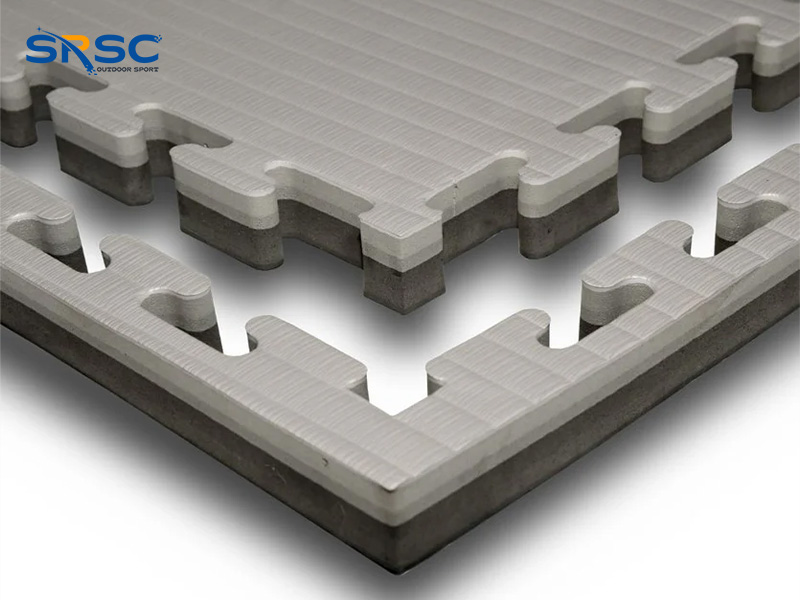
Taekwondo Mats are shock-absorbing sports flooring panels designed for martial arts training and competition.
A typical system may include:
- EVA or another closed-cell foam core
- Textured upper surface
- Anti-slip underside
- Interlocking puzzle edges
- Reversible colour surfaces
- Perimeter edge pieces
- Competition markings
- Custom logos
The current SRSC Taekwondo Mats use EVA foam and are available in 100 × 100 cm and 80 × 80 cm panel sizes. Published options include thicknesses from 20 to 50 mm, densities of 90 or 110 kg/m³, and hardness values of 35–45 Shore C.
Taekwondo Mat vs Ordinary Foam Tile
A general-purpose foam tile may be designed for children’s rooms, home exercise, exhibitions, or light floor protection.
A Taekwondo surface must support repeated athletic movement across a connected training area.
| Comparison Area | حصائر التايكوندو | General Foam Tiles |
|---|---|---|
| Primary use | Kicking, footwork, sparring, forms | Light exercise or floor protection |
| Surface grip | Controlled athletic traction | Product-dependent |
| Impact demand | Repeated training and falls | Usually lower |
| Joint stability | Important across full area | Often secondary |
| Density consistency | Important for uniform performance | May vary significantly |
| Competition use | Exact product must be verified | Normally unsuitable |
| Cleaning frequency | عالي | Low to moderate |
| Replacement matching | Colour and hardness must match | Less critical |
Concept: Installed Mat System
The installed mat system includes the foam panels, interlocking joints, perimeter edges, subfloor, safety clearance, markings, and maintenance process.
High-quality individual panels can still perform poorly when placed on an uneven floor or installed with open joints.
How Taekwondo Mats Differ From Judo Mats
Taekwondo and Judo involve different movement patterns.
Taekwondo Movement
Taekwondo training commonly includes:
- Fast stepping
- Pivoting
- Spinning kicks
- Jumping techniques
- Sparring
- Forms practice
- Controlled falls
- Conditioning drills
The surface therefore needs strong standing stability and predictable rotational movement.
Judo Movement
Judo includes more frequent:
- Throws
- Breakfalls
- Grappling
- Groundwork
- High-energy body impact
Judo mats are often designed with greater emphasis on cushioning for repeated throws while maintaining sufficient standing firmness.
Can One Mat Be Used for Both?
Some multipurpose products can support several martial arts activities, but buyers should not assume that every Taekwondo mat is suitable for intensive Judo throwing.
The decision should consider:
- Foam type
- سماكة
- Firmness
- Impact testing
- Surface texture
- Athlete level
- Frequency of throws
Understand Taekwondo Mat Thickness

Thickness is easy to compare, but it does not describe performance by itself.
SRSC currently offers Taekwondo Mat thicknesses of 20, 25, 30, 40, and 50 mm. The correct option depends on the training activity, foam density, hardness, subfloor, and user group.
20 mm Taekwondo Mats
A 20 mm system may be considered for:
- Forms practice
- Light technical training
- Fitness classes
- Low-impact school activities
- Temporary event flooring
Potential advantages include lower weight, easier handling, reduced storage volume, and smaller floor-height transitions.
It may not provide enough cushioning for programmes that include frequent hard falls.
25–30 mm Taekwondo Mats
This range can provide a balance between stability and cushioning for:
- General dojang training
- Sparring
- Kicking drills
- School martial arts programmes
- Mixed technical sessions
The final choice should still be based on the foam specification and tested finished product.
40–50 mm Taekwondo Mats
Thicker mats may be considered where training includes:
- More frequent falling
- Cross-training
- Grappling
- Children’s instruction
- Demonstration practice
- Higher cushioning requirements
However, a thick mat made from overly soft foam can reduce foot stability.
Thickness Comparison
| سماكة | Potential Application | Main Buyer Consideration |
| 20 mm | Forms and light technical practice | Limited impact capacity |
| 25 mm | General training | Balance of height and cushioning |
| 30 mm | Sparring and multi-purpose use | Common commercial option |
| 40 mm | Higher-impact or mixed martial arts | Stability must be verified |
| 50 mm | Specialised cushioning requirements | Weight, softness, and floor transition |
Thickness Is Not the Same as Protection
Two 30 mm mats can perform differently when they use different foam density, hardness, cell structure, surface texture, or manufacturing tolerances.
Compare Foam Density
Foam density describes the amount of material within a defined volume.
It may influence:
- Mat weight
- Compression resistance
- متانة
- Structural consistency
- Recovery
- Shipping cost
SRSC’s Taekwondo Mat specification currently lists density options of 90 and 110 kg/m³.
90 kg/m³ EVA Foam
This option may provide:
- Lower panel weight
- Easier installation
- Lower transport cost
- Suitable cushioning for general training
Its suitability depends on thickness, hardness, and the intended training intensity.
110 kg/m³ EVA Foam
A denser configuration may offer:
- Firmer standing support
- Greater resistance to compression
- Stronger dimensional stability
- Potentially longer life under intensive use
Higher density does not automatically mean better shock absorption.
Why Density Alone Is Insufficient
The finished performance also depends on:
- Shore hardness
- Foam cell structure
- سماكة
- Manufacturing consistency
- Surface layers
- Temperature
- Ageing
- Subfloor
A buyer should request a physical sample or complete test report rather than comparing only one density number.
Understand Shore C Hardness
Hardness describes how resistant the foam surface is to indentation.
SRSC currently lists a 35–45 Shore C hardness range for its Taekwondo Mats.
Softer Configuration
A softer mat may provide:
- More noticeable cushioning
- Greater comfort during floor exercises
- Reduced perceived impact
Possible disadvantages include:
- Less stable pivoting
- Deeper footprints
- Greater movement at joints
- Faster compression in high-use zones
Firmer Configuration
A firmer mat may provide:
- Stable footwork
- Faster direction changes
- More consistent kicking support
- Reduced surface deformation
If it becomes excessively firm, it may provide less cushioning during falls.
Density vs Hardness
| Characteristic | كثافة | صلابة |
| What it describes | Material mass per volume | Resistance to indentation |
| Typical unit | kg/m³ | Shore C |
| Influences | Weight, consistency, compression | Surface feel and stability |
| Higher value means | More material per volume | Firmer surface |
| Can it determine quality alone? | No | No |
The most suitable combination provides enough firmness for kicks and pivots while retaining appropriate impact management.
Choose the Right EVA Foam
EVA is commonly used for interlocking martial arts mats because it offers a closed-cell structure and can be produced in different densities, hardness levels, colours, and textures.
Potential EVA Advantages
- Relatively low water absorption
- Lightweight panel construction
- Reversible colour options
- Straightforward puzzle-edge production
- Easy surface cleaning
- Flexible thickness choices
- Convenient local replacement
Questions to Ask About EVA
Request information about:
- Raw material grade
- Recycled material content
- Odour
- Colour stability
- Foam uniformity
- Compression recovery
- Dimensional tolerance
- Chemical test reports
- Fire performance where required
Check for Permanent Compression
Ask the supplier how the foam performs after repeated loading from:
- Athlete footwork
- Equipment carts
- Benches
- Storage racks
- Heavy training bags
Permanent low areas can create an uneven surface and reduce joint alignment.
Select the Surface Texture
Taekwondo athletes need traction, but too much grip can interfere with rotational movement.
Tatami Texture
A tatami-style pattern creates a directional or woven appearance.
Potential advantages include:
- Controlled grip
- Professional martial arts appearance
- Reduced visibility of minor scratches
- Clear surface orientation
Embossed Pattern
Raised patterns may improve grip, but overly aggressive textures can increase friction during:
- Sliding
- Falling
- Ground exercises
- Barefoot pivots
Smooth Surface
A smoother surface can simplify cleaning but may become slippery when exposed to sweat, dust, or unsuitable cleaning residue.
Test With Bare Feet
A sample should be tested for:
- Forward stepping
- Side movement
- Pivoting
- Spinning
- Jumping
- Landing
- Knee contact
- Hand contact
Concept: Controlled Traction
Controlled traction allows athletes to accelerate, stop, and pivot without uncontrolled slipping or excessive resistance.
The best surface is not automatically the one with the strongest grip.
Reversible vs Single-Sided Taekwondo Mats
SRSC’s product information describes reversible interlocking foam tiles that can support two-colour layouts.
Reversible Mats
Potential advantages include:
- Two available colours
- Easier zone planning
- Flexible replacement
- Ability to change the visual layout
- Reduced need to stock separate colours
Single-Sided Mats
A single-sided system may provide:
- Dedicated anti-slip underside
- Specialised top texture
- Clear installation orientation
- Potentially stronger floor contact
Confirm the Actual Bottom Surface
Some reversible mats use a similar texture on both sides.
The buyer should confirm whether the lower surface provides enough friction on:
- أسمنت
- Hardwood
- Vinyl
- Ceramic tile
- Rubber flooring
- Raised platforms
Compare Puzzle Mats and Roll Mats
Interlocking Puzzle Mats
Puzzle mats use teeth along the panel edges to connect adjacent sections.
Potential advantages include:
- Simple modular installation
- Easy panel replacement
- Flexible room size
- Two-colour patterns
- Compact shipping
- No adhesive required in many installations
Potential disadvantages include:
- Many joints
- Edge separation if poorly fitted
- Greater installation labour for large areas
- Visible panel pattern
- Need for perimeter restraint
Roll Mats
Roll mats use longer foam sections with fewer joints.
Potential advantages include:
- Faster installation
- Fewer seams
- Easy temporary conversion
- Efficient storage for selected venues
Potential disadvantages include:
- Larger handling units
- Tape or hook-and-loop maintenance
- More difficult local replacement
- Potential curling at roll ends
System Comparison
| Decision Factor | Puzzle Mats | Roll Mats |
| Unit size | Small panels | Long sections |
| Installation | Panel by panel | Roll out |
| Local replacement | Easy | More difficult |
| Joint quantity | Higher | Lower |
| Custom room shape | Flexible | Requires planning |
| Two-colour layout | Easy | Must be prepared |
| Storage | Stacked panels | Rolled sections |
| Temporary events | Suitable | Often faster |
| Permanent dojang | Highly suitable | Suitable |
SRSC offers both interlocking Taekwondo Mats and separate حصائر لفافة مصنوعة من مادة XPE for martial arts and impact-related applications.
Determine the Required Mat Dimensions

Panel Size
SRSC’s current panel options include:
- 100 × 100 cm
- 80 × 80 cm
Larger panels reduce the total number of joints but weigh more and require more handling space. Smaller panels may be easier to replace and configure around columns.
Training Area
A dojang should provide enough space for:
- Individual kicking drills
- Partner practice
- Sparring
- Forms
- Instructor circulation
- Safety clearance
- Equipment storage
The final area depends on class size and training format.
Competition Area
The World Taekwondo competition rules accessible through WT’s official documentation describe a competition area comprising a contest area and surrounding safety area. The contest area measures approximately 8 metres, while recognised events require appropriate elastic, non-slippery competition mats. For sanctioned events, organisers should verify the latest edition and event-specific field-of-play instructions before ordering.
Do Not Order Only the Central Contest Area
Additional mat coverage may be needed for:
- Safety zones
- Athlete entry
- Referee positions
- Electronic scoring equipment
- Warm-up areas
- Adjacent competition courts
Calculate Taekwondo Mat Quantity
For square panels, use:
Total floor area ÷ area of one panel = preliminary panel quantity
Example With 1 × 1 m Panels
A 100 m² room requires a preliminary quantity of 100 full panels.
Additional panels may be required for:
- Perimeter cuts
- Door recesses
- Columns
- Colour zones
- Spare stock
- Future replacement
Example With 0.8 × 0.8 m Panels
One 80 × 80 cm panel covers 0.64 m².
The quantity must be rounded up, and additional material should be included for cuts and spares.
Order Spare Panels
A practical spare stock can help replace mats damaged by:
- Heavy equipment
- Sharp objects
- Contamination
- Heat
- Permanent compression
- Edge damage
Replacement panels should match the original thickness, density, hardness, colour, surface pattern, and puzzle-edge design.
Plan Mat Colours
SRSC currently offers red, blue, green, yellow, orange, grey, black, woodgrain, and custom colour options.
Training Colour Layouts
Colours can be used to identify:
- Sparring areas
- Instructor zones
- Warm-up sections
- Children’s classes
- Equipment areas
- Walking routes
Competition Layouts
For formal events, colours should follow the applicable federation and event requirements.
Brand Colours
Custom colour combinations can support:
- School identity
- Club branding
- Hotel design
- Sports centre interiors
- Sponsor activation
Avoid Too Many Colours
A busy floor may make the training area difficult to read visually.
Two or three coordinated colours are usually easier to manage than a highly complex pattern.
Add Custom Logos Carefully
SRSC offers custom logo options for Taekwondo Mats.
Possible locations include:
- Central training area
- Club entrance
- Competition centre
- Safety perimeter
- Instructor zone
Confirm the Logo Method
Ask whether the logo is:
- Printed
- Heat transferred
- Embossed
- Cut into another colour
- Applied as a surface layer
Check Surface Performance
A logo should not create a different:
- Friction level
- ارتفاع
- صلابة
- Cleaning response
- Wear pattern
Request an artwork proof and physical sample before approving bulk production.
Inspect the Subfloor
The mat system requires a stable base.
Suitable Subfloor Conditions
The floor should be:
- Flat
- Clean
- Dry
- Stable
- Free from sharp objects
- Free from oil
- Free from loose dust
Uneven Floors
Uneven concrete or tiles may create:
- Rocking panels
- Open joints
- Raised corners
- Inconsistent softness
- Premature wear
Hardwood Floors
When mats are installed over a wooden sports floor, confirm that the underside will not:
- Stain the coating
- Trap moisture
- Leave a texture
- Slide excessively
- React with cleaning products
Ceramic Tiles
Tile joints and damaged edges should be inspected before installation.
Large height differences may become visible through thinner mats.
Install Interlocking Taekwondo Mats
Step 1: Condition the Room
Allow the mats and room to reach suitable installation temperature before fitting.
Step 2: Clean the Subfloor
Remove dust, sharp debris, moisture, oil, and adhesive residue.
Step 3: Mark the Layout
Identify:
- Starting corner
- Training zones
- Colour pattern
- Competition area
- Perimeter cuts
Step 4: Connect the Panels
Align the puzzle edges and apply even pressure.
Do not force incompatible edge patterns together.
Step 5: Complete the Perimeter
Use edge strips, ramps, wall restraint, or another approved finishing method.
Step 6: Inspect All Joints
Check for:
- Raised teeth
- Open seams
- Mixed thicknesses
- Colour errors
- Unstable panels
Provide Suitable Perimeter Restraint
Interlocking joints reduce panel movement but may not eliminate it.
Wall-to-Wall Installation
A tightly planned wall-to-wall system can use the room perimeter to help control movement.
Leave only the expansion clearance recommended by the supplier.
Open-Area Installation
For a mat area positioned in the centre of a larger room, consider:
- Sloped edge pieces
- Retaining frames
- Anti-slip underlay
- Perimeter tape
- Mechanical border systems
Avoid Exposed Puzzle Teeth
Unfinished edges can create:
- Trip points
- Visible damage
- Difficult cleaning
- Premature wear
Clean and Maintain Taekwondo Mats
Daily Cleaning
A basic routine may include:
- Remove loose dirt
- Vacuum or dry-clean
- Apply a compatible cleaning solution
- Use controlled moisture
- Remove residue
- Allow the surface to dry
Avoid Excessive Water
Although EVA has relatively low water absorption, moisture can still enter joints and remain beneath the flooring.
This may create:
- Odour
- Mould on the subfloor
- Slippery areas
- Contamination
- Staining
Use Compatible Cleaners
Avoid unapproved:
- Strong solvents
- Oil-based cleaners
- Abrasive brushes
- Wax
- High-residue detergents
Lift Panels Periodically
Inspect beneath permanent installations for:
- Moisture
- Dust
- Insects
- Subfloor damage
- Odour
- Mat-bottom wear
Taekwondo Mat Procurement Checklist
| Specification Area | Buyer Should Confirm |
| Intended use | Forms, sparring, training, or competition |
| Panel dimensions | 100 × 100 cm or 80 × 80 cm |
| مادة | EVA grade and composition |
| سماكة | 20–50 mm or project requirement |
| كثافة | 90 or 110 kg/m³ where applicable |
| صلابة | Shore C value and tolerance |
| سطح | Texture, friction, and cleaning |
| Bottom | Reversible or dedicated anti-slip surface |
| Connection | Puzzle-edge design and compatibility |
| Colour | Standard or custom |
| الشعار | Method, size, and position |
| Subfloor | Flatness, moisture, and compatibility |
| Testing | Exact product reports |
| Packaging | Panel count, dimensions, and weight |
| Spares | Matching replacement stock |
| Warranty | Compression, joints, surface, and manufacturing |
Common Taekwondo Mat Buying Mistakes
Choosing Only by Thickness
Density, hardness, recovery, and surface grip are equally important.
Assuming the Highest Density Is Always Best
A very firm surface may not provide the cushioning required for the intended programme.
Buying Household Puzzle Tiles
Light-duty foam tiles may not support repeated kicking, sparring, and commercial use.
Mixing Different Production Batches
Colour, hardness, dimensions, and puzzle teeth may vary.
Ignoring the Subfloor
Uneven or damp flooring can reduce the performance of the complete system.
Ordering Without Edge Pieces
Exposed puzzle teeth can create an unfinished and less accessible perimeter.
Using Strong Grip as the Only Surface Test
Athletes also need controlled pivoting and rotational movement.
Storing Heavy Equipment on the Mats
Concentrated loads may create permanent compression.
خاتمة
Taekwondo Mats should be selected as a complete athletic flooring system rather than simple interlocking foam tiles.
Buyers should compare the intended activity, panel size, EVA quality, thickness, density, Shore hardness, surface texture, underside, puzzle connection, colour layout, subfloor condition, edge treatment, cleaning procedure, test documentation, and replacement plan.
Thinner systems can suit forms and light technical training, while 25–30 mm configurations can provide a practical balance for many commercial dojangs. Thicker mats may support more impact-oriented or multipurpose programmes, but stability must still be verified.
SRSC offers حصائر التايكوندو in multiple sizes, thicknesses, densities, hardness levels, colours, and custom-logo configurations. Buyers can also compare the complete Sports Mats range, review حصائر الجودو و حصائر لفافة مصنوعة من مادة XPE، أو contact SRSC with the room dimensions, training type, user level, preferred thickness, colour plan, and delivery destination.
التعليمات
What thickness is best for Taekwondo Mats?
For general Taekwondo training, buyers often compare 20–30 mm systems. Programmes involving more falling or mixed martial arts may consider thicker options, subject to foam firmness and performance.
Is 20 mm enough for Taekwondo?
It may suit forms and lighter technical training. Sparring or higher-impact activities may require a different thickness and foam specification.
Is 90 or 110 kg/m³ EVA better?
Neither is automatically better. A 90 kg/m³ product may be lighter, while a 110 kg/m³ configuration may feel firmer and resist compression differently. Hardness and thickness must also be considered.
What Shore hardness should Taekwondo Mats have?
SRSC currently offers a 35–45 Shore C range. The final selection should balance foot stability, pivoting, and cushioning.
What size are Taekwondo mat panels?
SRSC currently offers 100 × 100 cm and 80 × 80 cm panels.
Are puzzle mats suitable for competition?
They can be suitable when the exact product, layout, surface, approval status, and event requirements are confirmed.
Can Taekwondo Mats be used for Karate?
Selected products may support Karate, Wushu, Kung Fu, MMA, and other activities, but buyers should match the surface and cushioning to the specific discipline. SRSC lists several martial arts applications for its current product.
Can the mats be installed over concrete?
Yes, provided the concrete is sufficiently flat, stable, clean, and dry.
How should Taekwondo Mats be cleaned?
Use controlled moisture and a cleaner approved for the EVA surface. Avoid leaving water beneath the panels.
Does SRSC offer custom Taekwondo Mats?
SRSC currently offers multiple panel sizes, thicknesses, densities, colours, reversible interlocking construction, and custom logo options.