
BLOG
Best Padel Tennis Court Installation Guide
Recent Articles
Key Highlights of This Guide
- Deep technical breakdown of padel tennis court installation engineering system
- 2026 global construction cost benchmarks (€20,000–€90,000 per court)
- Structural steel + tempered glass + turf integrated system analysis
- Indoor vs outdoor investment return comparison for developers
- Multi-court commercial ROI strategy for sports clubs
- International market growth insights (US, EU, Middle East expansion)
- Supplier selection framework for long-term facility success
- Extended FAQ based on investor search behavior
Table of Contents
Introduction
The rapid global rise of padel has transformed it from a niche sport into a mainstream commercial facility investment. Padel Tennis Court Installation is now widely adopted in Europe, the Middle East, and emerging sports infrastructure markets due to its compact land requirement and high utilization rate.
Unlike traditional tennis courts, padel courts are fully engineered systems combining steel structures, tempered glass walls, artificial turf surfaces, drainage foundations, and lighting systems. This makes the installation process more similar to light industrial construction than simple sports flooring.
In 2026, global construction costs typically range from €20,000 to €90,000 per court, depending on quality level, design complexity, and installation environment. Premium panoramic courts in high-demand regions may exceed $100,000 per unit.
For investors, this combination of moderate construction cost and high revenue density makes padel one of the fastest-growing sports infrastructure assets worldwide.
Padel Tennis Court Installation Structural System Overview
Steel Frame Structural Engineering Concept
The steel frame is the core load-bearing structure of the entire padel court system.
Function of Steel Structure
- Supports tempered glass panels
- Stabilizes mesh fencing system
- Resists wind and impact loads
- Maintains geometric precision of the court
Engineering Standard Insight
Most professional systems use:
- Galvanized steel tubing (2–4 mm thickness)
- Anti-corrosion coating for outdoor durability
- Anchoring base plates with reinforced bolts
Concept: Structural Stability Control
Structural stability determines long-term safety and maintenance cost. Poor steel quality leads to deformation, instability, and glass misalignment over time.
Tempered Glass Wall System in Padel Tennis Court Installation
Functional Role Concept
Tempered glass is not just a barrier but part of gameplay dynamics.
Technical Standards
- 10–12 mm tempered safety glass
- Impact-resistant treatment process
- Anti-shatter safety fragmentation design
Performance Function
Glass walls allow continuous ball rebound, increasing game speed and spectator visibility.
Concept: Gameplay Continuity System
The glass system transforms padel into a dynamic rebound sport, increasing engagement and commercial attractiveness.
Artificial Turf System in Padel Tennis Court Installation
Surface Engineering Concept
Padel courts use sand-filled synthetic turf designed for controlled ball behavior.
Technical Characteristics
- Fiber density: 8,000–13,500 Dtex
- Silica sand infill for stability
- UV-resistant synthetic fibers
Functional Benefits
- Controlled ball bounce
- Improved player traction
- Reduced injury risk
Concept: Surface Performance Stability
The turf system ensures consistent playing conditions regardless of usage frequency.
Padel Tennis Court Installation Cost Structure (2026 Global Benchmark)
Detailed Cost Breakdown Table
| Component | Cost Range (EUR) | Function |
|---|---|---|
| Steel structure | €16,000–€35,000 | Frame system |
| Glass panels | €5,000–€15,000 | Rebound walls |
| Turf system | €1,000–€8,000 | Playing surface |
| Lighting system | €2,000–€8,000 | Night operation |
| Installation labor | €3,000–€10,000 | On-site assembly |
Total Investment Levels
- Standard court: €20,000–€45,000
- Premium panoramic court: €45,000–€90,000
- Multi-court sports facility: €100,000+
Types of Padel Tennis Court Installation Systems
Indoor Padel Tennis Court Installation

Controlled Environment Concept
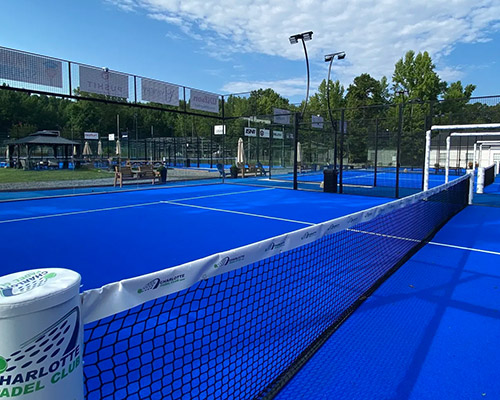
Indoor courts are installed inside enclosed buildings or sports halls.
Advantages
- Year-round operation
- Stable revenue generation
- Premium pricing potential
Business Insight
Indoor facilities typically achieve higher booking frequency due to weather independence.
Outdoor Padel Tennis Court Installation
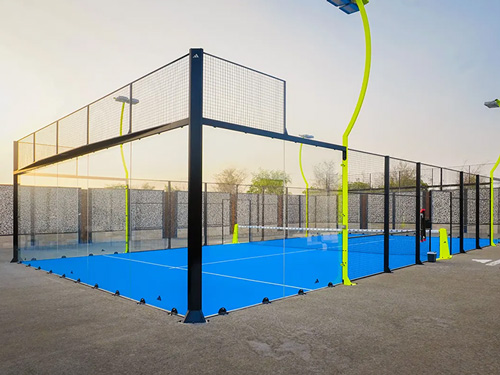
Open-Air Construction Concept
Outdoor courts are built in parks, resorts, and residential developments.
Advantages
- Lower initial investment
- Faster construction cycle
- Flexible land usage
Limitation
Weather conditions may affect utilization rate.
Panoramic Padel Tennis Court Installation System
High-End Glass Structure Concept
Panoramic courts use full glass walls instead of mesh fencing.
Commercial Advantages
- Premium visual appeal
- Higher tournament value
- Enhanced spectator experience
Padel Tennis Court Installation vs Traditional Tennis Court
Structural Comparison Table
| Feature | Padel Court | Tennis Court |
|---|---|---|
| Land requirement | ~200 m² | ~600+ m² |
| Enclosure system | Required | Not required |
| Construction complexity | High | Medium |
| Revenue density | High | Medium |
| User turnover rate | High | Lower |
Concept: Space Efficiency Monetization
Padel courts generate significantly higher revenue per square meter compared to tennis courts.
Padel Tennis Court Installation Construction Workflow
Stage 1: Site Evaluation
Engineering Concept
Site selection determines long-term stability and drainage performance.
Technical Requirements
- Flatness tolerance ≤ 0.5%
- Soil load-bearing capacity verification
- Drainage planning system
Stage 2: Foundation Construction
Reinforced Concrete Base Concept
A concrete slab provides the base for the entire system.
Technical Standards
- Thickness: 15–25 cm
- Reinforced steel mesh structure
- Drainage slope integration
Stage 3: Steel Structure Assembly
Frame Installation Concept
Steel components are assembled and anchored to the foundation.
Key Function
Ensures geometric accuracy and structural stability.
Stage 4: Glass & Fence Installation
Safety Integration System Concept
Glass panels and fencing are installed using anti-impact connectors.
Stage 5: Turf Installation
Surface Calibration Concept
Artificial turf is installed, leveled, and filled with silica sand.
Performance Result
Ensures consistent bounce and playing quality.
Market Growth Trends for Padel Tennis Court Installation
Global Expansion Concept
Padel is one of the fastest-growing sports globally.
- Europe: Mature leadership market
- Middle East: Luxury sports investment growth
- North America: Rapid emerging demand
Industry forecasts suggest continuous expansion driven by urban sports demand and real estate integration.
ROI Analysis for Padel Tennis Court Installation
Revenue Model Concept
Padel courts generate income through:
- Hourly rental fees
- Membership subscriptions
- Events and tournaments
Utilization Efficiency Concept
High booking frequency leads to faster return on investment compared to traditional sports facilities.
Supplier Selection Framework for Padel Tennis Court Installation
Engineering Capability Concept
Qualified suppliers must provide:
- Structural design capability
- Glass safety compliance
- Turf system integration
- Installation support
OEM Customization Concept
Customization options include:
- Brand identity integration
- Color system design
- Lighting configuration
Risk Management in Padel Tennis Court Installation
Structural Risk
Poor steel quality may cause deformation.
Surface Risk
Low-quality turf leads to inconsistent gameplay.
Drainage Risk
Poor design causes water accumulation.
Glass Risk
Improper installation creates safety hazards.
FAQ
What is Padel Tennis Court Installation?
It is a complete engineering process involving foundation, steel structure, glass walls, turf, and lighting system installation.
How much does a padel court cost in 2026?
Between €20,000 and €90,000 depending on system quality and configuration.
How long does installation take?
Typically 2–6 weeks depending on site conditions.
Which is better, indoor or outdoor courts?
Indoor offers stable revenue; outdoor has lower initial cost.
What is the lifespan of a padel court?
Steel: 15–20 years, turf: 5–8 years, lighting: 10+ years.
Conclusion
The global growth of Padel Tennis Court Installation reflects a strong shift toward compact, high-efficiency sports infrastructure. With increasing adoption across Europe, the Middle East, and North America, padel courts have become one of the most attractive commercial sports assets.
Success depends on:
- Proper structural engineering
- High-quality materials
- Reliable supplier selection
- Long-term operational planning
As global demand continues to expand, padel courts will remain a high-growth, high-utilization infrastructure investment in the sports real estate sector.