
Ratgeber
Hydraulic Basketball Hoop Buying Guide for Sports Facilities

Aktuelle Artikel
Inhaltsverzeichnis
Key points covered in this guide:
- How a Hydraulic Basketball Hoop works
- The differences between electric, manual, folding, and hydraulic-style systems
- How to select the correct extension arm length
- Why backboard material, rim height, padding, and counterweight matter
- Which basketball hoop is suitable for schools, clubs, and professional venues
- How much storage and court space a mobile basketball system requires
- What buyers should inspect before shipment and installation
- Which maintenance procedures support reliable hydraulic operation
A Hydraulic Basketball Hoop provides a practical combination of professional playing performance, height adjustment, mobility, and space-saving storage.
Compared with a permanently fixed basketball stand, a hydraulic model can normally be raised, lowered, moved, or folded through a manual or electric lifting system. This makes it suitable for indoor gymnasiums, training centres, schools, sports clubs, universities, and multi-purpose arenas.
However, hydraulic basketball systems vary significantly in structure, backboard thickness, extension arm length, counterweight, control method, padding, mobility, and intended competition level.
Buyers should therefore compare the complete equipment specification rather than choosing a model only by price or appearance.
What Is a Hydraulic Basketball Hoop?

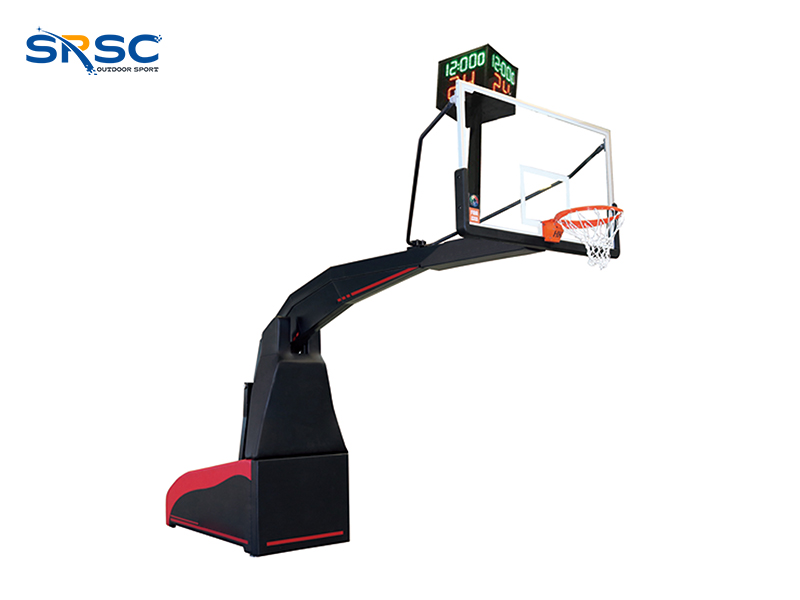
A Hydraulic Basketball Hoop uses a hydraulic cylinder, pump, or assisted lifting mechanism to control the movement of the support structure.
Depending on the model, the system may control:
- Raising the basketball support
- Lowering the support for storage
- Folding the extension arm
- Adjusting the rim height
- Extending or retracting transport wheels
- Locking the unit in its playing position
Main Components
A complete system may include:
- Steel base box
- Main upright arms
- Extension arm
- Hydraulic cylinder
- Manual or electric pump
- Tempered-glass backboard
- Basketball rim
- Net
- Protective padding
- Transport wheels
- Gegengewicht
- Optional shot clock
Concept: Backstop Unit
A backstop unit is the complete basketball goal assembly rather than only the rim and backboard.
It includes the support structure, base, backboard, rim, net, padding, stabilisation system, and related moving components.
Why Choose a Hydraulic Basketball Hoop?
Hydraulic basketball equipment can simplify court conversion and storage in facilities used for several sports or events.
Easier Setup
The lifting mechanism reduces the amount of manual force required to place a large basketball stand into its operating position.
This can help facility staff prepare courts more efficiently.
Space-Saving Storage
Folding basketball systems can reduce the amount of floor space required when the equipment is not in use.
This is useful in venues that also host:
- Volleyball
- Badminton
- Futsal
- Exhibitions
- School assemblies
- Community events
- Concerts
Professional Court Appearance
A commercial hydraulic system usually provides a larger extension arm, transparent glass backboard, padded base, and concealed counterweight.
These features create a more professional appearance than a lightweight recreational basketball stand.
Flexible Court Operation
Selected systems can support:
- Professional games
- Team training
- School competitions
- Youth coaching
- Multi-purpose gym use
- Club tournaments
Compare the Main Hydraulic Basketball Hoop Types
| Hoop Type | Lifting Method | Main Advantage | Suitable Facility |
|---|---|---|---|
| Electric hydraulic hoop | Motorised or microcomputer-controlled hydraulic system | Fast and convenient operation | Arenas and professional venues |
| Manual hydraulic hoop | Hand-operated hydraulic pump | Lower electrical dependence | Schools and training centres |
| Indoor folding hoop | Hydraulic system with folding structure | Efficient storage | Multi-purpose indoor halls |
| Hydraulic-style hoop | Assisted or fixed-height hydraulic design | Practical commercial configuration | Clubs and school gyms |
| Height-adjustable hoop | Manual or powered height adjustment | Supports younger players | Academies and schools |
| Electric folding hoop | Electric actuator controls folding | Rapid venue conversion | Competition arenas |
Elektrischer hydraulischer Basketballkorb
An electric model uses a powered hydraulic system or electronically controlled actuator.
Der SRSC Electric Hydraulic Basketball Hoop currently lists a microcomputer-controlled hydraulic lifting system, a 2.55-metre extension arm, a 12 mm ultra-clear tempered-glass backboard, and a 600 kg counterweight per unit.
This type can be suitable for:
- Professional arenas
- University gymnasiums
- Large sports centres
- Venues with frequent event changes
- Facilities requiring convenient staff operation
Manueller hydraulischer Basketballkorb
A manual model uses a hand pump and hydraulic cylinder.
It does not require the same powered lifting process as an electric system, making it useful where simple operation and reduced electrical dependence are priorities.
Der SRSC Manual Hydraulic Basketball Hoop currently uses a 2.55-metre extension arm, a 10 mm tempered-glass backboard, retractable wheels, full protective padding, and a 600 kg counterweight.
Manual Hydraulic Indoor Folding Hoop
An indoor folding system combines manual hydraulic lifting with a structure designed to occupy less storage space.
SRSC’s Manual Hydraulic Basketball Hoop for Indoor Folding currently lists a 3.25-metre extension arm, a 12 mm tempered-glass backboard, a manual hydraulic pump, and an 850 kg counterweight.
Basketballkorb im hydraulischen Stil
A hydraulic-style system may provide a simpler structure for schools, training centres, and commercial courts that do not require automated folding.
Der SRSC Hydraulic Style Basketball Hoop uses a 2.25-metre extension arm, a 10 mm tempered-glass backboard, and a 500 kg ballast requirement in its current specification.
Electric vs Manual Hydraulic Basketball Hoop

The lifting method affects convenience, purchase cost, maintenance, and venue operation.
Electric Hydraulic System
An electric system is generally more suitable when:
- Equipment is moved frequently
- Setup time is limited
- Staff need simple controls
- The venue hosts professional events
- Several basketball units must be prepared
Potential considerations include:
- Electrical supply
- Control-system maintenance
- Motor or actuator replacement
- Emergency manual operation
- Cable protection
- Staff training
Manual Hydraulic System
A manual system can be suitable when:
- Court conversion is less frequent
- The venue wants simpler controls
- Electrical access is limited
- Maintenance staff can operate a hand pump
- Initial budget is more controlled
Comparison Table
| Decision Factor | Electric Hydraulic | Manual Hydraulic |
| Operating effort | Lower | Higher |
| Setup speed | Generally faster | Depends on operator |
| Electrical supply | Required | Usually not required for lifting |
| Control complexity | Higher | Lower |
| Wartung | Hydraulic plus electrical | Primarily hydraulic and mechanical |
| Suitable venue | Arena and professional facility | School, club, or training centre |
| Initial cost | Generally higher | Generally lower |
| Emergency operation | Backup procedure required | Direct manual control |
Choose According to Operating Frequency
A venue changing its sports layout several times per week may benefit more from electric operation than a school that moves the equipment only occasionally.
Select the Correct Extension Arm Length
The extension arm determines the horizontal distance between the support base and the backboard.
Common commercial configurations may use arms around:
- 2.25 metres
- 2.55 metres
- 3.25 metres
Shorter Extension Arm
A shorter arm can reduce:
- Storage length
- Equipment weight
- Required floor area
- Structural complexity
It may suit school gyms and selected training courts.
Longer Extension Arm
A longer arm places the support base farther behind the endline.
This can improve player clearance and suit higher-level venue layouts, but it also requires:
- More floor space
- A larger support structure
- Greater counterweight
- More storage room
- Careful transport planning
Check the Complete Court Length
The equipment base and extension arm extend beyond the marked playing court.
SRSC’s current basketball products list minimum facility lengths ranging from approximately 34.4 metres to 36.7 metres depending on the model.
The buyer should mark the complete equipment footprint before placing an order.
Review the Basketball Backboard
The backboard affects ball response, visibility, safety, equipment weight, and court appearance.
Tempered-Glass Backboard
Tempered glass is commonly selected for competition and professional training equipment.
Its advantages may include:
- Clear visibility
- Professional appearance
- Consistent rebound
- Resistance to regular court use
- Compatibility with aluminium frames
Compare 10 mm and 12 mm Glass
SRSC’s current basketball range includes products using both 10 mm and 12 mm tempered-glass backboards.
| Backboard Specification | Possible Application |
| 10 mm tempered glass | Schools, training centres, standard commercial courts |
| 12 mm tempered glass | Professional arenas and higher-level competition systems |
| 12 mm glass with safety film | Facilities prioritising additional post-breakage protection |
| Acrylic or polycarbonate | Selected recreational or lower-level installations |
Glass thickness should be considered together with the frame, fixing method, support structure, and intended competition level.
Check the Backboard Dimensions
Professional buyers should confirm:
- Overall width
- Overall height
- Glass thickness
- Frame material
- Line markings
- Rim mounting plate
- Safety film
- Replacement procedure
- Packaging method
Verify Rim Height and Adjustment Range
A standard adult basketball rim is positioned at approximately 3.05 metres above the finished playing surface.
SRSC’s Hydraulic Style Basketball Hoop is currently specified with a 3.05-metre rim height, while the manual crank model can be adjusted from 1.4 metres to 3.05 metres.
Fixed Competition Height
A professional competition system should remain stable at the required playing height.
The locking mechanism should prevent unintended movement during use.
Height-Adjustable System
A height-adjustable hoop can support:
- Children
- Junior academies
- Beginner programmes
- School physical education
- Multi-age training
Der SRSC Manual Crank Height-Adjustable Basketball Hoop currently provides a rim-height range from 1.4 metres to 3.05 metres.
Avoid Adjusting Competition Equipment During Play
Height changes should be completed before the session begins.
Staff should confirm that all locks, cylinders, support arms, and wheels are returned to their approved operating positions.
Check the Rim and Net System
The rim experiences repeated impact from shots, rebounds, and dunking.
Professional Basketball Rim
Buyers should review:
- Rim diameter
- Steel specification
- Pressure-release mechanism
- Mounting plate
- Net attachment
- Coating
- Replacement availability
Pressure-Release Rim
A pressure-release rim can move downward under a defined load and then return to its normal position.
This helps reduce stress on the backboard and support structure during high-impact play.
Net Attachment
The net system should not contain:
- Sharp hooks
- Large finger gaps
- Exposed wire
- Loose connectors
- Damaged loops
Inspect the net and attachment points during routine court checks.
Evaluate Stability and Counterweight
A mobile Hydraulic Basketball Hoop must remain stable during play.
Why Counterweight Matters
The counterweight helps resist:
- Forward overturning
- Backboard vibration
- Impact at the rim
- Movement during play
- Dynamic forces during dunking
SRSC’s current range includes counterweights from approximately 500 kg to 850 kg per unit depending on the model and extension length.
Cement vs Steel Counterweight
| Counterweight Type | Main Advantage | Main Consideration |
| Cement ballast | Cost-effective and locally available | Requires correct casting and installation |
| Steel plate | Compact and accurately controlled | Higher material and shipping cost |
| Combined steel structure | Integrated with professional system | Greater equipment weight |
| Removable ballast blocks | Easier transport and replacement | Blocks must remain securely retained |
Confirm Whether Ballast Is Included
Some product prices include ballast, while others require the buyer to supply or purchase it separately.
The quotation should state:
- Counterweight material
- Required weight
- Quantity per unit
- Whether it is included
- Installation method
- Restraint system
Review the Mobile Wheel System
Mobile basketball systems require wheels that can support the complete equipment weight.
Wheel Functions
The wheel system may allow staff to:
- Move the hoop into storage
- Position it on the court
- Retract the wheels during play
- Raise the base above the floor
- Control movement direction
Check Floor Compatibility
Heavy basketball equipment may damage unsuitable sports flooring.
Facility managers should confirm:
- Wheel material
- Wheel width
- Load per wheel
- Turning method
- Floor-protection procedure
- Movement route
Do Not Move the Unit With Players Nearby
Only trained staff should move the equipment.
The route should remain clear of:
- Players
- Spectators
- Loose cables
- Floor transitions
- Doors
- Court furniture
Check Protective Padding
Padding protects players who collide with the base, upright arms, or backboard edges.
Areas Requiring Protection
A complete system may include padding around:
- Base box
- Front upright
- Extension arm
- Backboard bottom edge
- Backboard side edges
- Exposed support areas
Padding Material
Ask about:
- Foam density
- Padding thickness
- Outer covering
- Attachment method
- Fire performance where required
- Cleaning
- Replacement covers
- Custom colours and logos
Inspect After Every Impact
Damaged padding may expose hard steel edges or create loose material.
It should be repaired or replaced before normal play resumes.
Consider Folding and Storage Space
The equipment must fit through the storage route as well as inside the storage room.
Measure the Folded Dimensions
Request:
- Folded length
- Folded width
- Folded height
- Total weight
- Turning radius
- Wheel position
- Minimum door size
Check the Storage Route
Inspect:
- Door width
- Door height
- Corridor width
- Floor slopes
- Elevators
- Thresholds
- Fire doors
- Storage-room columns
Elektrischer, klappbarer Basketballkorb
Der SRSC Electric Folding Basketball Hoop currently uses a microcomputer-controlled electric actuator, a 3.25-metre extension arm, and a 12 mm tempered-glass backboard.
This configuration may suit arenas that convert frequently between basketball and other events.
Match the Hoop to the Facility
Professional Arena
Priorities may include:
- FIBA-approved equipment
- Electric operation
- Long extension arm
- 12 mm safety glass
- Shot-clock integration
- Heavy counterweight
- Complete padding
- Fast court conversion
FIBA maintains an approval programme for basketball equipment, including backstop units, flooring, lighting, scoreboards, and related venue systems. Approved products undergo independent testing through accredited institutes.
University and Training Centre
A manual or electric hydraulic model may be suitable depending on event frequency and staffing.
Buyers should prioritise:
- Haltbarkeit
- Reliable height
- Safe padding
- Storage
- Replacement parts
- Easy movement
School Gymnasium
A school may benefit from:
- Manual hydraulic operation
- Adjustable rim height
- Protective padding
- Simple controls
- Lockable adjustment
- Reduced storage footprint
Multi-Purpose Sports Hall
A folding system is often valuable when the building hosts several activities.
The equipment should be movable without damaging the hardwood or synthetic sports floor.
Basketball Hoop Model Comparison
| Modelltyp | Extension Arm | Rückwand | Gegengewicht | Main Use |
| Electric hydraulic | 2,55 m | 12 mm tempered glass | 600 kg | Professional venues |
| Manual hydraulic | 2,55 m | 10 mm tempered glass | 600 kg | Schools and clubs |
| Manual indoor folding | 3,25 m | 12 mm tempered glass | 850 kg | Multi-purpose arenas |
| Hydraulic style | 2,25 m | 10 mm tempered glass | 500 kg | Training centres |
| Electric folding | 3,25 m | 12 mm tempered glass | Model-specific | Competition arenas |
| Manual height-adjustable | 0.6–1.1 m adjustable arm | Model-specific | 300 kg optional | Junior and school use |
Specifications should be confirmed in the final quotation because product configurations and optional equipment may vary.
Request a Complete Supplier Quotation
A useful quotation should identify more than the product name.
Equipment Specification
Request:
- Product model
- Base dimensions
- Extension length
- Rim height
- Adjustment range
- Steel profiles
- Backboard size
- Backboard thickness
- Rim type
- Hydraulic system
- Wheel system
- Gegengewicht
- Polsterung
- Shot-clock compatibility
Commercial Information
Confirm:
- Price per unit or pair
- Packaging
- Delivery terms
- Production time
- Freight
- Installation
- Training
- Spare parts
- Warranty
- After-sales support
Optional Accessories
Possible options include:
- Shot clocks
- Electronic controls
- Custom padding
- Team logos
- Custom colours
- Floor anchors
- Spare nets
- Spare hydraulic seals
- Replacement wheels
Inspect the Hoop Before Shipping
Factory Inspection Checklist
| Inspection Area | What to Confirm |
| Steel structure | Correct profiles, welding, and alignment |
| Hydraulic system | Smooth lifting without leakage |
| Folding operation | Complete movement without interference |
| Rückwand | Correct size, thickness, and finish |
| Rand | Secure mounting and correct position |
| Polsterung | Complete coverage and secure attachment |
| Wheels | Smooth movement and correct retraction |
| Gegengewicht | Correct quantity and restraint |
| Controls | Buttons, switches, and emergency functions |
| Coating | Complete and free from major damage |
| Labels | Match the model and package list |
| Accessories | Nets, bolts, tools, and optional equipment included |
Test the Complete Operating Cycle
The supplier should demonstrate:
- Storage position
- Movement position
- Raising process
- Playing position
- Locking process
- Lowering process
- Return to storage
A short video record can help the buyer verify operation before shipment.
Install and Commission the Equipment
Prepare the Sports Floor
Before moving the hoop into position, confirm:
- Floor strength
- Surface condition
- Court markings
- Endline position
- Available run-off space
- Equipment route
- Storage access
Set the Rim Height
Measure from the finished sports floor to the top edge of the rim.
Complete the measurement after the equipment is fully lowered into its playing position.
Check the Backboard Position
Verify:
- Horizontal alignment
- Vertical alignment
- Distance from the endline
- Parallel position
- Rim centre
- Backboard vibration
Secure the Playing Position
Confirm that:
- Wheels are retracted
- Brakes or locks are engaged
- Ballast is installed
- Floor anchors are used where required
- Hydraulic controls are locked
- Padding is attached
FIBA’s venue guidance states that mobile or floor-fixed support units should be secured against movement and that sufficient unobstructed space and protective padding should be provided around the backstop area.
Maintain a Hydraulic Basketball Hoop
Daily Visual Checks
Before use, inspect:
- Rückwand
- Rand
- Net
- Polsterung
- Base
- Hydraulic hoses
- Visible oil leakage
- Wheels
- Locks
- Floor contact
Monthly Technical Checks
Depending on usage, review:
- Hydraulic fluid
- Cylinder condition
- Hose connections
- Pivot points
- Bolts
- Welds
- Wheel bearings
- Control switches
- Electrical cables
- Counterweight restraints
Annual Professional Inspection
A more detailed inspection may include:
- Structural alignment
- Backboard support
- Hydraulic pressure
- Electrical system
- Rim mechanism
- Padding performance
- Fastener torque
- Corrosion
- Floor anchors
Keep a Maintenance Record
Record the date, equipment number, inspection result, repairs, replacement parts, and responsible technician.
Repeated hydraulic leakage or alignment changes should be investigated rather than treated as routine appearance issues.
Common Hydraulic Basketball Hoop Buying Mistakes
Choosing Only by Price
A low quotation may exclude counterweights, padding, wheels, shot clocks, installation, or spare parts.
Ignoring the Required Court Length
The base and extension arm need additional space behind the endline.
Ordering a Hoop That Cannot Enter the Building
Check delivery doors, corridors, turning space, and storage access.
Selecting Manual Operation for Frequent Conversions
Repeated venue changes may justify an electric system.
Failing to Protect the Sports Floor
Heavy equipment and concentrated wheel loads can damage unsuitable flooring.
Assuming Every Model Is Competition Approved
Confirm the exact model, approval level, certificate, and validity rather than relying on a general company statement.
Ignoring Replacement Parts
Hydraulic seals, wheels, nets, padding covers, controls, and electrical components may eventually require replacement.
Abschluss
Selecting a Hydraulic Basketball Hoop requires a complete review of the lifting system, extension arm, backboard, rim, padding, counterweight, wheels, storage space, court dimensions, and intended competition level.
Electric hydraulic systems are suitable for facilities requiring frequent and efficient court conversion. Manual hydraulic systems provide a practical solution for schools, training centres, and clubs. Folding systems can help multi-purpose venues recover valuable floor space when basketball is not in use.
Buyers should confirm every included component before ordering and request drawings, operating videos, inspection records, packaging details, spare-parts information, and written warranty terms.
SRSC offers electric folding, electric hydraulic, manual hydraulic, hydraulic-style, and height-adjustable basketball systems. Buyers can explore the complete Basketball Stand product range, compare the Elektrischer hydraulischer Basketballkorb with the Manueller hydraulischer Basketballkorb, oder contact SRSC with the venue dimensions, court level, equipment quantity, and installation requirements.
Häufig gestellte Fragen
What is a Hydraulic Basketball Hoop?
It is a basketball support system that uses hydraulic assistance to raise, lower, fold, or adjust the hoop structure.
Is an electric or manual hydraulic hoop better?
Electric systems are more convenient for frequent venue changes. Manual systems are simpler and may cost less to operate and maintain.
How high is a standard basketball rim?
A standard adult basketball rim is approximately 3.05 metres above the finished playing surface.
How much counterweight does a basketball hoop need?
It depends on the structure and extension arm. SRSC’s current commercial models list counterweights from approximately 500 kg to 850 kg per unit.
Is a 10 mm or 12 mm backboard better?
The correct thickness depends on the equipment design and intended use. Professional systems commonly use heavier safety-glass configurations, while selected school and training models may use 10 mm tempered glass.
Can a hydraulic hoop be moved by one person?
This depends on total weight, wheel design, floor condition, and manufacturer instructions. Large professional systems should be moved by trained staff using the approved procedure.
Can the rim height be adjusted for children?
Selected height-adjustable models can reduce the rim height for junior training. Competition models may remain fixed at the standard playing height.
Does the basketball hoop include a shot clock?
Not always. SRSC lists single-sided, three-sided, and four-sided shot-clock configurations as optional on selected professional models.
What information should I send to the supplier?
Provide the venue type, court dimensions, competition level, floor material, storage space, door size, preferred lifting method, backboard requirement, shot-clock requirement, and delivery location.