
BLOG
Outdoor Intelligent Gym Buying Guide for Public Spaces
Recent Articles
Table of Contents
Key points covered in this guide:
- What makes an Outdoor Intelligent Gym different from traditional fitness equipment
- Which smart functions provide practical value to users and operators
- How to select cardio, strength, mobility, and assessment stations
- Why solar power, displays, lighting, and data transmission require coordinated planning
- How to determine equipment quantity, layout, and safe circulation
- Which materials and coatings suit outdoor environments
- What buyers should verify about foundations, installation, and accessibility
- How to create a realistic inspection and maintenance programme
An Outdoor Intelligent Gym combines weather-resistant fitness equipment with features such as exercise tracking, digital displays, voice guidance, adjustable resistance, solar power, lighting, and wireless data transmission.
It can be installed in parks, residential communities, schools, hotels, business campuses, sports centres, and municipal recreation areas. Unlike a conventional indoor gym, an outdoor facility can give users direct access to exercise without requiring a fully enclosed building.
However, adding screens or solar panels does not automatically create a successful smart gym. The project must also consider user groups, exercise variety, accessibility, safe circulation, foundations, drainage, corrosion protection, data management, maintenance, and long-term replacement parts.
This guide explains how public-space planners, developers, distributors, contractors, and facility operators can evaluate an Outdoor Intelligent Gym before purchasing equipment.
What Is an Outdoor Intelligent Gym?
An Outdoor Intelligent Gym is a collection of outdoor exercise stations that incorporates digital, electrical, mechanical, or data-based features.
Depending on the equipment, these functions may include:
- Exercise-duration tracking
- Repetition counting
- Calorie estimates
- Resistance adjustment
- Heart-rate testing
- Grip-strength testing
- Voice guidance
- Digital instruction displays
- Wireless data transmission
- Solar-powered lighting
- Mobile-device charging
- Smart-terminal connection
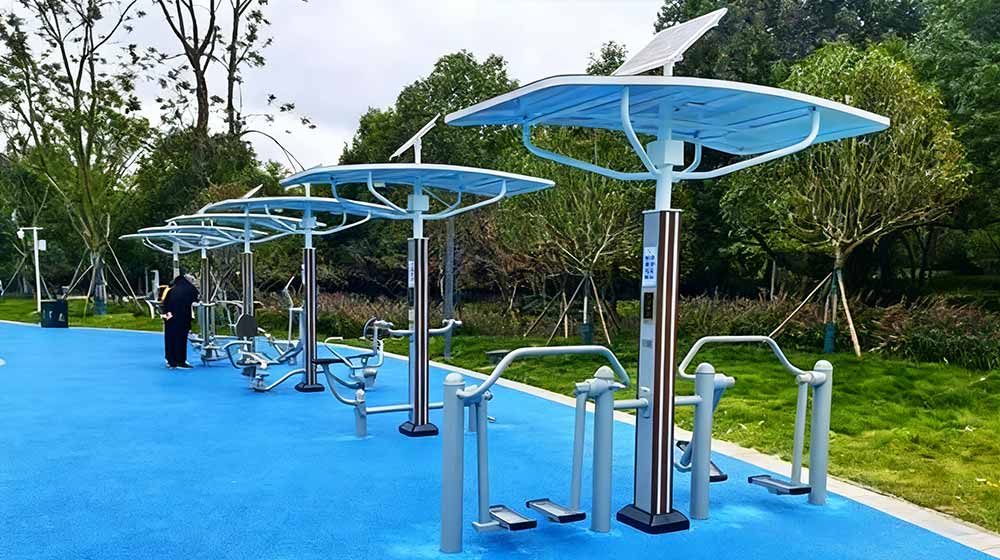
The SRSC Outdoor Fitness Equipment system currently combines solar generation, LED lighting, exercise testing, wireless charging, data collection, voice broadcasting, and smart-terminal access within an outdoor structure. Its listed main materials include steel, aluminium, plastic wood, aluminium-plastic panels, and tempered glass.
Traditional Outdoor Equipment
Traditional outdoor equipment normally uses simple mechanical movement without electronic tracking.
Its advantages may include:
- Straightforward operation
- Lower electrical complexity
- Limited software requirements
- Easier maintenance
- Lower initial investment
Intelligent Outdoor Equipment
Intelligent equipment adds feedback, resistance controls, displays, or connected features.
It may help users understand how long they exercised, how many repetitions they completed, or which movement the machine is designed to support.
Concept: Smart Functionality
Smart functionality is a feature that improves instruction, measurement, control, maintenance, or user interaction.
A screen that only plays promotional content may not provide the same practical value as a system that explains exercises, records use, or helps operators identify equipment problems.
Why Develop an Outdoor Intelligent Gym?
The World Health Organization identifies regular physical activity as important for health and includes recreational and community settings within broader efforts to increase physical activity.
The CDC also recommends improving access to places where people can be active, including parks and recreation facilities. Such spaces can support people with different mobility levels and health needs when they are designed appropriately.
Increase Access to Exercise
An Outdoor Intelligent Gym can place exercise equipment near:
- Residential areas
- Walking paths
- Public parks
- Schools
- Senior-living communities
- Office campuses
- Hotels
- Sports venues
Users do not need to enter a conventional fitness club before using the basic stations.
Support Self-Guided Exercise
Digital instructions and voice guidance can help people understand:
- Starting position
- Movement direction
- Repetition method
- Intended muscle group
- Session duration
These features do not replace professional medical or fitness advice, but they can make basic equipment easier to understand.
Extend Public-Space Functions
A smart gym can turn an underused park area into a multi-purpose recreation zone.
It may complement:
- Walking tracks
- Children’s play areas
- Basketball courts
- Padel Courts
- Community plazas
- Public-health programmes
- Outdoor classrooms
Identify the Main User Groups
Equipment selection should reflect the people expected to use the facility.
General Adult Users
A balanced public gym may provide low-to-moderate intensity stations for:
- Lower-body exercise
- Upper-body exercise
- Cardio movement
- Mobility
- Balance
- Core training
Simple instructions and intuitive movement are especially important in unsupervised settings.
Older Adults
Older users may value:
- Stable handles
- Controlled movement
- Comfortable seating
- Lower starting resistance
- Clear displays
- Rest areas
- Short walking distances
The project should not assume that every older user has the same ability or exercise needs.
Teenagers and Students
School and youth facilities may use equipment for:
- Physical-education activities
- Fitness assessment
- General conditioning
- Group exercise
- After-school recreation
Age limits and applicable equipment standards should be confirmed before installation.
Experienced Fitness Users
More active users may prefer:
- Adjustable resistance
- Repetition tracking
- Cardio stations
- Strength trainers
- Performance displays
A public smart gym should still prioritize controlled, understandable movement rather than trying to reproduce every machine found in a supervised commercial gym.
Build a Balanced Equipment Mix
A successful Outdoor Intelligent Gym should not consist entirely of similar lower-body machines or identical two-person stations.
Cardio Equipment
Cardio-oriented stations may include:
- Air walkers
- Outdoor exercise bikes
- Rowing-style trainers
- Steppers
- Elliptical-style machines
These machines can support continuous rhythmic movement.
Upper-Body Strength Equipment
Possible options include:
- Chest press
- Pull-down trainer
- Shoulder rotation station
- Back trainer
- Push-and-pull trainer
The SRSC Intelligent Double-Position Pull Down Trainer is designed as a two-user station for upper-limb and back exercise. Its published dimensions are approximately 2418 × 1220 × 3211 mm.
Lower-Body Equipment
Possible lower-body stations include:
- Leg press
- Pedal trainer
- Leg curl trainer
- Horse-riding machine
- Pendulum trainer
The SRSC Intelligent Double-Position Pedal accommodates two users and uses repeated leg flexion and extension as its main movement.
Mobility and Coordination Equipment
Mobility stations may support:
- Shoulder rotation
- Waist movement
- Controlled stretching
- Joint mobility
- Balance practice
Fitness Assessment Station
A central assessment unit may measure or display selected information such as:
- Height
- Grip strength
- Exercise duration
- Repetition count
- Heart-rate information
- Basic performance results
These functions should be explained clearly, and any results should not be presented as medical diagnoses.
Compare Traditional and Intelligent Outdoor Fitness Equipment
| Comparison Area | Traditional Equipment | Intelligent Equipment |
|---|---|---|
| Exercise guidance | Printed sign | Screen, voice, or digital instruction |
| Activity tracking | Usually unavailable | Time and repetition data may be displayed |
| Resistance | Fixed or bodyweight-based | Fixed, hydraulic, or electronically adjustable |
| Power supply | Normally none | Solar, battery, or wired power may be needed |
| Maintenance | Primarily mechanical | Mechanical, electrical, and software |
| User interaction | Basic | More engaging and measurable |
| Operator data | Limited | Selected systems may transmit usage data |
| Purchase cost | Generally lower | Generally higher |
| Replacement parts | Mainly mechanical | Mechanical and electronic parts |
| Nighttime use | Separate lighting required | Integrated lighting may be available |
Should Every Station Be Intelligent?
Not necessarily.
A project may combine:
- Intelligent feature stations
- Traditional stretching equipment
- Simple bodyweight equipment
- Benches
- Walking paths
- Accessible open space
A mixed layout can control costs while providing a visible smart-fitness centre.
Evaluate Smart Features Carefully
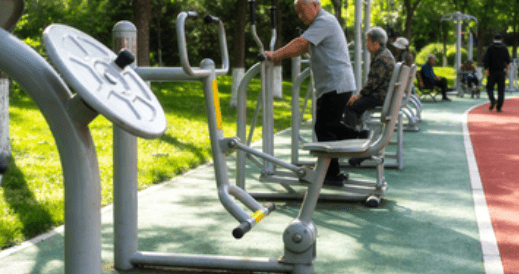
Buyers should understand what each digital function actually does.
Exercise Data Display
A display may show:
- Time
- Repetitions
- Calories
- Resistance level
- Movement instructions
The operator should ask how the information is calculated and whether calibration is required.
Voice Guidance
Voice broadcasting can help users understand the exercise sequence.
Confirm:
- Available languages
- Volume adjustment
- Quiet-hour controls
- Replacement speaker
- Weather resistance
- Software update method
Wireless Data Transmission
Wireless transmission may allow selected exercise or equipment data to appear on a fixed display or management terminal.
Before purchasing, confirm:
- What data is collected
- Where it is stored
- Who can access it
- Whether personal registration is required
- Network requirements
- Subscription fees
- Offline operation
- Data-retention policy
Concept: Useful Data
Useful data supports a specific operating decision.
For example, equipment-use frequency may help an operator plan maintenance or understand which station receives the most attention. Collecting large amounts of data without a management purpose may add cost without improving the facility.
Plan Solar Power and Electrical Systems
Smart outdoor equipment may use photovoltaic panels to support displays, lighting, charging, or low-voltage controls.
Solar Power Advantages
A solar-supported system may reduce dependence on a nearby grid connection for selected functions.
It can be useful in:
- Parks
- Remote recreation areas
- Large campuses
- Public plazas
- Sites where trenching is difficult
Solar Power Limitations
Actual energy production depends on:
- Solar exposure
- Panel orientation
- Shade
- Weather
- Battery capacity
- Equipment demand
- Cleaning
- Seasonal conditions
Trees, buildings, canopies, and advertising signs should not shade the solar panels unexpectedly.
Low-Voltage Operation
SRSC’s integrated Outdoor Fitness Equipment currently lists a DC 12V operating system for its smart functions.
The project should still confirm:
- Battery specification
- Controller
- Wiring
- Weatherproof connectors
- Overcurrent protection
- Earthing requirements
- Local electrical compliance
- Emergency isolation
Grid-Connected Backup
A grid connection may be considered when the facility requires reliable:
- Night lighting
- Continuous displays
- Network equipment
- Charging
- Security cameras
The electrical strategy should be agreed before foundations and paving are completed.
Review Resistance Systems
Smart outdoor fitness machines may use several resistance methods.
Bodyweight Resistance
The user moves part of their own bodyweight.
This system is mechanically simple but may not provide an adjustable training level.
Hydraulic Resistance
A hydraulic cylinder creates controlled resistance during movement.
It can provide smoother operation and may reduce uncontrolled speed.
Electromagnetic Resistance
Electromagnetic systems allow resistance to be changed through buttons or electronic controls.
The SRSC Outdoor Intelligent Gym Seated Leg Curl Trainer currently combines hydraulic and electromagnetic resistance with seven adjustable levels. Its display can show exercise time, repetition count, and estimated calories.
Compare Resistance Options
| Resistance Type | Main Advantage | Main Maintenance Area |
| Bodyweight | Simple and intuitive | Bearings and pivots |
| Fixed mechanical | Predictable movement | Wear and lubrication |
| Hydraulic | Smooth controlled resistance | Cylinder, seals, and leakage |
| Electromagnetic | Adjustable training levels | Electronics, controls, and power |
| Combined system | Wider functional range | Mechanical and electrical systems |
Select Durable Outdoor Materials
An Outdoor Intelligent Gym is exposed to weather and repeated public use.
Structural Steel
Ask the supplier to state:
- Steel grade
- Profile dimensions
- Wall thickness
- Welding method
- Surface preparation
- Coating system
- Base-plate design
- Anchor requirements
SRSC’s integrated smart-gym structure currently lists 150 × 150 × 3 mm main support columns and 50 × 150 × 3 mm support beams.
Aluminium and Composite Panels
Aluminium and aluminium-plastic panels may be used for:
- Canopies
- Equipment covers
- Decorative panels
- Display housings
- Solar-support structures
Plastic Wood
Plastic wood can be used for selected platforms, seats, or decorative surfaces.
Buyers should review:
- UV resistance
- Expansion
- Slip resistance
- Fasteners
- Cleaning
- Replacement colour
Tempered Glass
Tempered glass may be used around smart displays or fitness-testing modules.
It should be positioned and protected so that users, maintenance staff, and moving equipment do not create unnecessary impact risk.
Compare Coating and Corrosion Protection
Outdoor steel should not be specified only as “painted.”
Surface Preparation
A proper coating system begins with:
- Degreasing
- Cleaning
- Rust removal
- Shot blasting or another approved preparation method
- Drying
- Controlled coating application
SRSC describes a degreasing, shot-blasting, and electrostatic-spraying process for its Outdoor Fitness Equipment system.
Powder Coating
Powder coating can provide:
- Colour
- Barrier protection
- Wear resistance
- Consistent appearance
The buyer should confirm coating repair materials for scratches caused during shipping or installation.
Coastal Projects
Coastal installations may require additional review of:
- Galvanizing
- Powder coating
- Stainless or coated fasteners
- Salt cleaning
- Electrical enclosures
- Hidden water traps
- Inspection frequency
Review Applicable Safety Standards
Outdoor public fitness equipment may be used without direct staff supervision, making equipment design and installation especially important.
ASTM F3101-21a establishes design and manufacturing parameters for permanently anchored outdoor fitness equipment intended for unsupervised public settings. Its stated scope covers users aged 13 and older and is intended to reduce the likelihood of serious injury.
Confirm the Destination-Market Requirements
Depending on the project, applicable requirements may address:
- Entrapment
- Crushing and shearing points
- Moving-component clearances
- Structural stability
- Anchorage
- User instructions
- Age suitability
- Fall areas
- Surfacing
- Accessibility
- Inspection
The buyer should ask the supplier which exact standard and product model have been tested.
Do Not Accept General Certification Claims
A supplier may hold several company certificates, but this does not automatically prove that every equipment model meets every local requirement.
Request:
- Standard number
- Test report
- Product model
- Issue date
- Testing organization
- Scope
- Validity
- Destination-market relevance
Plan the Equipment Layout
The project should be designed as an exercise space rather than a row of machines placed wherever paving is available.
Create Functional Zones
Possible zones include:
- Warm-up
- Cardio
- Upper-body exercise
- Lower-body exercise
- Mobility
- Fitness assessment
- Rest and hydration
Allow Clear Circulation
Users should be able to move between stations without entering the moving range of another machine.
The layout should also consider:
- Wheelchairs
- Maintenance carts
- Emergency access
- Supervising adults
- Benches
- Lighting
- Landscaping
Avoid Overcrowding
A large quantity of equipment does not automatically create a better facility.
Overcrowding may cause:
- Conflicting movement zones
- Poor visibility
- Difficult cleaning
- Limited accessibility
- Higher maintenance
- Confusing circulation
Consider Dual-User Equipment
Two-position stations can increase simultaneous capacity without doubling the number of structures.
The SRSC Intelligent Double-Position Rower is designed for two users and has published dimensions of approximately 2418 × 1387 × 3211 mm.
Select a Suitable Site
Public Park
A park location should connect naturally with walking routes, entrances, lighting, and other recreation facilities.
Residential Community
Residential projects should consider:
- Distance from homes
- Operating hours
- Lighting
- Noise
- Children’s access
- Property-management responsibility
School Campus
School facilities need:
- Age-appropriate equipment
- Supervision policies
- Controlled access
- Safe routes
- Suitable surfacing
- Clear instructions
Hotel or Resort
A resort may prioritize:
- Appearance
- Shade
- Multilingual guidance
- Guest accessibility
- Coastal corrosion protection
- Integration with landscaping
Corporate Campus
Corporate sites may use an Outdoor Intelligent Gym for employee wellness and organised activity programmes.
The equipment should remain separate from vehicle routes, loading areas, and restricted operations.
Prepare the Ground and Foundations
Intelligent outdoor equipment needs stable foundations for both structural and electrical reasons.
Foundation Information
Request drawings showing:
- Equipment footprint
- Anchor positions
- Foundation dimensions
- Embedment
- Concrete requirements
- Finished level
- Cable conduits
- Drainage
- Installation clearances
SRSC currently lists an embedded foundation size of 800 × 800 × 700 mm for the main support system of its integrated Outdoor Fitness Equipment. The final foundation should still be verified for the selected model and actual project conditions.
Avoid Water Accumulation
The finished surface should direct water away from:
- Base plates
- Electrical cabinets
- Screens
- Charging systems
- User standing areas
Install Conduits Before Paving
Power, data, lighting, or security cables should be planned before concrete and paving are completed.
Late cutting can damage the finished landscape and create uncontrolled cable routes.
Choose the Right Safety Surfacing
The surface should suit the equipment, fall potential, drainage, accessibility, and local requirements.
Possible options include:
- Poured rubber
- Rubber tiles
- Synthetic sports surfacing
- Engineered wood fibre
- Artificial turf over a suitable base
- Textured concrete in approved low-risk zones
Surfacing Selection Factors
Compare:
- Impact performance
- Slip resistance
- Drainage
- Wheelchair access
- Heat
- Cleaning
- Vandalism resistance
- Repair method
- Lifecycle cost
The equipment and surfacing specifications should be reviewed together.
Plan Shade, Lighting, and User Comfort
Integrated Shade
A canopy can improve comfort in sunny climates.
The roof or shade system should be checked for:
- Wind loads
- Drainage
- Solar-panel position
- Height
- Column placement
- Corrosion protection
Night Lighting
Integrated LED lighting can extend operating hours.
The lighting design should avoid:
- Dark steps
- Glare
- Strong residential light spill
- Unlit access routes
- Hidden equipment edges
Seating and Water
Provide nearby:
- Benches
- Drinking water
- Waste bins
- Bicycle parking
- Shade
- Emergency information
These supporting facilities can influence whether people remain in and repeatedly use the space.
Evaluate Accessibility and Inclusive Design
An inclusive Outdoor Intelligent Gym should offer more than a wide path at the entrance.
Accessible Route
The route should provide:
- Stable surfacing
- Suitable width
- Controlled slopes
- Clear turning space
- Step-free access
- Connections to parking or pathways
Equipment Variety
Not every station will suit every user.
A more inclusive mix may include:
- Seated stations
- Standing stations
- Upper-body equipment
- Lower-body equipment
- Low-resistance options
- Open exercise space
Clear Instructions
Instructions should use:
- Large text
- Simple diagrams
- High contrast
- Multiple languages where necessary
- QR codes as a supplement, not the only method
Check Data Privacy and Software Responsibility
Connected equipment may collect usage or account information.
Ask What Data Is Collected
Distinguish between:
- Anonymous repetition counts
- Equipment operating hours
- Device-identification data
- User accounts
- Health-related data
- Location data
Confirm System Ownership
The contract should explain:
- Who owns the data
- Who hosts the platform
- Who maintains the software
- Whether fees apply
- How updates are installed
- What happens if the platform closes
- Whether the equipment works offline
Limit Unnecessary Collection
A public fitness station does not need to collect personal information simply because the technology allows it.
The system should collect only the information required for its intended function and comply with applicable privacy requirements.
Compare the Complete Project Cost
The equipment price is only one part of the project.
| Cost Category | Possible Items |
| Equipment | Smart stations, displays, testing modules |
| Power | Solar panels, batteries, controllers, grid connection |
| Civil work | Foundations, excavation, concrete, conduits |
| Surfacing | Rubber, synthetic surface, drainage |
| Site facilities | Benches, lighting, water, signs |
| Logistics | Freight, customs, unloading, storage |
| Installation | Labour, lifting, commissioning |
| Software | Platform, configuration, subscriptions |
| Maintenance | Cleaning, coating repairs, hydraulic parts |
| Replacement | Screens, sensors, batteries, speakers |
| Operations | Inspection, data management, public programmes |
Compare Lifecycle Cost
A lower-priced system may require more frequent:
- Battery replacement
- Coating repair
- Screen replacement
- Hydraulic maintenance
- Software support
- Imported spare parts
Ask for the expected maintenance and replacement requirements before purchasing.
Inspect the Equipment Before Shipping
Factory Inspection Checklist
- Equipment model matches the order
- Dimensions match the drawings
- Welds are complete
- Moving parts operate smoothly
- Resistance settings function
- Displays turn on
- Sensors record correctly
- Voice guidance works
- Solar charging operates
- Batteries hold power
- Lighting works
- Coating is complete
- Labels and instructions are correct
- Hardware is included
- Spare parts are identified
Request a Functional Video
The video can demonstrate:
- Startup
- User instruction
- Exercise movement
- Data collection
- Resistance adjustment
- Voice output
- Lighting
- Shutdown or standby
Maintain an Outdoor Intelligent Gym
Daily or Frequent Checks
Staff should look for:
- Broken screens
- Loose handles
- Unusual movement
- Hydraulic leakage
- Damaged seats
- Exposed wires
- Standing water
- Vandalism
- Sharp coating damage
Monthly Technical Checks
Review:
- Bolts
- Anchors
- Bearings
- Pivots
- Hydraulic cylinders
- Electrical connections
- Solar panels
- Battery status
- Lighting
- Display operation
- Data transmission
Seasonal Maintenance
Before severe weather seasons, inspect:
- Drainage
- Coating
- Foundations
- Canopies
- Solar supports
- Electrical enclosures
- Water seals
Keep a Fault-Reporting System
Each station should have:
- Equipment number
- QR code or contact information
- Simple fault-reporting method
- Maintenance record
- Closure procedure
A damaged machine should be taken out of service until the relevant issue is assessed and corrected.
Common Outdoor Intelligent Gym Buying Mistakes
Purchasing Technology Without an Operating Plan
Screens and sensors create little value when no one maintains or uses the data.
Selecting Too Many Similar Machines
A balanced facility should include cardio, strength, mobility, and accessible options.
Ignoring Software Fees
Platform subscriptions and future updates may affect lifecycle cost.
Installing Under Heavy Shade
Solar panels may not receive enough energy.
Forgetting Replacement Batteries
Battery availability and replacement procedures should be confirmed before purchase.
Placing Equipment Too Close Together
Moving components and user circulation need adequate separation.
Using Indoor Electronics Outdoors
Displays, connectors, speakers, and control units need appropriate environmental protection.
Ignoring Local Safety Requirements
The project should verify the standards and regulations applicable at the destination.
Conclusion
An Outdoor Intelligent Gym should be planned as a complete public fitness environment rather than a collection of digital exercise machines.
Buyers should begin by identifying the target users and selecting a balanced combination of cardio, strength, mobility, assessment, and accessible stations. Smart functions such as exercise tracking, voice guidance, adjustable resistance, solar power, lighting, and wireless transmission should each have a clear operating purpose.
The project must also coordinate equipment standards, foundations, safety surfacing, corrosion protection, drainage, electrical systems, software, data privacy, accessibility, spare parts, and maintenance.
SRSC provides integrated smart-gym structures and individual intelligent outdoor exercise stations for parks, communities, campuses, hotels, and municipal projects. Buyers can explore the Outdoor Smart Gym range, review the complete Outdoor Sports Equipment collection, compare the Intelligent Double-Position Rower and Intelligent Double-Position Pedal, or contact SRSC with the site plan, target users, equipment quantity, power requirements, and installation location.
FAQ
What is an Outdoor Intelligent Gym?
It is an outdoor fitness facility that combines exercise equipment with functions such as displays, activity tracking, adjustable resistance, voice guidance, lighting, solar power, or wireless data transmission.
Is intelligent outdoor equipment better than traditional equipment?
It can provide more guidance and data, but it also costs more and requires electrical, software, and component maintenance. The best solution depends on the project.
Can an Outdoor Intelligent Gym use solar power?
Yes. Solar power can support selected low-voltage functions, although capacity depends on sunlight, battery design, shade, weather, and equipment demand.
What equipment should a smart outdoor gym include?
A balanced project may include cardio, upper-body, lower-body, mobility, fitness-testing, and accessible stations.
Does outdoor fitness equipment need a foundation?
Permanent public equipment normally requires secure anchoring. The correct foundation depends on the model, soil, loads, and local requirements.
Which safety standard covers public outdoor fitness equipment?
ASTM F3101-21a covers permanently anchored outdoor fitness equipment intended for unsupervised public use in its stated scope. Other countries and projects may apply different standards.
Can the equipment collect personal data?
Some connected systems can, but buyers should confirm what is collected, who controls it, where it is stored, and which privacy requirements apply.
How often should an Outdoor Intelligent Gym be inspected?
Inspection frequency depends on usage, environment, manufacturer instructions, and local requirements. Frequent visual checks and scheduled technical inspections are advisable.
Does SRSC provide smart outdoor fitness equipment?
SRSC currently offers an integrated Outdoor Fitness Equipment system and individual intelligent stations, including rowers, pedals, air walkers, pull-down trainers, chest presses, and assessment functions.