
BLOG
Outdoor Padel Court Drainage: A Practical Guide for Rainy Conditions
Recent Articles
Table of Contents
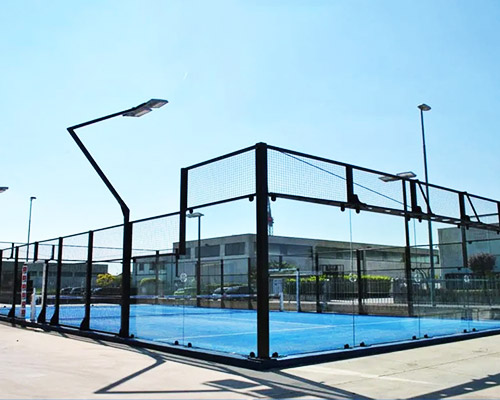
An Outdoor Padel Court is designed to operate under direct exposure to rain, humidity, dust, sunlight, and changing weather conditions. Among these environmental factors, water is one of the most important issues to control.
A court may use premium artificial turf, tempered glass, galvanized steel, and professional lighting, but poor drainage can still cause standing water, interrupted bookings, contaminated infill, algae growth, premature surface deterioration, and additional maintenance.
For sports clubs, schools, resorts, hotels, residential developments, and commercial padel investors, drainage should therefore be planned before foundation construction begins.
Key Takeaways
- Outdoor court drainage should be designed as a complete water-management system.
- Permeable artificial turf alone cannot prevent standing water.
- Surface levels, sub-base construction, perimeter channels, pipes, and final discharge points must work together.
- Local rainfall conditions should influence drainage capacity.
- Flatness and drainage slope are related but are not the same requirement.
- Water should be directed away from steel bases, electrical equipment, entrances, and surrounding buildings.
- Drainage systems should remain accessible for inspection and cleaning.
- Heavy-rainfall projects require more planning than courts in dry climates.
- Foundation and drainage drawings should be coordinated before concrete work starts.
Why Outdoor Padel Court Drainage Matters
Outdoor padel facilities need to return to service quickly after rainfall.
For commercial operators, every hour that a court remains flooded or unsafe can represent lost booking time.
Playing Availability
Standing water makes a playing surface unusable.
Even shallow puddles can affect player movement, ball bounce, traction, and infill distribution.
Commercial Impact
Imagine a four-court commercial club during a rainy weekend.
If poor drainage keeps all four courts closed several hours longer than necessary, the problem affects much more than maintenance. It affects revenue, customer satisfaction, league schedules, coaching sessions, and tournament planning.
Surface Performance
Artificial turf depends on a stable and properly prepared base.
Repeated water accumulation can encourage contamination and move sand infill into low areas.
Structural Protection
Drainage also helps protect areas around steel posts, base plates, anchors, electrical systems, and surrounding construction.
Water that consistently collects around structural bases can increase maintenance pressure over time.
How Does Water Leave an Outdoor Padel Court?
One of the most useful concepts for buyers is the drainage path.
Rainwater must travel through a series of stages before it leaves the facility.
Surface
Water first lands on the artificial turf, glass, steel structure, surrounding paving, and other exposed surfaces.
Turf Layer
Depending on its construction, artificial turf may allow water to move through the backing or travel across the surface.
Playing Base
The base underneath determines whether that water can move downward, sideways, or toward perimeter collection systems.
Drainage Channel
Channels can collect water around selected edges of the playing area.
Underground Pipe
Collected water may then move through pipes toward an approved discharge system.
Final Outlet
Every drainage system needs a destination.
Think About the Entire Route
A useful drainage sequence is:
Rain → Turf → Base → Drainage Channel → Pipe → Final Discharge
If one part of this route is blocked or incorrectly designed, water can remain on or around the court.
Does Artificial Turf Drain Water by Itself?
This is one of the most common questions buyers ask.
The answer is no—not as a complete system.
Permeable Turf
Many outdoor artificial turf systems use drainage holes or permeable backing that allows water to move through the carpet.
This is useful, but it only solves the first part of the drainage problem.
What Is Under the Turf?
Once water passes through the turf, the layer underneath must still accept and remove it.
Common Buyer Mistake
A buyer may order “high-drainage artificial grass” and assume the entire court will therefore drain quickly.
If that turf is installed over a poorly graded, non-draining base with no effective outlet, water still has nowhere to go.
Turf Drainage vs Court Drainage
| Feature | Turf Drainage | Complete Court Drainage |
|---|---|---|
| Allows water through carpet | Yes | Included |
| Controls foundation water | No | Yes |
| Uses drainage channels | Not necessarily | Often |
| Includes discharge pipes | No | Usually |
| Responds to local rainfall | Limited | Yes |
| Prevents surrounding runoff | No | Should |
| Requires maintenance | Yes | Yes |
A professional Outdoor Padel Court should therefore combine suitable turf with an engineered drainage strategy.
Surface Flatness vs Drainage Slope
Flatness and slope are often confused.
They describe two different characteristics.
Surface Flatness
Flatness refers to local irregularities in the playing surface.
A court can have an overall drainage gradient while still remaining very flat over short distances.
Drainage Slope
Slope creates a controlled change in elevation that encourages water to travel toward a designated drainage direction.
Why Both Matter
Too many local depressions can create puddles even when the overall court has an appropriate drainage strategy.
At the same time, excessive slope may negatively affect playing characteristics.
What Does FIP Say About Court Slope?
The International Padel Federation Rules of Padel provide useful guidance for court surfaces.
For surfaces without drainage, the current FIP rules specify a maximum transverse evacuation slope of 1% from the center toward the outer edges.
The rules also specify very tight surface-level tolerances.
What Does a 1% Slope Mean?
A 1% slope means approximately one unit of vertical change for every 100 units of horizontal distance.
It is a relatively gentle gradient.
More Slope Is Not Automatically Better
A contractor should not simply increase the slope because the project receives heavy rainfall.
The playing surface must remain suitable for padel.
Drainage capacity should instead be improved through the complete system: base construction, channels, pipes, storage, infiltration, or discharge infrastructure.
Three Common Outdoor Padel Court Drainage Systems
Different sites may require different approaches.
1. Surface Drainage
Surface drainage uses controlled levels or slopes to move water toward channels or collection points.
This method can be straightforward when the base itself is relatively impermeable.
Advantages
- Simple drainage concept
- Easy to inspect
- Compatible with many concrete bases
- Water movement is visible
Considerations
Surface levels must be constructed accurately to avoid puddles.
2. Permeable Base Drainage
In this system, water passes through the turf and into permeable construction layers underneath.
Those layers then transport water toward drains or allow controlled infiltration where permitted.
Advantages
- Water can move vertically away from the surface
- Can support rapid surface recovery
- Useful for selected high-rainfall applications
Considerations
The entire construction layer must be designed for permeability.
One permeable layer above an impermeable layer can simply trap water inside the system.
3. Combined Drainage System
Many projects benefit from combining several methods.
For example:
permeable turf + engineered base + perimeter channels + underground drainage
Why Combined Systems Work Well
Water does not always behave exactly as expected during intense storms.
Providing several controlled drainage routes can make the system more resilient.
Perimeter Drainage for Outdoor Padel Courts
Perimeter channels are commonly used to collect runoff before it reaches surrounding areas.
Channel Location
Drainage channels may be installed along selected court edges according to the level design.
They should not interfere with entrances, structural anchors, or player access.
Grates
Drainage grates should be suitable for sports-facility use.
They need to provide safe access while allowing water and debris to enter the drainage system.
Maintenance Access
A channel that cannot be opened or cleaned easily may become a long-term maintenance problem.
Leaves, sand, dust, and other debris can gradually reduce drainage performance.
Where Should Rainwater Go?
This question should be answered before construction begins.
Municipal Stormwater System
Some projects can discharge into an approved stormwater network.
Local regulations determine whether this is permitted and what capacity or treatment requirements apply.
Infiltration System
Suitable ground conditions may allow water to infiltrate into the soil through engineered systems.
Storage or Attenuation
Some developments temporarily store stormwater and release it at a controlled rate.
Local Requirements Matter
Drainage rules can vary considerably by country, region, municipality, and development type.
The court manufacturer can provide information about the court system, but local civil engineers should determine the appropriate final drainage solution for the site.
Why Local Rainfall Data Matters
A drainage system should not be selected using only the statement:
“This area receives a lot of rain.”
Engineering requires more useful information.
Rainfall Intensity
A location may receive moderate annual rainfall but experience very intense short-duration storms.
These events can overwhelm undersized channels and pipes.
Rainfall Duration
Long periods of steady rain create different drainage conditions from a short thunderstorm.
Storm Frequency
Drainage systems may also be designed according to specified storm events under local regulations.
Better Buyer Question
Instead of asking:
“Is this court waterproof?”
ask:
“What rainfall conditions should my local drainage engineer design for?”
The second question leads to a much more useful project discussion.
Outdoor Padel Court Drainage in Tropical Climates
Tropical projects often combine high rainfall with warm temperatures and humidity.
Intense Rainfall
Short but extremely heavy storms can deliver large quantities of water to the court quickly.
Channels and outlets must therefore move water fast enough to prevent prolonged flooding.
Organic Debris
Leaves, flowers, seeds, dust, and other vegetation can enter drainage channels.
Maintenance Frequency
A beautiful tropical resort surrounded by trees may require more frequent drainage cleaning than an open urban sports club.
Landscape design should therefore consider both appearance and maintenance.
Humidity and Algae
Areas that remain wet and shaded for long periods may develop algae or biological contamination.
Good drainage helps surfaces dry more quickly.
Outdoor Padel Court Drainage in Cold Climates
Cold-weather sites have different concerns.
Freeze-Thaw Conditions
Water trapped in construction layers may freeze and expand.
Repeated freeze-thaw cycles can contribute to movement or deterioration if the base is not designed appropriately.
Frozen Drains
Blocked or poorly positioned drainage infrastructure can become less effective during freezing conditions.
Local Engineering Is Essential
Foundation depth, drainage layers, materials, and frost protection should follow local engineering requirements rather than a generic court detail.
Outdoor Padel Court Drainage in Coastal Areas
Coastal projects combine water-management requirements with corrosion concerns.
Salt-Laden Water
Rain and airborne salt can collect around steel bases and fasteners.
Moving water away efficiently helps reduce prolonged exposure.
Sandy Ground
Some coastal sites have highly permeable soils, while others require engineered drainage due to groundwater conditions.
Never Assume Sand Means Good Drainage
Subsurface conditions, groundwater level, compaction, and site development all affect drainage.
A geotechnical assessment may be needed for larger commercial projects.
Can You Build an Outdoor Padel Court on a Concrete Slab?
Yes, concrete is commonly used as part of padel court construction.
However, drainage must be planned carefully.
Conventional Concrete
Standard dense concrete does not allow significant water to pass vertically through it.
Surface levels and perimeter drainage therefore become important.
Porous Construction
Alternative permeable construction systems can allow water to travel through the base.
Choose Before Construction
Changing from a surface-drainage approach to a permeable-base approach after concrete has already been poured can be difficult and expensive.
Drainage strategy should therefore be finalized before foundation work.
Outdoor Padel Court Foundation and Drainage Must Work Together
Drainage cannot be designed separately from the foundation.
Foundation Levels
The civil contractor must understand the required finished surface elevations.
Structural Anchors
Drainage channels should not interfere with structural post foundations or anchor zones.
Base Stability
Water must not weaken the underlying construction.
Sport England’s guidance for outdoor sports surfaces emphasizes that drainage systems should remove surface water while preventing water from reducing the load-bearing capacity of underlying layers.
Water Outside the Court Matters Too
A perfectly designed court drainage system can still fail when surrounding land sends large amounts of runoff toward the playing area.
The complete site should therefore be graded to control external water.
Prevent Water from Entering the Court
Good drainage is not only about removing water after it enters.
It also involves reducing unnecessary inflow.
Surrounding Ground Levels
Nearby landscaping and paving should not direct runoff toward the court.
Roof Drainage
For a roofed Outdoor Padel Court, gutters and downpipes must move roof water away from the playing base and structural foundations.
Buildings
Adjacent buildings can discharge surprisingly large volumes of water from their roofs.
Separate Water Sources
Where practical, roof drainage and court surface drainage should be managed separately rather than forcing all stormwater into a small perimeter channel.
Open Court vs Roofed Court Drainage
Roofed courts have different water-management requirements.
| Drainage Factor | Open Court | Roofed Court |
| Rain directly on turf | High | Reduced |
| Roof runoff | None | Significant |
| Perimeter channels | Important | Still important |
| Gutters | Not applicable | Usually required |
| Downpipes | Not applicable | Required |
| Wind-driven rain | Full exposure | Still possible |
| Foundation drainage | Important | Important |
| Stormwater concentration | Distributed | Can become concentrated |
Roof Runoff Can Be Large
A roof collects water across its entire surface and sends it toward a smaller number of outlets.
This can create concentrated flows during storms.
Bigger Roof Means More Water to Manage
The drainage design must account for roof area and local rainfall intensity rather than selecting gutters only by appearance.
Why Drainage Around Steel Posts Matters
The lower parts of the steel structure deserve special attention.
Base Plates
Water can collect around base plates when the surrounding surface has small depressions.
Anchor Bolts
Anchors and fasteners should not remain unnecessarily submerged or continuously wet.
Coating Damage
Small coating defects can become more problematic when exposed to persistent moisture.
Drainage and Corrosion Are Connected
Good water management cannot replace professional corrosion protection, but it can reduce unnecessary moisture exposure around vulnerable structural interfaces.
Drainage Around Electrical Equipment
An Outdoor Padel Court normally uses lighting and electrical infrastructure.
Water management must therefore be coordinated with electrical design.
Conduits
Underground electrical conduits should be positioned and sealed according to local electrical requirements.
Control Equipment
Electrical boxes and controls should not be installed in predictable water-collection zones.
Lighting Bases
Pole or structural lighting bases should not sit in permanent puddles.
Never Improvise Electrical Drainage
Electrical installation should comply with local regulations and be completed by qualified professionals.
How Fast Should an Outdoor Padel Court Dry?
There is no universal number of minutes that every court should achieve.
Drying performance depends on:
- Rainfall intensity
- Drainage design
- Turf construction
- Base permeability
- Sunlight
- Air temperature
- Wind
- Humidity
- Shade
- Maintenance condition
Commercial Objective
The practical goal is to minimize unnecessary downtime while maintaining a safe playing surface.
Ask a Better Question
Instead of asking:
“Will the court dry in 20 minutes?”
ask:
“How does water leave the court, and which part of the system determines recovery time after heavy rain?”
That question helps identify whether the supplier and contractor understand the complete drainage system.
Does Padel Turf Need Drainage Holes?
Many outdoor artificial turf systems incorporate perforated or permeable backing.
Perforation
Small openings allow water to move through the turf layer.
Backing Performance
Drainage capacity depends on backing construction, hole distribution, installation, infill, and what lies beneath the carpet.
Sand Can Affect Drainage
Poorly maintained infill, dust, organic material, and contamination can gradually reduce surface permeability.
Regular turf maintenance therefore supports drainage performance.
Sand Infill and Drainage
Sand is important for padel turf performance, but distribution needs to remain controlled.
Excess Sand
Large accumulations can influence surface behavior and may contribute to clogged drainage areas.
Uneven Sand
Water movement and playing characteristics can vary when infill migrates into depressions.
Regular Brushing
Brushing helps redistribute infill and keep turf fibers in appropriate condition.
Drainage Maintenance Is Also Turf Maintenance
Drainage should not be viewed only as a civil-engineering system beneath the court.
Keeping the playing surface clean is part of maintaining water movement.
Drainage Channel Maintenance
Even a well-designed system will lose performance if it is not maintained.
Remove Debris
Inspect channels for:
- Leaves
- Sand
- Soil
- Plastic
- Insects
- Vegetation
- Sediment
Check Grates
Damaged or displaced grates can create safety problems.
Inspect Outlets
Water must be able to leave the channel.
Before the Rainy Season
Commercial facilities should perform a detailed drainage inspection before seasonal heavy rainfall begins.
Waiting for the first storm to discover a blockage can result in avoidable court closures.
Signs Your Outdoor Padel Court Has Drainage Problems
Drainage problems often become visible before serious damage occurs.
Puddles After Normal Rain
Repeated standing water in the same location usually indicates a local level or drainage issue.
Slow Drying Zones
One section of the court remaining wet much longer than the rest may indicate poor drainage underneath.
Sand Migration
Large concentrations of infill appearing in low spots can suggest uneven surface levels or water movement.
Algae or Moss
Persistent biological growth can indicate areas that remain wet for long periods.
Water Around Post Bases
This suggests that surrounding levels or drainage details should be checked.
Early Diagnosis Saves Money
Correcting a blocked outlet is much easier than rebuilding a poorly constructed base.
Regular inspection helps distinguish simple maintenance problems from fundamental construction issues.
Common Outdoor Padel Court Drainage Mistakes
Mistake 1: Depending Only on Permeable Turf
Water still needs somewhere to go underneath the carpet.
Mistake 2: Building Before Finalizing Drainage
Drainage levels should be established before foundation construction.
Mistake 3: Making the Court Too Steep
More slope does not automatically create a better padel court.
Playing requirements still need to be respected.
Mistake 4: Undersizing Drainage Channels
A channel that works during light rain may overflow during a local design storm.
Mistake 5: Forgetting the Final Outlet
A large drainage pipe is useless when it empties into an already flooded location.
Mistake 6: Ignoring Surrounding Runoff
Water from parking lots, roofs, gardens, and neighboring surfaces should not be allowed to overwhelm the court drainage system.
Mistake 7: Hiding Drains Where They Cannot Be Cleaned
Every system requires maintenance.
Design for Access
The best drainage system is not only effective when new—it remains practical to inspect and maintain years later.
Outdoor Padel Court Drainage Buyer Checklist
Before approving construction, check the following items:
| Item | Buyer Should Confirm |
| Local rainfall | Design conditions are understood |
| Finished levels | Match approved drawings |
| Surface flatness | Meets required tolerance |
| Drainage slope | Appropriate for surface system |
| Turf | Suitable outdoor drainage properties |
| Base | Compatible with drainage approach |
| Perimeter channels | Correct location and capacity |
| Underground pipes | Sized and routed correctly |
| Final discharge | Approved and functional |
| Surrounding landscape | Does not drain toward court |
| Post bases | No standing-water zones |
| Electrical areas | Protected from water accumulation |
| Roof drainage | Coordinated where applicable |
| Maintenance access | Channels and outlets can be cleaned |
What Should You Ask the Padel Court Supplier?
A professional supplier should help coordinate the equipment with local civil construction.
What Surface Conditions Do You Require?
Ask for tolerances and finished elevation requirements.
Does the Turf Allow Water to Pass Through?
Request information about the selected turf backing and recommended base.
Where Should Drainage Channels Be Located?
This needs to coordinate with the court frame and entrances.
Where Are the Structural Anchors?
Drainage and structural work should not conflict.
Can You Provide a Foundation Drawing?
The final drawing should correspond to the exact court model being purchased.
One Useful Procurement Question
Ask the supplier:
“Can you show me the complete path rainwater should follow from the playing surface to the final drainage outlet?”
A clear answer demonstrates much more understanding than simply stating that the turf is waterproof or permeable.
FAQ
Does an Outdoor Padel Court need drainage?
Yes. Outdoor courts need a strategy for removing rainwater and preventing water from accumulating on the playing surface or around structural components.
The exact system depends on rainfall, base construction, soil, site levels, and local drainage requirements.
What slope should an Outdoor Padel Court have?
Current FIP rules state that for surfaces without drainage, the maximum transverse evacuation slope is 1% from the center toward the outer edges.
The final design should follow the applicable court requirements and the selected surface system.
Is permeable artificial turf enough for drainage?
No.
Permeable turf only allows water to move through the carpet. The foundation, sub-base, channels, pipes, and final outlet must still remove that water.
Why does my padel court still have puddles?
Common causes include local depressions, blocked drainage holes, uneven turf, clogged channels, incorrect base construction, insufficient slope, blocked pipes, or an inadequate outlet.
A site inspection is needed to identify the actual cause.
Can I install an Outdoor Padel Court on flat concrete?
The concrete base must meet the requirements of the complete court and drainage design.
A visually flat slab does not automatically provide adequate water management.
Should drainage channels go around the entire court?
Not necessarily.
Channel position depends on surface levels, rainfall, site layout, drainage strategy, entrances, and final outlet locations.
A civil engineer should determine the appropriate arrangement.
What is better: surface drainage or permeable drainage?
Neither system is automatically better.
Surface drainage can work effectively on correctly graded impermeable bases, while permeable systems can move water vertically through engineered layers.
The best solution depends on the project.
How do you drain a padel court in a tropical country?
Heavy-rainfall projects normally need careful consideration of rainfall intensity, channel capacity, sub-base drainage, final discharge, surrounding runoff, and maintenance.
Debris from tropical landscaping should also be considered.
Does a roofed Outdoor Padel Court still need drainage?
Yes.
Although a roof reduces direct rainfall on the playing surface, it concentrates rainwater into gutters and downpipes. Wind-driven rain and surrounding runoff can also reach the court.
Can poor drainage damage artificial turf?
Repeated water accumulation can contribute to contamination, sand movement, algae growth, slow drying, and maintenance problems.
The turf and base should therefore be designed as one system.
How often should padel court drains be cleaned?
The correct schedule depends on the environment.
Courts surrounded by trees, exposed to dust, or located in heavy-rainfall regions may need more frequent inspection. At minimum, drainage should be checked regularly and before expected rainy seasons.
Who should design the drainage system?
The padel court supplier should provide requirements related to the court structure and playing surface.
The site-specific drainage network and final discharge should normally be designed or verified by qualified local civil professionals according to local conditions and regulations.
Conclusion
Outdoor Padel Court drainage is not simply a matter of installing artificial turf with drainage holes.
A reliable system must control the complete movement of water from the playing surface to its final discharge point.
Surface flatness, controlled gradients, turf permeability, base construction, perimeter channels, underground pipes, surrounding landscaping, structural foundations, and local rainfall conditions all influence how quickly and reliably the court can return to service.
For B2B buyers, the best approach is to plan drainage before construction rather than trying to solve standing-water problems afterward.
Before approving a project, make sure the supplier, local contractor, and civil engineer can answer three questions:
Where will the rainwater enter the drainage system?
How will it move through the site?
Where will it finally go?
When those three answers are clear, an Outdoor Padel Court is much more likely to remain playable, easier to maintain, and commercially productive throughout wet weather.
SRSC supplies Outdoor Padel Court systems for clubs, hotels, resorts, schools, residential developments, and commercial sports facilities, with options including panoramic structures, artificial turf, tempered glass, galvanized steel, lighting, roof systems, and project installation support.