
BLOG
Outdoor Padel Court Guide: How to Choose the Right Court
Recent Articles
Table of Contents
Buying an Outdoor Padel Court is not simply a matter of comparing court prices. The structure, foundation, turf, tempered glass, drainage, lighting, corrosion protection, installation method, and local climate all influence how the court performs and how much it costs to operate over time.
For sports clubs, resorts, schools, real estate developments, community sports centers, and padel investors, the better approach is to evaluate the complete court as an integrated system.
Key Takeaways
- Match the court structure to local wind, rain, temperature, humidity, and corrosion conditions.
- Confirm regulation dimensions and available construction space before requesting a quotation.
- Compare classic, panoramic, and roofed court structures according to use rather than appearance alone.
- Evaluate steel, glass, mesh, artificial turf, lighting, and hardware separately.
- Plan drainage and foundation construction before the court components arrive.
- Compare the total installed project cost instead of only the equipment price.
- Ask suppliers for technical drawings, component specifications, packing plans, and installation support.
- Choose materials based on expected traffic, climate exposure, maintenance capacity, and project lifetime.
What Is an Outdoor Padel Court?
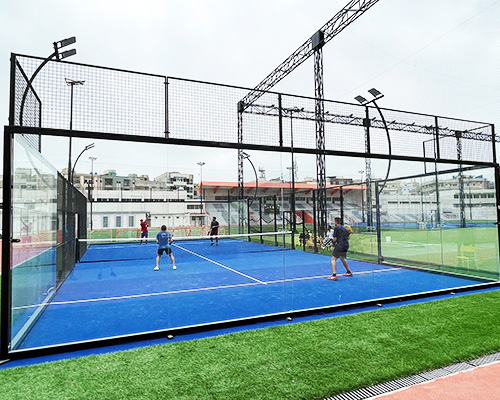
An Outdoor Padel Court is a complete enclosed sports system designed to operate under open-air environmental conditions. Unlike an indoor installation, it must continuously handle rain, sunlight, temperature changes, wind, dust, moisture, and other external conditions.
A complete court normally combines steel framing, tempered glass, welded mesh, artificial turf, a net system, lighting, fasteners, and a suitable foundation.
Outdoor Court as a Complete System
The individual components cannot be evaluated separately. Heavy glass requires stable structural support, the steel frame depends on secure anchoring, the turf depends on a flat and well-drained base, and lighting performance depends on correct pole position and fixture distribution.
This is why buyers should evaluate an Outdoor Padel Court as one engineered facility rather than as a collection of products.
Buyer Perspective
A lower-priced component does not necessarily create a lower-cost project.
For example, saving money on corrosion protection may increase future repainting costs, while insufficient drainage can cause water accumulation that affects both the playing surface and operating availability.
Buyers who want to review available configurations can start with SRSC’s Outdoor Padel Court product category. The company’s outdoor models use weather-resistant construction, galvanized steel mesh, tempered glass, and artificial turf for open-air applications.
Start with the Site Before Choosing an Outdoor Padel Court
One of the most common purchasing mistakes is choosing the court model first and evaluating the site later.
The site should determine the design.
Available Construction Space
According to the current International Padel Federation Rules of Padel, a standard court measures 10 meters wide by 20 meters long internally. Buyers must also consider external structural dimensions, access paths, maintenance space, drainage channels, lighting infrastructure, and any required safety zones.
Therefore, a plot measuring exactly 10 × 20 meters is not sufficient for a complete commercial project.
Think Beyond the Playing Area
When planning the site, ask:
- Where will players enter?
- Where will maintenance staff access the structure?
- Where will rainwater go?
- Is there space for electrical infrastructure?
- Will spectators need circulation space?
- Does the project require out-of-court play?
These questions often influence the final site layout more than the court itself.
Climate Exposure
Weather conditions should directly affect the specification of an Outdoor Padel Court.
A dry inland location and a humid coastal location may require very different levels of corrosion protection.
Coastal Environment
Salt-laden air can accelerate corrosion of exposed metal components. Hot-dip galvanizing, suitable coatings, stainless hardware in critical positions, and regular inspection become especially important.
High-Rainfall Environment
Drainage design becomes a priority. The foundation, perimeter channels, turf drainage capacity, and surrounding landscape should work together to move water away quickly.
High-Wind Environment
Do not select a panoramic structure only because it looks attractive.
Ask the supplier for structural information relevant to the project location and confirm local engineering requirements before construction.
Which Outdoor Padel Court Type Should You Choose?
There is no single design that is best for every project.
Commercial clubs, hotels, schools, resorts, residential developments, and tournament venues may have different priorities.
Classic Padel Court
Classic structures generally use more visible steel framing around the enclosure.
They can be a practical choice where structural simplicity, durability, and budget control are more important than maximum spectator visibility.
Panoramic Padel Court
A panoramic court reduces visual obstruction around important glass areas and creates a cleaner spectator experience.
It is particularly attractive for commercial clubs, premium resorts, event venues, and projects where visual presentation contributes to the facility’s brand.
For a more detailed design comparison, see Panoramic Padel Court vs Standard Court.
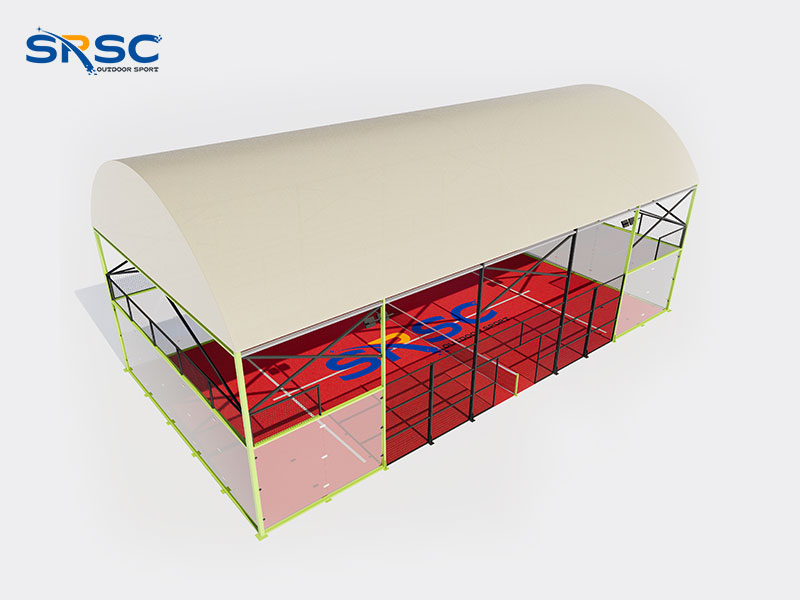
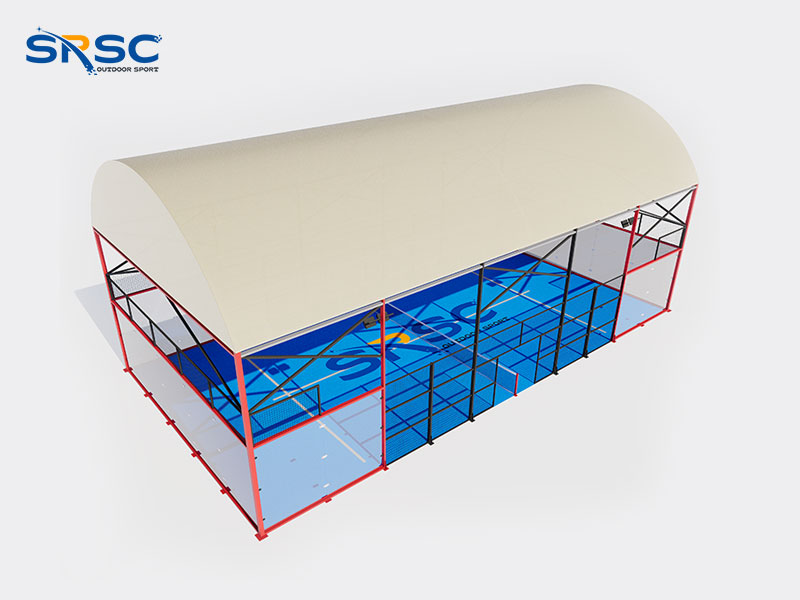
Roofed Outdoor Padel Court
A roof can reduce disruption from direct sun and rainfall and may increase usable playing hours in certain climates.
However, roofing introduces additional structural, wind-load, drainage, foundation, and permitting considerations.
SRSC’s RR05 Roofed Outdoor Padel Court is one example of a 20 × 10 m roofed configuration designed for outdoor use.
Outdoor Court Type Comparison
| Court Type | Main Advantage | Main Consideration | Suitable Projects |
|---|---|---|---|
| Classic Court | Practical structure | More visible framing | Schools, communities, training centers |
| Panoramic Court | Better visibility and premium appearance | Structural design requires careful evaluation | Clubs, resorts, commercial venues |
| Roofed Court | Better weather protection | Higher structural and project complexity | High-use commercial facilities |
| Single Court | Smaller format for special applications | Not equivalent to standard doubles layout | Space-constrained projects |
Check Court Dimensions and FIP Requirements
A professional buyer should separate product specification from playing regulation.
The supplier may manufacture the components, but the project owner is still responsible for checking local construction codes, electrical rules, permits, accessibility requirements, and other regulations.
Standard Playing Dimensions
The FIP specifies an internal court dimension of 20 m × 10 m, divided by a net.
The official rules also specify net dimensions, enclosure arrangements, access requirements, playing surface characteristics, safety areas, lighting conditions, and orientation recommendations.
For primary-source technical reference, buyers can consult the official FIP Rules of Padel.
Free Height Matters
The FIP rules state a minimum unobstructed height of 6 meters throughout the court and suggest 8 meters for new facilities. Lighting and other equipment should therefore be considered during the design stage rather than added without checking clearances later.
Why Buyers Often Miss This
A court can fit horizontally while still being unsuitable vertically.
This is especially relevant when installing a roof structure, overhead equipment, nearby trees, cables, canopies, or other architectural elements.
How to Evaluate the Steel Structure
The steel system is one of the most important elements of an Outdoor Padel Court because it supports glass, mesh, lighting-related elements, and repeated loading over many years.
Structural Strength
Do not judge a steel structure by appearance alone.
Ask about:
- Tube dimensions
- Wall thickness
- Steel grade
- Connection design
- Anchor system
- Welding quality
- Surface treatment
- Structural calculations where applicable
Wind Resistance Is Project-Specific
Statements such as “wind resistant” mean little without engineering context.
Wind conditions vary by geographic location, exposure category, building surroundings, court height, roofing arrangement, and local construction requirements.
A professional buyer should provide the project location to the supplier early.
Corrosion Protection
Outdoor steel is continuously exposed to moisture and oxygen.
Galvanizing combined with an appropriate coating system can improve long-term corrosion resistance compared with untreated steel.
SRSC’s padel product information describes galvanized steel mesh and multi-layer surface treatments intended for long-term outdoor exposure.
Questions to Ask the Supplier
Instead of asking only, “Is the steel galvanized?”, ask:
What galvanizing or coating process is used, which components receive it, and how are welded or cut areas protected?
That question usually produces a much more useful technical answer.
How to Choose Tempered Glass
Glass is both a playing wall and a major structural component of a padel enclosure.
Its quality affects safety, ball rebound, visibility, transportation, and installation.
Glass Thickness and Quality
SRSC’s current padel specifications describe 12 mm tempered glass panels, with a typical full-court arrangement using 18 panels measuring approximately 2 × 3 meters.
However, buyers should not evaluate glass only by thickness.
Also request information about:
- Tempering quality
- Edge finishing
- Hole machining
- Dimensional tolerance
- Flatness
- Packaging
- Certification
- Replacement availability
Glass Installation
Even high-quality tempered glass can fail if installation places excessive stress around holes or edges.
Correct gaskets, washers, fasteners, alignment, and tightening procedures are therefore critical.
Choosing Artificial Turf for an Outdoor Padel Court
Artificial turf has a direct influence on ball speed, traction, comfort, drainage, and maintenance.
The cheapest grass is rarely the best long-term choice for a commercial facility.
Straight Monofilament Turf
Straight fibers generally support a faster playing experience and are often selected where a more dynamic ball response is preferred.
They may be suitable for competition-focused clubs and experienced players.
Textured or Curled Turf
Textured fibers can offer a different balance between grip, sand stability, and ball speed.
They are worth considering for recreational clubs, hotels, schools, or facilities serving players with mixed skill levels.
SRSC lists both straight and curled turf options and describes its standard court turf as weather-resistant PE material designed for padel applications.
Turf Comparison
| Factor | Straight Turf | Curled/Textured Turf |
|---|---|---|
| Ball Speed | Generally faster | Generally more controlled |
| Playing Style | Dynamic | Balanced |
| Sand Visibility | Can be more noticeable | Often better stabilized |
| Typical Application | Competitive clubs | Commercial/recreational venues |
| Buyer Priority | Speed and consistency | Control and practical maintenance |
Do Not Ignore the Infill
Silica or quartz sand is not simply an accessory.
The correct quantity and distribution help stabilize fibers and influence ball response. Maintenance staff should periodically redistribute infill and brush the surface according to the turf supplier’s instructions.
A deeper component comparison is available in SRSC’s Padel Court Materials Guide for Commercial Buyers.
Foundation and Drainage Can Decide the Life of the Court
A premium Outdoor Padel Court installed on a poor foundation can still become a poor court.
Surface flatness, drainage, structural anchoring, and long-term settlement should therefore be resolved before equipment installation.
Foundation Flatness
An uneven base can create:
- Irregular ball bounce
- Turf wrinkles
- Standing water
- Alignment problems
- Glass installation difficulties
The FIP rules specify that surface level differences should remain below 3 mm when measured with a 3 m rule.
Drainage
Outdoor projects require a clear water-management strategy.
For surfaces without drainage, current FIP rules specify a maximum transverse evacuation slope of 1% from the center toward the outer edges. Local climate and engineering requirements may require additional drainage infrastructure.
Drainage Is More Than Turf Permeability
Water must have somewhere to go after passing through or across the playing surface.
That means the foundation, sub-base, channels, pipes, surrounding paving, and site grading need to be planned as one drainage system.
Outdoor Padel Court Lighting: What Should Buyers Check?
Lighting extends operating hours and can directly influence revenue for commercial venues.
But simply increasing wattage does not guarantee better playing conditions.
Uniform Illumination
Players need consistent visibility across the entire playing area.
Poor fixture placement may create dark zones, excessive contrast, glare, or difficulty tracking the ball.
The FIP requires artificial lighting to be uniform and arranged so that it does not impair the vision of players, officials, or spectators.
Outdoor Protection
For an Outdoor Padel Court, lighting equipment should also be selected according to rain, dust, temperature, electrical supply, and local electrical requirements.
SRSC currently specifies 200 W LED fixtures with IP66 protection for its padel systems.
Ask for a Lighting Layout
A professional quotation should ideally specify more than fixture wattage.
Ask about:
- Number of fixtures
- Fixture location
- Mounting height
- Beam angle
- Expected illuminance
- Uniformity
- Glare control
- IP protection
- Input voltage
How Should You Compare Outdoor Padel Court Quotations?
Two quotations can describe apparently similar courts while including very different specifications.
The total price alone tells you very little.
Compare Like with Like
Use a specification table when evaluating suppliers.
| Component | What Buyers Should Compare |
|---|---|
| Steel Structure | Tube sizes, thickness, treatment, anchors |
| Glass | Thickness, size, tempering, certification |
| Mesh | Wire diameter, grid size, coating |
| Turf | Fiber type, pile height, density, backing |
| Lighting | Power, quantity, IP rating, layout |
| Net System | Material, dimensions, posts |
| Hardware | Material and included quantity |
| Packing | Steel protection and glass crates |
| Installation | Manuals, drawings, supervision |
| Warranty | Coverage, duration, exclusions |
| Spare Parts | Availability and lead time |
Equipment Price vs Total Project Cost
The quotation for an Outdoor Padel Court may not include:
- Civil foundation work
- Drainage
- Local electrical installation
- Freight
- Customs duties
- Crane or lifting equipment
- Local labor
- Permits
- Site preparation
- Utility connections
Therefore, compare total project cost, not simply the supplier’s equipment price.
For budget planning, SRSC’s Cost to Build a Padel Court: 2026 Guide discusses the major cost categories involved in a complete project.
What Documents Should a Padel Court Supplier Provide?
Documentation becomes particularly important for international procurement.
The installation team may be thousands of kilometers away from the manufacturer when the containers arrive.
Technical Drawings
Drawings should clearly show the position of columns, glass panels, mesh, doors, anchors, turf, lighting, and other components.
Accurate drawings reduce interpretation errors during installation.
Foundation Drawings
The foundation must match the anchoring system of the selected Outdoor Padel Court.
Confirm foundation requirements before local concrete work begins.
Do Not Build from an Old Drawing
Always verify that the drawing corresponds to the exact model ordered.
Small structural revisions can change anchor locations or component dimensions.
Packing List
A detailed packing list makes receiving and inventory checks easier.
This is particularly important for fasteners and small fittings that may be difficult to identify after unloading.
Shipping and Installation Planning
International buyers should discuss logistics before confirming an order rather than after production is finished.
Glass Packaging
Tempered glass requires specialized export packaging because damaged edges can make panels unusable even when the main surface appears intact.
SRSC states that its glass panels are packed in plywood crates for transportation.
Installation Support
Ask whether the supplier provides:
- Installation drawings
- Component numbering
- Installation videos
- Remote technical support
- On-site supervision
- Spare hardware
- Replacement components
For additional planning details, see the Step-by-Step Padel Court Installation Guide.
Prepare Before the Container Arrives
Foundation curing, electrical conduits, drainage, lifting equipment, labor, storage space, and installation tools should already be prepared.
Good preparation can prevent equipment from sitting unused on site while contractors wait for civil work to finish.
Maintenance Should Influence Your Buying Decision
The best Outdoor Padel Court is not necessarily the model requiring zero maintenance—because no outdoor sports facility is maintenance-free.
A better goal is predictable, manageable maintenance.
Turf Maintenance
Regularly inspect sand distribution, seams, fiber condition, drainage, and surface contamination.
High-use commercial courts generally need more frequent brushing and inspection than lightly used private facilities.
Steel and Mesh Inspection
Check coatings, weld areas, fasteners, anchors, gates, and exposed metal.
Early repair of small coating damage can reduce the chance of corrosion spreading.
Glass Inspection
Look for damaged edges, loose fittings, abnormal movement, and hardware problems.
Any damaged glass should be evaluated promptly by qualified personnel.
Build Maintenance into the Purchase
Ask the supplier for recommended maintenance procedures before ordering.
This makes it easier to estimate labor, spare parts, and long-term operating costs.
Conclusion
Choosing an Outdoor Padel Court is ultimately a project-engineering decision as much as a purchasing decision.
The right court should match the site, local climate, player profile, business model, expected operating hours, maintenance capacity, and long-term investment plan. Steel strength, corrosion protection, tempered glass, turf, drainage, lighting, foundation quality, shipping, and installation support all contribute to the final result.
For commercial buyers, the most useful purchasing strategy is simple: define the site conditions first, create a technical specification second, and compare suppliers against the same requirements third.
SRSC provides padel court structures, turf, tempered glass, mesh systems, lighting, and project support for international sports facility projects. Buyers planning a new project can explore the company’s Padel Court range or review the Outdoor Padel Court options before requesting a project-specific quotation.
FAQ
What should I look for when buying an Outdoor Padel Court?
Start with the project location, climate, expected player traffic, foundation, drainage, steel structure, tempered glass, turf, lighting, installation support, and local compliance requirements.
Do not choose based on appearance and price alone.
How much space do I really need for an Outdoor Padel Court?
The official doubles playing area is 20 × 10 meters internally, but the complete project needs additional space for structural elements, access, drainage, maintenance, circulation, and potentially safety areas.
Ask the supplier for overall external dimensions before finalizing the site.
Is a panoramic or classic padel court better outdoors?
Neither is automatically better.
A panoramic court can provide better spectator visibility and premium aesthetics, while a classic structure may appeal to projects prioritizing structural simplicity and budget control. The decision should consider wind conditions, commercial positioning, engineering requirements, and intended use.
Do I need a roof over my outdoor padel court?
Not always.
A roof can be valuable in regions with frequent rain, strong sunlight, or where increasing playable hours has commercial value. However, it adds structural and foundation requirements, so the investment should be assessed at the project level.
Is 12 mm tempered glass suitable for a padel court?
Twelve-millimeter tempered glass is commonly used in professional court systems, including SRSC’s current product specifications.
Thickness alone is not enough, however. Tempering quality, machining, installation, support details, and compliance also matter.
Which artificial turf is best for an Outdoor Padel Court?
The answer depends on the playing experience and operating model you want.
Straight monofilament turf may suit faster competitive play, while textured turf may be attractive for facilities seeking controlled play and practical sand stabilization. Climate resistance and drainage should be considered for either type.
How do I know whether a padel court can handle my local weather?
Provide the supplier with the exact project location and request structural information relevant to local wind, rain, temperature, corrosion, snow, or other environmental loads.
Local structural engineers and authorities should verify compliance where required.
What should I ask a padel court manufacturer before ordering?
A useful question is:
“Can you provide a complete component specification, foundation drawing, structural information, packing list, installation manual, warranty terms, spare-part policy, and a clear list of what is not included in the quotation?”
That single question often reveals how complete the supplier’s project support really is.
How can I compare two Outdoor Padel Court suppliers fairly?
Create one comparison sheet and place both quotations against identical specifications.
Compare steel, glass, mesh, turf, lighting, hardware, packaging, warranty, installation assistance, freight scope, and after-sales support instead of comparing only the final number.