
BLOG
Outdoor Padel Court Winter Guide: Snow, Frost and Cold-Climate Design
Recent Articles
Table of Contents
Building an Outdoor Padel Court in a cold climate requires more planning than simply choosing weather-resistant steel and artificial turf. Snow, freezing temperatures, frost movement, ice, freeze-thaw cycles, short winter daylight hours, and seasonal moisture can all influence the court structure and daily operation.
For sports clubs, hotels, schools, residential communities, resorts, and commercial investors in colder regions, the key question is not whether an outdoor court can survive winter. The better question is how the entire court should be designed so that the structure, foundation, drainage, turf, glass, lighting, and maintenance plan work together throughout the cold season.
Key Takeaways
- Cold-climate Outdoor Padel Court projects should consider snow, frost, drainage, freezing temperatures, and winter wind together.
- Roof snow load must be evaluated for roofed courts instead of using a generic roof specification.
- Water trapped beneath or around the playing surface can create problems during freeze-thaw cycles.
- Foundation requirements depend on local soil and frost conditions.
- Artificial turf should remain clean and well drained before freezing weather arrives.
- Snow removal methods should avoid damaging turf, glass, coatings, and drainage systems.
- Winter lighting becomes more important because usable daylight hours are shorter.
- Roofed and indoor courts can extend the commercial playing season but have different investment requirements.
- Local structural and civil engineers should verify site-specific requirements.
Can You Build an Outdoor Padel Court in a Cold Climate?
Yes. An Outdoor Padel Court can be installed in many cold-climate regions when the project is designed around the actual environmental conditions.
Cold weather itself is not automatically the biggest problem. More often, difficulties come from water, snow accumulation, repeated freezing and thawing, unsuitable foundations, poor drainage, and incorrect winter maintenance.
Cold Climate Does Not Mean One Condition
A cold but relatively dry location has different requirements from a city that receives heavy wet snow.
Likewise, a mountain resort at high elevation may experience different structural loads from a low-elevation urban sports club.
Concept: Site-Specific Design
Site-specific design means selecting construction details according to the actual installation location rather than relying on one standard court specification.
The project location should therefore be provided to the manufacturer at the beginning of the quotation process.
What Winter Conditions Affect an Outdoor Padel Court?
Buyers should identify the main environmental risks before choosing the court configuration.
Snow
Snow can accumulate on the playing surface, surrounding areas, lighting structures, and especially any roof system.
For an open court, snow mainly creates operational and maintenance issues.
For a roofed court, it also becomes an important structural design load.
Frost
Freezing conditions can affect moisture within the soil and construction layers.
Concept: Frost Heave
Frost heave refers to upward ground movement that can occur when water in frost-susceptible soil freezes.
If different parts of a court foundation move unevenly, the result can include surface irregularities, cracks, drainage problems, and structural misalignment.
Ice
Ice creates an obvious player-safety problem.
It can also block drainage channels and create additional maintenance requirements around entrances and circulation areas.
Freeze-Thaw Cycles
Repeated transitions between freezing and warmer temperatures can be especially demanding.
Water enters small spaces, freezes, expands, melts, and then repeats the process.
Why Water Management Matters
This is why cold-climate court design cannot separate winter performance from drainage.
Keeping unnecessary water away from the foundation and structural interfaces can be just as important as choosing durable materials.
Open vs Roofed Outdoor Padel Court for Winter
The choice between an open and roofed court can significantly change winter operation.
| Factor | Open Outdoor Court | Roofed Outdoor Court |
|---|---|---|
| Snow on playing surface | High | Reduced |
| Roof snow load | None | Critical design factor |
| Rain protection | Limited | Better |
| Winter maintenance | More surface clearing | Roof inspection required |
| Structural complexity | Lower | Higher |
| Initial investment | Lower | Higher |
| Seasonal availability | Weather-dependent | Potentially greater |
| Foundation loads | Standard court loads | Additional roof loads |
| Commercial winter use | Limited in severe climates | Better potential |
Open Outdoor Court
An open Outdoor Padel Court normally has a simpler structural system.
However, snow and ice directly reach the turf, meaning winter closures may be more frequent in regions with persistent freezing conditions.
Roofed Outdoor Court
A roof can reduce direct snow and rainfall reaching the playing surface.
This may improve seasonal availability, but the roof introduces a major engineering question:
How much snow must the structure safely support?
A Roof Is a Structural System
Do not treat a padel court roof as a simple weather cover.
Columns, purlins, connections, anchors, foundations, drainage systems, and roof materials must work together under local environmental loads.
What Is Snow Load?
Snow load is the structural load created when snow accumulates on a roof or other supporting surface.
It is not determined simply by measuring how many centimeters of snow normally fall each winter.
Ground Snow Load
Ground snow load is a design parameter based on snow conditions for a geographic location.
Roof Snow Load
The load applied to a roof can be influenced by factors including:
- Ground snow conditions
- Roof geometry
- Roof slope
- Exposure
- Thermal conditions
- Snow drifting
- Risk category
- Surrounding structures
Snow Depth Is Not Enough
Ten centimeters of dry powder and ten centimeters of dense wet snow do not represent identical conditions.
Professional structural design therefore uses prescribed load methods rather than visual snow depth alone.
Why Roofed Outdoor Padel Courts Need Local Engineering
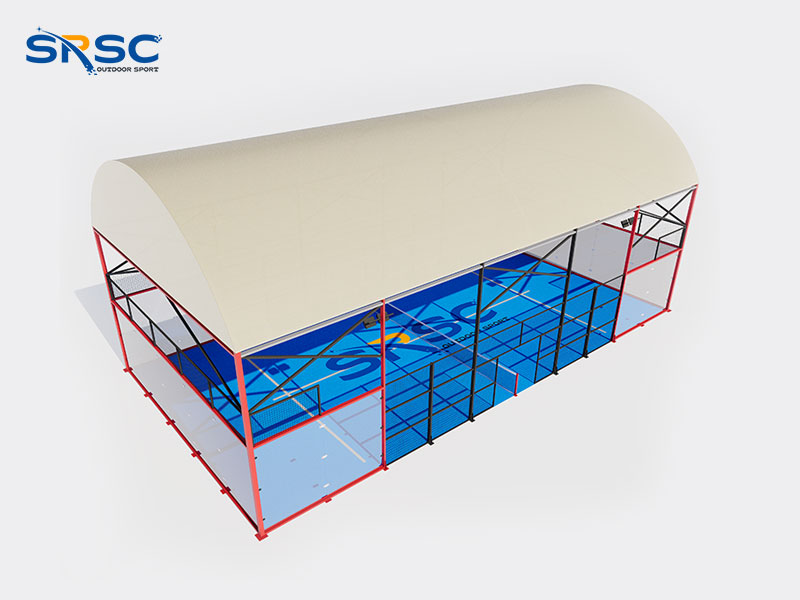
A roof specification that works in one country may not be suitable for another location.
Snow Accumulation
Roof shape affects where snow remains.
Snow Drift
Wind can move snow across a roof and create deeper accumulations in selected areas.
Concept: Snow Drift
Snow drift is uneven snow accumulation caused by wind and changes in roof geometry or surrounding conditions.
This can create concentrated structural loading rather than a perfectly uniform layer.
Rain-on-Snow Conditions
In some climates, rainfall can occur while snow remains on the roof.
This may change loading and drainage conditions.
Local Building Codes
For projects in snow regions, local structural regulations should be reviewed before choosing the roof specification.
The court supplier should provide structural information, while qualified local professionals verify that it satisfies project requirements.
Outdoor Padel Court Foundation Design for Freezing Conditions
The foundation is one of the most important parts of a cold-climate project.
Soil Conditions
Different soils react differently to water and freezing temperatures.
Fine-grained or moisture-sensitive soils may require more careful evaluation than well-drained construction layers.
Frost Depth
Many cold regions have established local frost-depth requirements for foundations.
Why Depth Matters
Foundation components positioned within frost-affected soil may move if the surrounding ground freezes and expands.
The appropriate solution depends on local conditions and construction standards.
Sub-Base Preparation
Good preparation may include:
- Suitable excavation
- Compacted structural layers
- Drainage materials
- Moisture control
- Correct grading
- Locally appropriate foundation details
More concrete alone does not automatically solve a poor sub-base.
Frost Heave vs Settlement
These concepts create different types of movement.
Frost Heave
Ground moves upward during freezing conditions.
Settlement
Ground or construction layers move downward because of compression, poor compaction, or other soil conditions.
| Problem | Typical Movement | Possible Effect on Court |
| Frost heave | Upward | Uneven surface |
| Settlement | Downward | Depressions and cracking |
| Differential movement | Uneven | Structural misalignment |
| Poor compaction | Variable | Long-term surface movement |
| Water saturation | Site-dependent | Increased ground problems |
Why Differential Movement Matters
The biggest concern is often not small uniform movement.
Problems become more serious when one section moves while another remains stable.
Glass and Steel Need Alignment
Padel courts use large tempered-glass panels mounted within a structural system.
Uneven foundation movement can make maintaining correct alignment more difficult.
Drainage Is Critical Before Winter Arrives
Cold-climate drainage should be planned before concrete construction.
Remove Surface Water
Water should not remain in depressions on the playing area.
Once freezing conditions begin, those puddles can become ice.
Keep Drainage Channels Clear
Leaves, sand, soil, and other debris should be removed before winter.
Frozen Blockages
A partially blocked drainage system may become completely ineffective after trapped water freezes.
Preventive cleaning is therefore particularly important before the cold season.
Control Surrounding Runoff
Water from roofs, roads, parking areas, and surrounding landscaping should not be directed toward the court.
A well-drained playing area can still experience problems when external runoff enters faster than the drainage system can remove it.
What Happens to Artificial Turf in Winter?
Professional artificial turf is designed for outdoor conditions, but winter still changes how it should be used and maintained.
Cold Turf
Low temperatures can influence the feel of the surface and surrounding construction materials.
The court should only be opened when playing conditions remain safe.
Frozen Surface
Players should not be allowed onto an icy surface simply because the turf itself appears undamaged.
Safety Comes First
Traction changes dramatically when moisture freezes.
Commercial facilities should have a clear winter-opening policy instead of leaving decisions to individual players.
Snow-Covered Turf
Snow may need to be removed before the court becomes playable.
Removal methods should avoid cutting, pulling, or damaging turf fibers.
How Should Snow Be Removed from Padel Turf?
Snow removal should be gentle and controlled.
Avoid Metal Shovels on the Turf
Sharp metal edges can damage artificial grass fibers and backing.
Use Suitable Non-Damaging Tools
Lightweight plastic or other appropriate snow-removal tools may reduce the risk of cutting the turf.
Do Not Aggressively Scrape Ice
Trying to mechanically break strongly bonded ice can damage the playing surface.
Let Conditions Help
Where practical, natural warming may be safer than aggressive mechanical removal.
The exact maintenance procedure should follow the artificial turf supplier’s instructions.
Should You Use Salt on a Padel Court?
De-icing products should not be applied casually.
Material Compatibility
Certain chemicals may affect:
- Artificial turf
- Metal components
- Coatings
- Concrete
- Drainage
- Nearby landscaping
Residue
De-icing materials can also remain on the playing surface and influence traction or maintenance.
Check Before Applying Chemicals
Use only products confirmed as suitable for the turf, court materials, local environmental regulations, and drainage system.
Do not assume that a product used on a parking lot is suitable for sports turf.
Artificial Turf Drainage in Freeze-Thaw Conditions
Permeable turf helps water move away from the playing surface, but that water must still leave the underlying construction.
Turf Permeability
Water may pass through drainage holes or permeable backing.
Base Drainage
The sub-base determines where the water goes next.
Complete Drainage Path
Think of winter drainage as:
Snow melts → water passes through or across turf → base receives water → drainage system removes it
If meltwater becomes trapped underneath the surface and freezes again, drainage performance may decline.
Does Turf Color Matter in Winter?
Turf color is usually selected for aesthetics, branding, playing visibility, and overall facility design.
Darker surfaces may absorb more solar radiation than lighter surfaces under comparable sunlight.
However, color should not become the primary winter-selection criterion.
More Important Specifications
Buyers should prioritize:
- Outdoor durability
- UV stabilization
- Fiber quality
- Backing construction
- Drainage performance
- Playing characteristics
- Maintenance requirements
Choose the Complete Turf System
A visually attractive turf that performs poorly under local moisture and maintenance conditions is not a good commercial choice.
Tempered Glass in Cold Weather
Tempered glass is a standard component of professional padel courts.
Temperature Changes
Outdoor glass experiences seasonal temperature variation.
Professional manufacturing and correct installation are therefore essential.
Glass Fixings
Glass panels should be correctly aligned and supported according to the court design.
Never Force Misaligned Panels
If winter ground movement has visibly affected the structure, do not simply tighten fittings to force glass back into position.
The cause of movement should be inspected first.
Snow and Ice Around Glass
Snow removal equipment should be kept away from glass edges.
Tempered glass is strong under normal design conditions, but edges remain particularly important areas to protect from impact.
Steel Structure Performance in Winter
The steel enclosure is exposed to cold temperatures, snow, moisture, and road or coastal salts depending on the location.
Galvanized Steel
Galvanizing helps protect steel against corrosion.
Protective Coating
A suitable outdoor coating system adds another protective layer and provides the desired appearance.
Fasteners
Connections should also be included in winter inspections.
Moisture + Salt
In regions where de-icing salt is frequently used around roads and parking areas, contaminated water can reach lower parts of the court structure.
Regular cleaning and inspection around base plates and fasteners may therefore be worthwhile.
Winter Corrosion vs Summer Corrosion
Corrosion does not disappear when temperatures fall.
Winter Conditions
Moisture, road salt, snowmelt, and repeated wetting can create demanding conditions.
Summer Conditions
Rain, humidity, UV exposure, and heat create another set of challenges.
Year-Round Protection
The steel specification should therefore be selected for the complete annual climate rather than one season alone.
Lighting an Outdoor Padel Court in Winter
Winter means shorter daylight hours in many northern regions.
For commercial facilities, lighting therefore becomes even more important.
Earlier Evening Bookings
A club that could operate several hours using natural light in summer may require artificial lighting much earlier during winter.
Uniform Illumination
Players need to track a relatively small fast-moving ball against different visual backgrounds.
Lighting should minimize strong shadows and glare.
Outdoor Protection
Fixtures should be designed for the expected outdoor environment.
Commercial Utilization
Good lighting allows usable court hours to remain less dependent on sunset.
For clubs in colder regions, that can be important even during snow-free periods.
Snow Around the Court Matters Too
Many project plans focus only on snow inside the playing area.
Players still need safe access to the facility.
Entrance Areas
Keep entrances free from snow and ice.
Emergency Access
Required emergency and service routes should remain available.
Spectator Areas
Benches and viewing areas may also need seasonal maintenance.
Parking and Walkways
Snow moved from parking areas should not be piled against court structures or drainage outlets.
Think Beyond 20 × 10 Meters
An Outdoor Padel Court operates as part of a complete facility.
Winter planning should include every space that players use before and after a match.
Should You Cover an Outdoor Padel Court for Winter?
A roof can increase weather protection, but the decision depends on the business model and local climate.
Seasonal Recreational Facility
A club may choose to operate outdoor courts only during suitable months.
In this case, investing heavily in winter protection may not be necessary.
Year-Round Commercial Facility
A commercial club seeking maximum booking availability may consider roofed or indoor options.
Hotel or Resort
The decision depends on when guests visit.
Winter Resort Example
A resort with peak business during winter may gain more value from protected courts than a seasonal summer destination.
Investment should follow expected customer behavior.
Outdoor vs Roofed vs Indoor Padel Court in Cold Climates
| Factor | Open Outdoor | Roofed Outdoor | Indoor |
| Initial complexity | Lowest | Medium/High | Highest |
| Snow on turf | Yes | Reduced | No |
| Snow-load design | No roof | Required | Required for building |
| Wind exposure | High | Moderate/Open sides | Controlled |
| Temperature control | None | Limited | Possible |
| Winter availability | Weather-dependent | Improved | Highest |
| Natural ventilation | Excellent | Good | Mechanical/natural |
| Lighting requirement | Seasonal | Seasonal | Continuous |
| Commercial year-round use | Limited in severe climates | Better | Best |
Which Option Is Best?
There is no universal answer.
The correct decision depends on:
- Climate
- Land cost
- Building cost
- Expected bookings
- Seasonal demand
- Heating requirements
- Local planning rules
- Available investment
How Roof Design Affects Winter Performance
A roofed court should be evaluated as a structural system rather than an accessory.
Roof Slope
Roof geometry affects rain and snow behavior.
Drainage
Snow eventually melts.
The roof drainage system must therefore handle meltwater in addition to rainfall.
Gutters and Downpipes
These areas need maintenance so that ice does not create persistent blockages.
Do Not Send Roof Water onto the Court
Roof drainage should discharge away from the playing surface and structural foundations.
Concentrating all roof runoff beside court posts can create avoidable water and ice problems.
Outdoor Padel Court Winter Maintenance Checklist
A seasonal maintenance plan can reduce unexpected closures.
| Component | Before Winter | During Winter | After Winter |
| Turf | Clean and inspect | Remove snow carefully | Check seams and infill |
| Drainage | Clear channels | Check ice blockage | Flush and inspect |
| Glass | Inspect fittings | Avoid impact | Clean and recheck |
| Steel | Inspect coating | Watch salt/moisture | Repair damaged areas |
| Anchors | Inspect visible areas | Monitor movement | Detailed check |
| Lighting | Test system | Clean as needed | Inspect fixtures |
| Net | Check tension | Remove when required | Reinstall/adjust |
| Roof | Inspect structure | Monitor snow | Check membrane/roof |
| Gutters | Clean | Monitor ice | Clean again |
| Foundation | Check cracks | Observe movement | Compare condition |
When Should an Outdoor Court Be Closed?
Court operators should have objective closure rules.
Ice on the Playing Surface
Do not operate the court when traction is unsafe.
Heavy Snow
The playing area should be cleared appropriately before reopening.
Structural Concerns
Unusual movement, damaged glass, loose structural parts, excessive roof accumulation, or other visible problems require inspection.
Extreme Weather
Local warnings and facility safety policies should take priority over bookings.
Revenue Should Not Override Safety
One cancelled session costs less than an injury or structural problem.
Professional operation includes knowing when not to open the court.
What Should Buyers Tell the Manufacturer?
Before requesting an Outdoor Padel Court quotation for a cold region, provide:
Exact Project Location
City and country are more useful than simply saying “cold climate.”
Court Type
Specify whether the project requires:
- Open Outdoor Padel Court
- Panoramic Padel Court
- Classic Padel Court
- Roofed Outdoor Padel Court
Local Snow Information
Provide applicable design requirements when available.
Foundation Conditions
Share geotechnical or local civil-engineering information when relevant.
Planned Operating Season
Tell the supplier whether the court will close during winter or operate year-round.
Better Information Creates Better Specifications
A manufacturer cannot evaluate environmental requirements that have not been communicated.
Cold-Climate Outdoor Padel Court Buyer Checklist
Before ordering, confirm:
- Project city and climate
- Local minimum temperatures
- Snow-load requirements where applicable
- Foundation and frost requirements
- Soil conditions
- Drainage system
- Turf outdoor specification
- Roof structural design
- Roof drainage
- Steel corrosion protection
- Lighting for winter operation
- Snow-removal plan
- Safe player access
- Winter maintenance responsibilities
- Local engineer review
Common Winter Padel Court Mistakes
Using a Generic Foundation Drawing
Foundation design should reflect local ground and frost conditions.
Ignoring Snow Load on a Roof
A weather roof is still a structure and should be designed accordingly.
Blocking Drainage Before Freezing Weather
Leaves and debris can turn a small drainage problem into a major winter problem.
Using Sharp Snow-Removal Tools
Aggressive snow removal can damage artificial turf.
Applying De-Icing Chemicals Without Checking Compatibility
Products suitable for roads may not be appropriate for court materials.
Forgetting Roof Meltwater
Snow protection does not remove water from the project—it changes where the water goes.
Focusing Only on the Playing Area
Player access, spectator zones, pathways, drainage outlets, and emergency routes also need winter planning.
Think About the Facility as a System
Successful winter operation depends on more than the court itself.
FAQ About Outdoor Padel Courts in Winter
Can an Outdoor Padel Court stay outside all winter?
Yes, a properly specified outdoor court can remain installed throughout winter.
Whether it can remain playable every day depends on snow, ice, temperature, turf conditions, maintenance, and local operating policies.
Can you play padel on artificial turf in winter?
Potentially, when the surface is clean, unfrozen, and safe.
Play should stop when ice, snow, or unsafe traction conditions are present.
Does snow damage artificial padel turf?
Snow itself does not automatically mean turf damage.
Problems are more likely to arise from trapped water, ice, unsuitable snow-removal methods, poor drainage, or inappropriate maintenance.
Should I remove snow from an Outdoor Padel Court?
Snow may need to be removed before play resumes.
Use methods suitable for artificial sports turf and avoid sharp tools or aggressive scraping that could damage the fibers or backing.
Can I use salt to melt ice on padel turf?
Do not apply de-icing products without confirming compatibility with the turf, steel, concrete, drainage system, and manufacturer recommendations.
Does a roofed padel court need a snow-load calculation?
In snow regions, roof structures should be designed according to applicable local snow-load requirements.
The required load depends on the project location and structural regulations.
Is a roofed Outdoor Padel Court suitable for snowy regions?
It can be, provided the complete roof, supporting structure, anchors, foundation, drainage, and snow-load design are appropriate for the specific location.
Does the concrete foundation need special winter protection?
Foundation requirements vary according to local frost depth, soil, groundwater, drainage, and building regulations.
A local engineer should evaluate the project conditions.
Why does my Outdoor Padel Court develop puddles after snow melts?
Possible causes include blocked drainage, frozen outlets, low areas in the playing surface, poor base drainage, snow piles blocking channels, or inadequate final discharge.
Should I remove the padel net during winter?
If the court will remain closed for a long winter period, removing or reducing unnecessary exposure of selected removable components may be useful.
Follow the manufacturer’s recommended seasonal-maintenance procedure.
Is an indoor court always better in a cold climate?
Not necessarily.
Indoor courts offer more consistent year-round conditions but require greater building investment.
Open or roofed outdoor courts may be more economical where winters are shorter or facilities can operate seasonally.
What information should I send when requesting a cold-climate court quotation?
Provide the project location, court quantity, open or roofed design, expected operating season, snow requirements, foundation information, local regulations, and any available engineering data.
This allows the supplier to discuss a more appropriate Outdoor Padel Court configuration.
Conclusion
A cold-climate Outdoor Padel Court should be designed around more than low temperature.
Snow loads, frost-sensitive ground, meltwater, drainage, artificial turf, corrosion protection, winter lighting, safe access, and seasonal maintenance all influence the long-term performance of the facility.
For an open court, the main challenge is maintaining a safe and well-drained playing surface during changing winter conditions.
For a roofed court, buyers must also consider snow accumulation, roof drainage, structural loads, anchors, and foundations.
The most practical procurement sequence is:
Identify the site → review winter climate → choose the court type → confirm structural and foundation requirements → design drainage → prepare seasonal maintenance → install the court.
For commercial buyers, this approach helps avoid one of the most common mistakes in sports-facility procurement: purchasing a standard product first and trying to adapt the site to it afterward.
A well-planned Outdoor Padel Court can remain a durable long-term sports asset even in demanding climates when the court, foundation, drainage system, roof, and maintenance plan are designed as one complete project.