
BLOG
Outdoor Pedal Trainer vs Horse-Riding Machine: Which Should You Choose?
Recent Articles
Table of Contents
An Outdoor Pedal Trainer provides a simple seated exercise movement for parks, residential communities, schools, senior-friendly spaces, and public fitness projects.
However, buyers may also consider horse-riding machines, intelligent sports cars, and outdoor rowers. Although these products all use seated exercise positions, their movements, space requirements, and training functions are different.
Understanding these differences helps buyers create a more balanced outdoor fitness area instead of purchasing several machines that provide nearly identical exercises.
Key Takeaways
- An Outdoor Pedal Trainer provides a simple circular leg movement.
- A horse-riding machine coordinates the arms and legs.
- An intelligent sports car focuses on continuous pedal movement.
- An outdoor rower combines pulling and lower-body movement.
- Seated equipment can be easy for first-time users to understand.
- Dual-position designs allow two users to exercise together.
- Product dimensions must be combined with user movement space.
- Foundations, bearings, drainage, coatings, and spare parts affect long-term performance.
What Is an Outdoor Pedal Trainer?
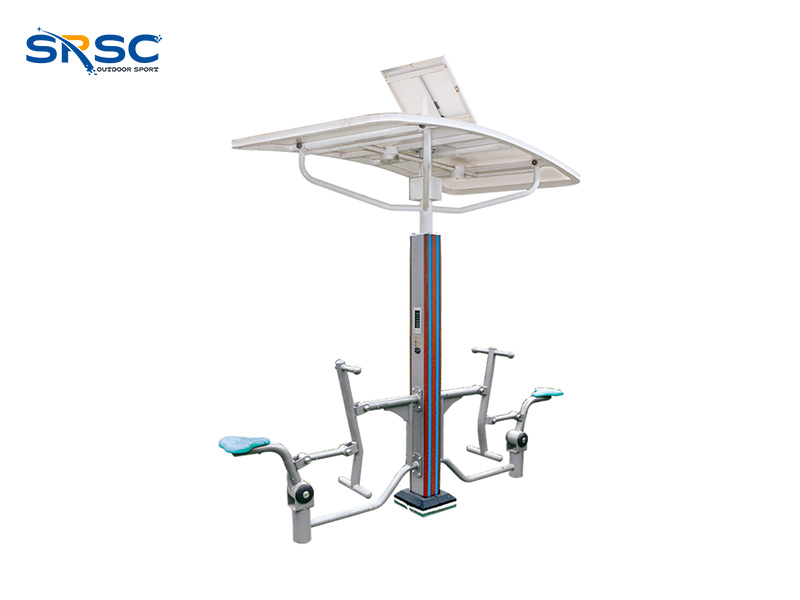
An Outdoor Pedal Trainer is a seated exercise machine with pedals positioned in front of the user.
The user sits on the seat, holds the handles, and moves the pedals through a repeated circular motion.
Main Benefits
The equipment provides:
- Simple seated operation
- Continuous lower-body movement
- A controlled movement path
- Dual-user capacity
- Easy integration into community fitness areas
The circular movement is similar in principle to stationary cycling. General background about this exercise category is available in Wikipedia’s article on the stationary bicycle.
What Is a Two-Seat Horse-Riding Machine?
The Intelligent Two-Seat Horse-Riding Machine uses coordinated arm and leg movements.
The user sits on the seat, holds the handles, places the feet on the pedals, and moves the equipment through a repeated riding-style action.
More Coordinated Movement
Compared with a basic pedal trainer, the horse-riding machine requires greater coordination between the upper and lower body.
It can add variety to an outdoor fitness circuit that already contains simple leg-training equipment.
Outdoor Pedal Trainer vs Horse-Riding Machine
| Factor | Outdoor Pedal Trainer | Horse-Riding Machine |
|---|---|---|
| Main movement | Circular pedaling | Coordinated riding movement |
| User position | Seated | Seated |
| Upper-body involvement | Limited | Higher |
| Learning difficulty | Very easy | Easy to moderate |
| Main project role | Lower-body activity | Full-body coordination |
| User capacity | Two | Two |
| Movement space | Moderate | Generally larger |
| Suitable location | Community and senior-friendly parks | General outdoor fitness zones |
Which Is Easier to Use?
The Outdoor Pedal Trainer normally has the simpler movement.
Users can sit, hold the handles, and begin pedaling without coordinating several moving components.
Which Provides More Exercise Variety?
The horse-riding machine includes greater arm and leg coordination.
It may be more suitable when a project already has several basic pedal or walking-style machines.
What Is an Intelligent Sports Car?
The SR-006 Intelligent Sports Car is another seated dual-user machine using circular pedal movement.
Despite its product name, it is an outdoor fitness machine rather than a vehicle.
Main Movement
Users sit on the seats, hold the handles, and move the pedals in a repeated circular direction.
The equipment can support general lower-body and coordinated seated exercise.
Pedal Trainer vs Intelligent Sports Car
The two products have related movement patterns, so buyers should compare their actual structure carefully.
Check:
- Pedal position
- Seat height
- Handle design
- Resistance system
- Movement range
- Product dimensions
- Digital functions
- Foundation requirements
Avoid Duplicate Equipment
A small fitness area may not need both products when their movements are very similar.
A larger project may use them in separate zones or select different configurations for different user groups.
How Does an Outdoor Rower Differ?
The Intelligent Double-Position Rower uses a pulling movement rather than continuous circular pedaling.
The user sits, holds the handles, and coordinates the arms and legs through a rowing-style action.
More Upper-Body Involvement
An outdoor rower provides a different movement category from a pedal trainer.
It can help create a more balanced equipment mix by adding:
- Pulling movement
- Arm involvement
- Back-related exercise
- Leg coordination
- Seated aerobic activity
General information about rowing-style exercise is available in Wikipedia’s overview of the indoor rower.
Which Equipment Is Best for Different Projects?
Senior-Friendly Community
Consider:
- Outdoor Pedal Trainer
- Air Walker
- Rotation Trainer
- Seated lower-leg equipment
Simple movements and clear support handles should be prioritized.
General Public Park
Consider:
- Horse-Riding Machine
- Outdoor Rower
- Air Walker
- Chest Press
- Waist Twister
This creates greater exercise variety.
School Fitness Area
Consider equipment with:
- Clear instructions
- Durable moving parts
- Moderate resistance
- Dual-user capacity
- Good staff visibility
Residential Development
A compact combination could include:
- Outdoor Pedal Trainer
- Intelligent Double-Position Rower
- Intelligent Dual Position Chest Press
- Intelligent Two-Position Air Walker
This combination provides pedaling, pulling, pushing, and walking-style movements.
How Much Installation Space Is Required?
The product footprint is not the complete space requirement.
Buyers must also consider:
- Moving handles
- Pedal movement
- User entry and exit
- Waiting space
- Circulation
- Maintenance access
- Distance from other machines
Dual-Position Equipment
Two-person machines need adequate space on both sides.
Users should be able to enter and exercise without interfering with each other.
Request a Layout Drawing
Before confirming the order, request:
- Product dimensions
- Movement-zone dimensions
- Foundation positions
- Recommended spacing
- Installation orientation
Foundations and Ground Surfaces
Outdoor equipment needs a stable supporting base.
Foundation
Use the foundation drawing supplied for the exact machine.
Do not assume that a pedal trainer and horse-riding machine require identical concrete foundations.
Ground Surface
Possible options include:
- Rubber surfacing
- Artificial turf
- Concrete
- Paving
- Engineered safety surfaces
The final choice depends on local regulations, accessibility, maintenance, and equipment design.
Drainage
Water should not remain around:
- Seats
- Pedals
- Structural posts
- Bearings
- Access paths
Good drainage makes the facility easier to use after rainfall and reduces unnecessary moisture exposure.
Outdoor Durability and Maintenance
Seated outdoor machines contain moving components that require regular inspection.
Components to Check
- Pedals
- Handles
- Seats
- Bearings
- Pivot points
- Fasteners
- Welds
- Coatings
- Foundations
- Digital displays
Surface Protection
Ask the supplier about:
- Steel specifications
- Surface preparation
- Outdoor powder coating
- Galvanized components
- Fastener materials
- Coastal-use options
- Coating-repair procedures
Spare Parts
Confirm whether replacement pedals, handles, bearings, seats, covers, and electronic components will remain available.
Common Buying Mistakes
Selecting Several Similar Pedal Machines
Every machine should provide a clear function within the fitness circuit.
Comparing Only Product Size
The complete movement and circulation zones are larger than the steel structure.
Ignoring User Age
Seat dimensions, handles, resistance, and movement range should match the intended users.
Forgetting Drainage
Standing water creates usability and maintenance problems.
Making Medical Claims
Outdoor equipment supports general physical activity but should not be described as treating medical conditions.
Ignoring Future Maintenance
Even simple outdoor equipment requires inspections and replacement parts.
Outdoor Pedal Trainer Buyer Checklist
Before ordering, confirm:
- Target users
- Number of stations
- Seat dimensions
- Pedal movement
- Handle position
- Resistance system
- Product footprint
- Complete movement zone
- Foundation drawing
- Ground surface
- Drainage
- Steel specification
- Coating system
- Digital functions
- Spare parts
- Installation instructions
- Maintenance plan
- Warranty
FAQ
What is an Outdoor Pedal Trainer used for?
It provides seated circular leg movement for general outdoor exercise.
It is commonly installed in parks, communities, schools, and senior-friendly fitness areas.
Is a pedal trainer better than a horse-riding machine?
It depends on the project.
A pedal trainer offers simpler lower-body movement, while a horse-riding machine involves greater arm and leg coordination.
Can two people exercise at the same time?
Dual-position models are designed for two users, with one person using each station.
Is an Outdoor Pedal Trainer suitable for older users?
It may be suitable when the seat, handles, movement range, site surface, and instructions match the intended users.
Does the equipment require electricity?
The mechanical pedal movement may not require power, while smart displays, lighting, sensors, or data functions may need electricity.
How much space is required?
Buyers should include the product footprint, moving components, user access, circulation, and maintenance space.
Does it need a concrete foundation?
Permanent outdoor fitness equipment normally requires an approved foundation or anchoring system.
Use the drawing supplied for the exact model.
What documents should buyers request?
Request product specifications, dimensions, movement-zone drawings, foundation plans, material details, installation instructions, maintenance guidance, spare-parts information, and warranty terms.
Conclusion
An Outdoor Pedal Trainer, horse-riding machine, intelligent sports car, and outdoor rower all provide seated exercise, but their movement patterns are different.
The pedal trainer offers simple circular lower-body movement. The horse-riding machine coordinates the arms and legs. The intelligent sports car provides another pedal-based option, while the rower adds pulling and upper-body involvement.
For a smaller project, avoid selecting several machines with similar pedal movements. Instead, combine complementary equipment that provides aerobic, pushing, pulling, mobility, and lower-body exercise.
SRSC provides:
- SR-003 Intelligent Double-Position Pedal
- SR-005 Intelligent Two-Seat Horse-Riding Machine
- SR-006 Intelligent Sports Car
- SR-004 Intelligent Double-Position Rower
Matching each product to a clear exercise function can create a more balanced and cost-effective outdoor fitness area.