
BLOG
Outdoor Waist Twister vs Rotation Trainer: Which Equipment Should You Choose?
Recent Articles
Table of Contents
An Outdoor Waist Twister is a common choice for parks, residential communities, schools, senior-friendly exercise areas, and public outdoor gyms. It provides a simple standing movement that users can understand without professional instruction.
However, a waist twister is not the only outdoor machine designed around rotational movement. Rotation trainers, kneaders, and pendulum machines use different movement directions and target different exercise functions.
For B2B buyers, understanding these differences helps prevent repetitive equipment selection and creates a more balanced outdoor fitness area.
Key Takeaways
- An Outdoor Waist Twister mainly uses controlled upper-body rotation.
- A rotation trainer focuses more on the shoulders and upper limbs.
- A kneader uses coordinated circular hand movements.
- A pendulum trainer uses a side-to-side lower-body movement.
- Dual-position machines improve user capacity and space efficiency.
- Equipment footprint must include the complete moving area.
- Foundations, drainage, bearings, coatings, and spare parts affect long-term use.
- A complete park may benefit from combining several movement types.
What Is an Outdoor Waist Twister?
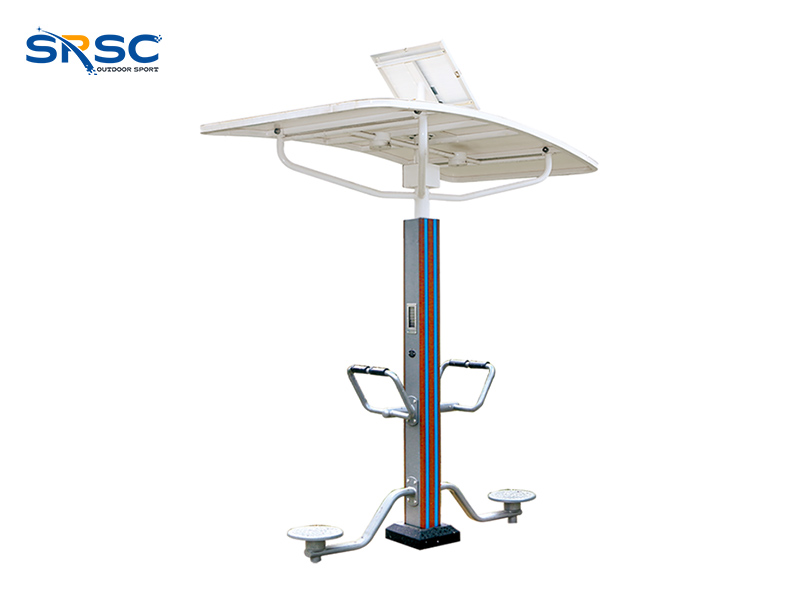
An Outdoor Waist Twister uses rotating foot platforms combined with fixed handrails.
The user stands on the platform, holds the handrails, and rotates the upper body in a controlled direction.
Main Exercise Function
The movement is commonly used for general waist, trunk, balance, and coordination exercise.
The equipment should be operated gradually rather than through fast or uncontrolled twisting.
Dual-Position Design
SRSC’s Intelligent Double-Position Waist Twister provides two exercise stations within one structure.
This allows two people to use the equipment simultaneously while reducing the number of separate foundations required.
What Is an Outdoor Rotation Trainer?
The Intelligent Double-Position Rotation Trainer uses rotating hand wheels rather than rotating foot platforms.
Users stand in front of the equipment, hold the handles, and turn the wheels clockwise or counterclockwise.
Upper-Limb Movement
The rotation trainer focuses more heavily on the arms and shoulders.
It can be used as a lighter movement station within a community fitness circuit.
Waist Twister vs Rotation Trainer
| Factor | Outdoor Waist Twister | Rotation Trainer |
|---|---|---|
| Main movement | Upper-body twisting | Hand and arm rotation |
| User position | Standing on rotating platform | Standing on fixed surface |
| Main contact point | Feet and handrails | Hand-wheel handles |
| Primary equipment role | Trunk and coordination | Upper-limb mobility |
| User capacity | Two | Two |
| Best placement | General fitness zone | Mobility or warm-up zone |
Which One Is Better?
Neither machine is universally better.
The waist twister is more suitable when the project needs a trunk-rotation station. The rotation trainer is more appropriate when the equipment mix needs a simple upper-limb movement.
What Is an Intelligent Two-Position Kneader?
The Intelligent Two-Position Kneader also uses rotating hand wheels.
However, users can turn the two wheels in the same or opposite directions, creating a coordinated upper-limb movement.
Coordination Training
The equipment requires both hands to work together.
This makes the movement different from simply rotating one wheel with both hands.
Suitable Applications
The kneader can be included in:
- Community parks
- Senior-friendly exercise areas
- Residential developments
- School recreation spaces
- Public wellness projects
- Outdoor mobility circuits
General background on joint movement and exercise flexibility is available in Wikipedia’s overview of range of motion.
What Is a Two-Position Pendulum?
The Intelligent Two Position Pendulum uses foot pedals and fixed handrails.
Users stand on the pedals and move the lower body from side to side in a pendulum-style motion.
Lower-Body Movement
Unlike the Rotation Trainer and Kneader, the pendulum equipment places more emphasis on the hips, legs, balance, and waist coordination.
Pendulum vs Waist Twister
| Factor | Pendulum Trainer | Waist Twister |
| Foot movement | Side-to-side swinging | Rotational |
| Upper body | Supported by handrails | Rotates with trunk |
| Main function | Lower-body coordination | Waist and trunk rotation |
| Movement space | Larger side clearance | Mainly around platform |
| User learning | Easy | Easy |
| Recommended zone | Aerobic or coordination | Mobility and core zone |
How to Choose the Right Equipment
The best machine depends on the movement functions already available in the outdoor gym.
Choose an Outdoor Waist Twister When:
- The site needs a simple trunk-rotation station.
- Users prefer an easy standing movement.
- The project serves a broad range of adult users.
- A dual-position machine is required.
- The fitness zone already contains upper-body equipment.
Choose a Rotation Trainer When:
- The project needs a lighter upper-limb station.
- Shoulder and arm movement are underrepresented.
- The equipment will be placed in a warm-up zone.
- Simple operation is a priority.
Choose a Kneader When:
- Coordinated two-hand movement is required.
- The project needs more exercise variety.
- The equipment mix already contains waist twisters.
- The facility targets general mobility and recreational exercise.
Choose a Pendulum When:
- Lower-body coordination is a priority.
- The park needs a movement similar to a side-swinging cardio station.
- Sufficient lateral clearance is available.
- The equipment mix lacks standing leg movement.
Can These Machines Be Installed Together?
Yes. These products provide related but different movements.
A compact outdoor mobility circuit could include:
This combination provides trunk rotation, arm movement, two-hand coordination, and lower-body swinging.
Avoid Repetitive Product Selection
Installing several machines with nearly identical movements reduces the practical variety of the fitness area.
Each selected machine should have a clear role within the exercise circuit.
Site Planning and Safety Space
Product dimensions do not represent the complete installation area.
Movement Zone
The equipment needs enough space for:
- Rotating platforms
- Moving arms
- Swinging pedals
- User entry
- User exit
- Waiting users
- Maintenance access
Circulation
Users should be able to walk around the equipment without entering another machine’s movement zone.
Surface Selection
Possible surfaces include:
- Rubber surfacing
- Artificial turf
- Concrete
- Paving
- Engineered safety surfaces
The correct option depends on local safety, accessibility, drainage, and maintenance requirements.
Foundations and Drainage
Outdoor exercise equipment must remain stable during repeated use.
Foundation Drawing
Use the foundation drawing supplied for the exact model.
Do not assume that a waist twister, pendulum, and rotation trainer require identical foundations.
Drainage
Water should not remain around:
- Structural posts
- Rotating platforms
- Pedals
- Seats
- Access pathways
Good drainage reduces maintenance pressure and makes the fitness area easier to use after rainfall.
Materials and Outdoor Durability
Outdoor equipment is exposed to sunlight, rain, humidity, dust, and temperature changes.
Steel Structure
Buyers should request information about:
- Steel section sizes
- Wall thickness
- Welding
- Surface preparation
- Powder coating
- Galvanized components
- Fastener materials
Moving Components
Bearings, pivots, platforms, and handles require regular inspection.
The general benefits of regular movement are discussed in Wikipedia’s overview of physical exercise, but the equipment itself should be promoted for general fitness rather than medical treatment.
Maintenance Checklist
| Component | What to Check |
| Platforms | Looseness or abnormal movement |
| Handrails | Secure fixing and surface damage |
| Wheels | Smooth rotation |
| Bearings | Noise and excessive play |
| Fasteners | Tightness and corrosion |
| Coating | Scratches or peeling |
| Foundation | Cracks or movement |
| Drainage | Standing water or blockage |
| Instructions | Visibility and readability |
Routine Inspection
Frequently used public equipment should receive regular visual checks.
More detailed mechanical inspections should follow the manufacturer’s recommendations and local operating conditions.
Common Buying Mistakes
Choosing Only by Appearance
Similar-looking equipment may provide different movements and use zones.
Installing Machines Too Close Together
Pendulum pedals and rotating platforms need clear operating space.
Buying Several Similar Machines
A complete fitness zone should include upper-body, lower-body, aerobic, strength, and mobility equipment.
Ignoring Target Users
Equipment dimensions and movement ranges should match the expected user group.
Making Medical Claims
Outdoor fitness products support general exercise but should not be described as treating spinal, shoulder, waist, or joint conditions.
Forgetting Spare Parts
Bearings, handgrips, rotating platforms, covers, and fasteners may eventually require replacement.
Buyer Checklist
Before ordering, confirm:
- Main exercise function
- Target user group
- Number of users
- Product dimensions
- Complete movement zone
- Foundation method
- Ground surface
- Drainage
- Steel specification
- Surface treatment
- Bearing system
- Instruction signage
- Custom colors
- Spare parts
- Maintenance guidance
- Warranty terms
FAQ About Outdoor Waist Twisters
What does an Outdoor Waist Twister do?
It provides a controlled standing rotation movement using a rotating foot platform and fixed handrails.
It is commonly included in general outdoor fitness and mobility zones.
Is a waist twister the same as a rotation trainer?
No.
A waist twister rotates through the lower platform and trunk, while a rotation trainer uses hand wheels for upper-limb movement.
Is a pendulum trainer similar to an air walker?
Both use standing pedal movements, but the direction and movement structure differ.
A pendulum generally moves from side to side, while an air walker moves the legs forward and backward.
Can two people use the equipment together?
Dual-position models are designed for two users, with one person at each station.
Does the equipment need a concrete foundation?
Permanent outdoor equipment normally requires an engineered foundation or anchoring method.
Use the drawing supplied for the exact model.
How much space is required?
Buyers need to account for the product footprint, moving components, user access, circulation, and maintenance space.
Can these products be installed in senior-friendly parks?
They may be suitable when movement range, access, instructions, site surface, and target-user requirements are appropriately evaluated.
What documents should buyers request?
Request product specifications, dimensions, movement-zone drawings, foundation plans, materials, coating details, installation instructions, maintenance guidance, spare-parts information, and warranty terms.
Conclusion
An Outdoor Waist Twister, rotation trainer, kneader, and pendulum machine may all appear to belong to the same equipment group, but they provide different movement patterns.
The waist twister supports trunk rotation. The rotation trainer focuses on upper-limb movement. The kneader adds coordinated circular hand movements, while the pendulum provides side-to-side lower-body activity.
For a balanced public fitness area, buyers should select equipment according to movement function rather than appearance alone.
SRSC provides:
- Intelligent Double-Position Waist Twister
- Intelligent Double-Position Rotation Trainer
- Intelligent Two-Position Kneader
- Intelligent Two Position Pendulum
A well-planned combination can create a more varied, understandable, and space-efficient outdoor fitness circuit.