
BLOG
Padel Court Electrical System Guide: Wiring, Protection, and Control
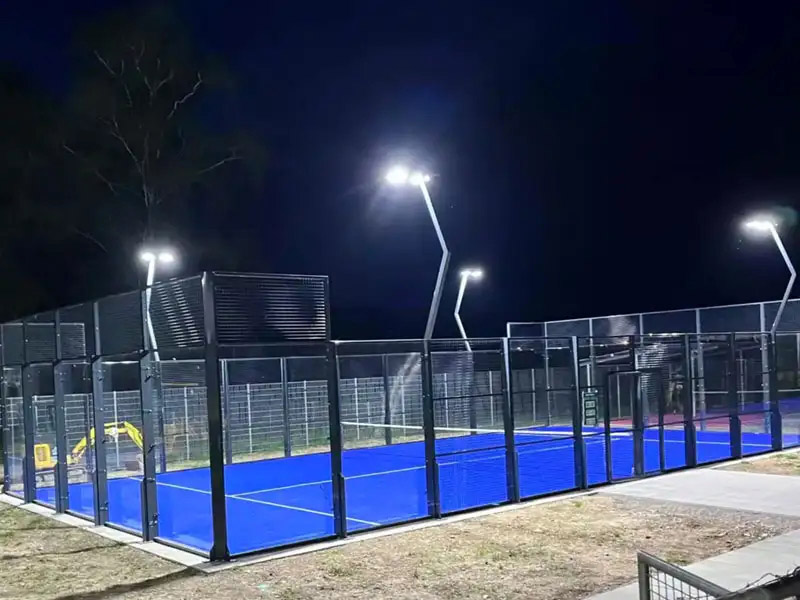
Recent Articles
Table of Contents
Key points covered in this guide:
- What is included in a complete Padel Court Electrical System
- How to estimate the preliminary electrical load for one or multiple courts
- Why each court should have clearly divided lighting circuits
- How to route cables without affecting players, glass, gates, or drainage
- What IP ratings mean for outdoor electrical equipment
- Why earthing, bonding, surge protection, and residual-current protection matter
- How indoor, outdoor, coastal, and roofed courts differ
- What drawings and electrical documents buyers should request
- How to commission and maintain the completed installation
A professional Padel Court Electrical System supplies and controls the lighting, booking controls, access equipment, scoreboards, cameras, emergency systems, and other electrical components around the court.
Although court suppliers may provide LED fixtures and lighting posts, the electrical installation normally requires coordination with the local electrical designer, licensed contractor, civil contractor, court installer, building operator, and utility provider.
Poor coordination can result in exposed cables, overloaded circuits, water entering junction boxes, difficult maintenance access, uneven lighting control, nuisance tripping, damaged LED drivers, or electrical equipment positioned inside the playing and safety areas.
Electrical planning should therefore begin before the concrete foundation, drainage channels, paving, and court structure are completed.
What Is a Padel Court Electrical System?
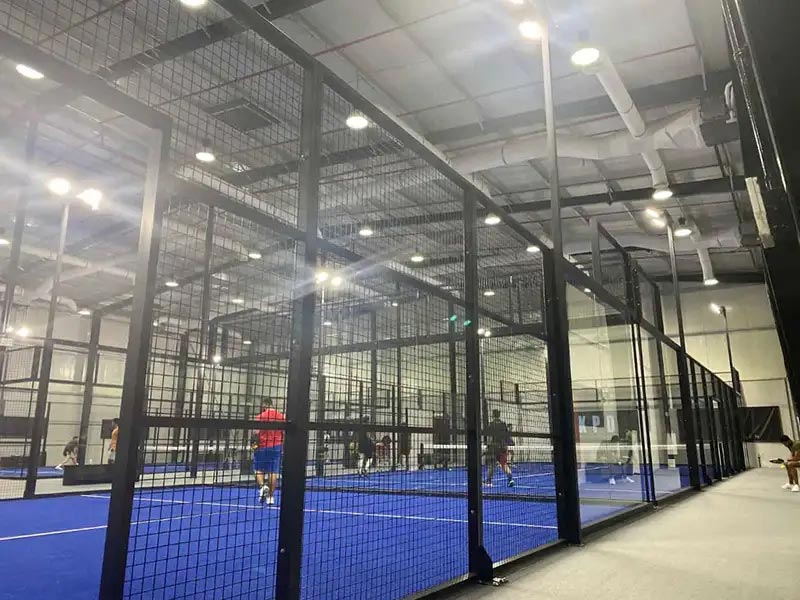
A Padel Court Electrical System is the complete network that distributes, protects, controls, and isolates electrical power used by the court.
It may include:
- Main electrical supply
- Distribution board
- Circuit breakers
- Residual-current protection
- Surge protective devices
- Earthing conductors
- Equipotential bonding
- Lighting cables
- Lighting control circuits
- Junction boxes
- Cable ducts
- LED drivers
- Local isolators
- Timers
- Contactors
- Smart controls
- Emergency lighting
- Scoreboards
- Cameras
- Access-control equipment
Lighting Is Only One Part of the System
LED floodlights are the most visible electrical components, but they cannot operate reliably without correctly sized cables, protective devices, enclosures, connections, controls, and earthing.
Concept: Electrical Coordination
Electrical coordination means designing the supply, cables, protection, controls, court structure, foundation, and maintenance access as one system.
A high-quality LED fixture cannot compensate for an undersized cable, unsuitable enclosure, unprotected circuit, or water-filled junction box.
Start With the Intended Court Use
The electrical design should reflect how the facility will operate.
Recreational Club
A recreational club may require:
- Standard court lighting
- Individual court controls
- Booking-system integration
- Timers
- Limited camera coverage
- Emergency pathway lighting
Commercial Multi-Court Facility
A multi-court club may also require:
- Central lighting control
- Court-by-court energy metering
- Dimming
- Cleaning mode
- Reception controls
- Remote fault alerts
- CCTV
- Access gates
- Wi-Fi equipment
Tournament Venue
A competition facility may require:
- Higher lighting performance
- Broadcast lighting
- Additional distribution capacity
- Scoreboards
- Camera power
- Media positions
- Backup operating procedures
The current FIP Rules of Padel require artificial lighting to be uniform and positioned so that it does not create visual difficulty for players, officials, or spectators. The rules also identify at least 1,000 lux of vertical illumination for television broadcasts and film recording.
Main Electrical Components of a Padel Court
| Component | Main Function | Buyer Should Confirm |
|---|---|---|
| Main distribution board | Receives and distributes electrical supply | Capacity, location, protection, spare ways |
| Court distribution board | Supplies one court or court group | Circuit identification and enclosure rating |
| Circuit breaker | Protects against overcurrent and faults | Rating and coordination |
| Residual-current device | Provides additional shock protection where required | Type, sensitivity, testing method |
| Surge protective device | Limits transient overvoltage | System compatibility and replacement indicator |
| Earthing conductor | Connects exposed conductive parts to earth | Size, continuity, termination |
| Bonding conductor | Connects metal parts to a common potential | Court posts, lighting poles, enclosures |
| Cable | Transmits electrical power or controls | Size, voltage rating, environment |
| Conduit or duct | Protects and organizes cables | Route, drainage, capacity |
| Junction box | Creates protected cable connections | IP rating, glands, accessibility |
| LED driver | Converts and regulates power for LED fixtures | Voltage, dimming, surge capability |
| Isolator | Allows safe local disconnection | Position and lockability |
| Control system | Switches, schedules, or dims lights | Manual override and compatibility |
Estimate the Preliminary Electrical Load
The preliminary load helps the designer plan the distribution board, cables, protective devices, utility capacity, and future expansion.
SRSC’s current Padel Court listings commonly specify eight 200W LED fixtures for a standard court. This represents an illustrative connected lighting load of approximately 1.6kW per court before allowing for drivers, controls, cameras, scoreboards, sockets, or other equipment. Product-specific fixture quantity and electrical specifications should be confirmed in the final quotation.
Illustrative Lighting Loads
| Court Quantity | Eight 200W Fixtures per Court | Preliminary Connected Lighting Load |
| 1 court | 8 fixtures | 1.6kW |
| 2 courts | 16 fixtures | 3.2kW |
| 4 courts | 32 fixtures | 6.4kW |
| 6 courts | 48 fixtures | 9.6kW |
These values are preliminary examples rather than final electrical designs.
Include Additional Loads
The project may also need power for:
- LED drivers
- Control panels
- CCTV cameras
- Wi-Fi access points
- Digital scoreboards
- Booking terminals
- Gate controls
- Maintenance sockets
- Emergency lighting
- Roof ventilation
- Water pumps
- Clubhouse facilities
Do Not Size the System Only by Fixture Wattage
The electrical designer should also consider:
- Supply voltage
- Starting or inrush current
- Power factor
- Voltage drop
- Circuit length
- Ambient temperature
- Grouped cables
- Future court expansion
- Local electrical rules
Divide Lighting Into Separate Circuits
Using one circuit for every light in a large club can create unnecessary operational risk.
One Court per Control Zone
Each court should normally be independently controllable.
This allows the operator to:
- Light only booked courts
- Isolate a faulty court
- Reduce unnecessary energy use
- Perform maintenance without closing the club
- Use different settings for training and events
Divide Fixtures Within One Court
Depending on the electrical design, fixtures on one court may be divided into two or more circuits.
For example:
- Left-side lights
- Right-side lights
- Alternate fixtures
- Training mode
- Full competition mode
A divided arrangement can prevent the entire court from becoming dark after one protective device operates.
Keep Emergency and General Lighting Separate
Pathways, exits, reception areas, stairs, and emergency lighting should not depend solely on the court-lighting circuit.
Select the Correct Supply Voltage
SRSC’s current product information states that selected Padel Court LED systems can support a broad 110–220V operating range. The exact fixture voltage, frequency, driver configuration, and local supply compatibility must still be confirmed before production.
Information to Confirm
Provide the supplier with:
- Nominal voltage
- Frequency
- Single-phase or three-phase supply
- Earthing arrangement
- Plug or hardwired connection
- Local certification requirements
- Maximum available capacity
Do Not Assume the Voltage From the Country Name
Large commercial sites may use different supply arrangements from residential buildings.
The local electrical professional should confirm the actual supply at the project location.
Plan Cable Routes Before Concrete Work
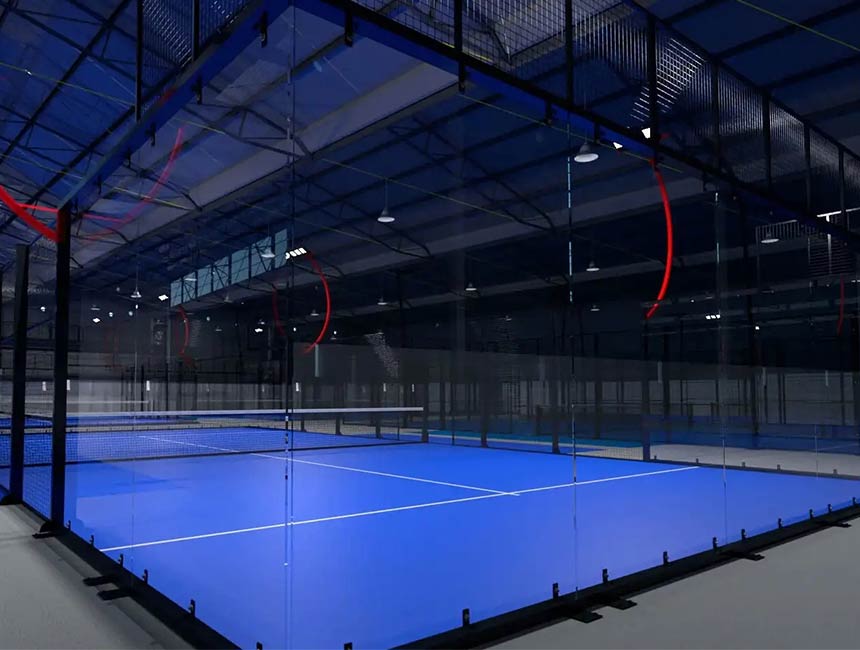
Cable routing should be coordinated with foundations, anchors, drainage, gates, turf, and access routes.
Underground Conduits
Underground conduits can provide protected routes between:
- Main electrical room
- Court distribution board
- Lighting poles
- Control panels
- Cameras
- Scoreboards
They should be installed before final concrete, paving, or artificial turf.
Avoid Anchor Conflicts
Cable ducts should not pass through areas required for:
- Court post anchors
- Lighting-column foundations
- Roof columns
- Gate posts
- Drainage channels
The court foundation and electrical drawings should use the same coordinate system.
Keep Cables Outside the Playing Area
The FIP rules state that the upper part of framed metallic fencing must remain free from elements that are not part of the structure, including cables, electrical boxes, and lighting devices.
Cables should therefore be routed through approved posts, conduits, or external service zones rather than attached casually to the inner fence surface.
Provide Draw Wires and Spare Capacity
Empty spare conduits can support future:
- Cameras
- Scoreboards
- Booking systems
- Access controls
- Additional lighting
- Data cables
Adding an empty conduit during civil construction usually requires less disruption than cutting the completed floor later.
Route Cables Through Lighting Posts Carefully
Lighting poles may provide a concealed route for power cables.
Entry Points
Cable-entry holes should have:
- Smooth edges
- Suitable glands
- Protective bushes
- Drainage consideration
- Corrosion repair around cut metal
Avoid Sharp Steel Edges
A cable should not rest directly against an unprotected drilled edge.
Movement caused by wind or maintenance can gradually damage the insulation.
Separate Power and Data
Where practical and required by the system design, power circuits should be coordinated separately from sensitive data and communication cables.
Provide Maintenance Access
Technicians should be able to reach:
- Driver connections
- Terminal boxes
- Isolators
- Cable glands
- Protective devices
Access should not require removing a glass panel or damaging the artificial turf.
Understand IP Ratings
Outdoor fixtures, junction boxes, control panels, switches, and connectors need appropriate protection against dust and water.
The IEC developed the IP Code under IEC 60529. The first numeral represents protection against solid objects, ranging from 0 to 6, while the second numeral represents protection against liquids, ranging from 0 to 9.
Example IP Ratings
| IP Rating | General Interpretation |
| IP44 | Protection against selected solid objects and splashing water |
| IP54 | Limited dust protection and protection against water splashes |
| IP65 | Dust-tight enclosure and protection against water jets |
| IP66 | Dust-tight enclosure and protection against stronger water jets |
| IP67 | Dust-tight enclosure and temporary immersion protection under defined tests |
The exact test conditions and limits are defined by IEC 60529.
IP Rating Is Not a Complete Quality Rating
An IP code does not automatically define:
- Corrosion resistance
- UV resistance
- Impact resistance
- Cable-gland quality
- Operating temperature
- Expected service life
The complete product specification should be reviewed.
Confirm Every Electrical Component
Do not check only the LED fixture.
The project should also review the IP rating of:
- Junction boxes
- Drivers
- Connectors
- Switches
- Distribution boards
- Sensors
- Control panels
- Cable glands
A high-IP fixture connected through a poorly sealed box does not create a weather-resistant system.
Compare Indoor and Outdoor Electrical Systems
| Requirement | Indoor Court | Outdoor Court |
| Rain exposure | Limited | Direct exposure possible |
| UV exposure | Low | High |
| Condensation | Building-dependent | Common |
| Junction boxes | Indoor-rated where suitable | Weather-resistant |
| Cable route | Building trays or conduits | Underground or protected outdoor conduit |
| Corrosion | Moderate | Higher |
| Surge exposure | Site-dependent | Often more significant |
| Drainage | Building-controlled | Must be designed |
| Maintenance access | Lifts or ceiling access | Poles and outdoor access equipment |
| Lighting controls | Building-management integration possible | Weatherproof local controls |
Indoor Courts
Indoor projects should coordinate electrical services with:
- Roof beams
- HVAC ducts
- sprinklers
- acoustic panels
- cameras
- ceiling access
Lights and services must remain outside the required unobstructed playing height. FIP requires a minimum free height of 6 metres and recommends 8 metres for new facilities; lighting projectors positioned inside the vertical projection of the court walls should follow the related height guidance.
Outdoor Courts
Outdoor projects need additional protection against:
- Rain
- condensation
- dust
- insects
- UV exposure
- temperature cycles
- irrigation water
- coastal salt
Plan Earthing and Equipotential Bonding
Padel courts contain extensive conductive steelwork, including posts, mesh frames, lighting poles, base plates, roof structures, and electrical enclosures.
IEC 60364-5-54 addresses earthing arrangements, protective conductors, and protective bonding conductors for low-voltage electrical installations.
Components That May Require Coordination
The electrical designer should review:
- Lighting poles
- Court steel frame
- Roof columns
- Distribution boards
- Metal junction boxes
- Cable trays
- Electrical equipment housings
Protective Earthing
Protective earthing provides a defined path for fault current so the protective system can operate.
Equipotential Bonding
Bonding connects conductive parts to reduce dangerous potential differences.
Do Not Rely on Structural Bolts Alone
Paint, powder coating, corrosion, gaskets, and loose mechanical joints may interrupt electrical continuity.
Where bonding is required, use designed conductors, terminals, and tested connections.
Protect Earthing Connections
Outdoor terminations should remain:
- Accessible
- Corrosion-resistant
- Secure
- Clearly identified
- Protected from mechanical damage
Use Appropriate Residual-Current Protection
Residual-current devices are intended primarily to provide protection against electric-shock hazards by detecting certain current imbalances and disconnecting the supply. IEC 60755 provides general requirements and information relating to residual-current protective devices.
The exact RCD type, rating, sensitivity, and circuit arrangement should be selected according to:
- Local electrical rules
- Earthing system
- Fixture drivers
- Circuit characteristics
- Environmental conditions
- Manufacturer instructions
Avoid Unnecessary Club-Wide Shutdowns
One residual-current device serving every court may cause several courts to lose power after one fault.
Circuit division can improve fault isolation while maintaining the required protection.
Test Devices Periodically
The maintenance plan should include functional testing according to the device manufacturer and local requirements.
Provide Overcurrent and Short-Circuit Protection
Circuit breakers or fuses protect conductors and equipment from excessive current.
Coordinate Protection With Cables
The protective device should match:
- Cable size
- Installation method
- Ambient temperature
- Circuit length
- Load
- Fault level
- Driver inrush characteristics
Label Every Circuit
A clear schedule can identify:
- Court number
- Fixture group
- Control circuit
- Camera circuit
- Scoreboard
- Emergency lighting
- Spare circuit
Labels should remain readable after years of operation.
Protect the System From Surges
Outdoor LED drivers and controls can be affected by transient overvoltages caused by switching events or lightning-related effects.
IEC 61643-01:2024 establishes common requirements for surge protective devices, while IEC 61643-11:2025 addresses SPDs connected to AC low-voltage power systems.
SPD Planning
The electrical designer should review:
- Main distribution board protection
- Court-level distribution
- Long outdoor cable runs
- Lighting poles
- Sensitive controls
- Cameras
- Data networks
IEC 61643-12 describes principles for selecting, locating, operating, and coordinating surge protective devices in AC low-voltage systems.
Replaceable Protection
Where the selected SPD has a status indicator or replaceable module, the distribution board should allow easy inspection and replacement.
Lightning Protection Is a Separate Review
An SPD does not replace a complete lightning-risk assessment or external lightning-protection system where one is required.
Select LED Drivers Carefully
The LED driver regulates power supplied to the fixture.
Driver Information to Request
Ask for:
- Input voltage
- Input frequency
- Output current
- Power factor
- Efficiency
- Dimming compatibility
- Operating-temperature range
- Surge capability
- IP rating
- Warranty
- Replacement model
Integrated vs Remote Drivers
| Driver Type | Main Advantage | Main Consideration |
| Integrated driver | Compact fixture package | Maintenance may require fixture access |
| Remote driver | Easier ground-level maintenance | Longer output wiring and enclosure needed |
| Replaceable driver compartment | Reduced fixture replacement | Weather sealing must be maintained |
| Sealed non-serviceable driver | Strong factory sealing | Whole unit may require replacement |
Plan Replacement Access
LED chips may remain functional while the driver fails.
The facility should know whether a driver can be replaced without removing the entire lighting pole or closing neighbouring courts.
Design Practical Lighting Controls
Manual Switching
Simple local switches can be appropriate for:
- Private courts
- Schools
- Low-use facilities
They should remain protected from unauthorized operation and weather exposure.
Timer Controls
Timers can prevent lights from remaining on after closing.
Booking-System Integration
A commercial club may connect lighting to the court reservation system.
The system can:
- Turn on before a booking
- Turn off after the session
- Extend lighting after payment
- Record operating hours
Dimming
Dimming can provide:
- Cleaning mode
- Training mode
- Full-match mode
- Event mode
- Reduced off-peak consumption
Fixture drivers, controls, and wiring must use compatible dimming protocols.
Manual Override
Automated systems should provide an authorized manual operating method for:
- Maintenance
- Events
- Software faults
- Emergency procedures
Plan Multi-Court Distribution
A multi-court facility should not simply duplicate one small-court electrical design without reviewing the complete site.
Distribution Approaches
Possible arrangements include:
- One central board for all courts
- One board per court
- One board per group of courts
- Main board with local court panels
Central Board
Advantages:
- Central maintenance
- Simplified monitoring
- Fewer exposed enclosures
Considerations:
- Longer cable runs
- More voltage-drop calculations
- Larger board
- Greater impact of central faults
Local Court Boards
Advantages:
- Shorter final circuits
- Easier court isolation
- Clear expansion zones
Considerations:
- More outdoor enclosures
- More maintenance locations
- Additional corrosion and weather protection
Leave Expansion Capacity
Where future courts are planned, consider:
- Spare breaker positions
- Spare conduits
- Additional distribution capacity
- Control-system expansion
- Data-network capacity
Electrical Requirements for Roofed Padel Courts
Roofed courts introduce additional coordination points.
Roof-Mounted Fixtures
Fixtures may be installed on:
- Roof beams
- Purlins
- Dedicated lighting rails
- Court lighting poles
The mounting system should support the fixture and cable without uncontrolled drilling into structural members.
Rainwater and Electrical Equipment
Keep electrical boxes and cable outlets away from:
- Gutters
- Downpipes
- Roof edges
- Condensation drip points
- Overflow routes
Additional Roof Loads
Roofed facilities may also include:
- Fans
- ventilation
- emergency lighting
- signage
- cameras
- sound systems
SRSC’s current RR05 roofed model lists eight 200W LED fixtures as part of the court package, while its roof structure and weather exposure require coordinated structural and electrical installation.
Prepare Complete Electrical Drawings
Construction should not begin from a product brochure alone.
Single-Line Diagram
The single-line diagram should show:
- Incoming supply
- Main isolator
- Distribution boards
- Protective devices
- Circuit ratings
- Earthing arrangement
- Connected loads
Court Electrical Layout
The layout should show:
- Light positions
- Lighting poles
- Junction boxes
- Control panel
- Underground conduits
- Cable routes
- Cameras
- Scoreboards
- Earthing points
Cable Schedule
The schedule may include:
- Cable reference
- Origin
- Destination
- Cable type
- Conductor size
- Length
- Installation method
Control Schematic
For smart lighting, provide:
- Controller
- contactors
- relays
- dimming interface
- sensors
- booking connection
- manual override
Revision Control
Every drawing should identify:
- Project
- Drawing number
- Revision
- Date
- Approval status
- Responsible designer
Padel Court Electrical Installation Process
Step 1: Confirm the Power Supply
Verify voltage, frequency, capacity, earthing arrangement, and connection point.
Step 2: Coordinate the Civil Layout
Mark foundations, posts, drainage, conduits, distribution boards, and control locations.
Step 3: Install Underground Conduits
Complete conduit runs before final concrete and paving.
Step 4: Install Earthing and Bonding Components
Provide required conductors and connection points before access becomes restricted.
Step 5: Erect Court and Lighting Structures
Protect cable entries and avoid damaging hidden conduits.
Step 6: Pull and Terminate Cables
Use suitable cable glands, terminals, identification, and enclosure seals.
Step 7: Install Protective and Control Devices
Complete the distribution boards, isolators, breakers, RCDs, SPDs, timers, and controllers.
Step 8: Install and Aim LED Fixtures
Mount fixtures at the approved height and orientation.
Step 9: Test the Installation
Complete electrical safety tests and lighting checks.
Step 10: Provide Handover Documents
Deliver drawings, schedules, test reports, instructions, and spare-part information.
Commissioning and Testing Checklist
| Test Area | What to Verify |
| Supply voltage | Correct at distribution and fixtures |
| Circuit identification | Matches drawings |
| Protective conductors | Continuous and correctly terminated |
| Bonding | Court steel and equipment coordinated |
| Insulation | Meets applicable installation requirements |
| Polarity | Connections are correct |
| Protective devices | Correct type and operation |
| RCD operation | Tested where installed |
| SPD status | Correctly installed and active |
| Isolators | Accessible and labelled |
| IP sealing | Glands, covers, and boxes closed |
| Controls | Manual, timer, and smart functions operate |
| Dimming | Stable without flicker |
| Fixture operation | All LEDs function |
| Lighting uniformity | Matches approved design |
| Glare | Fixture direction does not obstruct vision |
| Emergency systems | Operate independently where required |
| Drawings | Match the completed installation |
Conduct Nighttime Testing
Daytime operation does not reveal:
- Dark areas
- glare
- uneven aiming
- reflections
- neighbouring-property light spill
The final lighting inspection should include realistic nighttime conditions.
Maintenance of a Padel Court Electrical System
Frequent Visual Checks
Inspect:
- Damaged fixtures
- Open boxes
- loose cables
- water entry
- cracked glands
- corrosion
- non-operating lights
- exposed conductors
Scheduled Electrical Inspection
A qualified professional should review:
- Distribution boards
- terminals
- protective devices
- earthing
- bonding
- insulation
- control operation
- fixture connections
Clean LED Fixtures
Dust, insects, salt, and dirt can reduce usable light output.
Use a method compatible with the fixture housing, lens, coating, and electrical protection.
Inspect After Severe Weather
After storms, flooding, or lightning activity, check:
- lighting poles
- fixture brackets
- junction boxes
- SPDs
- underground cable routes
- control panels
- earthing connections
Keep Maintenance Records
Record:
- Court number
- Circuit number
- Inspection date
- Test results
- Fault
- Repair
- Parts replaced
- Technician
Padel Court Electrical Procurement Checklist
| Specification Area | Buyer Should Confirm |
| Supply | Voltage, frequency, phase, and available capacity |
| LED fixtures | Quantity, wattage, optics, IP rating, and voltage |
| Drivers | Location, surge capability, dimming, and replacement |
| Distribution board | Size, enclosure, spare capacity, and labels |
| Circuit division | Per court and fixture group |
| Protection | Breakers, RCDs, SPDs, and isolation |
| Cables | Type, size, route, and environmental suitability |
| Conduits | Diameter, route, and spare capacity |
| Earthing | Conductors, electrodes, terminals, and testing |
| Bonding | Court frame, poles, roof, and enclosures |
| Controls | Manual, timer, booking, or dimming |
| Enclosures | IP rating and corrosion protection |
| Drawings | Single-line, layout, cable, and control drawings |
| Testing | Electrical and lighting commissioning |
| Spare parts | Drivers, fixtures, SPDs, glands, and controls |
| Warranty | Fixtures, drivers, panels, and installation |
Common Padel Court Electrical Mistakes
Installing Conduits After the Court Foundation
Late cutting can damage drainage, reinforcement, turf, and anchors.
Supplying All Courts From One Circuit
One fault may shut down the entire facility.
Checking Only the Fixture IP Rating
Junction boxes, drivers, glands, switches, and connectors must also suit the environment.
Attaching Cables to the Inner Fence
Cables and boxes should not create obstacles or exposed elements inside the court enclosure.
Ignoring Earthing and Bonding
Large metal structures require a coordinated electrical-safety review.
Installing No Surge Protection
Long outdoor circuits and sensitive LED drivers may remain exposed to transient overvoltage risks.
Placing Electrical Boxes Beside Drainage Outlets
Water discharge and electrical equipment should be separated.
Ordering Fixtures Without Confirming Voltage
The delivered driver may not match the project supply.
Providing No Manual Override
A software or booking-system failure can prevent staff from operating the lights.
Hiding Drivers Without Maintenance Access
A minor driver replacement can become a major court shutdown.
Conclusion
A reliable Padel Court Electrical System requires more than connecting LED fixtures to a nearby power supply.
The project must coordinate electrical capacity, circuit division, voltage, cable sizing, conduits, junction boxes, IP protection, overcurrent devices, residual-current protection, earthing, bonding, surge protection, controls, maintenance access, and future expansion.
Civil and electrical planning should be completed before the concrete, paving, drainage, artificial turf, and court structure restrict access. Each commercial court should also be clearly identified, independently controllable, and easy to isolate for maintenance.
SRSC’s current court packages commonly include eight 200W LED fixtures, while fixture voltage, IP rating, optics, driver type, controls, cable requirements, and local compliance should be confirmed for each destination. Buyers can explore the complete Padel Court range, compare the RR01 Panoramic Padel Court with the RR05 Roofed Outdoor Padel Court, read the LED Padel Court Lighting Guide, or contact SRSC with the court quantity, supply voltage, project location, control requirements, and electrical drawings.
FAQ
How much power does one Padel Court need?
It depends on the fixture quantity, wattage, controls, cameras, scoreboards, and supporting facilities. Eight 200W lights create an illustrative connected lighting load of approximately 1.6kW before additional equipment and design allowances.
Should every Padel Court have a separate circuit?
Independent court control and fault isolation are usually valuable for commercial clubs. The exact circuit division should be designed by the electrical professional.
What IP rating should outdoor Padel Court lights have?
The required rating depends on the exposure and installation. SRSC currently describes selected court lighting as IP65 or IP66 depending on the product listing, so buyers should confirm the exact final fixture specification.
What do the two IP numbers mean?
The first number indicates protection against solids, while the second indicates protection against liquids under IEC 60529.
Do lighting poles need to be earthed?
Conductive poles and court structures should be reviewed as part of the installation’s earthing and bonding design. The final requirements depend on the electrical system and local rules.
Does a Padel Court need surge protection?
Outdoor lighting and sensitive controls may benefit from coordinated surge protection. The electrical designer should evaluate the site and select devices according to the applicable system requirements.
Can the cables run along the court mesh?
The FIP rules state that the upper part of framed metallic fencing should remain free of unrelated cables, boxes, and lighting devices. Protected routes outside the playing enclosure are preferable.
Can Padel Court lights be connected to a booking system?
Yes, when the control system, contactors, drivers, software, and manual override are designed to work together.
How high should the light fixtures be?
FIP requires at least 6 metres from the ground to the lower part of the projectors and recommends 8 metres for new facilities when lights are installed within the vertical projection of the court side walls.
What documents should the electrical contractor provide?
Request the approved single-line diagram, court layout, circuit schedule, cable schedule, control schematic, test reports, as-built drawings, equipment manuals, and maintenance instructions.