
BLOG
Padel Court for Hotels: A Resort Planning and Revenue Guide
Recent Articles
Table of Contents
Key points covered in this guide:
- How a Padel Court can strengthen a hotel’s sports and leisure offering
- Which court type is suitable for resorts, city hotels, and holiday properties
- Where to position the court without affecting rooms and relaxation areas
- How to create coaching, family, corporate, and tournament programmes
- Which facilities should be planned around the court
- How to manage bookings for hotel guests and outside players
- What costs and operational responsibilities should be reviewed
- How to measure guest use and commercial performance
A Padel Court can give a hotel or resort a distinctive activity that combines sport, social interaction, coaching, and entertainment. Unlike a conventional fitness room that guests often use individually, padel encourages groups to play, watch, learn, and spend time together.
For hotels, the objective should not be limited to installing a court. The project should connect accommodation, leisure, food and beverage, events, wellness, and guest services into one coordinated experience.
Sports tourism includes travel connected with participating in or watching sports and can create economic, social, and destination-development opportunities. This makes sports infrastructure increasingly relevant to hotels and resorts seeking experiences beyond accommodation alone.
Why Hotels Are Adding Padel Courts
Hotels compete through location, rooms, service, food, wellness facilities, and memorable guest experiences. A court can help differentiate a property from nearby accommodation offering only a gym or swimming pool.
Create a Social Guest Activity
Padel is normally played in doubles, making it suitable for:
- Couples travelling with friends
- Families
- Corporate groups
- Wedding guests
- Sports teams
- Wellness retreats
- Long-stay visitors
- Local club members
Guests do not need to spend the entire day playing. A short introductory session can become part of a broader resort programme.
Extend the Guest Experience
A hotel can combine court use with:
- Accommodation packages
- Private coaching
- Recovery treatments
- Pool access
- Restaurant offers
- Group events
- Equipment rental
- Junior activities
Concept: Experience Packaging
Experience packaging means combining several services into one bookable product.
Instead of selling only a room or one court hour, a resort may sell a weekend package that includes accommodation, breakfast, coaching, court reservations, equipment, and wellness services.
Match the Padel Court to the Property Type
Different hotel projects require different court designs.
Urban Hotel
A city hotel may have limited land and close neighbouring buildings. The main considerations include noise, evening lighting, parking, rooftop loads, and access for construction equipment.
An indoor or carefully enclosed facility may be more appropriate where outdoor operating hours would create conflicts.
Beach or Coastal Resort
A coastal project must consider salt, humidity, wind, sand, and intensive sunlight.
The buyer should request suitable corrosion protection for steel posts, bolts, hinges, fencing, lighting supports, and damaged coating areas.
Mountain Resort
A mountain property may experience snow, ice, low temperatures, strong wind, and seasonal operating periods.
Roof loads, access, drainage, surface freezing, and winter maintenance should be reviewed by local engineers.
Wellness Resort
A wellness property may position padel as one part of an active-stay programme alongside yoga, fitness, swimming, cycling, recovery, and nutrition.
The visual design should complement the surrounding landscape and the property’s wider brand identity.
Compare Court Types for Hotels and Resorts
| Court Type | Main Hotel Advantage | Suitable Setting | Main Planning Issue |
|---|---|---|---|
| Classic court | Practical and familiar structure | Community hotels and standard resorts | Structural visibility |
| Panoramic court | Clear views and premium appearance | Luxury resorts and event hotels | Higher presentation expectations |
| Super panoramic court | Strong photography and spectator value | High-end destination resorts | Engineering and procurement scope |
| Roofed outdoor court | Improved weather protection | Rainy or high-sun destinations | Roof loads and drainage |
| Indoor court | More predictable year-round use | Urban and cold-climate hotels | Building height and acoustics |
| Single court | Reduced width for selected projects | Smaller private properties | Limited standard doubles use |
SRSC currently offers classic, panoramic, super panoramic, single, indoor, outdoor, and roofed configurations within its Padel Court product range. The listed doubles models generally use a 20 × 10 metre court size, while customized colours are available for several models.
Use a Panoramic Court as a Resort Feature
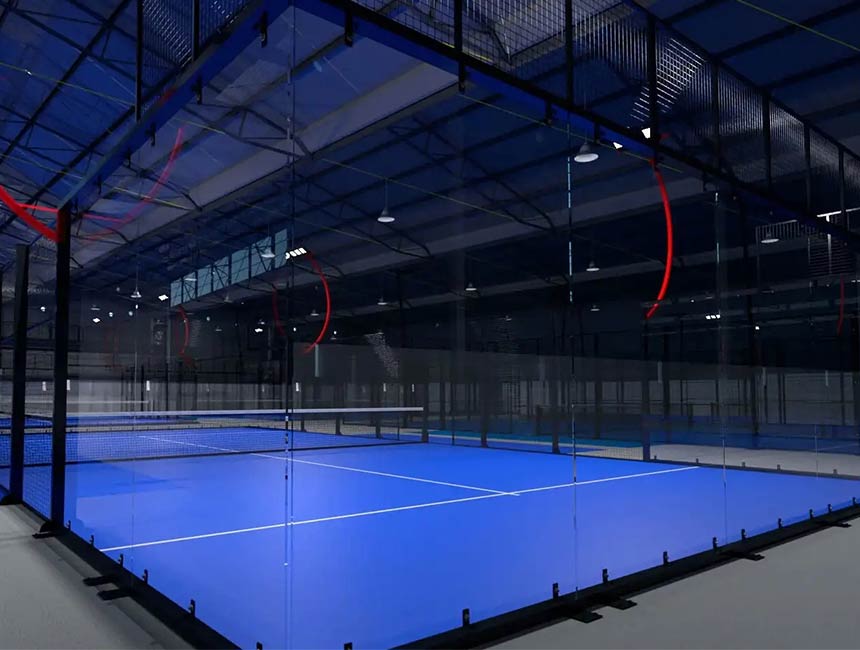
A panoramic Padel Court can work well where appearance, photography, and viewing are important.
The reduced visual obstruction around major glass areas can help the court become part of the property’s architectural and social experience.
Position It Near Active Guest Areas
Possible locations include:
- Sports club
- Pool complex
- Beach club
- Wellness centre
- Family activity zone
- Event lawn
- Outdoor café
- Recreation building
The court should remain visible enough to attract interest without disrupting quiet rooms, spas, gardens, or private villas.
The SRSC RR01 panoramic model is presented as a 20 × 10 metre system using galvanized steel, 12 mm tempered glass, artificial turf, and LED lighting. Final specifications should still be confirmed for each project.
Consider a Roofed Court for Weather Protection
Weather-related closures can reduce the value of a hotel sports facility.
A roofed Outdoor Padel Court may help protect play from rain and strong sunlight while retaining an open-air environment.
Coordinate the Roof With the Site
The roof design should consider:
- Local wind conditions
- Rainwater collection
- Snow loads where applicable
- Column positions
- Lighting
- Ventilation
- Shade movement
- Planning approval
- Foundation size
A roof should not be added to an existing court without reviewing the structural and foundation system.
Select the Padel Court Location Carefully
The location can determine whether the court becomes a valued amenity or a source of complaints.
Protect Guest Rooms From Noise
Ball impacts, player voices, gates, and spectator activity may be noticeable near accommodation buildings.
Avoid placing the court directly beside:
- Bedroom balconies
- Private villas
- Spa treatment rooms
- Quiet gardens
- Conference rooms
- Wedding ceremony areas
Buildings, landscaped mounds, solid barriers, and service structures may help separate active and quiet zones.
Control Lighting Spill
Resort guests may expect low lighting around gardens, villas, and beachfront areas at night.
Court lighting should provide suitable playing conditions without shining into guest rooms or dominating the wider landscape.
Plan a Convenient Walking Route
The court should be easy to reach from reception, rooms, changing areas, and leisure facilities.
Guests should not need to walk through loading zones, service yards, or vehicle routes while carrying rackets and sports bags.
Plan the Supporting Guest Facilities
The quality of the guest experience depends on more than the playing enclosure.
Equipment Rental
Many hotel guests will not travel with padel equipment.
Provide:
- Rental rackets
- Balls
- Grips
- Towels
- Drinking water
- Suitable footwear information
- Storage and cleaning area
Rental equipment should be inspected between users and removed from service when damaged.
Seating and Shade
Guests may arrive early, watch friends, wait for coaching, or rest after play.
Include comfortable seating, shade, water, and clear views without blocking court entrances.
Changing and Shower Facilities
The court should connect conveniently to suitable changing rooms, toilets, lockers, and showers.
A resort expecting outside members or day visitors may need separate access arrangements so they do not pass through private guest areas.
Food and Beverage
A nearby café, juice bar, restaurant terrace, or pool bar can extend the value of each visit.
The service area should remain far enough from the playing enclosure to avoid loose glassware, food waste, or crowded walkways around the gates.
Develop Hotel Padel Programmes
A court without organised programming may remain unused outside a few peak periods.
Complimentary Guest Introductions
Short beginner sessions can help guests try the sport without committing to a full lesson.
The hotel may provide equipment and basic instruction at scheduled times.
Private Coaching
Private lessons can be offered as:
- Individual sessions
- Couples’ coaching
- Family lessons
- Junior training
- Advanced player sessions
- Multi-day holiday packages
Social Mix-In Sessions
A social session allows individual travellers or couples to join other players of a similar ability.
This can be valuable at resorts where guests want to play but have not travelled with three partners.
Corporate Activities
Padel can support company retreats and conferences through:
- Team competitions
- Beginner clinics
- Round-robin events
- Branded tournaments
- Award ceremonies
- Food and beverage packages
Avoid Overcomplicated Events
Corporate guests may include complete beginners. Use simple formats, short matches, clear instructions, and sufficient coaching support.
Coordinate Hotel and Public Bookings
Some properties reserve the facility exclusively for hotel guests, while others allow local players and club members to book.
Guest-Only Model
This model protects availability for staying guests and maintains a private-resort atmosphere.
However, court demand may vary strongly by season and hotel occupancy.
Public Membership Model
Allowing local customers to play can create more regular use and revenue.
The hotel must then manage:
- External parking
- Access control
- changing facilities
- Security
- Payment
- Operating hours
- Separation from guest-only areas
Hybrid Model
A hybrid model can reserve priority booking windows for hotel guests and release unused slots to local players later.
The booking system should apply these rules automatically.
Calculate the Complete Resort Project Cost
The court equipment price is only one part of the investment.
Budget categories may include:
- Site survey
- Design and engineering
- Planning approval
- Ground preparation
- Foundations
- Drainage
- Court structure
- Artificial turf
- Lighting
- Electrical connection
- Roof or shade system
- Shipping
- Installation
- Landscaping
- Seating
- Equipment
- Booking technology
- Staff training
The Padel Court construction cost guide provides an overview of the cost areas that may influence a complete project. SRSC states that its project support can cover site analysis, material selection, installation, and project management.
Measure Hotel Padel Court Performance
The court should be evaluated as both a guest amenity and an operating asset.
Usage Metrics
Track:
- Booked hours
- Guest use
- Local member use
- Coaching sessions
- Peak and off-peak demand
- Weather cancellations
- Equipment rentals
Guest-Experience Metrics
Monitor:
- Guest feedback
- Review mentions
- Repeat participation
- Programme attendance
- Family use
- Corporate enquiries
Revenue Metrics
Possible direct revenue includes:
- Court bookings
- Coaching
- Equipment rental
- Events
- Memberships
- Food and beverage
- Branded packages
Indirect value may come from stronger guest satisfaction, package differentiation, event bookings, and visual marketing content.
Avoid Unsupported ROI Claims
The court’s return depends on location, occupancy, room rates, seasonality, local demand, pricing, programming, staffing, and construction cost.
Use the hotel’s own operating data rather than relying on a universal revenue promise.
Common Hotel Padel Court Mistakes
Installing the Court Too Close to Rooms
A convenient location may become unsuitable when evening play affects quiet guest areas.
Providing No Beginner Programme
Many guests may be interested but unsure how to start.
Forgetting Equipment Rental
Travellers rarely pack large sports equipment unless the trip is specifically organised around padel.
Building Without Shade or Seating
Players and spectators need comfortable waiting and recovery areas, especially in hot climates.
Restricting the Court Without Promoting It
The amenity should appear on the hotel website, booking confirmations, activity schedule, in-room information, and guest application.
Ignoring Local Demand
A hotel-only court may be underused during low occupancy. Local memberships or coaching can help, provided they do not reduce the guest experience.
FAQ
Is a Padel Court suitable for a small hotel?
It can be, provided the property has sufficient land, demand, access, and budget. Smaller properties should compare the court with other possible uses of the same space.
Should a resort choose a panoramic court?
A panoramic design can provide stronger views and a premium appearance, making it suitable for feature locations and marketing content.
Can hotel guests play without experience?
Yes. Beginner coaching, rental equipment, and social sessions can make the activity accessible to first-time players.
Should outside customers be allowed to book?
This depends on the hotel’s brand, security, demand, seasonality, and available support facilities. A hybrid booking model can protect guest priority.
Does the hotel need a roofed court?
Not always. A roof may be valuable in rainy, sunny, or highly seasonal destinations, but it adds structural and planning requirements.
How much space does the project need?
The official doubles court is a 20 × 10 metre rectangle inside the enclosure. Additional space is required for the structure, foundations, circulation, seating, drainage, and maintenance.
What information should be sent to a supplier?
Provide the project address, site dimensions, climate, court quantity, preferred model, hotel positioning, guest profile, operating hours, access conditions, and target opening date.
Conclusion
A Padel Court can help a hotel or resort create a more social, active, and marketable guest experience.
The strongest projects connect the court with accommodation packages, coaching, family activities, corporate events, food and beverage, wellness services, and local demand. Court type, location, weather protection, noise, access, equipment, and programming should therefore be planned together.
SRSC offers classic, panoramic, super panoramic, indoor, outdoor, single, and roofed court configurations with customizable colour options. Buyers can explore the full Padel Court collection, learn more about the company’s design and installation capabilities, or contact SRSC with the hotel site plan and project requirements.