
BLOG
Padel Court Turf: Textured vs Monofilament Buyer’s Guide
Recent Articles
Table of Contents
Choosing the right padel court turf affects ball speed, bounce consistency, player grip, maintenance workload, drainage, and the overall playing experience. Although different artificial grass systems may look similar in photographs, their fiber construction and infill requirements can produce noticeably different results.
Before ordering a court, buyers should match the turf to the expected player level, booking frequency, climate, maintenance capacity, and project budget.
Key points covered in this guide:
- Compare textured and straight monofilament turf.
- Understand pile height, fiber density, backing, and infill sand.
- Match the surface to recreational, commercial, or competition use.
- Check drainage and UV resistance for outdoor courts.
- Estimate ongoing brushing, cleaning, and sand redistribution needs.
- Review the supplier’s technical documents and warranty conditions.
- Avoid choosing artificial grass based only on color or price.
Why Padel Court Turf Selection Matters
The playing surface influences every movement and rally. Players need enough grip to change direction safely, while the ball needs a predictable bounce across the entire court.
An unsuitable or poorly installed surface may cause inconsistent ball response, loose fibers, visible sand movement, slow drainage, or premature wear. For a commercial club, these problems can affect customer satisfaction and increase maintenance downtime.
Ball Speed
Turf construction and infill distribution influence how quickly the ball travels after bouncing. A relatively fast surface can suit experienced players and high-intensity matches, while a more controlled surface may be easier for beginners and mixed-level club users.
Player Movement
Padel includes lateral movement, rapid acceleration, turning, and short stops. The turf must balance traction with controlled sliding rather than producing an excessively slippery or aggressive surface.
Court Appearance
Artificial grass covers approximately 200 square meters on a standard doubles court. Color consistency, fiber recovery, seam quality, sand visibility, and regular grooming all influence the appearance of the completed facility.
What Is Padel Court Turf Made From?
Most modern padel surfaces use synthetic fibers attached to a reinforced backing. The finished system also includes joining tape, adhesive, line markings, and a specified quantity of infill material.
Buyers can review the turf options included in SRSC’s padel court systems when comparing complete court packages.
Polyethylene Fibers
Polyethylene is commonly used because it can provide a relatively soft contact surface with suitable wear resistance. The fiber shape, thickness, texture, and UV treatment vary between products.
The material name alone does not establish quality. Ask for technical information about yarn construction, total fiber weight, wear testing, and intended application.
Primary and Secondary Backing
The backing holds the fibers in position and provides dimensional stability. A multi-layer backing may combine woven polypropylene with a latex, polyurethane, or other secondary coating.
For outdoor use, the backing must also allow water to pass through at an appropriate rate.
Infill Sand
Silica or quartz sand supports the fibers, stabilizes the turf, and affects ball speed and player movement. The correct amount depends on pile height, fiber construction, manufacturer instructions, and desired performance.
Sand Quality
Infill should be clean, dry, correctly graded, and suitable for sports turf. Sand containing excessive dust or irregular particles may compact, contaminate the surface, or reduce drainage.
Textured vs Monofilament Padel Court Turf
The two main choices are often described as textured or curled turf and straight monofilament turf. Neither is automatically best for every project.
| Feature | Textured turf | Straight monofilament turf |
|---|---|---|
| Fiber shape | Curled or textured | Straighter individual fibers |
| Typical playing speed | Controlled to medium | Medium to fast |
| Sand visibility | Usually less visible | Often more visible |
| Infill stability | Generally more stable | May require more redistribution |
| Maintenance | Often easier to keep visually uniform | Regular brushing is important |
| Player profile | Beginners, mixed levels and clubs | Experienced and fast-play users |
| Visual appearance | Dense and uniform | More traditional grass-like look |
| Purchasing priority | Control and manageable upkeep | Speed and dynamic response |
Textured Turf
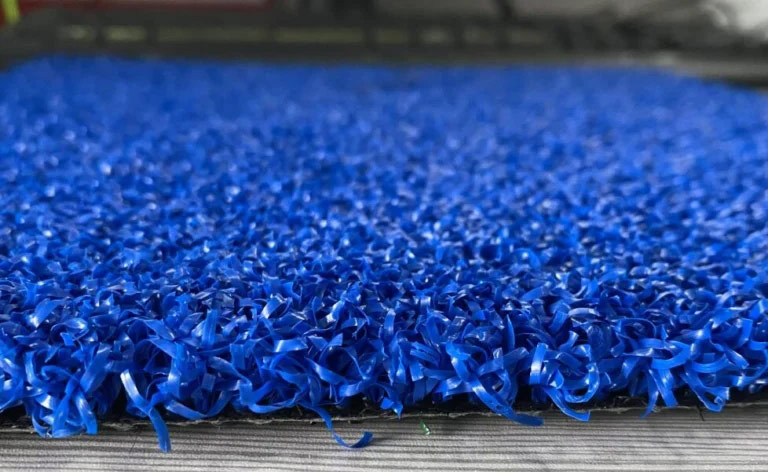
Textured fibers curl naturally and tend to surround the infill. This construction can help keep sand distributed within the surface and create a neat, uniform appearance.
It is often selected for busy clubs that want balanced playing speed and manageable daily maintenance.
Controlled Play
Textured padel court turf generally supports a more controlled ball response. This can make rallies accessible to beginners while remaining suitable for regular club competition.
Reduced Sand Movement
Because the fibers help contain the infill, sand may remain more stable during play. Maintenance is still required, but visible displacement may be less pronounced than on some straight-fiber systems.
Straight Monofilament Turf
Straight monofilament products use individual upright fibers. They can deliver a faster, more dynamic playing style when combined with the correct pile height and sand level.
The traditional grass-like appearance may also appeal to clubs seeking a familiar visual finish.
Faster Ball Response
The ball may move more quickly across a straight-fiber surface, especially when sand distribution and fiber condition allow a relatively open playing layer.
The actual result depends on the full system rather than fiber shape alone.
Greater Grooming Demand
Player movement can shift infill toward corners, glass walls, and lower-traffic areas. Regular brushing and sand redistribution help prevent uneven playing conditions.
How Turf Influences Ball Performance
According to the International Padel Federation’s Rules of Padel, the playing surface must allow regular ball bounce. Artificial grass and other synthetic surfaces must also meet the applicable requirements used for court approval.
Pile Height
Padel turf commonly uses a relatively short pile compared with landscaping grass or some field sports surfaces. The correct pile height helps stabilize infill and maintain predictable movement.
A taller pile is not necessarily more comfortable or more durable. Excessive fiber movement can alter ball response and increase maintenance requirements.
Fiber Density
Density describes how much yarn is installed across the surface. A dense product can improve coverage and appearance, but stitch count should be assessed alongside yarn weight, fiber shape, pile height, and backing construction.
Do not compare products using stitch density alone because manufacturers may calculate or present it differently.
Infill Depth
Sand depth influences the amount of exposed fiber and how the ball interacts with the surface. Too little sand may leave fibers unsupported, while excessive infill can slow play, increase sand movement, or create harder areas.
Court Consistency
The quantity of sand should be uniform across service boxes, baselines, net areas, entrances, and corners. Uneven infill is one of the most common reasons a court feels different from one area to another.
Choosing Turf by Project Type
The best padel court turf depends on how the facility will be used. A private residential court may need a different surface from a club operating from early morning until late evening.
Private Padel Courts
Residential buyers may prioritize comfort, appearance, and manageable maintenance. A textured surface can be practical when professional grooming equipment or full-time maintenance staff are unavailable.
Commercial Clubs
A high-traffic club needs a balance of durability, player acceptance, predictable performance, and efficient upkeep. The owner should consider daily bookings, coaching sessions, leagues, and expected annual playing hours.
Mixed-Level Membership
When beginners and experienced players share the same facility, a controlled surface can make the court more accessible. It may also support longer rallies and a less demanding introduction to the sport.
Competition Venues
Tournament projects should confirm the requirements of the relevant federation, organizer, and competition level. Surface approval may involve more than selecting a particular fiber type.
Lighting, dimensions, glass, access, free height, ball behavior, and overall court construction may also be reviewed.
Hotels, Resorts and Schools
These projects often serve players with different experience levels. A visually consistent surface with moderate playing speed and straightforward maintenance can be a practical choice.
Indoor vs Outdoor Padel Court Turf
Indoor and outdoor courts face different environmental conditions even when their playing requirements are similar.
Indoor Turf
Indoor surfaces are protected from rain and direct sunlight. However, dust, fiber wear, spilled drinks, and repeated high traffic still require routine cleaning.
Artificial lighting can also make seams, color variation, or infill distribution more visible.
Outdoor Turf
Outdoor padel court turf must cope with UV exposure, rainfall, temperature changes, windborne dirt, leaves, and organic contamination. Weather resistance and drainage performance therefore become major purchasing factors.
Buyers planning an open-air project can compare SRSC’s Outdoor Padel Court options.
UV Resistance
Ask whether the fibers, backing, and line markings include UV stabilization appropriate for the project location. Prolonged sunlight may otherwise contribute to fading, brittleness, or reduced fiber strength.
Water Permeability
Outdoor turf should allow water to move efficiently into the drainage layer. The supplier should provide a permeability value or relevant technical test rather than only stating that the turf is “waterproof.”
Padel Turf Colors
Blue, green, terracotta, black, pink, and other custom colors may be available. Color affects more than branding because it also influences line contrast, glare, heat absorption, and perceived cleanliness.
Blue Turf
Blue is widely used in modern clubs and creates strong contrast with a yellow ball. It can also give the facility a clean, competition-oriented appearance.
Green Turf
Green offers a familiar sports-field look and may blend naturally with landscaped outdoor surroundings. Sand and dust visibility depends on the precise shade and fiber construction.
Terracotta Turf
Terracotta or clay-colored turf creates a distinctive visual identity. Buyers should confirm that court lines and balls remain clearly visible under both daylight and artificial lighting.
Dark Colors
Black or very dark turf can create a premium appearance, but it may absorb more solar heat outdoors. Request a sample and evaluate it under local lighting and temperature conditions.
Color Consistency
All turf rolls should come from a consistent production batch when possible. Different batches may show slight shade variation, which becomes noticeable after installation.
Check the Turf Technical Specification
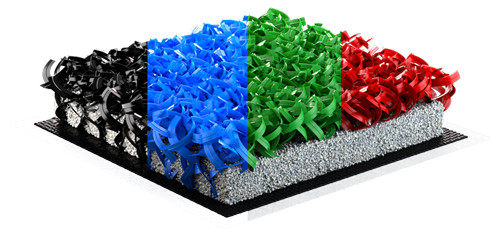
Product samples and photographs are useful, but they cannot replace a complete data sheet.
| Specification | What buyers should verify |
|---|---|
| Yarn material | Fiber polymer and UV treatment |
| Fiber shape | Textured, curled or straight monofilament |
| Pile height | Finished fiber height |
| Yarn weight | Amount of fiber used in the product |
| Stitch density | Tufting concentration and calculation method |
| Backing | Primary layers and secondary coating |
| Roll dimensions | Compatibility with the court layout |
| Water permeability | Suitability for outdoor drainage |
| Infill requirement | Sand type, grading and quantity |
| Color options | Available colors and batch consistency |
| Test documents | Applicable performance or quality reports |
| Warranty | Coverage, duration and maintenance conditions |
Total Product Weight
Total weight includes fibers and backing. It can support product comparison, but a heavier turf is not automatically better.
Buyers should review how the weight is distributed between yarn and backing.
Roll Width and Seams
The roll layout affects the number and position of seams. Fewer well-planned seams can simplify installation, but every joint still needs correct cutting, adhesive coverage, and curing.
Ask the supplier to provide a turf installation plan before material is cut.
Line Markings
Court lines may be tufted into the turf or installed by cutting and joining contrasting strips. The selected method should produce straight lines with secure seams and clear color contrast.
Padel Court Turf Installation Process
Even premium turf can perform poorly when installed over an uneven or contaminated base.
Base Inspection
Before installation, confirm that the foundation is clean, dry enough for the adhesive system, correctly leveled, and free from sharp projections. Drainage should be tested before the turf covers the base.
Roll Acclimation
Turf rolls may need time to relax after transportation. Unrolling them in the correct position can reduce wrinkles and make final trimming more accurate.
Seam Preparation
Edges should be cut cleanly without damaging adjacent fibers. Joining tape and adhesive must be compatible with the backing and expected indoor or outdoor conditions.
Adhesive Curing
Moving the turf or applying infill before the adhesive has cured may weaken seams. Installation schedules should account for temperature, humidity, and product-specific curing times.
Sand Application
Sand should be spread gradually in multiple passes rather than deposited in large piles. Brushing between passes helps the material settle evenly around the fibers.
The sand must be dry enough to spread efficiently.
Common Turf Purchasing Mistakes
Choosing by Price per Square Meter
A low material price may exclude joining tape, adhesive, lines, infill sand, delivery, installation, or spare material. Compare the full installed surface cost.
Ignoring Maintenance Capacity
Some surfaces require more frequent grooming and sand redistribution. A club without suitable equipment or staff should consider maintenance needs before choosing a faster surface.
Using Landscaping Grass
Decorative artificial grass is not designed for padel ball response, player movement, sports wear, or sand infill. It should not be substituted for a purpose-designed court product.
Comparing Density Without Context
A high stitch figure can sound impressive, but it does not show fiber durability, yarn weight, backing strength, drainage, or playing characteristics.
Installing Turf Before Drainage Testing
Once the turf is bonded, foundation corrections become more difficult. Test levels and water movement before installation begins.
Padel Court Turf Maintenance
Maintenance protects both playing quality and service life. The schedule should be adapted to usage, fiber type, climate, and surrounding environment.
Routine Debris Removal
Remove leaves, dust, litter, and organic material before it becomes embedded in the infill. Use equipment that will not pull fibers or damage seams.
Regular Brushing
Brush in multiple directions to lift fibers and redistribute sand. High-use areas near the baseline, net, entrances, and glass walls may need extra attention.
Brush Selection
Use the type of brush recommended by the turf manufacturer. Aggressive metal tools or unsuitable powered equipment can damage fibers and backing.
Infill Inspection
Measure or visually check sand depth across different court zones. Add compatible infill gradually when required rather than waiting until large areas become unstable.
Stain Treatment
Treat spills promptly with approved cleaning products. Strong solvents, bleach, and high-pressure cleaning can damage fibers, adhesives, or line seams.
Seam and Edge Checks
Inspect seams, lines, entrances, and perimeter edges for lifting or separation. Early repairs are normally easier and less disruptive than replacing a damaged section.
When Should Padel Court Turf Be Replaced?
There is no universal replacement interval. Service life depends on playing hours, fiber quality, UV exposure, maintenance, installation, drainage, footwear, and local climate.
Visible Fiber Wear
Flattened, split, brittle, or missing fibers can affect appearance and playing performance. Compare high-traffic zones with protected areas near corners to assess uneven wear.
Persistent Infill Problems
If sand continually migrates or cannot be distributed evenly, the fiber structure may no longer support it effectively. Foundation or drainage problems should also be ruled out.
Unstable Ball Response
Inconsistent bounce or speed can indicate uneven infill, contamination, poor seams, foundation defects, or advanced turf wear.
Failed Backing or Seams
Widespread delamination and repeated seam failure may make full replacement more practical than continued local repair.
Questions to Ask a Padel Court Turf Supplier
Before ordering, ask:
- Is the turf textured or straight monofilament?
- What playing speed is the system designed to provide?
- What are the pile height, yarn weight, and stitch density?
- What materials are used in the primary and secondary backing?
- How much sand is required per square meter?
- Which sand grading should the installer use?
- What is the water-permeability rating?
- Is the product suitable for the local UV and climate conditions?
- Can you provide a sample from the proposed production batch?
- Are joining tape, adhesive, lines, and spare turf included?
- What maintenance equipment is recommended?
- Which conditions can invalidate the warranty?
SRSC provides court design, manufacturing, turf supply, installation assistance, and after-sales support. Buyers can review the company’s sports facility services or contact the SRSC project team for a project-specific proposal.
Conclusion
Choosing padel court turf requires more than deciding between blue and green artificial grass. Fiber shape, pile height, yarn weight, backing, drainage, infill, installation, and maintenance all influence the finished court.
Textured turf is often suitable for clubs seeking controlled play and stable sand distribution. Straight monofilament turf can provide a faster playing experience but may require more frequent grooming. Buyers should compare complete technical specifications, request product samples, and confirm installation and maintenance requirements before placing an order.
FAQ
What is the best turf for a padel court?
The best surface depends on player level, desired ball speed, court traffic, climate, and maintenance capacity. Textured turf often suits mixed-level commercial use, while straight monofilament turf can support faster play.
Is textured turf better than monofilament turf?
Textured turf is not universally better, but it can provide stable infill, controlled play, and a consistent appearance. Monofilament turf may be preferred when buyers want a faster and more traditional playing surface.
How much sand does padel turf need?
The required quantity depends on the turf specification, pile height, fiber construction, and manufacturer’s installation method. Use the supplier’s documented value instead of applying a generic quantity.
Why is there sand on a padel court?
Sand supports the fibers, adds surface stability, influences ball behavior, and helps control player movement. It needs to be clean, correctly graded, and evenly distributed.
Can padel be played without sand infill?
Some specialized turf systems may use different or reduced-infill designs. Do not remove sand from a conventional infilled system unless the manufacturer confirms that the product is designed for this use.
How often should padel turf be brushed?
Frequency depends on court traffic and turf type. Busy commercial courts may require frequent inspection and regular brushing, while low-use private courts may need it less often.
Can tennis-court turf be used for padel?
A product intended for tennis may not provide the correct ball behavior, pile construction, infill stability, or movement characteristics for padel. Use a surface designed and specified for a padel court.
Which turf color is best?
Blue and green are widely used because they provide good ball and line visibility. The best color also depends on branding, sunlight, lighting, heat, surrounding architecture, and maintenance preferences.
How do I know if padel court turf is worn out?
Look for flattened or broken fibers, exposed backing, unstable seams, persistent sand movement, poor drainage, and inconsistent ball response. A professional inspection can determine whether maintenance or replacement is appropriate.
Can old turf be installed on a new court?
Reusing turf can introduce worn fibers, weakened backing, contaminated infill, incorrect roll dimensions, and damaged seams. Its condition and compatibility should be carefully evaluated before reuse.