
BLOG
Padel Court Wind Resistance: A Buyer’s Guide for Outdoor Projects
Recent Articles
Table of Contents
When buyers compare an Outdoor Padel Court, appearance, glass thickness, turf quality, and price often receive most of the attention. However, for outdoor installations, structural resistance to wind can be one of the most important factors affecting long-term safety, stability, maintenance, and project approval.
A padel court combines large glass surfaces, steel frames, mesh panels, lighting structures, anchor bolts, and a concrete foundation. These components must work together as a complete structural system.
Key Takeaways
- Padel Court Wind Resistance should be evaluated according to the actual project location.
- A simple “maximum wind speed” claim is not enough to judge structural performance.
- Glass panels, steel columns, anchors, connections, and foundations all form part of the load path.
- Panoramic and classic courts can respond differently to demanding outdoor conditions.
- Coastal, open-field, and storm-prone sites normally require more careful structural evaluation.
- Local building requirements should be checked before production and foundation construction.
- Buyers should request engineering information instead of comparing only steel thickness.
- Roofed courts require additional consideration because the roof introduces another wind-loaded surface.
What Does Padel Court Wind Resistance Mean?
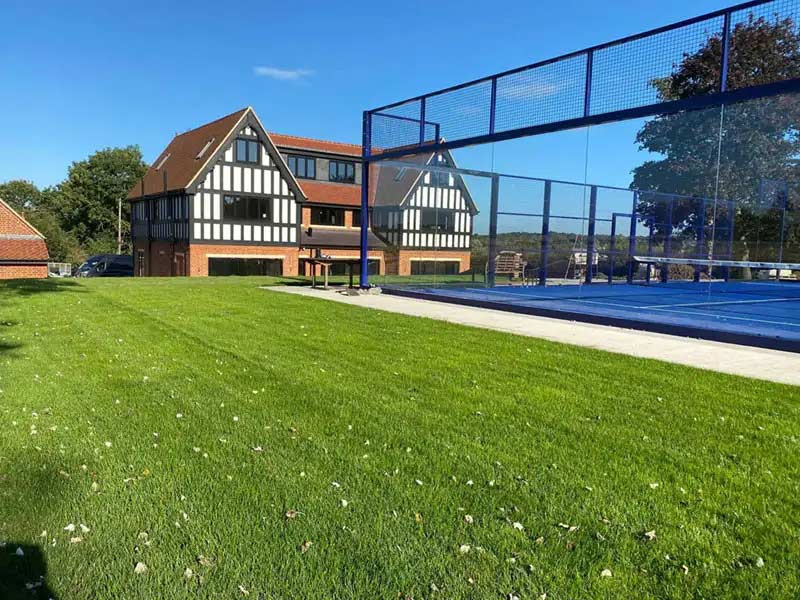
Padel Court Wind Resistance describes the ability of the complete court structure to safely transfer forces caused by wind through its glass, mesh, steel frame, connections, anchors, and foundation.
It should not be interpreted as a single specification attached only to the steel columns.
Wind Load
Wind load is the pressure or force created when moving air interacts with a structure.
For an Outdoor Padel Court, large vertical glass panels can receive considerable pressure. The resulting forces must then travel through the supporting frame into the foundation.
A Complete Load Path
A useful way to understand the concept is:
Glass → Frame → Connections → Anchors → Foundation → Ground
If one part of this chain is inadequate, simply increasing the thickness of another component may not solve the problem.
Why Wind Resistance Matters More for an Outdoor Padel Court
Indoor courts are generally protected by a surrounding building, while an outdoor installation is directly exposed to environmental conditions.
This difference changes the structural design priorities.
Large Glass Surfaces
Padel courts use extensive glass walls because glass forms part of the playing enclosure.
The current International Padel Federation rules specify a 10 × 20 m internal playing area and define glass or other suitable materials as part of the enclosure system.
Unlike an ordinary open sports fence, these solid surfaces can receive substantial wind pressure.
Open Locations
An Outdoor Padel Court beside an open field, coastline, rooftop, large parking area, or exposed resort may experience different wind conditions from a court surrounded by buildings.
This is why project location matters.
Concept: Exposure
Exposure describes how surrounding terrain and obstacles affect wind reaching a structure.
A protected urban site and an unobstructed coastal site may require different structural calculations even when the two courts look identical.
Is a “120 km/h Wind Rating” Enough?
Not necessarily.
Buyers frequently ask suppliers:
“How much wind can your padel court withstand?”
It sounds like a simple question, but the answer is rarely represented accurately by one number.
Wind Speed Is Only One Variable
Structural design may also depend on factors such as:
- Court geometry
- Terrain exposure
- Wind direction
- Risk category
- Structure height
- Glass configuration
- Local codes
- Foundation conditions
- Roof configuration
- Connection design
For projects in the United States, for example, the 2024 International Building Code specifies that wind loads on buildings and structures are determined using ASCE 7 procedures, including basic wind speed and exposure conditions.
Design Wind Speed vs Marketing Wind Speed
A supplier may advertise that a court has been “tested for strong winds,” but buyers should ask how that figure was determined.
Better Question
Instead of asking:
“What wind speed can this court handle?”
Ask:
“Can you evaluate this court according to my project location, wind conditions, court configuration, foundation, and applicable local standard?”
That question provides much more useful purchasing information.
What Parts Determine Padel Court Wind Resistance?
Wind-resistant design does not come from one oversized steel column.
Several components must work together.
Steel Columns and Frames
Steel framing provides the primary structural support around the enclosure.
Buyers should compare section dimensions, wall thickness, steel grade, reinforcement design, welding, connection points, and corrosion protection.
Bigger Is Not Automatically Better
A larger tube may appear stronger, but structural performance depends on geometry, connections, unsupported length, loading direction, and foundation design.
For procurement purposes, engineering documentation is more useful than judging products visually.
Tempered Glass
Glass is not only a playing surface.
In an Outdoor Padel Court, it is also exposed to wind pressure and transfers forces into the supporting structure.
SRSC’s outdoor court range uses steel, glass, artificial turf, and galvanized mesh as the main court system components.
For buyers comparing different glass specifications, the site’s existing Padel Court Glass Thickness: 10mm vs 12mm Buyer’s Guide provides a more detailed material comparison.
Anchors
Anchor bolts connect the steel structure to the foundation.
They must resist forces that may attempt to slide, lift, or overturn parts of the structure.
Concept: Anchorage
Anchorage is the connection between the court frame and the concrete foundation.
A strong steel frame with inadequate anchors does not create a strong complete system.
Foundation
The foundation receives loads from the structure and transfers them into the ground.
Its dimensions and reinforcement should therefore reflect site conditions and structural design rather than being copied automatically from an unrelated project.
Connections
Bolts, plates, welded joints, brackets, and glass fixing systems may appear small compared with the main columns, but they play an essential role in transferring loads.
Connections should be included when buyers evaluate structural documentation.
Classic vs Panoramic Court for Windy Locations
Both designs can be engineered for outdoor applications, but their structural configurations are different.
| Factor | Classic Padel Court | Panoramic Padel Court |
|---|---|---|
| Steel around glass | More visible framing | Reduced framing in viewing areas |
| Visibility | Good | Excellent |
| Structural approach | More traditional framed system | Requires carefully engineered large openings |
| Commercial appearance | Practical | Premium |
| Wind evaluation | Required outdoors | Especially important for exposed sites |
| Typical buyers | Schools, communities, clubs | Clubs, resorts, tournaments |
Classic Court
Classic courts normally have more steel framing around the glass panels.
This can make them attractive for buyers who prioritize straightforward structural support and durability.
Panoramic Court
Panoramic courts minimize visual obstruction and provide a premium spectator experience.
However, fewer visible supports do not mean structural requirements disappear. The remaining structural elements must be designed appropriately.
Which Is Better in Strong Wind?
There is no universal answer.
A properly engineered panoramic court may be suitable for an outdoor project, while a poorly designed framed court may still be unsuitable.
For a broader comparison, see SRSC’s Panoramic Padel Court vs Standard Court guide.
How Does Project Location Change the Court Specification?
One of the best things a buyer can do is provide the exact installation location when requesting a quotation.
Coastal Sites
Coastal projects may face both wind exposure and increased corrosion risk.
The steel structure should therefore be evaluated not only for strength but also for long-term surface protection.
Salt Exposure
Salt-containing moisture can accelerate corrosion.
Galvanization, protective coatings, suitable hardware, and regular maintenance become particularly important.
Open Fields
An open field provides less shielding from surrounding structures.
The court may therefore experience higher exposure than a similar installation inside a dense development.
Rooftop Projects
Rooftop padel projects require particularly careful structural analysis.
The court structure interacts with the existing building, and wind conditions at elevation can differ substantially from those at ground level.
Storm-Prone Areas
Projects in hurricane-, typhoon-, or severe-storm-prone regions should involve qualified local engineers early in the planning stage.
A generic catalogue specification should not replace site-specific engineering.
How Do Engineers Determine Wind Conditions?
The exact method depends on the country and applicable code.
For U.S. projects, the ASCE Hazard Tool can provide location-specific environmental design parameters, including wind data used with ASCE standards.
Basic Wind Speed
Basic wind speed is a design input established according to the applicable structural standard.
It should not be confused with an ordinary weather forecast.
Exposure Category
Exposure accounts for the surrounding terrain and obstructions.
A structure beside open water may not be evaluated in the same way as one surrounded by buildings.
Risk Category
Structural standards may also differentiate facilities according to their intended use and consequences of failure.
Important Buyer Note
Manufacturers can provide structural information, but approval requirements ultimately depend on local authorities and engineering regulations.
Always verify local requirements before finalizing the foundation.
Why the Foundation Cannot Be Chosen Separately
Buyers sometimes order the court first and ask a local contractor to “make a concrete slab” later.
That approach can create unnecessary risk.
Structural Loads Must Reach the Ground
Wind forces transmitted through the court eventually reach the foundation.
The foundation must resist:
- Sliding
- Overturning
- Uplift
- Local anchor forces
- Settlement
The 2024 IBC specifically requires structures to resist prescribed wind loads, while construction documents include relevant structural design information such as basic wind speed, exposure, and soil-related data.
Soil Conditions Matter
Two identical courts may need different foundation solutions because their soil conditions differ.
Concept: Bearing Capacity
Bearing capacity describes the ability of soil to support loads without unacceptable failure or settlement.
It is one reason a foundation drawing should be reviewed against actual site conditions.
Does Adding a Roof Change Padel Court Wind Resistance?
Yes, significantly.
A roof adds a large surface that can receive both downward and uplift forces generated by wind.
Open Court
An open court primarily exposes its vertical enclosure and structural frame.
Roofed Court
A roofed Outdoor Padel Court introduces additional:
- Wind uplift
- Roof dead load
- Rainwater management
- Potential snow load
- Larger structural members
- Foundation reactions
SRSC currently offers a 20 × 10 m roofed outdoor configuration, while its roofed court guide discusses wind, snow, foundations, and structural design as additional engineering considerations.
Buyers considering a covered facility can review the Roofed Outdoor Padel Court Build Guide.
Wind Resistance vs Corrosion Resistance
These two concepts are related but not interchangeable.
Wind Resistance
Wind resistance concerns structural forces and stability.
Corrosion Resistance
Corrosion resistance concerns how well the metal structure survives moisture, salt, rain, and environmental exposure over time.
| Requirement | Wind Resistance | Corrosion Resistance |
|---|---|---|
| Main concern | Structural loading | Material deterioration |
| Key components | Frame, anchors, foundation | Steel surfaces, welds, fasteners |
| Location sensitivity | Very high | Very high |
| Engineering required | Often | Material/specification based |
| Maintenance impact | Structural inspection | Coating and corrosion inspection |
Why Both Matter
A structure may be properly engineered when new but gradually lose performance if severe corrosion damages structural members or connections.
Outdoor buyers should therefore consider both initial engineering and lifecycle maintenance.
What Documents Should Buyers Request?
Professional purchasing should move beyond brochures and product photographs.
Structural Drawing
The drawing should identify major frame members and connections.
Foundation Drawing
This should show anchor positions and foundation requirements for the selected court model.
Material Specifications
Ask for steel grades, tube dimensions, glass specifications, mesh details, fasteners, and coating systems.
Wind Design Information
Where relevant, request calculations or structural data showing the design assumptions.
Do Not Accept an Unclear Certificate
A certificate stating simply “wind resistant” provides limited purchasing value.
Ask:
What standard was used?
What wind condition was assumed?
Was the complete court evaluated?
Which foundation was assumed?
Does the configuration match the model I am ordering?
Outdoor Padel Court Wind Resistance Buyer Checklist
Before confirming an order, buyers can use the following checklist:
| Checkpoint | What to Confirm |
|---|---|
| Project location | Exact city/site |
| Court model | Classic, panoramic, or roofed |
| Local wind condition | Relevant design data |
| Steel frame | Grade, sections, thickness |
| Glass | Type, thickness, fixing system |
| Connections | Bolts, welds, brackets |
| Anchors | Specification and layout |
| Foundation | Dimensions and reinforcement |
| Soil | Local conditions |
| Corrosion protection | Galvanizing/coating |
| Engineering documents | Drawings/calculations where needed |
| Local approval | Engineer/authority requirements |
SRSC’s broader Outdoor Padel Court Checklist can also help buyers evaluate turf, lighting, drainage, glass, shipping, and installation requirements.
Common Mistakes When Buying a Wind-Resistant Padel Court
Comparing Only Column Thickness
Steel thickness is useful information, but it does not describe complete structural performance.
Connections, geometry, anchors, foundations, and loads must also be considered.
Using the Same Specification Everywhere
A court designed for a protected inland project should not automatically be assumed suitable for an exposed coastal installation.
Location First, Product Second
The better procurement sequence is:
site → environmental requirements → engineering → court specification → quotation
rather than:
price → court model → installation site
Ignoring the Foundation
The court and foundation form one structural system.
Ordering them independently without coordination can create installation and approval problems.
Choosing Panoramic Design Only for Appearance
Panoramic courts can provide excellent visibility and commercial value, but design selection should also consider site exposure.
Adding a Roof Later
Adding a roof changes structural loading.
It should not be treated as a simple accessory attached to a court that was originally designed only as an open structure.
Conclusion
For outdoor projects, Padel Court Wind Resistance should be treated as a structural engineering issue rather than a marketing specification.
A reliable Outdoor Padel Court depends on how effectively glass, steel frames, connections, anchors, and foundations work together under the environmental conditions of the actual site. Buyers should therefore avoid selecting a court based only on price, steel thickness, or a single advertised wind-speed figure.
The most practical approach is to identify the project location first, understand local requirements, select an appropriate court configuration, and then ask the manufacturer for technical information that can be reviewed against those conditions.
For commercial clubs, resorts, schools, sports centers, and outdoor recreation projects, SRSC’s Outdoor Padel Court range includes outdoor-oriented steel, glass, turf, and enclosure systems that can be discussed according to individual project requirements.
FAQ
How much wind can an Outdoor Padel Court withstand?
There is no single correct wind speed for every court.
The answer depends on structure design, project location, exposure, glass configuration, anchors, foundation, local regulations, and other factors.
Is a classic padel court better for high-wind areas?
Classic courts typically contain more visible framing, which can make them attractive for demanding outdoor applications.
However, suitability should still be confirmed through engineering rather than assumed from appearance alone.
Can a panoramic padel court be installed outdoors?
Yes.
Panoramic courts are widely used outdoors, but the structural design should match local wind conditions and foundation requirements.
Does 12 mm glass improve wind resistance?
Glass thickness is only one part of the system.
Panel dimensions, glass quality, support conditions, fixings, steel structure, anchors, and design pressure must all be considered.
Do I need a structural engineer for an Outdoor Padel Court?
Requirements vary by country and jurisdiction.
For exposed sites, commercial facilities, rooftop installations, roofed courts, or projects requiring permits, qualified local structural engineering review is particularly important.
How do I know the wind speed for my project location?
Use the method required by the local building code.
For U.S. projects, engineers can obtain relevant site-specific design information through resources such as the ASCE Hazard Tool.
Should the foundation be designed before ordering the court?
The court model and foundation should be coordinated before construction begins.
The final foundation should reflect the court’s anchor layout, structural loads, soil conditions, and applicable local engineering requirements.
What should I send a padel court manufacturer before requesting a quote?
A useful initial project package includes:
- Installation location
- Number of courts
- Classic, panoramic, or roofed preference
- Outdoor or indoor application
- Available site dimensions
- Local wind or environmental requirements if available
- Soil/foundation information
- Local engineering or permit requirements
Providing this information helps the supplier recommend a more appropriate Outdoor Padel Court configuration.