
BLOG
Senior Outdoor Fitness Equipment: A Practical Buyer’s Guide
Recent Articles
Table of Contents
Choosing Senior Outdoor Fitness Equipment requires more than selecting machines with simple movements. Equipment for senior-friendly parks and communities should provide stable support, clear instructions, comfortable access, controlled movement, and an appropriate level of exercise intensity.
For municipalities, retirement communities, residential developments, hospitals, parks, and senior activity centers, the objective is to create an outdoor fitness area that encourages regular activity without making the equipment difficult to understand or maintain.
Key Takeaways
- Senior-friendly equipment should offer controlled and easy-to-understand movements.
- Support handles and seated positions can improve user confidence.
- A complete fitness area should include aerobic, upper-body, lower-body, and mobility stations.
- Resistance should be moderate or adjustable.
- Equipment should not be promoted as medical treatment.
- Pathways, seating, shade, drainage, and signage are part of the complete project.
- Dual-position machines can improve space efficiency and social interaction.
- Buyers should consider maintenance and replacement parts before ordering.
What Is Senior Outdoor Fitness Equipment?

Senior Outdoor Fitness Equipment refers to outdoor exercise machines selected around the needs of older and general community users.
The equipment may support:
- Walking-style aerobic movement
- Shoulder and upper-limb mobility
- Controlled leg exercise
- Coordination
- Balance
- Light strength training
- General flexibility
An outdoor gym normally combines weather-resistant exercise equipment with an open public environment.
Senior-Friendly Does Not Mean Senior-Only
A well-designed fitness area can serve older adults while remaining useful for younger residents, beginners, and people seeking light exercise.
The main difference is that the equipment mix prioritizes controlled movement, accessibility, and simple operation.
Best Types of Senior Outdoor Fitness Equipment
A balanced senior-friendly area should include several movement categories.
| Equipment Type | Main Function | Typical User Position |
|---|---|---|
| Air walker | Aerobic and coordinated movement | Standing |
| Rotation trainer | Shoulder and arm mobility | Standing |
| Pedal trainer | Lower-body movement | Seated |
| Elliptical trainer | Coordinated full-body activity | Standing |
| Leg curl trainer | Controlled leg exercise | Seated |
| Calf massager | Lower-leg movement and relaxation | Seated |
| Rower | Arm, back and leg coordination | Seated |
Walking-Style Equipment
Air walkers and elliptical machines provide continuous movement without requiring users to run.
Seated Equipment
Pedal and leg-training machines provide a defined starting position and may be easier to understand for users who prefer additional support.
Mobility Equipment
Rotation wheels and controlled arm movements can add lighter exercise options to the fitness area.
Air Walkers for Senior-Friendly Parks
The Intelligent Two-Position Air Walker uses suspended foot platforms and fixed handrails.
Users hold the handles while moving their legs forward and backward.
Main Advantages
- Simple movement pattern
- Fixed hand support
- Dual-user capacity
- Suitable for general aerobic activity
- Easy to include beside walking paths
General information about continuous moderate movement is available in Wikipedia’s overview of aerobic exercise.
Site Consideration
Air walkers require sufficient clearance around the moving foot platforms.
Do not install benches, bins, trees, or other equipment inside the movement area.
Rotation Trainers for Upper-Limb Mobility
The SR-002 Intelligent Double-Position Rotation Trainer uses rotating hand wheels for controlled upper-limb movement.
Two people can use the equipment simultaneously.
Why It Fits Community Parks
The movement is relatively easy to understand:
- Stand in front of the wheel.
- Hold the handles.
- Rotate slowly in the selected direction.
- Maintain a comfortable range of movement.
Buyer Checks
Confirm:
- Wheel height
- Handle size
- Rotation resistance
- User clearance
- Instruction signage
- Maximum number of users
The equipment should support general exercise rather than make medical rehabilitation claims.
Seated Pedal Trainers
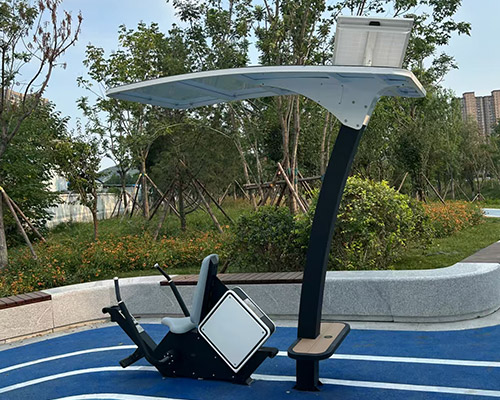
The SR-003 Intelligent Double-Position Pedal allows users to sit and repeatedly flex and extend their legs against the pedals.
Main Benefits
- Seated starting position
- Two exercise stations
- Lower-body movement
- Clear operating method
- Suitable for community fitness circuits
Seat Design Matters
Buyers should check the seat height, back support, handle position, pedal distance, and ease of entry.
A machine may provide a suitable movement but still be uncomfortable when the seat and handles do not match the intended users.
Outdoor Elliptical Machines
The Intelligent Double Position Ellipticals coordinate pedal and handle movement.
Compared with an air walker, the elliptical machine normally creates a more structured full-body exercise pattern.
Elliptical vs Air Walker
| Factor | Elliptical Machine | Air Walker |
| Arm movement | Active | Mainly supported |
| Leg movement | Elliptical | Forward and backward |
| Exercise intensity | Moderate | Light to moderate |
| Coordination required | Higher | Lower |
| Best use | Full-body fitness | Simple aerobic activity |
For a senior-focused facility, an air walker may be easier for first-time users, while an elliptical machine can provide another option for more active residents.
Seated Leg Training Equipment
The Outdoor Intelligent Gym Seated Leg Curl Trainer provides seated leg movement with adjustable resistance.
Its smart configuration includes exercise-duration, repetition, and calorie displays.
Adjustable Resistance
Different users have different strength levels.
Lower settings can support beginners, while higher settings provide progression for more active users.
Digital Feedback
A simple display can help users understand:
- Exercise duration
- Number of repetitions
- Selected resistance
- Estimated workout information
Digital features should remain easy to operate and should not replace permanent safety instructions.
Knee and Calf Exercise Stations
The Intelligent Sitting Type Knee Joint Gastrocnemius Muscle Combined Massager uses a seated design with rolling components for controlled lower-leg movement.
Suitable Project Role
This type of equipment can be positioned as a lighter station between strength and aerobic machines.
It may appeal to users who prefer slower, seated activity.
Avoid Medical Claims
The product should be described as supporting general movement, flexibility, and fitness.
It should not be presented as diagnosing or treating knee, calf, or circulation conditions.
How to Plan a Senior-Friendly Outdoor Gym
A good layout should be simple and easy to navigate.
Recommended Five-Station Layout
- Intelligent Two-Position Air Walker
- SR-002 Rotation Trainer
- SR-003 Pedal Trainer
- Seated Leg Curl Trainer
- Knee Joint and Calf Massager
This combination includes aerobic, upper-limb, lower-body, and lighter seated movements.
Supporting Site Features
The fitness area should also consider:
- Flat pathways
- Rest benches
- Shade
- Drinking water
- Clear signage
- Good drainage
- Evening lighting
- Emergency access
Accessible equipment alone does not create an accessible outdoor gym.
Surface and Foundation Requirements

Outdoor equipment requires stable foundations and suitable surrounding surfaces.
Foundation
Use the foundation drawing supplied for the exact machine.
Different equipment models may have different post positions, loads, and anchoring requirements.
Surface
Possible options include:
- Rubber surfacing
- Artificial turf
- Paving
- Concrete
- Engineered safety surfaces
The final selection should follow local safety, accessibility, drainage, and maintenance requirements.
Drainage
Water should not collect around seats, pedals, foundations, or pathways.
Standing water can reduce usability and increase maintenance requirements.
How to Compare Suppliers
Buyers should request the same information for every product.
| Buyer Check | Information Required |
| User position | Seated or standing |
| Maximum users | One or two |
| Product dimensions | Complete equipment size |
| Movement zone | Required operating clearance |
| Resistance | Fixed or adjustable |
| Main materials | Steel and other components |
| Surface treatment | Outdoor coating process |
| Foundation | Installation drawing |
| Instructions | Permanent user guidance |
| Spare parts | Bearings, seats and handles |
| Warranty | Mechanical and electronic coverage |
Common Buying Mistakes
Selecting Only Seated Equipment
A complete area should also provide suitable standing and aerobic movements.
Installing Machines Too Close Together
The product footprint does not include the complete user movement area.
Using Complicated Digital Controls
Senior-friendly equipment should remain easy to understand.
Ignoring Shade and Rest Areas
Users may need places to rest between stations.
Making Medical Claims
Outdoor fitness equipment supports general activity but does not replace medical advice or professional rehabilitation.
Forgetting Maintenance
Seats, handles, bearings, displays, fasteners, and coatings require regular inspection.
Conclusion
Selecting Senior Outdoor Fitness Equipment requires a balance between exercise variety, simple operation, user support, outdoor durability, and site accessibility.
A practical project should combine:
aerobic movement + upper-limb mobility + seated leg exercise + controlled resistance + rest facilities
Do not fill the site with several machines that provide nearly identical movements.
Instead, choose complementary equipment and plan the complete environment around safe circulation, shade, drainage, signage, and maintenance.
SRSC provides several suitable options for senior-friendly and community fitness projects, including air walkers, rotation trainers, seated pedal equipment, elliptical machines, adjustable leg trainers, and lower-leg exercise stations.
FAQ
Which outdoor fitness equipment is best for seniors?
Air walkers, rotation trainers, seated pedal machines, light-resistance leg trainers, and controlled mobility stations are common options.
The final choice should match the intended users and local safety requirements.
Is seated equipment better for older adults?
Seated equipment can provide a clear starting position and additional support.
However, a complete fitness area may also include suitable standing and walking-style machines.
Should resistance be adjustable?
Adjustable resistance allows users with different fitness levels to select a more appropriate training intensity.
The controls should remain clear and simple.
Can senior fitness equipment be installed in public parks?
Yes. It can be used in parks, residential communities, retirement communities, schools, and public recreation areas.
How much space is required?
Space requirements include the machine footprint, moving components, user entry, circulation, and maintenance access.
Request a layout drawing for every selected product.
Does the equipment require regular maintenance?
Yes. Operators should inspect foundations, bearings, pedals, seats, handles, fasteners, coatings, displays, and moving parts.
What documents should buyers request?
Request product specifications, dimensions, movement-zone drawings, foundation plans, installation instructions, maintenance guidance, spare-parts information, and warranty terms.