Ratgeber
Artificial Turf Padel Court: Complete Guide
Aktuelle Artikel
Key Takeaways
- The performance of an artificial turf padel court is determined by fiber type, sand infill system, and pile height engineering
- Monofilament, fibrillated, and hybrid turf systems serve different performance tiers from recreational to professional courts
- International padel facility standards prioritize consistent ball rebound, surface friction control, and shock absorption
- Proper turf selection can extend court lifespan by 30–50% and reduce maintenance cost by up to 40%
- Sand infill density typically ranges between 8–15 kg/m² depending on playing level requirements
- Europe dominates global padel infrastructure development, accounting for over 65% of installed courts (2025 data estimate)
Einführung
The rapid global expansion of padel has transformed it into one of the fastest-growing sports infrastructure markets. According to multiple European sports facility reports (2024–2025), padel court installations have grown by over 170% in five years, driven largely by private clubs and commercial sports centers.
At the center of every artificial turf padel court is the playing surface system, which directly controls:
- Ball rebound consistency (bounce height deviation <10% in premium courts)
- Player traction and slip resistance
- Shock absorption (reducing joint impact stress by up to 25–35%)
- Surface durability under 8–12 hours daily usage
Unlike tennis or basketball courts, padel surfaces are engineered as a composite sports interaction system, combining synthetic fibers + silica sand + elastic base layers.
Inhaltsverzeichnis
Artificial Turf Padel Court System Engineering Overview
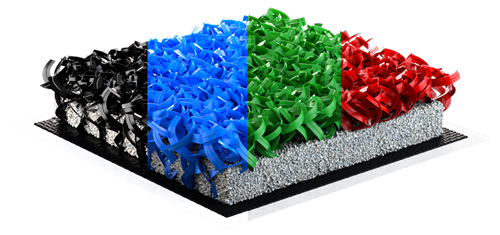
Structural Layers of Artificial Turf Padel Court
A professional padel turf system consists of multiple engineered layers:
Concept: Multi-Layer Load Distribution System
Each layer serves a structural function:
- Top fiber layer → ball interaction
- Sand infill layer → stability & friction control
- Elastic shock pad (optional) → injury reduction
- Base asphalt/concrete → structural foundation
This layered design ensures consistent performance even under high-frequency usage.
Artificial Turf Padel Court Turf Types Explained in Detail
Monofilament Turf Systems
Monofilament turf is the dominant choice for professional padel clubs.
Engineering Concept: Single-Strand Fiber Memory Retention
Each fiber is extruded individually, allowing controlled deformation and rapid rebound after impact.
Technical Characteristics:
- Fiber thickness: 250–400 microns
- Density range: 9,000–12,000 stitches/m²
- Ball speed coefficient: medium-fast (0.65–0.78 friction index)
- UV resistance lifespan: 5,000–8,000 sunlight hours
Performance Insight:
Monofilament turf provides the most balanced competitive playing surface, widely used in FIP-standard tournaments.
Fibrillated Turf Systems
Fibrillated turf uses slit-film fibers that expand into a mesh over time.
Concept: Self-Interlocking Fiber Network
As fibers open, they trap sand more effectively, increasing surface grip.
Technical Characteristics:
- Fiber structure: slit-film polypropylene
- Sand retention efficiency: high
- Ball speed: slower (0.55–0.65 friction index)
- Maintenance frequency: low
Application:
- Beginner courts
- Community sports facilities
- Budget installations
Hybrid Turf Systems (Premium Engineering Grade)
Hybrid turf combines monofilament fibers with reinforced base stabilization layers.
Concept: Reinforced Composite Sports Surface Engineering
This system integrates structural reinforcement to improve durability under extreme usage conditions.
Technical Characteristics:
- Lifespan: 8–12 years
- Shock absorption improvement: +20–30%
- Surface deformation rate: <5% under load
- Maintenance cycle: extended (quarterly)
Artificial Turf Padel Court Performance Benchmark Table
| Turf Type | Ball Speed | Stoßdämpfung | Haltbarkeit | Wartungsstufe | Target User |
|---|---|---|---|---|---|
| Monofilament | Medium–Fast | Medium | Hoch | Medium | Professional clubs |
| Fibrillated | Langsam | Hoch | Medium | Niedrig | Recreational use |
| Hybrid | Balanced | Very High | Very High | Niedrig | Premium facilities |
Key Engineering Parameters in Artificial Turf Padel Court Design
Pile Height Optimization
Concept: Vertical Fiber Energy Response
Pile height directly affects ball rebound dynamics and player movement behavior.
- 10–12 mm → faster gameplay, lower damping
- 12–14 mm → standard professional range
- 14–16 mm → enhanced comfort, slower ball speed
Sand Infill Engineering System
Silica sand is essential for stabilizing artificial turf.
Concept: Friction Modulation Layer
Sand controls:
- Ball rolling speed
- Fiber stability
- Surface friction coefficient
Standard Values:
- Recreational courts: 8–10 kg/m²
- Professional courts: 10–15 kg/m²
- High-intensity courts: up to 18 kg/m²
Fiber Material Science
Common polymer materials include:
- Polyethylene (PE): soft touch, high elasticity
- Polypropylene (PP): cost-effective, lower durability
- Nylon blends: high wear resistance
Artificial Turf Padel Court vs Hard Court Systems
Performance Comparison
| Besonderheit | Kunstrasen | Acrylic Court | Concrete Court |
|---|---|---|---|
| Spielerkomfort | Hoch | Medium | Niedrig |
| Ball Speed | Controlled | Schnell | Very Fast |
| Injury Risk | Niedrig | Medium | Hoch |
| Maintenance Cost | Medium | Niedrig | Very Low |
Concept: Biomechanical Impact Reduction
Artificial turf reduces:
- Knee joint stress by ~25–35%
- Ankle injury risk by ~18–22%
- Fatigue accumulation during long matches
Installation Engineering Process of Artificial Turf Padel Court

Base Construction Standards
Concept: Structural Load Distribution Foundation
A stable base ensures consistent ball behavior.
Typical requirements:
- Concrete thickness: 10–15 cm
- Surface flatness tolerance: ±3 mm per 3 meters
- Drainage slope: 0.5–1%
Turf Installation Process
Steps include:
- Surface cleaning and leveling
- Turf roll alignment (seam gap <2 mm)
- Adhesive bonding system application
- Sand infill distribution
- Fiber brushing calibration
Quality Control Testing
After installation:
- Ball rebound consistency test
- Friction coefficient measurement
- Drainage performance test
Artificial Turf Padel Court Maintenance Standards
Weekly Maintenance Protocol
- Surface brushing to maintain fiber upright structure
- Debris removal
- Sand leveling checks
Monthly Maintenance
Concept: Surface Energy Recovery Cycle
Monthly maintenance restores:
- Fiber elasticity
- Sand distribution balance
- Surface consistency
Annual Deep Maintenance
- Sand replacement (20–30%)
- Fiber realignment
- Shock pad inspection
Cost Structure and Lifecycle Analysis
Installation Cost Breakdown
| Component | Cost Share |
|---|---|
| Turf Material | 35–45% |
| Base Construction | 25–35% |
| Sand System | 10–15% |
| Labor | 10–15% |
| Drainage System | 5–10% |
Lifecycle Cost Model
Concept: 10-Year Total Cost Optimization
- Initial investment: high
- Maintenance cost: medium-low
- ROI period: 2.5–5 years (commercial courts)
Artificial turf systems reduce long-term resurfacing costs by up to 40% compared to hard courts.
Industry Case Study: European Padel Expansion Model
Spain, Italy, and Sweden lead global padel adoption.
Key Findings:
- Spain: over 20,000 courts installed
- Average court utilization: 6–10 hours/day
- Revenue per court: €25,000–€60,000/year (club model)
Einblick:
Most successful installations use monofilament artificial turf padel court systems due to their balance between performance and durability.
Market Trends and 2026 Forecast
1. Smart Turf Monitoring Systems
Emerging sensors embedded in turf layers to track:
- Usage intensity
- Surface wear
- Maintenance cycles
2. Eco-Friendly Turf Materials
- Recyclable PE fibers
- Low-carbon production systems
- Water-efficient cleaning systems
3. Hybrid Performance Courts
Combining:
- Shock pads
- Smart sand systems
- Reinforced fiber architecture
Abschluss
The design of an artificial turf padel court is a highly engineered system combining materials science, sports biomechanics, and structural engineering.
Understanding turf types—monofilament, fibrillated, and hybrid—allows investors, clubs, and facility managers to optimize performance, reduce maintenance cost, and extend court lifespan.
As padel continues global expansion, artificial turf systems will remain the core foundation of modern court infrastructure development.
Häufig gestellte Fragen
What is the best turf type for padel courts?
Monofilament turf is widely considered the best option for professional artificial turf padel court installations.
How long does artificial turf last?
Average lifespan ranges from 6 to 12 years depending on usage intensity and maintenance.
How much sand is needed for a padel court?
Typically between 8–15 kg/m² depending on performance level.
Is artificial turf better than acrylic courts?
Yes for comfort and injury reduction, but acrylic offers faster gameplay.
What affects padel turf performance most?
Fiber type, sand infill density, and pile height are the three most critical factors.