
Ratgeber
Basketball Hoop Buying Guide: Electric vs Hydraulic Systems
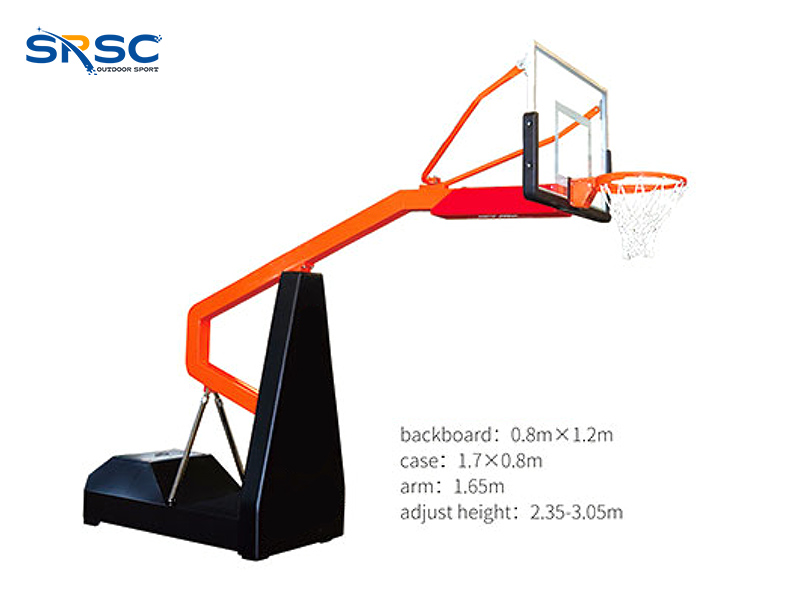
Aktuelle Artikel
Inhaltsverzeichnis
Choosing a professional Basketballkorb involves much more than comparing the backboard, rim, and purchase price. The lifting mechanism, extension arm, base structure, counterweight, mobility system, protective padding, folding method, and available court space all influence how well the equipment fits a sports facility.
Electric, electric-hydraulic, manual-hydraulic, and mechanically adjustable basketball systems are designed for different venue types. A professional arena may prioritize rapid electric folding and integrated controls, while a school gym may prefer a simpler manual system with lower maintenance requirements.
This guide compares the main Basketball Hoop operating systems and explains what B2B buyers should check before placing an order.
Key Takeaways
- Electric basketball systems offer convenient operation for frequently converted venues.
- Hydraulic mechanisms provide controlled lifting and folding of heavy structures.
- Manual-hydraulic systems can reduce electrical complexity while retaining adjustable operation.
- The extension arm length affects equipment placement and the total floor space required.
- A professional Basketball Hoop should be evaluated together with the sports floor.
- Tempered glass thickness alone does not determine backboard quality.
- Counterweights, base dimensions, wheels, anchors, and locking devices influence stability.
- Protective padding should cover the main player-contact areas.
- FIBA approval should be verified against the exact product model.
- Buyers should compare installation, operation, maintenance, and lifecycle costs.
What Is a Professional Basketball Hoop?
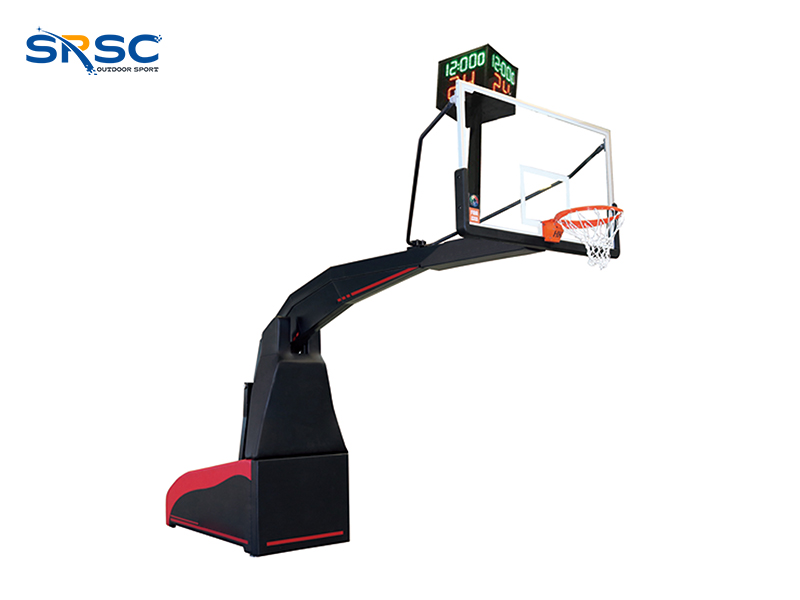
A professional Basketball Hoop is a complete basketball backstop system consisting of more than the visible rim.
Depending on the model, the equipment may include:
- A tempered-glass backboard
- An aluminum or steel backboard frame
- A professional basketball rim
- A net
- An extension arm
- A supporting frame
- A base box
- Counterweights
- Protective padding
- Wheels
- A folding or lifting system
- Optional shot clocks
General background on the rim, net, backboard, and standard basket structure is available in Wikipedia’s overview of the basket in basketball.
Backstop Unit
The complete structure supporting the backboard and basket is often described as a backstop unit.
FIBA maintains an official Backstop Units Catalogue containing tested mobile, wall-mounted, and ceiling-mounted systems for different competition levels.
Buy the Complete System
A high-quality rim installed on an unstable frame does not create professional equipment.
Buyers should evaluate how the backboard, rim, arm, frame, base, counterweight, wheels, controls, and flooring work together.
What Is an Electric Folding Basketball Hoop?
An electric folding system uses an electric actuator or motorized mechanism to raise, lower, open, or fold the basketball structure.
The operator can complete the movement through a control system instead of manually moving the main support frame.
Convenient Venue Conversion
Electric folding is particularly valuable for facilities that regularly change between basketball and other activities.
Typical applications include:
- Professional arenas
- University gymnasiums
- Multi-purpose sports halls
- Exhibition centers
- Tournament venues
- Large school sports facilities
SRSC’s Elektrischer, klappbarer Basketballkorb uses a microcomputer-controlled electric actuator to support lifting and folding.
Faster Operation
A motorized system can reduce the physical effort required from facility staff.
This is useful when basketball equipment must be repositioned frequently.
Electric Does Not Mean Automatic Safety
Operators still need to confirm that:
- The movement area is clear
- The wheels are correctly positioned
- Locks are engaged or released as required
- Power is available
- Staff understand the operating procedure
- No player or object is inside the movement path
What Is an Electric Hydraulic Basketball Hoop?
An electric hydraulic system combines electrical controls with hydraulic lifting equipment.
An electric motor or control system activates hydraulic components that move the heavy basketball structure.
Controlled Lifting
Hydraulic systems are well suited to moving heavy equipment because they can provide smooth and controlled motion.
SRSC’s Elektrischer hydraulischer Basketballkorb uses a microcomputer-controlled hydraulic lifting mechanism and is intended for professional courts, schools, and other high-use venues.
Heavy-Duty Application
An electric hydraulic Basketball Hoop may be attractive when buyers require:
- Stable professional equipment
- Controlled lifting
- Frequent setup changes
- Tempered-glass backboards
- Optional shot clocks
- Protective base padding
- High-capacity supporting structures
Electrical and Hydraulic Maintenance
This type of equipment contains both electrical and hydraulic components.
The maintenance plan should therefore cover controls, cables, cylinders, hoses, seals, oil leakage, mechanical joints, locks, and wheels.
Electric Folding vs Electric Hydraulic Basketball Hoop
The terms are sometimes used interchangeably, but buyers should inspect the actual mechanism.
| Factor | Electric Folding System | Electric Hydraulic System |
|---|---|---|
| Main movement source | Electric actuator or motor | Electric-powered hydraulic mechanism |
| Operator effort | Niedrig | Niedrig |
| Movement control | Motorized | Hydraulic and motorized |
| Wartung | Electrical and mechanical | Electrical, hydraulic, and mechanical |
| Typical venue | Multi-use arena | Professional and high-use venue |
| Folding convenience | Exzellent | Exzellent |
| Power required | Ja | Ja |
| Hydraulic components | Not always | Ja |
| Purchase complexity | Medium to high | Hoch |
| Best buyer priority | Fast conversion | Controlled heavy-duty movement |
Which Is Better?
Neither system is automatically better.
The decision depends on:
- Equipment weight
- Required extension length
- Frequency of folding
- Venue staff
- Maintenance capacity
- Available power
- Storage conditions
- Competition level
- Project budget
Ask How the System Moves
Instead of asking only whether the Basketball Hoop is electric, ask:
“Which component creates the movement, and what maintenance does that mechanism require?”
This helps distinguish an electric actuator from an electrically powered hydraulic system.
What Is a Manual Hydraulic Basketball Hoop?
A manual hydraulic Basketball Hoop uses a hand-operated hydraulic pump to raise or lower the structure.
It provides hydraulic assistance without depending on a powered control unit for normal movement.
Reduced Electrical Complexity
Manual operation can be useful in schools, training centers, and gymnasiums where equipment adjustments are not performed every day.
SRSC’s Manual Hydraulic Basketball Hoop for Indoor Folding uses a manual hydraulic pump and cylinder to control raising and lowering.
Controlled Movement
The hydraulic mechanism helps staff move a heavy supporting structure with less physical effort than a completely mechanical lifting method.
Suitable Venue Types
Manual hydraulic systems may suit:
- School gymnasiums
- Training facilities
- Community sports centers
- University courts
- Indoor basketball halls
- Facilities with occasional court conversion
Manual Hydraulic vs Electric Basketball Hoop
The main difference is how the lifting mechanism is activated.
| Factor | Manual Hydraulic | Electric System |
| Power supply | Normally not required for lifting | Required |
| Operator involvement | Higher | Lower |
| Adjustment speed | Mäßig | Faster |
| Mechanical simplicity | Higher | Lower |
| Electrical maintenance | Minimal | Required |
| Hydraulic maintenance | Required | Depends on system |
| Purchase cost | Generally lower | Generally higher |
| Frequent conversion | Suitable | Better |
| Occasional adjustment | Exzellent | May be unnecessary |
| Staff training | Mäßig | Control and safety training |
When Is Manual Hydraulic Better?
Manual hydraulic equipment can be practical when:
- The Basketball Hoop remains in position most of the time
- Court conversion occurs only occasionally
- Electrical infrastructure is limited
- The buyer prefers simpler controls
- Budget control is important
- Trained staff are available
When Is Electric Better?
Electric systems become more valuable when equipment must be folded or moved frequently.
Frequency Determines Value
A professional arena that converts three times per week may gain considerable operational value from electric control.
A school that moves its Basketball Hoop only twice per year may not need the same level of automation.
What Is a Hydraulic-Style Basketball Hoop?

Some products use a fixed or simplified hydraulic-style structure without the same powered folding functions found in premium electric systems.
These models can provide professional dimensions and a stable mobile base while maintaining a more accessible purchasing cost.
SRSC’s Basketballkorb im hydraulischen Stil uses a mobile base, tempered-glass backboard, professional rim, padding, and counterweight system.
Practical Professional Structure
This type of system may be suitable for:
- Schools
- Training halls
- Local competitions
- Sports centers
- Community facilities
- Budget-controlled court projects
Fewer Automated Components
A simpler system can reduce initial cost and maintenance complexity.
Check What “Hydraulic-Style” Means
Product terminology differs between suppliers.
Ask whether the system includes:
- A hydraulic cylinder
- A manual pump
- An electric pump
- Folding capability
- Wheel lifting
- Height adjustment
- Mechanical locking
Do not assume these functions from the product name alone.
Electric vs Hydraulic vs Manual Basketball Hoop Comparison
| System | Main Advantage | Main Limitation | Recommended Facility |
| Electric Folding | Fast and convenient operation | Requires power and controls | Multi-use arenas |
| Electric Hydraulic | Smooth heavy-duty lifting | More complex maintenance | Professional venues |
| Manual Hydraulic | Simpler controlled movement | More operator involvement | Schools and training centers |
| Hydraulic-Style | Practical professional structure | Limited automation | Community facilities |
| Manual Crank | Wide height adjustment | Not intended for elite competition | Youth training |
| Fixed Basketball Hoop | Simple and stable | Limited venue conversion | Dedicated courts |
How Does Extension Arm Length Affect Selection?
The extension arm positions the backboard and rim away from the supporting base.
This dimension affects both player safety and total equipment footprint.
Shorter Extension Arm
A shorter arm can reduce the total space required behind the endline.
However, buyers must still ensure that the structure satisfies the intended court layout and safety requirements.
Longer Extension Arm
A longer arm places the base farther away from the playing area.
This can create more clearance behind the backboard but requires a longer overall facility.
Check Total Court Length
Do not evaluate only the official playing-court dimensions.
The complete building must accommodate:
- Playing area
- Boundary space
- Basketball Hoop extension
- Base structure
- Movement area
- Equipment storage
- Player circulation
Request the supplier’s minimum required facility length before approving the model.
Why the Base Dimensions Matter
The base supports the Basketball Hoop and carries the counterweight.
Its size affects stability, storage, mobility, and required floor space.
Stability
A larger or heavier base can improve resistance to unwanted movement.
However, stability depends on the complete design rather than size alone.
Storage
A large base may be difficult to store in a small equipment room.
Venue Conversion
The base must move through doors, corridors, tunnels, and storage entrances.
Measure the Transport Route
Before ordering, compare the equipment dimensions with:
- Loading doors
- Internal doors
- Corridors
- Elevators
- Storage-room entrances
- Turning spaces
A Basketball Hoop that fits the court but cannot reach the court creates a major project problem.
Counterweights and Basketball Hoop Stability
Mobile systems use counterweights to balance the extension arm, backboard, rim, and forces created during play.
Counterweight Material
Depending on the product, counterweights may use:
- Steel plates
- Cement blocks
- Cast components
- Combined steel and cement systems
Included vs Not Included
Some product quotations include the counterweight, while others require the buyer to source cement ballast locally.
Clarify Before Shipping
Ask:
- Is the counterweight included?
- What is the total required weight?
- Is it steel or cement?
- Can it be sourced locally?
- How is it secured?
- Is the weight included in shipping calculations?
The difference can significantly affect freight cost and installation preparation.
Why the Sports Floor Matters
A mobile professional Basketball Hoop places concentrated loads on the playing surface.
The floor must support the equipment during use and transportation.
Static Load
The base and counterweight create continuous loading when the equipment remains in position.
Rolling Load
When the unit moves, its wheels transfer weight through smaller contact areas.
The current FIBA Basketball Equipment Rules require mobile backboard support structures to distribute their weight in a way that avoids damaging the sports floor during use and transportation.
Floor Protection
Buyers should coordinate the Basketball Hoop with the selected sports flooring system.
Equipment and Flooring Are One Project
SRSC’s Hardwood Sports Flooring systems include different single-layer and double-layer structures for basketball venues.
Before moving a heavy hoop over the floor, confirm:
- Wheel material
- Wheel width
- Total equipment weight
- Gegengewicht
- Floor rolling-load capacity
- Movement route
- Required protective panels
Tempered-Glass Backboard Selection
Professional basketball equipment commonly uses transparent tempered-glass backboards.
Glasdicke
SRSC Basketball Hoop models are available with different glass specifications, including 10 mm and 12 mm tempered glass depending on the product.
Thickness should be evaluated together with:
- Glass quality
- Frame construction
- Edge protection
- Safety film
- Mounting method
- Backboard support
- Zertifizierung
Safety Film
Some professional models include an explosion-resistant or safety film intended to retain fragments if the glass is damaged.
Glass Thickness Is Not the Only Specification
A poorly supported thick backboard may perform worse than a correctly engineered complete system.
Buyers should ask for the full backboard assembly specification.
What Is a Breakaway Basketball Rim?
A breakaway rim includes a spring or hinged mechanism that allows the rim to move downward under a specified load and return to position afterward.
The design helps manage forces created during dunking.
Wikipedia’s article on the breakaway rim explains how the hinged and spring-loaded system reduces stress on the backboard and rim assembly.
Professional Play
Breakaway rims are widely associated with high-level basketball.
Return Performance
The rim should return to its horizontal playing position after release.
Verify the Exact Rim Model
A Basketball Hoop may use a professional structure while offering different rim options.
Confirm:
- Rim type
- Internal diameter
- Release mechanism
- Net attachment
- Zertifizierung
- Replacement-part availability
Protective Padding Requirements
Players may contact the base or supporting structure during high-speed play.
Protective padding helps reduce injury risk.
Base Padding
The front and sides of the base should be evaluated according to the product design and intended use.
Support-Arm Padding
Exposed structural areas close to the playing zone may also require protection.
Padding Material
Buyers should compare:
- Foam density
- Dicke
- Cover material
- Attachment method
- Cleaning resistance
- Replacement availability
Padding Is Not Decorative
Do not select padding only by color.
It is a functional safety component and should remain securely attached during play.
Wheels and Mobility Systems
A mobile Basketball Hoop must move safely without damaging the floor.
Retractable Wheels
Some systems raise the base onto wheels during movement and lower it into the playing position afterward.
Directional and Swivel Wheels
Different wheel arrangements influence turning and straight-line movement.
Hydraulic Wheel Control
Certain manual hydraulic models integrate the wheel-extension system with the hydraulic controls.
SRSC’s Manueller hydraulischer Basketballkorb includes retractable wheels and hydraulic control for lifting the support arms and wheel system.
Check Floor Contact
The wheels should distribute load appropriately and should not contain damaged edges, embedded debris, or materials that mark the sports floor.
Height-Adjustable Basketball Hoops
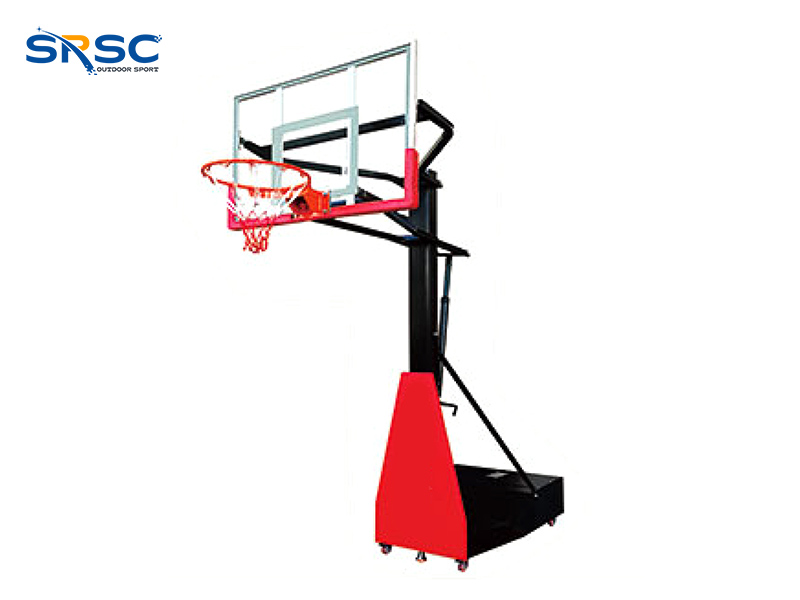
Not every basketball facility operates only at the standard adult rim height.
Youth programs and training centers may require lower settings.
Manual Crank Adjustment
A crank mechanism allows staff to raise or lower the rim through a defined range.
SRSC’s Höhenverstellbarer Basketballkorb mit manueller Kurbel supports adjustable rim heights for youth training and multi-age programs.
Youth Training
Lower rim heights can support:
- Beginner skill development
- Children’s basketball
- School programs
- Shooting technique
- Recreational use
Professional Competition vs Training
An adjustable youth system and a FIBA-level professional backstop solve different needs.
Do not purchase one system and expect it to perform every role equally well.
Fixed Height vs Adjustable Basketball Hoop
| Factor | Fixed Professional Height | Height-Adjustable System |
| Main users | Adult and competition players | Youth and mixed-age users |
| Structural simplicity | Higher | More adjustment components |
| Training flexibility | Beschränkt | Exzellent |
| Professional competition | Stark | Model-dependent |
| Adjustment maintenance | Minimal | Required |
| Typical venue | Arena | School or academy |
| Purchase priority | Competition stability | Program flexibility |
Which Should Schools Choose?
Schools should consider the age range of their users.
A secondary school focused on full-height competition may select professional fixed equipment.
A multi-age academy may gain more value from adjustable Basketball Hoop systems.
Optional Shot Clock Integration
Professional and competition venues may require shot clocks.
Some Basketball Hoop models allow single-sided, three-sided, or four-sided shot-clock configurations.
Visibility
The display needs to remain visible to players, officials, coaches, and spectators.
Structural Support
The Basketball Hoop should safely support the display and associated wiring.
Electrical Coordination
Power and signal cables need to be planned before installation.
Include Shot Clocks in the Original Order
Retrofitting displays later may require:
- New brackets
- Additional wiring
- Structural checks
- Control-system changes
- Display synchronization
Ask for shot-clock options during the original equipment selection.
Electric Basketball Hoop Power Requirements
Electric systems depend on reliable power and controls.
Input Power
Confirm voltage, frequency, plugs, control voltage, and local electrical requirements.
Emergency Operation
Ask how the system can be moved if power is unavailable.
Control Location
The control should be accessible to authorized staff but protected from accidental use.
Local Electrical Compliance
Electrical work should be completed according to local regulations by qualified professionals.
The product supplier provides equipment specifications, while the local electrical team manages site compliance.
Maintenance Requirements by System Type
Different mechanisms require different inspection routines.
| Component | Electric | Electric Hydraulic | Manual Hydraulic |
| Electrical cables | Ja | Ja | Beschränkt |
| Control panel | Ja | Ja | No/limited |
| Electric actuator | Common | No/depends | No |
| Hydraulic cylinder | No/depends | Ja | Ja |
| Hydraulic hoses | No/depends | Ja | Ja |
| Manual pump | No | No | Ja |
| Mechanical joints | Ja | Ja | Ja |
| Wheels | Ja | Ja | Ja |
| Locks | Ja | Ja | Ja |
| Polsterung | Ja | Ja | Ja |
Routine Inspection
Inspect:
- Bolts
- Welds
- Pivot points
- Wheels
- Locks
- Polsterung
- Rückwand
- Rand
- Net
- Hydraulic components
- Electrical connections
Before Every Major Event
Complete an operational test before players enter the court.
Maintenance Records
Professional venues should document inspections, repairs, replacement parts, and operational issues.
This helps operators identify repeated problems before they cause equipment downtime.
How to Compare Basketball Hoop Suppliers
Use the same technical checklist for each quotation.
| Buyer Check | Information to Compare |
| Operating system | Electric, hydraulic, manual |
| Extension arm | Length and construction |
| Rückwand | Size, glass thickness, safety film |
| Rand | Type and certification |
| Base | Dimensions and steel construction |
| Gegengewicht | Material, weight and inclusion |
| Wheels | Type and load distribution |
| Polsterung | Coverage and thickness |
| Folding method | Operation and locking |
| Shot clock | Available configurations |
| Floor requirement | Total space and rolling loads |
| Zertifizierung | Exact model and license |
| Installation | On-site requirements |
| Warranty | Coverage and exclusions |
| Spare parts | Availability and lead time |
Request a Movement Demonstration
Product photographs cannot show how smoothly equipment opens, folds, locks, or moves.
Ask for:
- Operation videos
- Factory testing videos
- Control instructions
- Folding sequence
- Wheel demonstration
- Locking demonstration
Common Basketball Hoop Buying Mistakes
Choosing Only by Backboard Thickness
The backboard is one component of a complete system.
Ignoring the Minimum Facility Length
A long extension arm and large base require additional space.
Forgetting Counterweight Costs
Locally sourced cement ballast may require preparation before installation.
Assuming Electric Means Maintenance-Free
Electric controls add convenience but also add components.
Ignoring Floor Loading
Heavy mobile systems can affect hardwood sports floors.
Buying a Youth System for Professional Competition
Height adjustment does not automatically mean professional certification.
Ignoring Storage Dimensions
Folded equipment still requires storage space.
Failing to Verify Certification
Check the exact model through the FIBA Approved Basketball Equipment database.
Basketball Hoop Buyer Checklist
Before ordering, confirm:
- Facility type
- Competition level
- Court dimensions
- Total available facility length
- Storage space
- Door and corridor dimensions
- Fixed or mobile design
- Electric or hydraulic mechanism
- Adjustment frequency
- Extension-arm length
- Base dimensions
- Total equipment weight
- Counterweight requirements
- Backboard material
- Glass thickness
- Backboard frame
- Rim type
- Protective padding
- Wheel system
- Floor load requirements
- Shot-clock requirements
- Power supply
- Installation method
- Zertifizierung
- Spare parts
- Maintenance plan
- Warranty
FAQ About Electric and Hydraulic Basketball Hoops
Is an electric or hydraulic Basketball Hoop better?
Neither is universally better.
Electric systems are useful for frequent, convenient court conversion, while manual hydraulic systems can provide controlled movement with less electrical complexity.
What is the difference between electric and electric-hydraulic basketball equipment?
An electric system may use an actuator or motor directly.
An electric-hydraulic system uses electrical controls to operate hydraulic components that move the structure.
Does a professional Basketball Hoop need a tempered-glass backboard?
Transparent tempered glass is commonly used for professional basketball backboards.
The complete specification should also include the frame, mounting, safety film, rebound performance, and certification.
How much space does a folding Basketball Hoop need?
Space requirements depend on extension-arm length, base dimensions, folding geometry, movement area, and storage position.
Request the supplier’s complete layout drawing.
Can a heavy Basketball Hoop damage hardwood flooring?
Potentially, if the floor and equipment are not properly coordinated.
Mobile backstops should distribute their weight appropriately, and the sports floor should be designed for the expected static and rolling loads.
What is the purpose of the counterweight?
The counterweight balances the extended structure and contributes to equipment stability.
The required weight depends on the product design.
Does a manual hydraulic Basketball Hoop need electricity?
The manual lifting mechanism normally operates through a hand pump, although optional accessories such as shot clocks may still require electricity.
Is an electric Basketball Hoop suitable for a school?
Yes, particularly when the school frequently converts its sports hall.
However, a manual hydraulic system may offer better value when adjustments are infrequent.
Can the basketball rim height be adjusted?
Some training models provide height adjustment, while professional competition backstops normally operate at the standard rim position.
Check the adjustment range of the exact model.
What does FIBA-approved Basketball Hoop mean?
It generally means the exact backstop model has been tested and listed for a defined competition level by the FIBA Equipment & Venue Centre.
Buyers should verify the model name and license through the official FIBA catalogue.
Should shot clocks be mounted on the Basketball Hoop?
They can be mounted on the backstop support structure when the selected system and competition requirements allow it.
The structural bracket, power, visibility, and control system should be planned together.
What documents should I request before ordering?
Request:
- Product drawing
- Maße
- Gewicht
- Backboard specification
- Rim specification
- Counterweight details
- Operating instructions
- Floor-load information
- Installation guide
- Zertifizierung
- Packing list
- Maintenance instructions
- Warranty terms
Abschluss
Selecting a professional Basketballkorb is a facility-planning decision rather than a simple equipment purchase.
Electric folding systems offer convenient operation for arenas that convert frequently. Electric-hydraulic systems provide smooth, controlled movement for heavy professional structures. Manual-hydraulic systems reduce electrical complexity and can deliver excellent value for schools, universities, training centers, and community facilities.
The correct choice depends on:
venue use + adjustment frequency + available floor space + sports flooring + maintenance capacity + competition requirements + project budget
Buyers should compare the complete system, including the backboard, rim, extension arm, base, counterweight, wheels, padding, controls, shot clocks, and installation requirements.
SRSC provides several Basketball Hoop configurations for professional arenas, schools, training centers, universities, and multi-purpose facilities, including:
- Elektrischer, klappbarer Basketballkorb
- Elektrischer hydraulischer Basketballkorb
- Manual Hydraulic Basketball Hoop for Indoor Folding
- Manueller hydraulischer Basketballkorb
- Basketballkorb im hydraulischen Stil
- Höhenverstellbarer Basketballkorb mit manueller Kurbel
By defining the venue requirements before comparing models, buyers can select equipment that is safer to operate, easier to maintain, compatible with the sports floor, and better suited to the facility’s long-term use.