
Ratgeber
LED Lights for Tennis Courts in Padel & Tennis Facilities
Aktuelle Artikel
Inhaltsverzeichnis
Einführung
The global sports infrastructure market is rapidly evolving, and lighting has become one of the most critical performance and safety components in modern court design. In particular, led lights for tennis courts have transformed how padel and tennis facilities operate, delivering higher visibility, reduced energy consumption, and compliance with international sports lighting standards.
Padel tennis, known for its fast-paced rallies and glass-enclosed court design, places extreme demands on lighting consistency and glare control. Unlike traditional floodlighting systems, modern LED solutions provide instant illumination, precise beam control, and significantly improved uniformity ratios, making them the preferred choice for clubs, stadiums, and recreational facilities worldwide.
This guide provides a deep technical and commercial breakdown of LED lighting upgrades for padel tennis courts, including design principles, standards, comparisons, case insights, and engineering-level recommendations.
Core Lighting Engineering Principles for LED Lights for Tennis Courts
Illuminance (Lux) and Performance Standards
Illuminance, measured in lux, defines how much light reaches the playing surface. According to international sports lighting guidelines (including EN 12193 and IES RP-6-20), padel courts typically require:
- Recreational play: 300–500 lux
- Club-level competition: 500–750 lux
- Professional broadcast level: 750–1000+ lux
The precision of led lights for tennis courts allows designers to achieve these values with high consistency across the entire playing field, reducing shadow zones and enhancing ball visibility.
Uniformity Ratio in Sports Lighting
Uniformity is a critical parameter defined as:
- U1 = minimum illuminance / average illuminance
- U2 = minimum illuminance / maximum illuminance
For padel courts, recommended values are:
- U1 ≥ 0.6
- U2 ≥ 0.4
High-quality LED systems maintain superior uniformity compared to conventional metal halide lighting, which often produces uneven hotspots and dark corners.
Color Temperature and Visual Comfort
Color temperature directly affects player perception and broadcast quality:
- 4000K–5000K: Ideal for outdoor padel courts
- 5000K–5700K: Professional competition and TV broadcasting
LED lighting systems offer stable color rendering index (CRI ≥ 80 or 90), ensuring natural ball visibility and reduced eye fatigue.
LED Lights for Tennis Courts vs Traditional Lighting Technologies
Technical Comparison Overview
| Performance Metric | LED Sports Lighting | Metal Halide Lighting | Halogen Systems |
|---|---|---|---|
| Energy Efficiency | 60–80% savings | Low efficiency | Very low |
| Lifespan | 50,000–100,000 hrs | 10,000–20,000 hrs | 2,000–5,000 hrs |
| Instant Start | Ja | No | Ja |
| Maintenance Frequency | Niedrig | Hoch | Very high |
| Light Uniformity | Hoch | Medium–Low | Niedrig |
| Heat Emission | Niedrig | Hoch | Very high |
The operational advantages of led lights for tennis courts directly translate into reduced lifecycle cost and improved facility uptime.
Industry Transition Trends
According to multiple sports infrastructure reports (including global stadium lighting white papers published between 2022–2024), over 70% of new sports court installations now adopt LED-based lighting systems. Municipal sports upgrades in Europe and North America have increasingly replaced legacy systems due to energy regulations and sustainability targets.
Padel Court Lighting Design Architecture

Perimeter Lighting System Configuration
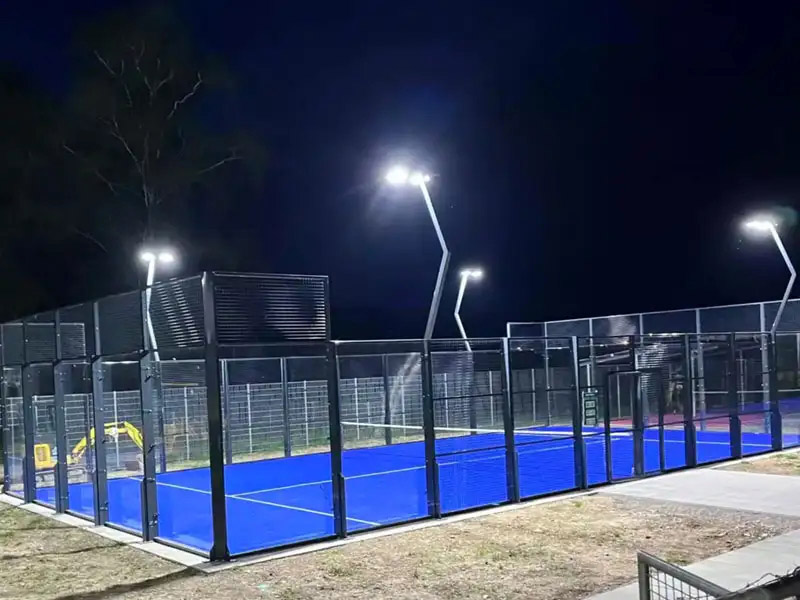
Padel courts typically use a four-corner or six-pole lighting configuration. The goal is to eliminate shadows caused by glass walls and fencing.
Key design considerations include:
- Pole height: 6–8 meters
- Fixture tilt angle: 15°–45°
- Mounting distance: optimized based on beam spread
Proper configuration ensures consistent light distribution without visual obstruction during high-speed rallies.
Beam Distribution Engineering
Beam angle selection is critical:
- Narrow beam (30°–60°): High intensity, focused lighting
- Medium beam (60°–90°): Balanced coverage
- Wide beam (90°–120°): Uniform distribution for recreational courts
Modern led lights for tennis courts often use asymmetric optical lenses to direct light precisely onto the playing surface while minimizing spill light outside the court.
Anti-Glare Optical Technology
Glare rating (UGR) is a major consideration in sports lighting. For padel courts:
- Recommended UGR: < 50 (sports environment standard context)
- Advanced LED systems integrate cut-off reflectors and shielding
- Reduces direct visual discomfort for players and spectators
Energy Efficiency and Operational Cost Modeling
Energy Consumption Benchmarking
A typical padel court lighting system comparison:
- Metal halide system: 2000W–4000W per court
- LED system: 600W–1500W per court
This results in:
- 60%–75% energy savings
- Significant reduction in CO₂ emissions
- Lower peak load on electrical infrastructure
Lifecycle Cost Analysis
| Kostenfaktor | LED System | Traditional System |
|---|---|---|
| Initial Investment | Medium–High | Niedrig |
| 5-Year Energy Cost | Niedrig | Hoch |
| Maintenance Cost | Very Low | Hoch |
| Replacement Cost | Minimal | Frequent |
Over a 10-year cycle, led lights for tennis courts typically reduce total cost of ownership by 40%–60%.
Smart Lighting Systems and IoT Integration
Intelligent Control Systems
Modern LED sports lighting integrates smart controls:
- Dimming control (0–100%)
- Motion-based activation
- Scheduled operation
- Remote monitoring via IoT platforms
These systems allow padel clubs to optimize energy use based on real-time court occupancy.
Wireless Control Advantages
Wireless lighting systems reduce installation complexity and enable:
- Centralized facility management
- Mobile app control
- Automated energy optimization
LED Lighting Installation Standards and Compliance
International Lighting Standards
Padel and tennis court lighting should comply with:
- EN 12193 (European Sports Lighting Standard)
- IES RP-6-20 (North American Sports Lighting Guide)
- FIFA/ITF lighting principles (adapted for racket sports)
These standards define lux levels, uniformity ratios, and glare limits.
Electrical Safety Requirements
Proper installation includes:
- IP65–IP66 rated fixtures for outdoor courts
- Surge protection systems (6kV–10kV recommended)
- Grounding and overload protection
- Heat dissipation design (aluminum housing systems)
Case Study: LED Upgrade in a European Padel Club
A mid-sized padel facility in Spain upgraded from metal halide to LED lighting:
- Number of courts: 6
- Previous system power: 18 kW total
- New LED system: 6.5 kW total
Results after upgrade:
- 65% energy reduction
- 40% improvement in light uniformity
- 30% increase in night-time bookings
- Payback period: approximately 18–24 months
This reflects the real-world ROI potential of led lights for tennis courts in commercial sports facilities.
Maintenance and Reliability Engineering
LED Driver Reliability
LED drivers are critical components affecting lifespan and stability:
- High-quality drivers support constant current output
- Thermal protection prevents overheating
- Surge resistance ensures stability during voltage fluctuations
Predictive Maintenance Systems
Advanced lighting systems use predictive diagnostics:
- Failure prediction algorithms
- Temperature monitoring
- Usage cycle tracking
This reduces unexpected downtime and improves facility reliability.
Environmental and Sustainability Impact
Carbon Reduction Benefits
Switching to LED lighting significantly reduces carbon emissions:
- Up to 70% lower electricity consumption
- Reduced material waste due to longer lifespan
- Compliance with green building certifications
Sustainability Certifications
Facilities upgrading to LED systems often align with:
- LEED certification standards
- BREEAM environmental ratings
- Local government energy efficiency programs
Advanced Design Considerations for Padel Tennis Courts

Multi-Court Lighting Optimization
In multi-court facilities:
- Shared lighting poles reduce infrastructure costs
- Zonal lighting control improves flexibility
- Adaptive dimming supports mixed usage schedules
Broadcast and Video Compatibility
For professional padel tournaments:
- Flicker-free LED drivers are required
- High CRI ensures accurate camera reproduction
- Stable color temperature is essential for broadcasting consistency
LED Lights for Tennis Courts Market Outlook
Industry forecasts indicate:
- Strong growth in sports infrastructure LED adoption
- Increasing demand for smart lighting integration
- Rising investment in padel court construction globally
The expansion of padel sports in Europe, the Middle East, and Latin America continues to drive demand for advanced led lights for tennis courts solutions.
Häufig gestellte Fragen
What is the ideal lighting level for padel tennis courts?
Recreational courts require 300–500 lux, while professional courts may require up to 1000 lux depending on competition level and broadcast requirements.
Why are LED lights preferred over traditional lighting?
LED systems offer higher energy efficiency, longer lifespan, better uniformity, and instant startup, making them more suitable for modern sports facilities.
How many LED fixtures are needed per padel court?
Most installations require 4 to 8 fixtures depending on pole height, beam angle, and required lux level.
Are LED sports lights suitable for outdoor weather conditions?
Yes, high-quality systems are designed with IP65 or higher ratings to withstand rain, dust, and temperature fluctuations.
What is the return on investment for LED upgrades?
Most facilities achieve ROI within 18–36 months due to reduced energy consumption and maintenance costs.
Abschluss
The transition to led lights for tennis courts represents a major technological shift in sports infrastructure. From energy savings and compliance with international standards to improved player performance and smart control systems, LED lighting has become the foundation of modern padel court design.
As padel continues its global expansion, high-performance lighting systems will play a decisive role in shaping the quality, safety, and commercial success of sports facilities worldwide.