
Ratgeber
Padel Court Drainage Design Guide for Outdoor Projects
Aktuelle Artikel
Inhaltsverzeichnis
Key points covered in this guide:
- Why drainage should be planned before the court foundation is built
- How surface drainage and subsurface drainage work together
- What buyers should check when comparing concrete and permeable bases
- How artificial turf, infill, slope, and drainage outlets affect water removal
- Which site conditions increase the risk of standing water
- What information a court supplier and civil contractor should provide
- How to inspect drainage before the court enters commercial operation
- Which maintenance steps help prevent blocked drains and surface damage
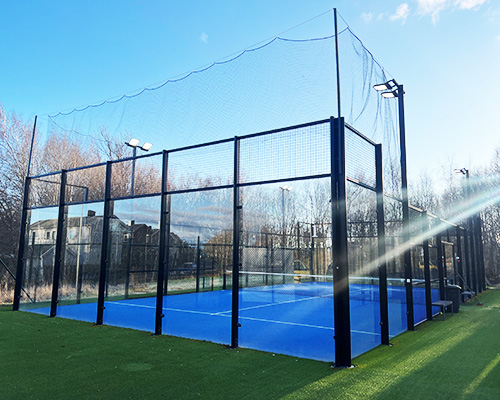
An outdoor Padelplatz must remain stable, level, safe, and playable during changing weather conditions. Although steel, glass, lighting, and artificial turf are the most visible parts of the facility, the drainage system underneath and around the playing area can determine how reliably the court performs after rainfall.
Poor drainage can lead to standing water, slow reopening after rain, contaminated infill, algae growth, unpleasant odours, damaged turf seams, corrosion around steel bases, and gradual deterioration of the foundation.
Drainage should therefore be treated as part of the original court design rather than a repair added after the project is completed. This guide explains what buyers, developers, contractors, schools, clubs, resorts, and sports facility operators should verify before ordering and constructing an outdoor court.
Why Padel Court Drainage Matters
An outdoor playing surface receives rain directly. Water must move through or across the turf, enter the designed collection system, and discharge safely away from the structure.
The drainage process involves several connected components:
- Kunstrasen
- Sand infill
- Turf backing
- Permeable or sloped base
- Drainage layer
- Perimeter channels
- Underground pipes
- Inspection chambers
- Final discharge outlet
- Surrounding landscaping
A problem in any one of these areas can reduce the performance of the complete system.
Player Safety
Standing water can change traction and increase the risk of slipping. Wet or uneven infill may also produce inconsistent movement and ball response.
A playable surface should provide regular bounce and remain sufficiently level. Current FIP rules state that internal level differences should be less than 3 mm when measured with a 3 m straightedge. For surfaces without drainage, the maximum transverse evacuation slope is 1% from the centre toward the outer edges.
Verfügbarkeit des Gerichts
Commercial clubs depend on bookable hours. A court that remains wet long after rainfall can lose reservations and create refund or rescheduling pressure.
Efficient drainage does not guarantee immediate play in every storm, but it can reduce unnecessary downtime when the system is correctly designed, installed, and maintained.
Long-Term Material Protection
Repeated water accumulation can affect more than the playing surface. Moisture around steel base plates, anchors, electrical conduits, door frames, and turf joints may increase maintenance requirements.
SRSC’s commercial Padel Court materials guide describes a court as a connected system involving turf, steel, glass, lighting, foundations, fasteners, and drainage rather than a collection of unrelated products.
Assess the Site Before Designing Drainage
No drainage layout should be approved without first understanding the project site.
Local Rainfall Conditions
The design should reflect local rainfall patterns rather than relying on one standard solution for every market.
A site with occasional light rain has different requirements from a tropical, coastal, monsoon, or storm-prone location. Local civil engineers should use applicable rainfall data and municipal drainage requirements when sizing channels and underground pipes.
Existing Ground Levels
A topographic survey can show:
- High and low points
- Natural flow direction
- Adjacent road levels
- Building entrances
- Existing drains
- Retaining walls
- Neighbouring properties
- Potential discharge locations
Concept: Positive Drainage
Positive drainage means water moves intentionally toward a suitable outlet instead of collecting in low areas.
The finished court, surrounding pavement, access route, and landscaping should all direct water away from structures that need protection.
Soil Conditions
Clay, sand, gravel, fill material, and compacted soil allow water to move at different rates. A soil investigation may be needed to determine whether infiltration is practical.
Where the ground drains slowly, the project may require a more complete pipe and channel system rather than relying mainly on natural infiltration.
Groundwater Level
A high groundwater level can reduce the effectiveness of a permeable base. It may also create upward moisture movement or instability if the subgrade and drainage layer are poorly designed.
The civil engineer should assess groundwater, seasonal changes, flooding history, and nearby waterways before finalizing the foundation.
Surface Drainage vs Subsurface Drainage
A reliable Padel Court may use surface drainage, subsurface drainage, or a combination of both.
| Drainage Method | How It Works | Main Advantages | Points to Verify |
|---|---|---|---|
| Surface slope | Moves water across the finished surface | Simple and visible | Correct slope and no low spots |
| Perimeter channels | Collects water around the court edges | Easy to inspect and clean | Channel capacity and outlet position |
| Permeable base | Allows water to move vertically through the surface | Reduces surface flow | Base porosity and stable construction |
| Aggregate drainage layer | Moves water below the court toward outlets | Supports broad drainage coverage | Grading, depth, and contamination control |
| Perforated drainage pipes | Collects subsurface water | Useful for wet sites | Pipe slope, filter material, and access |
| Inspection chambers | Provides access to underground drainage | Simplifies cleaning and diagnosis | Position and maintenance clearance |
| External stormwater connection | Carries collected water away from the site | Controlled final discharge | Local approval and sufficient capacity |
Surface Drainage
Surface drainage moves water across the top of the court or surrounding pavement toward channels and outlets.
It depends on accurate construction. Even when the general slope is correct, small depressions can hold water after rain.
Avoid Excessive Slope
A steep surface may remove water quickly but negatively affect player movement and ball behaviour.
The court must balance drainage performance with playing-surface requirements. The FIP limit for a non-drained surface provides an important reference, but final construction should also comply with local project standards.
Subsurface Drainage
Subsurface systems allow water to pass through the artificial turf and base into a drainage layer below.
This arrangement may include graded aggregate, geotextile layers, perforated pipes, collection trenches, and controlled outlets.
Concept: Hydraulic Continuity
Hydraulic continuity means every drainage layer connects to the next without an obstruction.
A permeable turf system provides limited benefit when the base underneath is sealed, compacted incorrectly, contaminated with fine material, or disconnected from an outlet.
Compare Padel Court Base Systems
The base supports the playing surface, steel structure, and drainage strategy. Buyers should not select it only by construction cost.
Permeable Aggregate Base
A permeable aggregate base allows rainwater to pass through the turf and move within the underlying stone layers.
It can offer good drainage when the aggregate grading, compaction, edge restraint, and subgrade preparation are suitable.
Vorteile
- Supports vertical water movement
- Can reduce visible surface runoff
- Works well with permeable turf systems
- May allow distributed drainage across the court
Points to Check
- Aggregate particle grading
- Compaction method
- Surface tolerances
- Edge stability
- Geotextile requirements
- Pipe and outlet connections
- Risk of fine-material contamination
Porous Concrete Base
Porous concrete combines structural support with openings that allow water to pass through.
Its performance depends on the mix design, placement, curing, thickness, joint layout, and the permeability of the layers below.
Improper finishing or contamination may reduce the intended drainage capacity.
Conventional Concrete Slab
A conventional slab generally relies more heavily on designed surface slopes and perimeter drainage.
It can provide a stable installation platform, but the contractor must construct the levels accurately and avoid creating low points.
Concrete Is Not Automatically Waterproof
Cracks, joints, anchor holes, and edges may allow moisture to enter. The project should define how water is controlled around base plates, conduits, and slab interfaces.
Existing Tennis or Sports Court Base
Some developers convert underused sports areas into padel facilities. The existing base may appear suitable but still contain hidden drainage problems.
Before reuse, inspect:
- Existing slope
- Surface cracking
- Settlement
- Drain positions
- Water-flow direction
- Structural capacity
- Permeability
- Previous repair areas
- Finished level relative to nearby land
A detailed construction review can prevent the new enclosure from being installed over an unsuitable base.
Check Artificial Turf Drainage Performance
Artificial turf is the visible playing layer, but its drainage depends on the backing, perforations, seams, infill, and supporting base.
SRSC’s panoramic court specification describes artificial grass with a multilayer backing and drainage-related performance intended for court use. Product details should still be matched to the project climate, base system, and maintenance plan.
Turf Backing
Ask the supplier for information about:
- Backing construction
- Drainage perforations
- Water permeability
- Roll dimensions
- Seam design
- Adhesive requirements
- Installation direction
- Warranty conditions
A turf product with drainage openings should be installed so that adhesive and jointing materials do not unnecessarily block water paths.
Sand Infill
Sand helps control fiber position, movement, traction, and ball response. However, contaminated or uneven infill may slow surface drainage.
Common Infill Problems
- Excessive sand in low areas
- Fine dust blocking turf openings
- Organic debris mixed with infill
- Algae forming in shaded wet areas
- Sand migration after heavy rain
- Uneven brushing and distribution
The maintenance plan should include brushing, debris removal, inspection of wet areas, and redistribution of infill.
Turf Seams
Poorly joined seams can lift, separate, collect dirt, or restrict water flow.
The contractor should follow the specified seam tape, adhesive, temperature, and curing requirements. Seams should be inspected before infill is distributed.
Design Perimeter Channels and Outlets
Perimeter drainage collects water leaving the playing area and surrounding pavement.
Channel Position
Channels may be placed outside the enclosure, along selected court edges, around the foundation, or between court rows.
The position should avoid creating:
- Player trip hazards
- Difficult maintenance access
- Water flow toward doorways
- Saturated areas near steel bases
- Conflicts with foundations or anchors
Channel Covers
Covers should be strong, stable, corrosion-resistant, removable for cleaning, and suitable for the expected pedestrian or vehicle load.
Openings should not create hazards for footwear, maintenance equipment, or access routes.
Drainage Outlet
Every channel requires a confirmed outlet. A channel without sufficient downstream capacity may simply relocate the standing-water problem.
Ask where the system discharges:
- Municipal stormwater network
- On-site soakaway
- Retention tank
- Detention area
- Drainage ditch
- Infiltration trench
- Water-reuse system
Local approval may be required before connecting to a public drainage network.
Plan Drainage for Multi-Court Facilities
A facility with several courts collects more water than a single-court project.
Avoid Sending Water Toward Another Court
Each court should have a defined drainage path. Water should not leave one playing area and flow across an adjacent court, pedestrian route, or building entrance.
Central Drainage Corridors
Multi-court clubs may use drainage corridors between court rows. These can combine channels, pipes, electrical routes, and maintenance access.
The layout should maintain enough space for cleaning, glass replacement, steel inspection, and turf work.
Coordinate With Clubhouse Drainage
Roof water from a clubhouse, canopy, or covered seating area should not discharge onto the court.
Building downpipes and court drainage must be coordinated within the wider stormwater plan.
Roofed Padel Court Drainage
A roof reduces direct rain on the playing area but creates another drainage challenge.
Der RR05 Roofed Outdoor Padel Court combines a covered structure with ventilation and drainage considerations for outdoor operation.
Roof Runoff
A roof concentrates rainwater at gutters, valleys, and downpipes. These outlets must carry water away without flooding the court perimeter.
Check:
- Roof slope
- Gutter dimensions
- Downpipe quantity
- Overflow routes
- Connection to the site drainage system
- Protection from leaves and debris
- Access for cleaning
Wind-Driven Rain
A roof does not keep all rain outside the court. Wind may carry water through open sides.
The playing surface and perimeter should therefore retain a functional drainage system even when the court is covered.
Condensation
Roofed and partially enclosed facilities may experience condensation under certain temperature and humidity conditions.
Dripping water should not be confused with roof leakage. Ventilation, insulation, material selection, and roof geometry may all influence condensation control.
Padel Court Drainage Buyer Checklist
Before approving the project, request the following information:
Site and Civil Engineering
- Topographic survey
- Soil or subgrade assessment
- Local rainfall information
- Finished floor levels
- Drainage calculations where required
- Final discharge location
- Foundation and drainage coordination
Court Supplier Information
- External court dimensions
- Base-plate and anchor layout
- Turf drainage specification
- Turf roll and seam plan
- Installation tolerances
- Maintenance requirements
- Areas that must remain clear of drains
Contractor Information
- Base-system construction method
- Material specifications
- Compaction requirements
- Slope-control procedure
- Drainage-pipe layout
- Channel details
- Inspection-chamber positions
- Testing and handover process
Test the Drainage Before Handover
Drainage should be inspected before the facility opens.
Check Surface Levels
Use suitable surveying equipment and straightedges to confirm levels and identify low spots.
Visual inspection alone may miss shallow depressions that become obvious only during rainfall.
Conduct a Controlled Water Test
Where appropriate, the contractor can apply water to selected areas and observe:
- Flow direction
- Drain entry
- Ponding
- Turf permeability
- Seam behaviour
- Channel performance
- Outlet discharge
The test method should be agreed with the project engineer and should not damage unfinished materials.
Inspect After Natural Rainfall
A real rainfall event can reveal issues that a limited test does not show.
Record where water remains and how long the surface takes to recover. Mark recurring wet areas for correction before final acceptance.
Review Drainage Documentation
The final handover package should include:
- As-built drainage drawing
- Pipe and channel locations
- Outlet details
- Inspection points
- Product information
- Cleaning instructions
- Maintenance schedule
- Warranty responsibility
Common Padel Court Drainage Mistakes
Installing Turf Before Correcting Low Spots
Artificial turf follows the shape of the base underneath. It does not remove depressions or correct an inaccurate slope.
Using Drains That Are Difficult to Clean
A drainage system needs accessible covers, chambers, and outlets. Hidden pipes without inspection access can be difficult to diagnose.
Directing Water Toward Foundations
Water should not repeatedly collect around steel base plates, anchors, walls, or electrical equipment.
Ignoring Surrounding Landscaping
Soil, leaves, mulch, and sand can wash toward the court and block channels. Finished landscaping levels should direct debris and water away from the playing area.
Assuming a Roof Eliminates Drainage Requirements
Wind-driven rain, washing, condensation, and accidental water entry can still occur under a roof.
Failing to Define Responsibility
The supplier, civil contractor, turf installer, plumber, and project engineer may each control a different part of the drainage path.
The contract should explain who designs, installs, tests, approves, and maintains each component.
Maintaining Padel Court Drainage
Remove Debris Regularly
Leaves, plastic, dust, turf fibers, sand, and organic matter can block channels and covers.
High-risk locations should be inspected after storms and during seasonal leaf fall.
Brush and Redistribute Infill
Regular brushing helps maintain an even playing surface and reduces local buildup.
The site’s Padel Court maintenance guide recommends checking drains and surface slopes as part of routine court care.
Watch for Algae and Persistent Dampness
Algae or moss may indicate shade, slow drying, poor cleaning, or inadequate drainage.
Treatment should be compatible with the turf, infill, players, and local environmental rules.
Record Repeated Ponding
Photograph recurring wet areas and record rainfall conditions. This information can help identify whether the problem relates to blocked drains, base settlement, turf contamination, or insufficient outlet capacity.
Abschluss
Effective drainage protects player safety, court availability, artificial turf, steel components, foundations, and the long-term value of an outdoor sports facility.
The best system combines accurate site levels, a suitable base, permeable surface components, correctly positioned channels, accessible pipes, and a confirmed discharge outlet.
Buyers should request drainage information before ordering the court and coordinate the supplier’s drawings with the local civil engineer and contractor. Waiting until turf installation to discuss water movement can result in expensive corrections.
SRSC supplies panoramic, classic, single, indoor, outdoor, and roofed court systems for international projects. Buyers can explore the complete Padel Court product range oder contact SRSC with the project address, site layout, local climate, court quantity, and drainage requirements.
Häufig gestellte Fragen
Does every outdoor Padel Court need drainage?
Yes. The exact system may vary, but every outdoor project needs a controlled method for removing rainwater from the playing surface and surrounding areas.
What slope should a Padel Court have?
The required slope depends on the surface and drainage system. FIP rules specify a maximum transverse evacuation slope of 1% for surfaces without drainage, from the centre toward the outer edges.
Is artificial turf naturally permeable?
Many sports turf products contain drainage openings, but performance depends on the backing, seams, infill, base, and outlet system. Turf alone cannot correct an impermeable or poorly graded foundation.
Can I build a Padel Court on an existing concrete slab?
Possibly, but the slab should be checked for level, slope, cracking, drainage, structural condition, anchor suitability, and surrounding finished levels.
Why does water remain on one part of the court?
Common causes include a low spot, blocked turf openings, excessive infill, damaged seams, base settlement, blocked drains, or insufficient outlet capacity.
Should drainage channels be inside or outside the enclosure?
The best position depends on the court structure and civil design. Channels should remove water efficiently without creating a player hazard or conflicting with foundations.
Does a roofed court still need floor drainage?
Yes. Wind-driven rain, cleaning water, condensation, and accidental water entry can still reach the playing surface.
Who should design the drainage system?
The court supplier should provide court dimensions and interface requirements. A qualified local civil engineer or drainage specialist should design the site system according to local rainfall, soil, regulations, and discharge conditions.
How often should drains be cleaned?
Inspection frequency depends on weather, surrounding vegetation, dust, and usage. Drains should also be checked after heavy rainfall or whenever water begins to clear more slowly.