
Ratgeber
Padel Court for Corporate Campuses: A Planning Guide
Aktuelle Artikel
Inhaltsverzeichnis
Key points covered in this guide:
- How a Padel Court can support employee wellness and workplace activities
- Which corporate campuses are suitable for an on-site court
- How to select a location without disturbing offices or production areas
- How to manage employee bookings, guests, coaching, and company events
- Which court type is suitable for headquarters, factories, and business parks
- What supporting facilities should be included
- How to control maintenance and operating costs
- What buyers should verify before requesting a supplier quotation
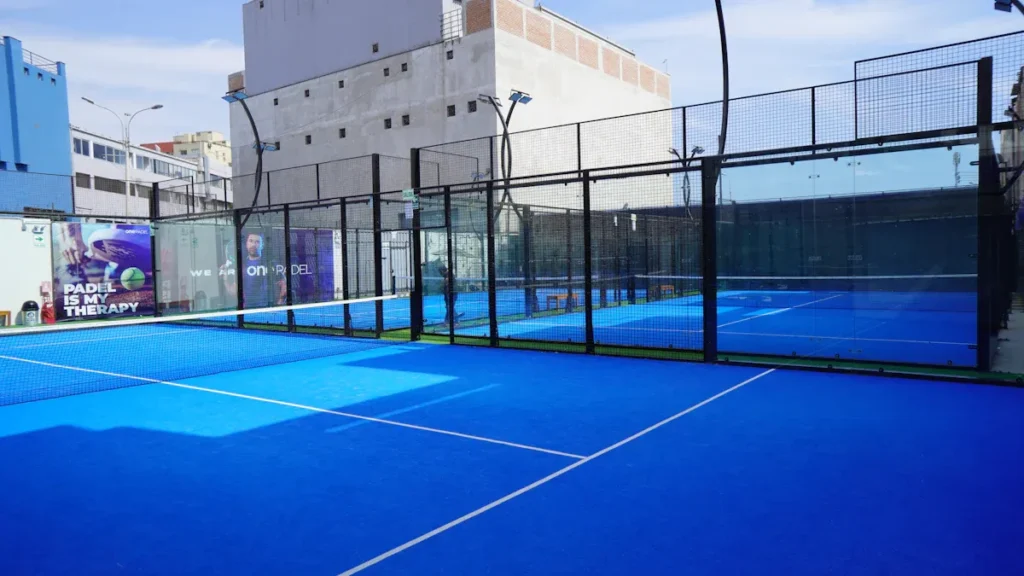
A Padelplatz can give a corporate campus a practical facility for employee exercise, social interaction, team activities, and customer events. Unlike a conventional fitness room used mainly by individuals, padel encourages communication between colleagues and creates opportunities for organized group participation.
However, installing a court does not automatically create an effective workplace wellness programme. The location, operating rules, equipment, scheduling, coaching, maintenance, and employee access should be planned together.
This guide explains how corporations, industrial parks, technology companies, factories, office campuses, and property-management teams can evaluate an on-site Padel Court project.
Why Add a Padel Court to a Corporate Campus?
Regular physical activity can provide physical and mental health benefits. The World Health Organization also identifies workplaces as important settings for creating more opportunities for physical activity. Review the WHO physical activity guidance.
A workplace court can make exercise more convenient by reducing the need for employees to travel to an external club.
Support Employee Wellness
The facility may be used for:
- Lunchtime exercise
- After-work sessions
- Staff leagues
- Beginner coaching
- Department competitions
- Wellness campaigns
- Executive recreation
- Family activity days
The CDC encourages employers to support physical activity through workplace programmes and environments that make active choices easier. See the CDC employer resources.
Encourage Social Interaction
Padel is normally played in doubles, so employees need to communicate, coordinate positions, and make decisions with a partner.
Concept: Informal Team Building
Informal team building develops workplace relationships through shared activities rather than formal meetings.
A regular game may help employees from different departments interact in a more relaxed setting, although employers should avoid making participation feel compulsory.
Create a Distinctive Campus Amenity
A well-planned court can strengthen the sports and leisure offering of a corporate headquarters or business park.
It may also be used during recruitment events, customer visits, company celebrations, and regional staff meetings.
Which Corporate Sites Are Suitable?
Not every workplace needs an on-site court. The project should match the available land, employee population, climate, working hours, and management capacity.
Corporate Headquarters
A headquarters may use a panoramic court as a visible feature close to the employee recreation or hospitality area.
The facility should still be separated from meeting rooms, executive offices, and quiet work areas.
Industrial and Manufacturing Sites
A factory campus may have more available land but stricter rules regarding traffic, security, protective equipment, and restricted operating zones.
The court should not interfere with:
- Truck routes
- Loading areas
- Hazardous-material zones
- Production entrances
- Emergency access
- Shift-change circulation
Multi-Tenant Business Parks
A shared court can serve several companies within the same development.
This model requires clear rules for cost sharing, booking priority, guest access, insurance, maintenance, and disputes.
Select the Right Padel Court Type
| Gerichtstyp | Corporate Advantage | Suitable Setting | Main Consideration |
|---|---|---|---|
| Classic court | Practical structure and controlled cost | Factories and standard office parks | Visual weight and post layout |
| Panoramic court | Clearer views and premium appearance | Headquarters and customer-facing campuses | Presentation and maintenance |
| Super panoramic court | Strong event and media value | Large branded corporate centres | Engineering and budget |
| Roofed outdoor court | Improved protection from rain and sun | Campuses with changing weather | Roof loads and drainage |
| Indoor court | Predictable year-round use | Large office or recreation buildings | Clear height and ventilation |
| Single court | Reduced-width alternative | Selected space-limited projects | Different use from standard doubles play |
Der SRSC Padel Court range includes classic, panoramic, super panoramic, indoor, outdoor, single, and roofed configurations.
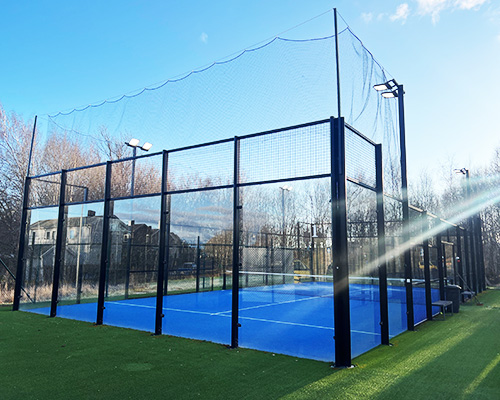
Klassischer Padelplatz
A classic Padel Court can be suitable for regular employee bookings, training sessions, and industrial campuses prioritizing practical operation.
Its structural colour can be coordinated with the company’s buildings or brand identity.
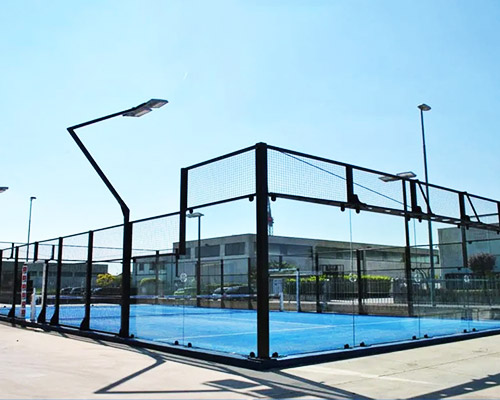
Panorama-Padelplatz
A panoramic Padel Court can provide clearer spectator views and a more open appearance.
It may be positioned near a visitor centre, employee lounge, café, or company-event area.
Roofed Outdoor Court
A roofed Outdoor Padel Court can increase usable hours during rain or strong sunlight.
The roof should be included in the original structural, foundation, drainage, and permit planning.
Choose the Corporate Campus Location
The court should be easy for employees to reach without interfering with normal business operations.
Separate the Court From Work Areas
Ball impact, player communication, gates, and spectators can create noticeable sound.
Avoid placing the court directly beside:
- Conference rooms
- Customer-service offices
- Laboratories
- Recording rooms
- Executive offices
- Employee rest areas requiring quiet
- Residential buildings near the campus
Existing buildings, landscaped mounds, parking structures, or professionally designed barriers may help separate active and quiet zones.
Maintain Safe Access
Employees should not need to cross heavy-vehicle routes or restricted industrial areas to reach the court.
Provide a clear route from offices, changing rooms, parking areas, and employee facilities.
Concept: Operational Separation
Operational separation keeps recreational activity away from areas where it could conflict with production, logistics, security, or emergency operations.
A short walking route is useful, but safety and business continuity are more important than placing the court as close as possible to the main building.
Plan Employee Booking Rules
An internal Padel Court can quickly become difficult to manage when booking policies are unclear.
Set Booking Eligibility
The company should decide whether the facility is available to:
- All employees
- Selected office locations
- Contractors
- Interns
- Employee family members
- Customers
- Company guests
- Outside community members
The policy should explain whether the employee must remain present when bringing guests.
Limit Active Reservations
A maximum number of future bookings per employee or team can prevent a small group from controlling the most popular periods.
Once a session is completed, the booking allowance can be released again.
Manage Peak Periods
Lunch breaks and early evenings may attract the highest demand.
Possible solutions include:
- Shorter peak-hour sessions
- Department booking limits
- Advance-booking windows
- Waiting lists
- Rotating league schedules
- Off-peak coaching sessions
Develop Corporate Padel Programmes
A court may receive limited use when employees are expected to organize everything independently.
Beginner Sessions
Many employees may be interested but unfamiliar with padel.
Short introductory programmes can explain basic rules, racket use, safety, serving, scoring, and court movement.
Department Leagues
A company league can create regular participation over several weeks.
Use simple formats and balanced divisions so that beginners do not need to compete immediately against experienced players.
Customer and Partner Events
The court may support:
- Customer hospitality
- Supplier events
- Product launches
- Executive networking
- Charity tournaments
- Regional management meetings
Keep Events Inclusive
Not every guest will want or be able to play.
Provide seating, refreshments, demonstrations, and alternative activities so the event does not depend entirely on sports participation.
Provide Supporting Facilities
Changing Rooms and Lockers
Employees need a convenient place to change clothes and store work items.
The design should consider shower capacity, lockers, ventilation, cleaning, and shift-change demand.
Equipment Storage
A secure storage area may contain:
- Rental rackets
- Balls
- Training cones
- Coaching baskets
- Turf brushes
- Cleaning equipment
- Spare nets
- Replacement hardware
Sports equipment should be separated from chemicals, industrial tools, and maintenance machinery.
Seating and Drinking Water
Provide waiting seats and drinking water near the court without blocking gates or emergency routes.
Outdoor projects may also need shade and weather protection.
Manage Safety and Responsibility
The company should define who is responsible for inspections, closures, coaching, equipment, and emergency response.
Daily Checks
Before use, inspect:
- Kunstrasen
- Glass panels
- Metal fencing
- Gates
- Nets
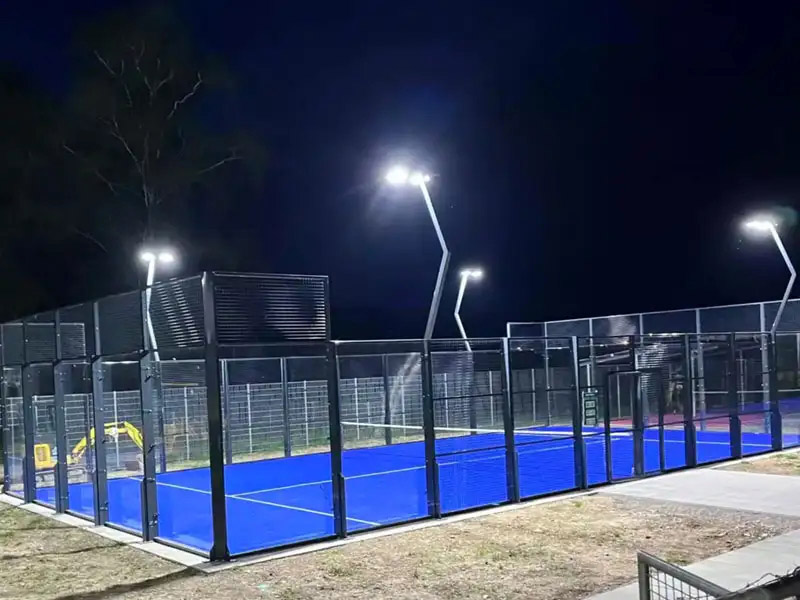
- Beleuchtung
- Drainage
- Walkways
- Visible connections
A damaged court should be closed until it has been properly assessed.
Employee Rules
Court rules may cover:
- Appropriate footwear
- Booking times
- Guest access
- Equipment return
- Food and drinks
- Damage reporting
- Weather closures
- Junior visitors
- Unsupervised use
Emergency Planning
The site emergency plan should include the sports facility.
Employees should know how to contact medical support and provide the exact court location to emergency responders.
Estimate the Complete Corporate Project Cost
The equipment price represents only part of the total investment.
Construction Costs
A complete budget may include:
- Site survey
- Planning approval
- Soil assessment
- Foundation
- Drainage
- Court structure
- Kunstrasen
- Beleuchtung
- Electrical supply
- Shipping
- Unloading
- Installation
- Landscaping
- Access control
- Changing facilities
Operating Costs
Long-term expenses may include:
- Electricity
- Cleaning
- Turf brushing
- Glass cleaning
- Hardware replacement
- Drain maintenance
- Booking software
- Coaching
- Insurance
- Periodic professional inspection
Avoid Unsupported ROI Claims
The value of a corporate Padel Court cannot be measured only through direct revenue.
Employers may also consider employee participation, facility utilization, recruitment, staff feedback, customer events, and workplace experience. These results depend on the company culture and should be measured using real internal data.
Measure Corporate Padel Court Performance
Participation Metrics
Track:
- Registered users
- Active monthly users
- Booked court hours
- Repeat participation
- Beginner-session attendance
- Department-league participation
- No-show rate
Operational Metrics
Monitor:
- Maintenance costs
- Energy use
- Equipment damage
- Peak-hour demand
- Weather closures
- Customer-event use
Employee Feedback
Ask whether employees find the booking system, location, operating hours, changing facilities, and beginner support practical.
Do not assume low participation means a lack of interest. The problem may be inconvenient schedules, poor communication, or difficulty finding playing partners.
Common Corporate Padel Court Mistakes
Building Without Employee Research
A court should reflect the actual workforce rather than management assumptions.
Placing It Near Quiet Offices
The shortest available distance from the main building may not be the most suitable location.
Allowing Unlimited Peak Bookings
A small group of experienced players can discourage broader participation.
Providing No Beginner Support
Employees unfamiliar with padel may never book without an introduction.
Ignoring Shift Workers
A programme designed only for standard office hours may exclude a large part of an industrial workforce.
Treating the Court as Maintenance-Free
Steel, glass, turf, lighting, gates, and drainage require regular inspection and care.
Abschluss
A Padel Court can become a useful employee wellness, social, and corporate-event facility when it is integrated into the wider workplace plan.
The strongest projects begin by evaluating employee demand, site safety, operational separation, court type, booking rules, beginner support, maintenance, and long-term costs.
A court should not be treated only as a visible campus feature. It needs structured programming and clear responsibility to remain active, safe, and useful.
Corporate buyers can explore the complete Padel Court product range, review SRSC’s project services, oder contact SRSC with the campus plan, employee population, preferred court type, and operating requirements.
Häufig gestellte Fragen
Is a Padel Court suitable for an office campus?
Yes, provided the site has sufficient space, suitable access, employee demand, and a clear operating plan.
Can customers and suppliers use the court?
They can when the company’s access, insurance, security, and guest policies allow it.
How should employee bookings be managed?
Use a centralized booking system with defined eligibility, advance-booking limits, cancellation rules, and waiting lists.
Does the company need a coach?
A permanent coach is not essential, but introductory coaching can help beginners use the facility confidently.
Should a corporate campus choose a panoramic court?
A panoramic design may suit headquarters and customer-facing campuses. A classic design may be more appropriate for practical employee use and controlled budgets.
Can the court be used during lunch breaks?
Yes, but session length, changing time, cleaning, and demand should be considered when creating the timetable.
Who should maintain the facility?
Responsibility may belong to facilities management, property management, a sports contractor, or a specialist maintenance provider. The scope should be documented clearly.