
BLOG
Hardwood Sports Flooring: Single vs Double-Layer Keel Systems
Recent Articles
Table of Contents
Choosing Hardwood Sports Flooring involves much more than selecting the wood species or surface color. The supporting structure beneath the visible hardwood can strongly influence shock absorption, dimensional stability, load distribution, installation height, maintenance, and the long-term performance of a sports facility.
Among commercial sports flooring systems, single-layer and double-layer keel structures are two common options. Both can provide a professional playing surface, but they are designed around different project priorities.
For schools, basketball arenas, training centers, universities, community gyms, and multi-purpose sports halls, understanding these structural differences can make supplier comparisons much easier.
Key Takeaways
- Hardwood Sports Flooring should be evaluated as a complete system rather than only by the top hardwood layer.
- Single-layer keel systems generally offer simpler construction and controlled project costs.
- Double-layer keel systems provide additional structural layers that can improve load distribution and system flexibility.
- Shock absorption depends on the complete floor structure, including pads, keels, subfloor layers, and hardwood.
- Maple is widely used for professional sports flooring because of its appearance, hardness, and consistent playing characteristics.
- More structural layers do not automatically mean a better floor for every facility.
- Moisture control and subfloor preparation can be as important as the flooring structure itself.
- Buyers should compare tested system performance rather than only individual material thicknesses.
- Schools, professional arenas, and multi-purpose gyms may require different flooring solutions.
What Is Hardwood Sports Flooring?

Hardwood Sports Flooring is an engineered indoor sports surface combining hardwood boards with one or more supporting layers underneath.
The visible hardwood is only the upper part of the system. Professional sports floors may use different supporting structures depending on the required athletic performance, project budget, installation height, and intended venue.
Surface Layer
The top layer provides the actual playing surface.
It must deliver an appropriate balance of:
- Ball response
- Traction
- Wear resistance
- Appearance
- Cleaning performance
Indoor basketball courts commonly use polished wood surfaces, with maple being one of the best-known materials for professional facilities. More general background about court surfaces is available in Wikipedia’s overview of the basketball court.
Supporting Structure
Below the surface are structural components that help distribute loads and provide resilience.
Depending on the system, these may include:
- Hardwood boards
- Plywood
- Keels or battens
- Elastic pads
- Moisture barriers
- Leveling components
Concept: Sports Flooring System
A sports floor should be understood as a system in which multiple layers work together.
Changing one layer can influence how the entire floor responds to athlete movement, rolling loads, impacts, and environmental changes. Wikipedia’s introduction to a performance surface provides additional context about how sports surfaces combine traction, shock absorption, deformation, and playing performance.
Why the Keel Structure Matters
The keel structure forms the supporting framework underneath the hardwood playing surface.
It affects both mechanical behavior and construction requirements.
Load Distribution
Athletes create repeated point and dynamic loads as they run, stop, land, and change direction.
The substructure distributes these forces across a larger floor area, helping the surface maintain consistent performance during frequent use.
Resilience
Elastic components beneath or around the keel system can allow controlled vertical movement.
Too Hard vs Too Soft
An extremely rigid floor may provide limited impact reduction.
An excessively soft floor can feel unstable or create undesirable deformation.
Professional Hardwood Sports Flooring aims to balance stability with controlled resilience. The general construction principle is similar to a sprung floor, which combines a performance surface with a resilient subfloor and shock-absorbing components.
What Is Single-Layer Keel Hardwood Sports Flooring?
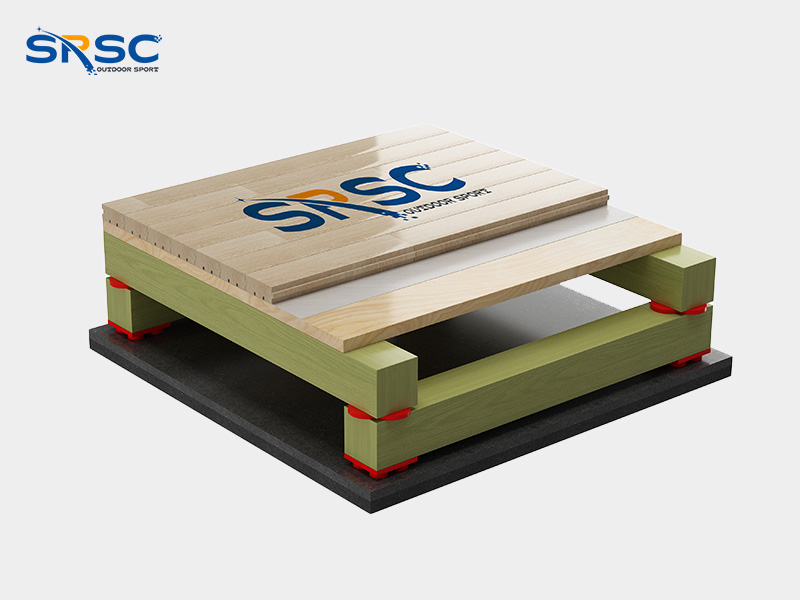
A single-layer keel structure uses one principal layer of timber battens or keels below the playing surface assembly.
Its relatively straightforward construction makes it attractive for many schools, community facilities, and training venues.
Simpler Structural Layout
With fewer structural layers, installation can be less complex.
This may also reduce total construction height and make the system easier to coordinate with existing doors, equipment, and floor transitions.
For projects emphasizing a practical structure and controlled investment, SRSC’s Basic Hardwood Sports Flooring uses a single-layer pine keel structure with a North American maple surface and elastic support pads.
Controlled Cost
Single-layer systems typically use fewer supporting components than more complex double-layer structures.
They can reduce material quantity and installation complexity while retaining the essential performance required by many general sports facilities.
Suitable Projects
Single-layer Hardwood Sports Flooring may be appropriate for:
- School gyms
- Community sports centers
- Training halls
- Recreational basketball courts
- Multi-purpose facilities
- Projects with controlled budgets
For facilities seeking a more integrated single-layer panelized structure, Classic Hardwood Sports Flooring provides another option combining maple boards, a single-layer keel framework, and shock-absorbing support.
The correct choice still depends on tested system performance rather than structure name alone.
What Is Double-Layer Keel Hardwood Sports Flooring?
A double-layer keel system uses two supporting batten layers, commonly arranged across one another.
The additional structure creates another level of load distribution beneath the playing surface.
Cross-Layer Support
The second structural layer can distribute loads in more than one direction.
This can be particularly valuable in facilities where long-term stability and high-frequency sports use are priorities.
SRSC’s Anti-Slip Hardwood Sports Flooring combines a cross-laid double pine keel structure with elastic cushioning and a maple playing surface for professional and high-use applications.
Greater Structural Depth
Double-layer systems generally require more installation height.
This needs to be considered when coordinating:
- Doors
- Seating
- Equipment
- Floor transitions
- Building clearances
Commercial Application
Double-layer Hardwood Sports Flooring can be attractive for professional sports facilities, universities, competition halls, and high-use commercial venues.
Projects requiring a cross-laid structure with an emphasis on stability can also consider Shock-Absorbing Hardwood Sports Flooring, which uses a double-layer pine keel arrangement and elastic support components.
Single-Layer vs Double-Layer Keel Flooring
The two systems can be compared across several project factors.
| Factor | Single-Layer Keel | Double-Layer Keel |
|---|---|---|
| Structural complexity | Lower | Higher |
| Installation height | Generally lower | Generally higher |
| Material quantity | Lower | Higher |
| Load distribution | Good | Enhanced |
| Installation time | Usually shorter | Usually longer |
| Project cost | Generally lower | Generally higher |
| High-intensity use | Suitable by specification | Strong option |
| Professional arena use | System-dependent | Common choice |
| Subfloor tolerance | Requires good preparation | Still requires good preparation |
| Long-term stability | Good when properly designed | Enhanced structural support |
Which One Is Better?
Neither system is universally better.
A double-layer structure may be unnecessary for a small school gym, while a simplified single-layer solution may not be the preferred specification for a major competition arena.
Better Question
Instead of asking:
“Which structure is stronger?”
ask:
“Which complete flooring system delivers the performance required by my facility?”
That question produces a much more useful purchasing discussion.
Single-Layer Keel vs Double-Layer Keel Cost
Cost differences come from more than the quantity of timber.
Material Cost
Double-layer structures generally contain more keel material and additional installation components.
A higher-density support arrangement can further increase the number of keels, pads, connections, and installation operations required.
Labor
More structural layers can increase installation time and alignment work.
The construction team must control keel spacing, pad placement, subfloor levels, panel connections, expansion details, and final surface positioning.
Building Preparation
Floor height differences may require changes to thresholds, ramps, seating, or doors.
Total Installed Cost
When comparing quotations, calculate:
materials + shipping + subfloor preparation + installation + finishing + court markings + future maintenance
A cheaper square-meter price does not always create the lowest total project cost.
How Does Shock Absorption Work?
Shock absorption is one of the most important concepts in sports flooring.
When an athlete lands, part of the impact energy is transferred into the floor.
Elastic Pads
Many wooden sports floor systems incorporate resilient pads underneath structural elements.
These pads compress under loading and recover afterward.
Structural Movement
Keels and panels may also contribute to controlled deformation.
Concept: Energy Management
The objective is not to make the floor soft.
The objective is to manage impact while maintaining sufficient stability for running, jumping, ball control, and directional changes.
The relationship between the finished surface and resilient supporting layers is also explained in Wikipedia’s overview of sprung floor construction.
Does Double-Layer Flooring Always Absorb More Shock?
Not necessarily.
Shock absorption depends on the full system.
Important variables include:
- Pad material
- Pad thickness
- Pad spacing
- Keel spacing
- Plywood
- Hardwood thickness
- Structural geometry
- Installation quality
Compare Tested Performance
Two double-layer floors can behave differently.
Likewise, a properly engineered single-layer system may outperform a poorly designed double-layer system.
Buy the System, Not the Layer Count
For B2B procurement, performance test results are more meaningful than simply counting layers.
The completed structure should be tested and evaluated as one system rather than presenting the specifications of individual boards, keels, or pads separately.
Area-Elastic Sports Flooring Explained
Many professional hardwood sports floors are designed as area-elastic systems.
Local Impact
When an athlete lands, the floor does not respond at only one tiny point.
The surrounding area also contributes to the floor response.
Force Distribution
This spreads impact over a wider portion of the structural system.
Why It Matters
Area-elastic behavior can create a more consistent playing environment across basketball, volleyball, badminton, and other indoor sports.
Buyers planning multi-purpose halls should consider how the floor performs across multiple activities rather than optimizing for one isolated movement. For additional terminology related to sports surface performance, see Wikipedia’s explanation of a performance surface.
Maple vs Other Hardwood Sports Flooring
The supporting structure is important, but the surface wood also matters.
Maple Hardwood
Maple is widely associated with professional indoor sports flooring.
It provides a clean appearance and a dense, relatively uniform playing surface. Many professional indoor basketball courts use polished wood, commonly maple, as noted in the basketball court overview.
Oak
Oak can provide excellent durability and a distinctive visual character.
Beech
Beech is also used in sports flooring systems in different international markets.
| Wood | Appearance | Typical Characteristic | Common Application |
|---|---|---|---|
| Maple | Light and uniform | Dense professional surface | Basketball and arenas |
| Oak | Strong grain | Durable appearance | Multi-purpose halls |
| Beech | Warm, consistent | Good sports-floor option | European-style venues |
Is Maple Always the Best?
Not automatically.
Wood species should be evaluated together with the complete structural system, coating, local climate, maintenance practices, budget, and certification requirements.
General information about solid and engineered timber flooring, installation methods, and moisture-related dimensional changes is available in Wikipedia’s article on wood flooring.
Why North American Maple Is Popular
Maple provides a bright visual background that works well with court markings.
This can improve contrast between the playing surface, boundary lines, team logos, and basketball markings.
Uniform Appearance
Commercial buyers often value consistent board grading because premium arenas require a clean visual finish.
Surface Refinishing
Quality hardwood surfaces can also be sanded and refinished during their lifecycle when construction and wear conditions allow.
Long-Term Asset
This is one reason many facility owners evaluate Hardwood Sports Flooring over decades rather than only comparing initial purchase prices.
Surface Coating Matters as Much as the Wood
The visible finish affects traction, wear resistance, cleaning, and appearance.
Sports Lacquer
Purpose-designed sports coatings create a finished playing surface while preserving the visual character of the timber.
Anti-Slip Performance
Athletes need controlled grip.
Too little grip increases slipping risk, while excessive friction can interfere with movement.
Gloss
Highly reflective floors can create unwanted glare under strong arena lighting.
Matte Professional Appearance
Many professional sports facilities therefore prefer controlled-gloss or matte finishes that maintain court visibility.
Buyers should confirm whether the coating is intended for athletic surfaces rather than relying on a general residential or commercial wood finish.
What Is EN 14904?
EN 14904 is an important European standard associated with indoor multi-sports surfaces.
Its published title is Surfaces for Sports Areas – Indoor Surfaces for Multi-Sports Use – Specification.
Why Standards Matter
A buyer cannot accurately evaluate sports performance from a product photograph.
Performance characteristics need measurable criteria.
Complete System Testing
Testing the finished flooring system is more meaningful than independently testing one timber board or foam pad.
Buyer Perspective
When a supplier mentions compliance with a sports flooring standard, ask:
- Which standard?
- Which exact flooring system was tested?
- Is the report current?
- Does the supplied structure match the tested structure?
- Which laboratory issued the test report?
- Are the product dimensions identical to the tested configuration?
FIBA and Basketball Flooring
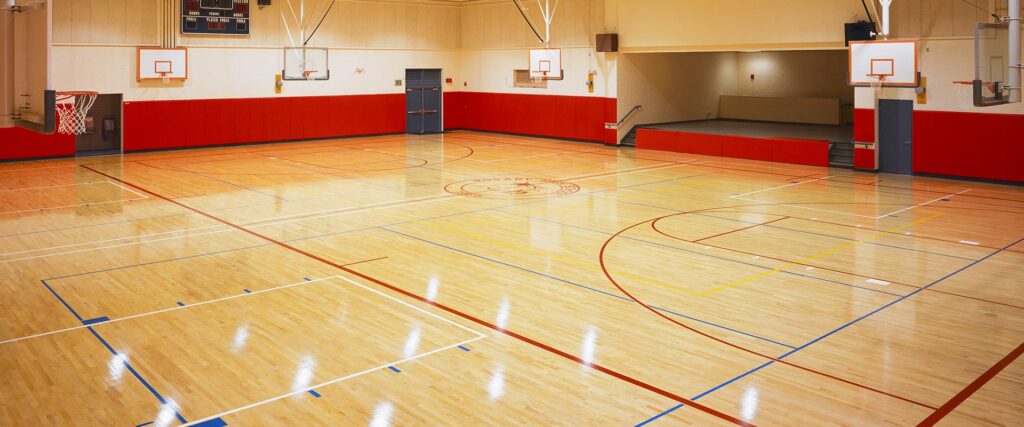
For basketball projects, FIBA requirements may become relevant depending on competition level and facility objectives.
FIBA maintains an official catalogue of approved basketball equipment, including fixed and portable wooden flooring systems.
Professional Arenas
Facilities intended for higher-level basketball competition should confirm current requirements early in the design process.
School Gyms
A school sports hall may not need the same competition certification as an international arena.
Match Certification to Project Need
Do not pay for specifications you do not require.
At the same time, do not select a recreational-grade system for a venue that intends to host professional competition.
Buyers should verify the exact product name and license information against the current FIBA catalogue instead of relying only on a general certification statement in promotional materials.
Fixed vs Portable Hardwood Sports Flooring
Keel structure is not the only structural decision.
Some facilities also need to choose between permanent and portable systems.
Fixed Flooring
Fixed Hardwood Sports Flooring remains installed as the permanent sports surface.
It is suitable for:
- Dedicated basketball halls
- School gyms
- Universities
- Training centers
- Multi-purpose sports buildings
Portable Flooring
Portable systems are designed to be assembled, removed, transported, or stored.
They are useful for:
- Arenas hosting different events
- Temporary competitions
- Rental venues
- Multi-use event centers
SRSC’s CourtMaster Interlock Flooring uses a modular connection system that supports installation, dismantling, transportation, and reuse where venue conversion is required.
Different Business Models
A dedicated training hall generally values permanence.
A large event arena may value rapid floor conversion.
The correct flooring system should support the venue’s operating model.
Single vs Double-Layer Keel for Basketball Courts
Basketball places significant demands on sports flooring because athletes repeatedly sprint, stop, jump, land, and change direction.
School Basketball
A quality single-layer system may provide a practical balance between performance and investment.
Professional Basketball
Higher-use facilities may prioritize more sophisticated supporting structures, including double-layer or high-density systems.
Multi-Use Arena
The floor must also accommodate other sports and potentially equipment loads.
Rolling Loads
Retractable seating, portable basketball systems, maintenance equipment, and event infrastructure can impose loads different from normal athlete use.
Facility owners should tell the flooring supplier about these conditions before selecting the structure.
Hardwood Sports Flooring for Badminton and Volleyball
A wooden sports floor is not limited to basketball.
Badminton
Players rely on rapid lateral movement, lunges, and repeated changes in direction.
Volleyball
Jumping and landing occur frequently.
Multi-Sport Design
When one gym serves basketball, badminton, volleyball, physical education, and community programs, the flooring should be evaluated as a multi-sport system.
This is especially important for schools and municipal sports centers.
Double-Layer vs High-Density Keel Systems
Not all double-layer systems are identical.
Standard Double-Layer
Two crossing structural layers create a robust support network.
High-Density Double-Layer
Closer keel spacing increases the number of support points beneath the playing surface.
SRSC’s Stable Hardwood Sports Flooring uses a double-layer, high-density pine keel arrangement intended to improve load distribution and reduce long-term surface deformation.
Why Use Higher Density?
Potential project objectives include:
- Greater load distribution
- Increased floor stability
- High-frequency sports use
- Demanding commercial venues
- Professional and institutional applications
More material also increases cost and installation requirements, so the specification should match the application.
What Is a Primary-Secondary Keel Structure?
A primary-secondary structure uses two supporting keel levels with defined structural roles.
Primary Keels
These provide the main load-bearing framework.
Secondary Keels
These help distribute surface loads and support the playing structure.
SRSC’s Professional Hardwood Sports Flooring uses longitudinal primary keels and secondary cross-supports to combine vertical elasticity with horizontal stability.
Structural Balance
This arrangement can provide effective load distribution across heavily used sports surfaces.
It is another reason buyers should not treat all “double-layer” products as interchangeable.
What Is a 45° Skew-Laying Keel Structure?
Some Hardwood Sports Flooring systems use an angled supporting layout.
Diagonal Support
Keels positioned at an angle can distribute loads across the flooring in a different pattern from conventional parallel systems.
Structural Precision
The system requires accurate installation and layout control.
SRSC’s 45° Hardwood Sports Flooring uses a skew-laid double-layer keel arrangement designed to support load distribution and structural stability in demanding indoor sports venues.
When Is It Useful?
Such structures may appeal to venues seeking specialized load distribution and high structural stability.
However, buyers should evaluate measurable performance rather than choosing an unusual structure simply because it sounds more advanced.
Flooring Height and Building Coordination
Sports flooring adds height above the structural concrete slab.
Door Thresholds
Doors need sufficient clearance after flooring installation.
Equipment
Basketball backstops, seating, storage systems, and other equipment should be coordinated with finished floor level.
Accessibility
Transitions between sports flooring and surrounding circulation surfaces should be planned.
Renovation Projects
This becomes particularly important when installing Hardwood Sports Flooring inside an existing gym.
Even a small height change can affect doors, ramps, wall details, retractable seating, and existing equipment.
Subfloor Flatness
A premium floor cannot fully compensate for a badly prepared concrete base.
Uneven Concrete
Large irregularities can create difficulties during installation.
Leveling
The contractor may need to correct the base before flooring installation begins.
Check Before Shipping
For international projects, verify the concrete base before the flooring arrives.
Discovering major leveling problems after installation teams are already on site can create unnecessary delays, additional labor costs, and disputes between the flooring installer and civil contractor.
Moisture Control in Hardwood Sports Flooring
Wood naturally responds to changes in environmental moisture.
This makes moisture management especially important.
Concrete Moisture
New concrete may contain substantial residual moisture.
Installing hardwood too early can create dimensional problems.
Indoor Humidity
Large seasonal humidity changes can also affect wood.
Wikipedia’s overview of wood flooring explains that changes in humidity can contribute to gapping, cupping, crowning, and other dimensional changes in timber flooring.
Moisture Barrier
Depending on the system, an appropriate moisture-control layer may be installed between the concrete and wooden structure.
Acclimation
Hardwood products may need time to adapt to the intended indoor environment before final installation.
Follow the manufacturer’s project-specific instructions rather than using one universal acclimation period.
HVAC and Sports Flooring
Indoor environmental control supports long-term flooring stability.
Temperature
Extremely large temperature changes can affect the building and flooring system.
Relative Humidity
Stable indoor humidity helps reduce excessive dimensional movement in wood.
Flooring Is Part of the Building
Facility owners sometimes treat the hardwood floor as separate from the HVAC system.
In reality, long-term indoor environmental conditions are part of floor maintenance.
The HVAC system should ideally be operational before flooring acclimation and should continue maintaining suitable conditions after installation.
Installation Quality vs Product Quality
Even excellent materials can perform poorly when installation is inaccurate.
Keel Spacing
Supporting elements need to follow the specified layout.
Pad Position
Elastic pads need consistent placement.
Board Installation
Surface boards require proper fastening and expansion detailing.
Court Lines
Final markings should follow the intended sports layout.
Facilities requiring customized graphics, team branding, or integrated court markings can also review 3D-Printed Sports Wooden Flooring.
System Consistency
The installed floor should match the design and test configuration supplied by the manufacturer.
Unauthorized changes made on site can alter performance and may affect warranty or certification claims.
Hardwood Sports Flooring Maintenance
A professional wooden sports floor is a long-term facility asset.
Routine maintenance protects both appearance and playing performance.
Daily Cleaning
Remove dust, sand, and loose debris.
Spill Management
Liquids should be cleaned promptly.
Periodic Inspection
Check:
- Surface wear
- Court markings
- Coating condition
- Loose areas
- Abnormal movement
- Moisture issues
Refinishing
Over time, suitable hardwood sports floors may be recoated or refinished depending on surface condition.
Avoid Household Cleaning Products
Sports floors require appropriate cleaning methods.
Products that leave slippery residues can change surface traction and create inconsistent playing conditions.
Single-Layer vs Double-Layer Maintenance
Maintenance of the visible hardwood surface is generally similar.
The major difference is access and structural complexity if deeper repairs are eventually required.
Single-Layer System
Simpler construction can make structural diagnosis relatively straightforward.
Double-Layer System
More components provide more structural functions but also create a more complex assembly.
Preventive Maintenance Wins
For both systems, maintaining indoor humidity, cleaning the surface correctly, and responding early to water damage is more important than waiting for major structural problems.
How to Compare Hardwood Sports Flooring Suppliers
Use a technical comparison rather than selecting the lowest price per square meter.
| Buyer Check | What to Compare |
|---|---|
| Wood species | Maple, oak, beech, other |
| Surface grade | Appearance and board quality |
| Top-layer thickness | Actual specification |
| Keel system | Single, double, high-density |
| Pad system | Material and spacing |
| Shock absorption | Tested system data |
| Ball response | Tested performance |
| Surface friction | Sports-use suitability |
| Coating | Sports-specific finish |
| Certification | Relevant project standards |
| Moisture system | Barrier and requirements |
| Installation | Method and supervision |
| Warranty | Scope and exclusions |
| Spare materials | Future availability |
Request Comparable Documents
Ask each supplier for the same types of information:
- Section drawing
- Material list
- Installation height
- Test report
- Certificate or license number
- Installation method
- Maintenance instructions
- Warranty terms
This makes it easier to compare complete systems rather than marketing descriptions.
Which Hardwood Sports Flooring System Should You Choose?
Start with the facility type.
School Gym
Priorities often include:
- Durability
- Controlled cost
- Multi-sport use
- Simple maintenance
A well-designed single-layer structure may be appropriate.
Professional Basketball Arena
Priorities may include:
- Certified performance
- High shock absorption
- Consistent ball response
- Heavy usage
- Premium appearance
More advanced double-layer systems may be attractive.
University Sports Hall
Universities often combine competition, training, and general student use.
A durable multi-purpose system with strong lifecycle performance is important.
Community Sports Center
Budget and maintenance efficiency may have greater weight.
Match Structure to Facility
The best system is not the one with the most layers.
It is the one that delivers the required athletic performance, structural stability, installation practicality, and lifecycle value for the specific project.
Common Hardwood Sports Flooring Buying Mistakes
Comparing Only Wood Thickness
The top board is only one part of the floor.
Assuming Double-Layer Is Always Better
Additional structure should solve a real project requirement.
Ignoring Moisture
Water and uncontrolled humidity can create serious long-term problems.
Buying Without Test Data
A product description cannot replace measurable sports-floor performance.
Forgetting Installation Height
Floor buildup affects doors, access, equipment, and transitions.
Choosing Residential Wood Flooring
Residential flooring and professional Hardwood Sports Flooring are designed for different performance requirements.
Ignoring Maintenance Costs
Purchase price is only one part of lifecycle cost.
Hardwood Sports Flooring Buyer Checklist
Before placing an order, confirm:
- Intended sports
- Facility level
- Competition requirements
- Floor area
- Concrete condition
- Subfloor flatness
- Moisture conditions
- Hardwood species
- Surface board specification
- Single or double-layer keel
- Elastic pad system
- Floor construction height
- Shock-absorption performance
- Ball response
- Surface friction
- Coating specification
- Court markings
- Installation method
- Certification requirements
- Maintenance plan
- Warranty
FAQ About Hardwood Sports Flooring
Is single-layer or double-layer Hardwood Sports Flooring better?
Neither is universally better.
Single-layer systems can provide a practical and cost-effective solution for schools, training halls, and community facilities, while double-layer systems may provide additional structural support for demanding commercial or professional venues.
Is maple the best wood for basketball flooring?
Maple is widely used in professional basketball flooring because of its appearance and playing characteristics.
However, the complete flooring structure, coating, shock absorption, certification, maintenance, and project budget should also influence material selection.
Does a thicker sports floor absorb more impact?
Not necessarily.
Shock absorption depends on the complete structure, including elastic pads, keel spacing, plywood, hardwood, and system geometry.
What is a double-layer keel sports floor?
It uses two supporting batten or keel layers beneath the playing surface.
The layers typically create a stronger load-distribution network compared with simpler structures.
Is Hardwood Sports Flooring suitable for volleyball and badminton?
Yes.
Professional wooden sports flooring can be designed for basketball, volleyball, badminton, physical education, and multi-purpose indoor sports halls.
How long does Hardwood Sports Flooring last?
Service life depends on construction quality, traffic, environmental control, maintenance, coating care, moisture exposure, and refurbishment.
A professionally maintained hardwood floor should be evaluated as a long-term facility investment rather than a short-term finish.
Does sports flooring require shock absorption?
Athletic facilities commonly evaluate impact reduction and deformation as important sports-floor performance characteristics.
The required level should match the intended sport, facility standard, and applicable specification.
Can Hardwood Sports Flooring be installed over concrete?
Yes, many systems are installed above prepared concrete slabs using supporting structures and moisture-control layers.
The concrete should first meet the required flatness, moisture, and structural conditions.
What should I ask a Hardwood Sports Flooring manufacturer?
Ask for:
Complete system construction, wood specification, keel spacing, elastic-pad details, test reports, certification, installation requirements, moisture conditions, warranty, and maintenance instructions.
These details provide much more purchasing value than simply asking for the price per square meter.
Is FIBA certification necessary for every basketball court?
No.
Certification requirements depend on the intended competition level and project objectives.
Professional competition venues should verify current requirements through the official FIBA Wooden Flooring Catalogue, while schools and recreational facilities may have different specifications.
Conclusion
Choosing Hardwood Sports Flooring is ultimately a system-selection decision.
The visible maple or other hardwood surface is important, but long-term performance also depends on the keel structure, elastic pads, subfloor, moisture control, coating, installation, and indoor environment.
Single-layer keel systems offer a practical structure that can suit schools, community gyms, and training facilities.
Double-layer systems provide additional structural depth and load distribution that may appeal to universities, professional sports centers, arenas, and other high-use facilities.
For B2B buyers, the most reliable purchasing process is:
Define the facility → determine performance requirements → evaluate the subfloor → compare complete flooring systems → review testing and certification → confirm installation → plan maintenance.
Do not select Hardwood Sports Flooring simply because one quotation contains more timber, more layers, or a higher price.
Select the floor that provides the right balance of player performance, structural stability, durability, installation practicality, and lifecycle cost for the facility.
SRSC provides Hardwood Sports Flooring systems including single-layer, double-layer, high-density keel, primary-secondary keel, 45-degree structural, customized printed, and modular flooring solutions for basketball arenas, schools, training centers, universities, community facilities, and multi-purpose sports halls.