
BLOG
Padel Court Corrosion Protection Guide for Outdoor Projects
Recent Articles
Table of Contents
Key points covered in this guide:
- Why corrosion protection should match the installation environment
- How hot-dip galvanizing differs from powder coating and ordinary paint
- Why coastal Padel Courts need additional protection
- How a duplex coating system protects the steel structure
- Which posts, welds, base plates, fasteners, and gates require closer inspection
- What buyers should include in a corrosion-protection specification
- How shipping and installation can damage a finished coating
- How regular cleaning and touch-up work can reduce long-term repair costs
A reliable Padel Court Corrosion Protection plan begins before the steel structure enters production.
Outdoor courts are exposed to rain, condensation, ultraviolet radiation, airborne salt, dust, cleaning chemicals, temperature changes, and moisture around the foundation. These conditions can gradually affect posts, mesh frames, welds, gates, base plates, bolts, lighting supports, and roof structures.
The correct solution is not simply to request “anti-rust paint.” Buyers should define the project environment, steel preparation, zinc coating, colour coating, fastener materials, repair process, inspection records, and maintenance responsibilities as one complete system.
This guide explains how commercial buyers can compare corrosion-protection options for inland, coastal, humid, industrial, indoor, and roofed Padel Court projects.
Why Padel Court Corrosion Protection Matters
The steel structure supports the tempered glass, metallic mesh, gates, lighting, net system, and other court components.
Corrosion may begin in a small damaged area but gradually affect:
- Coating adhesion
- Steel appearance
- Bolted connections
- Welded joints
- Gate operation
- Base-plate condition
- Replacement-part compatibility
- Customer perception
Corrosion Is Not Only an Appearance Problem
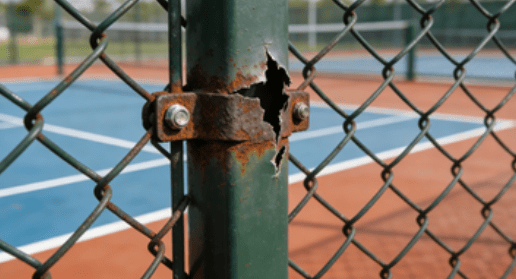
Early surface staining may appear cosmetic. However, corrosion that continues beneath damaged coating can eventually reduce material thickness or weaken important connections.
Operators should distinguish between:
- Surface contamination
- Zinc oxidation
- Local coating damage
- Rust staining
- Active steel corrosion
- Advanced section loss
A qualified person should assess structural areas when the extent of deterioration is uncertain.
Outdoor Courts Have Many Water Traps
Water can remain around:
- Base plates
- Horizontal tubes
- Open bolt holes
- Gate hinges
- Mesh-frame corners
- Welded brackets
- Lighting connections
- Roof gutters
Concept: Corrosion Trap
A corrosion trap is a detail that allows water, dirt, salt, or chemicals to remain against a metal surface.
Good structural detailing should reduce these traps and allow inspection, drainage, cleaning, and coating application.
Classify the Installation Environment
Corrosion protection should be selected according to actual environmental exposure rather than the court colour or purchase price.
ISO 12944-2 classifies the principal environments affecting steel structures and provides atmospheric-corrosivity categories for evaluating exposure. The standard is commonly used as a framework when protective paint systems are being selected.
Dry Indoor Environment
An indoor court inside a controlled, ventilated building may experience relatively limited direct weather exposure.
However, operators should still consider:
- Condensation
- Roof leaks
- Wet cleaning
- Humid changing rooms
- Nearby swimming pools
- Coastal air entering the building
- Poor ventilation
Indoor installation does not automatically eliminate corrosion risk.
Standard Inland Outdoor Environment
An inland court may experience regular rain, dew, temperature changes, pollution, and wet debris around the base.
A suitable galvanized or coated system is still necessary for long-term outdoor use.
Coastal Environment
Coastal air can deposit salt on:
- Mesh panels
- Posts
- fasteners
- Gate hardware
- Welds
- Base plates
- Glass fittings
Salt retains moisture and can accelerate deterioration where the coating has been damaged.
Industrial Environment
Factories, ports, transport yards, chemical-processing areas, and heavy industrial zones may expose the court to dust, exhaust, cleaning chemicals, or aggressive airborne contamination.
The buyer should provide the supplier with information about nearby industrial activities before approving the coating system.
High-Humidity Environment
Tropical regions, enclosed sports halls, and poorly ventilated buildings may experience frequent condensation.
These locations require careful attention to hollow sections, horizontal surfaces, electrical enclosures, and areas where airflow is limited.
Compare Common Steel Protection Systems
Different surface treatments provide different levels and types of protection.
| Protection System | Main Function | Typical Buyer Consideration |
|---|---|---|
| Ordinary paint | Adds colour and limited barrier protection | Surface preparation and maintenance frequency |
| Powder coating | Creates a durable decorative barrier | Pretreatment, film consistency, and repair method |
| Zinc-rich primer | Provides zinc-based protection under paint | Application quality and complete system compatibility |
| Pre-galvanized steel | Uses steel coated before final fabrication | Cut edges and weld areas require attention |
| Hot-dip galvanizing | Coats fabricated steel through immersion in molten zinc | Venting, drainage, coating inspection, and appearance |
| Galvanizing plus powder coating | Combines zinc protection with a coloured barrier | Pretreatment, adhesion, and repair compatibility |
Ordinary Painted Steel
A basic paint finish may provide acceptable short-term appearance in a mild, controlled environment.
Its performance depends heavily on:
- Surface cleaning
- Rust removal
- Primer
- Paint type
- Film thickness
- Edge coverage
- Drying conditions
A low-cost painted frame may require more frequent touch-up work outdoors.
Powder-Coated Steel
Powder coating provides a smooth, coloured finish and a protective barrier over the prepared metal.
Its performance depends on the complete process, including:
- Surface preparation
- Pretreatment
- Powder formulation
- Application consistency
- Curing
- Edge coverage
- Handling after coating
Powder coating should not be evaluated only by colour and gloss.
Hot-Dip Galvanized Steel
ISO 1461:2022 specifies general coating properties and test methods for hot-dip galvanized coatings applied to fabricated iron and steel articles.
During the process, fabricated steel is immersed in a zinc melt. The resulting coating provides a zinc-based protective layer over suitable exposed surfaces.
Duplex Protection System
A duplex system combines a zinc coating with an additional paint or powder-coated layer.
The zinc layer provides underlying protection, while the external coating supplies colour and an additional barrier against the environment.
SRSC’s current panoramic court specification uses hot-dip galvanized steel with zinc and plastic-powder coatings, while its Padel Court category describes a dual zinc-polyester protection system for selected products.
Hot-Dip Galvanizing vs Powder Coating
These treatments should not be treated as interchangeable.
Hot-Dip Galvanizing
The main purpose is zinc-based corrosion protection.
Possible advantages include:
- Coverage of many fabricated surfaces
- Protection around suitably designed connections
- Resistance to limited handling damage
- Reduced dependence on colour coating alone
The structure must be designed correctly for galvanizing, including suitable venting and drainage arrangements. ISO 14713-2 provides design guidance for fabricated articles that will be hot-dip galvanized.
Powder Coating
The main purposes are barrier protection, appearance, and colour customization.
Possible advantages include:
- Consistent finished appearance
- Wide colour selection
- Brand matching
- Reduced visible zinc variation
- Additional environmental protection
Should Buyers Use Both?
A galvanized-and-coated system can be valuable for:
- Outdoor commercial clubs
- Hotels and resorts
- Coastal projects
- High-humidity locations
- Premium customer-facing courts
- Facilities requiring custom brand colours
The final decision should reflect the environmental category, expected durability, maintenance access, budget, and local specification.
Pre-Galvanized vs Hot-Dip Galvanized After Fabrication
Buyers should understand when zinc protection is applied.
Pre-Galvanized Steel
Pre-galvanized profiles or sheets receive a zinc coating before the final court components are cut, welded, and drilled.
Fabrication can expose or disturb protection around:
- Cut edges
- Weld zones
- New holes
- Ground surfaces
- Modified brackets
These areas require an appropriate repair or coating procedure.
Galvanizing After Fabrication
With post-fabrication hot-dip galvanizing, the completed steel article is galvanized after cutting, drilling, and welding.
This may provide broader coverage of the fabricated component, provided the part is designed to allow safe zinc flow, venting, drainage, and handling.
Ask the Supplier Directly
The quotation should state whether components are:
- Manufactured from pre-galvanized profiles
- Hot-dip galvanized after fabrication
- Zinc primed
- Powder coated
- Galvanized and powder coated
The general word “galvanized” is not detailed enough for a technical comparison.
Design Hollow Steel Sections for Drainage
Hollow posts, mesh frames, beams, and roof components need suitable detailing.
Vent and Drain Holes
When fabricated hollow sections are hot-dip galvanized, openings may be needed to allow gases and liquids to enter and exit safely.
Their positions should be planned before production rather than drilled randomly after coating.
Prevent Water Accumulation
After installation, hollow or horizontal components should not collect rainwater.
Check:
- End caps
- Drain holes
- Tube orientation
- Welded closures
- Roof members
- Gate frames
- Lighting supports
Do Not Seal Unknown Moisture Inside
A damaged cap should not be replaced before checking whether water has already entered the component.
Where necessary, the part should be inspected, dried, treated, and resealed through an approved procedure.
Protect Welds, Edges, and Corners
Coating systems are frequently less uniform around complex details.
Welded Areas
Welds should be:
- Complete
- Free from excessive spatter
- Properly cleaned
- Accessible for treatment
- Inspected before coating
Poorly finished welds can create rough areas that are difficult to coat consistently.
Sharp Edges
Very sharp edges may receive less protective coating than flat surfaces.
The fabrication process should provide suitable edge finishing before galvanizing or powder coating.
Cut and Drilled Areas
Site drilling, grinding, cutting, or welding can remove the original corrosion protection.
Any authorized modification should include a compatible repair system.
ISO 12944-3 addresses design criteria intended to reduce premature corrosion and make coating application, inspection, transport, and maintenance more practical.
Pay Special Attention to Base Plates
Base plates are located close to the foundation, drainage water, dust, leaves, turf material, and cleaning residue.
Common Base-Plate Risks
Problems may include:
- Standing water
- Soil contact
- Blocked drainage
- Damaged coating during installation
- Rusting anchors
- Unsealed construction gaps
- Continuous wet debris
- Chemical cleaning residue
Maintain a Clean Perimeter
The area around each post should allow:
- Water drainage
- Visual inspection
- Cleaning
- Coating repair
- Bolt access
Do not permanently bury base plates under soil, turf offcuts, decorative mulch, or uncontrolled sealant.
Check Grout and Concrete Interfaces
Where non-shrink grout or levelling material is used, confirm that it does not create an uncontrolled water pocket around the steel.
The civil and steel contractors should agree on the finishing detail.
Select Suitable Fasteners
The main frame can use a strong coating system while small bolts and washers become the first visible areas of corrosion.
Fastener Specification
Ask the supplier to identify:
- Material
- Strength grade
- Coating
- Dimensions
- Installation location
- Washer arrangement
- Replacement equivalent
Avoid Mixing Incompatible Metals
Contact between dissimilar metals in the presence of moisture may contribute to galvanic corrosion.
Fasteners, brackets, glass fittings, gate hardware, and structural coatings should be selected as a compatible system.
Keep Spare Fasteners
Commercial operators may keep a labelled stock of approved:
- Bolts
- Nuts
- Washers
- Caps
- Gate hardware
- Mesh connectors
- Glass fittings
Replacement parts should match the original material and coating rather than only the visible dimensions.
Corrosion Protection for Padel Court Mesh
The mesh contains many wire intersections and frame connections.
Welded Mesh Risks
Inspect:
- Weld points
- Wire ends
- Frame welds
- Cut edges
- Gate areas
- Connection holes
- Coating consistency
A small missed area can become highly visible on a dark mesh panel.
Galvanizing Before or After Welding
Buyers should ask whether:
- The wire was galvanized before welding
- The complete panel was galvanized after fabrication
- Weld areas received additional treatment
- Powder coating was applied to the final panel
Mesh Cleaning
Salt, dust, leaves, and pollution can collect in the wire grid.
A regular low-pressure cleaning programme may be particularly useful for coastal and industrial sites.
Protect Gate and Moving Components
Gates experience movement, contact, and repeated handling.
High-Risk Gate Areas
Inspect:
- Hinges
- Pins
- Latches
- Handles
- Lower frame edges
- Welded brackets
- Fasteners
- Scratched contact points
Movement can gradually damage the coating around hinge and latch areas.
Use Compatible Lubricants
Some lubricants or cleaning chemicals may affect surrounding finishes or trap dirt.
Follow the hardware and coating supplier’s maintenance recommendations.
Repair Impact Damage
Gate frames may be hit by maintenance equipment, rackets, carts, or landscaping machinery.
Coating damage should be recorded and repaired before active corrosion spreads beneath the surrounding finish.
Coastal Padel Court Corrosion Protection
Coastal courts require more than changing the steel colour or washing the structure once per year.
Coastal Protection Checklist
| Project Area | Recommended Review |
| Steel structure | Galvanizing and external coating system |
| Mesh panels | Weld protection and coating continuity |
| Fasteners | Material and coating compatibility |
| Base plates | Drainage and salt accumulation |
| Gates | Hinges, latches, and moving contact points |
| Lighting | Pole coating and electrical enclosure rating |
| Roof structure | Gutter, purlin, joint, and downpipe details |
| Maintenance | More frequent cleaning and inspection |
| Spare parts | Matching coating and hardware availability |
Position Relative to the Coast
A court directly exposed to sea spray may face different conditions from a court several kilometres inland.
The supplier should receive accurate information about:
- Distance from the sea
- Prevailing wind
- Direct spray
- Building shelter
- Cleaning water
- Nearby pools
- Seasonal storms
Increase Inspection Frequency
Coastal operators should not wait for visible red rust before inspecting connections.
Early cleaning and local coating repair are generally easier than correcting extensive corrosion later.
Corrosion Protection for Roofed Courts
A roof can protect the playing surface from direct rain while creating additional steel and drainage details.
Roof Structure Areas
Review:
- Columns
- Beams
- Purlins
- Bracing
- Bolted joints
- Gutters
- Downpipes
- Roof-sheet fixings
- Water-discharge areas
Condensation
Moist air can condense on the underside of roof components.
The design should consider ventilation, water paths, coating, and inspection access.
Rainwater Discharge
Roof drainage should not release water directly onto:
- Court posts
- Gate areas
- Base plates
- Electrical cabinets
- Player entrances
SRSC’s roofed outdoor model uses hot-dip galvanized steel and includes additional roof members that should be incorporated into the original coating, foundation, drainage, and maintenance plan.
Specify the Coating Before Production
A professional quotation should include measurable requirements.
Useful Specification Items
Request written information about:
- Steel grade
- Surface preparation
- Galvanizing method
- Applicable galvanizing specification
- Coating system
- Powder type
- Colour reference
- Coating application sequence
- Inspection method
- Repair procedure
- Packaging protection
- Maintenance guidance
ISO 12944-5 describes common paint types and protective paint systems for steel structures and provides guidance for selecting systems for different environments and durability expectations.
Define the Colour Standard
A description such as “dark green” may lead to disagreement.
Use an agreed:
- RAL colour
- Manufacturer colour code
- Approved physical sample
- Signed production sample
Confirm Visible Finish Expectations
Hot-dip galvanized surfaces can have natural variations in texture and appearance.
The buyer should distinguish between:
- Functional coating acceptance
- Premium decorative finish requirements
- Customer-facing appearance standards
Inspect the Coating Before Shipment
Factory inspection should occur before components are wrapped and loaded.
Coating Inspection Checklist
| Inspection Item | What to Check |
| Coverage | No obvious untreated areas |
| Colour | Matches the approved reference |
| Surface | No major contamination or handling damage |
| Welds | Adequately covered |
| Edges | No exposed cut areas |
| Drain holes | Open and correctly positioned |
| Bolt holes | Correct dimensions and coating condition |
| Base plates | Both visible and concealed areas reviewed |
| Mesh panels | Weld intersections and wire ends covered |
| Gate hardware | Compatible finish and protection |
| Labels | Do not damage the finished coating |
| Repair areas | Completed using the approved method |
Coating-Thickness Records
Where required by the project specification, the inspection plan may include coating-thickness measurements.
The contract should define:
- Measurement method
- Sampling locations
- Acceptance criteria
- Reporting format
- Corrective action
Use Reference Components
A representative sample or first production component can be approved before the full batch is completed.
This is especially useful for custom colours and premium hotel or resort projects.
Prevent Damage During Shipping
A completed coating can be damaged by metal-to-metal movement inside the container.
Packaging Protection
Suitable packaging may include:
- Foam separators
- Protective film
- Wrapped corners
- Plywood cartons
- Secure bundles
- Labelled hardware boxes
- Stable container bracing
SRSC’s panoramic court page lists polyethylene foam and plywood cartons as part of its current packaging approach.
Avoid Trapped Moisture
Protective packaging should reduce water exposure without trapping uncontrolled moisture against the steel for extended periods.
Wet packaging should be investigated promptly after delivery.
Inspect Before Unloading
Record:
- Container condition
- Water entry
- Package movement
- Torn wrapping
- Scratched components
- Bent frames
- Damaged hardware boxes
Transport damage should be documented before repairs begin.
Repair Coating Damage During Installation
Minor damage can occur during unloading, lifting, bolting, alignment, or glass installation.
Do Not Ignore Small Scratches
A narrow scratch may expose the underlying steel or zinc layer.
The installation team should identify and repair damage before the court opens.
Follow an Approved Repair System
The process may include:
- Cleaning the area
- Removing loose coating or corrosion
- Preparing the surface
- Applying the approved zinc-rich or repair layer
- Restoring the colour coating
- Recording the repair
The correct method depends on the original coating system and the extent of damage.
Avoid Unapproved Site Welding
Welding a completed galvanized and powder-coated frame damages the protection around the work area.
When site welding is unavoidable and technically approved, the repair procedure should be specified before the work begins.
Build a Preventive Maintenance Programme
Corrosion protection continues after handover.
Routine Inspection Areas
Inspect:
- Post bases
- Anchors
- Welds
- Mesh frames
- Gates
- Lighting poles
- Roof members
- Fasteners
- Cut edges
- Previous repair areas
Clean According to Exposure
Cleaning frequency should reflect:
- Coastal salt
- Industrial dust
- Humidity
- Rainfall
- Bird contamination
- Landscaping debris
- Customer traffic
Record Every Repair
The maintenance log should include:
- Date
- Court number
- Component
- Damage type
- Photographs
- Repair materials
- Responsible person
- Follow-up date
Concept: Localized Preventive Repair
Localized preventive repair addresses a small damaged area before corrosion spreads beneath the surrounding coating.
It is generally easier to manage than waiting until a complete panel or post requires extensive refurbishment.
Repair or Replace Corroded Components?
The decision depends on the location, depth, extent, and structural importance of the damage.
Local Repair May Be Suitable When
- Corrosion is superficial
- Steel dimensions remain acceptable
- The area can be cleaned properly
- An approved repair system is available
- Connections remain stable
- The repair can be inspected
Replacement May Be Necessary When
- Significant section loss is visible
- Welds or connections are affected
- The component is seriously deformed
- Corrosion continues inside a closed section
- Gate or glass alignment is affected
- The repair cannot restore reliable performance
Structural concerns should be reviewed by a qualified professional.
Common Padel Court Corrosion Protection Mistakes
Requesting Only “Rust-Proof Steel”
The quotation should define the actual galvanizing, coating, fastener, and inspection system.
Selecting Protection by Colour
Identical-looking black frames may use completely different preparation and coating processes.
Ignoring the Installation Environment
A standard inland specification may not suit a coastal or industrial project.
Drilling and Cutting After Coating
Site modifications expose unprotected surfaces and require an approved repair.
Allowing Water to Remain Around Base Plates
Blocked drainage can keep important connections continuously wet.
Mixing Replacement Fasteners
Unapproved materials may reduce corrosion resistance or create compatibility problems.
Using Decorative Paint for Every Repair
A colour-matched topcoat may not restore the original protective layers.
Failing to Clean Coastal Courts
A strong factory coating does not eliminate the need to remove salt and contamination.
Conclusion
Padel Court Corrosion Protection should be treated as a complete design, manufacturing, installation, and maintenance system.
Buyers should begin by classifying the installation environment and then confirm the steel preparation, galvanizing method, powder coating, fasteners, drainage details, inspection criteria, packaging, repair procedure, and maintenance schedule.
A premium colour finish alone does not guarantee long-term protection. The most vulnerable areas—including welds, edges, gate hardware, mesh intersections, bolts, base plates, roof joints, and site modifications—require clear specifications and regular inspections.
SRSC supplies classic, panoramic, super panoramic, indoor, outdoor, single, and roofed court systems using galvanized and coated steel configurations for different projects. Buyers can explore the complete Padel Court collection, review the Padel Court Steel Structure Guide, read the Padel Court Materials Guide, or contact SRSC with the project location, distance from the coast, local environment, court quantity, preferred colour, and maintenance requirements.
FAQ
What is the best corrosion protection for an outdoor Padel Court?
The best system depends on the climate, coastal exposure, humidity, industrial pollution, design, budget, and maintenance plan. Hot-dip galvanizing combined with a compatible colour coating is commonly considered for demanding outdoor projects.
Is powder coating enough for a coastal court?
Powder coating provides barrier protection and colour, but buyers should review the underlying metal preparation, zinc protection, fasteners, detailing, cleaning, and maintenance requirements.
What standard applies to hot-dip galvanized steel?
ISO 1461:2022 specifies general properties and test methods for hot-dip galvanized coatings on fabricated iron and steel articles.
What is a duplex coating system?
It combines a zinc coating, such as hot-dip galvanizing, with an additional paint or powder-coated layer.
Does SRSC use galvanized steel?
SRSC’s current panoramic model and product category describe hot-dip galvanized steel with additional zinc and powder-based surface protection for selected court systems.
Can scratches be repaired after installation?
Yes, limited damage can often be repaired using a system compatible with the original galvanizing and colour coating. The supplier should provide the approved repair method.
How often should coastal steel be cleaned?
The frequency depends on direct salt exposure, rainfall, shelter, court design, and coating specification. Coastal facilities should establish a shorter inspection and cleaning cycle than protected indoor sites.
Why does corrosion often appear near the foundation?
Water, soil, debris, cleaning residue, damaged coating, and poor drainage commonly collect around base plates and anchors.
Should stainless-steel bolts always be used?
Not automatically. Fastener material, strength, coating, galvanic compatibility, and structural requirements should all be reviewed.