
BLOG
Padel Court for Schools: A Planning Guide
Recent Articles
Table of Contents
Key points covered in this guide:
- How a Padel Court can support school and university sports programmes
- Which court type is suitable for different educational institutions
- How to schedule lessons, clubs, coaching, and community bookings
- What safety, supervision, and accessibility factors should be reviewed
- How to plan equipment storage, lighting, seating, and changing facilities
- How schools can improve court utilization outside teaching hours
- Which technical documents should be requested from suppliers
- How to compare initial cost with long-term operating value
A Padel Court can expand the range of sports available to students while creating opportunities for physical education, recreational play, school competitions, staff wellness, and community programmes.
Because padel is normally played in doubles, it encourages communication, movement, teamwork, and social interaction. However, installing a court at a school or university requires more than selecting a product and preparing a concrete base.
Educational buyers must consider student age, supervision, timetables, accessibility, storage, maintenance, safeguarding, weather, noise, lighting, and after-hours access. The most successful projects connect the court with the institution’s wider sports and community strategy.
Why Schools Are Considering Padel Courts

Schools and universities increasingly need sports facilities that can support different ability levels, group sizes, and programme formats.
The World Health Organization recommends that children and adolescents aged 5–17 complete an average of at least 60 minutes of moderate-to-vigorous physical activity each day. Sports, physical education, games, and recreational activities can all contribute to this goal. Read the WHO physical activity recommendations.
Introduce a New Racket Sport
A Padel Court gives students an alternative to tennis, badminton, basketball, football, and other established school sports.
The enclosed format can make rallies easier for beginners because the surrounding walls remain part of play. Students can develop racket control, positioning, communication, and tactical awareness through modified lessons.
Encourage Social Participation
Padel is generally played by four people, creating regular interaction between partners and opponents.
Concept: Cooperative Competition
Cooperative competition means students compete while still depending on communication and teamwork.
Partners must coordinate court coverage, shot selection, and movement. This makes padel suitable for lessons that combine physical skills with collaboration.
Support Wider Educational Goals
UNESCO’s International Charter of Physical Education, Physical Activity and Sport states that schools and organizations responsible for sports facilities should work together to design, provide, and optimize the use of facilities and equipment. Review the UNESCO charter.
A court can support:
- Physical education
- Student recreation
- School sports clubs
- Staff wellness
- Inter-school matches
- University societies
- Community coaching
- Holiday programmes
Define the Educational Use Before Ordering
The correct court specification depends on how the institution plans to use it.
Primary and Secondary Schools
Schools may prioritize introductory lessons, student safety, durability, simple supervision, and controlled access.
A classic structure can be suitable where the main goal is regular teaching and recreational use. SRSC describes its RR03 Classic Padel Court as an option for schools, community centres, gyms, and private projects.
Colleges and Universities
Universities may require a more flexible facility capable of supporting:
- Student societies
- Recreational bookings
- Coaching
- Intramural leagues
- Inter-university competitions
- Staff memberships
- External community use
A panoramic model may be considered for feature matches and events where spectator visibility is important.
International and Private Schools
Private institutions may use the court as part of a wider campus sports programme and as a visible facility for prospective students and parents.
The design may therefore place greater emphasis on colours, branding, landscaping, viewing areas, and integration with existing buildings.
Compare Padel Court Options for Education
| Court Type | Main Advantage | Suitable Institution | Important Consideration |
|---|---|---|---|
| Classic court | Practical framed structure | Schools and community campuses | Durability and cost control |
| Panoramic court | Clearer spectator views | Universities and event-focused schools | Viewing and media requirements |
| Super panoramic court | Premium visual presentation | International schools and sports academies | Engineering and project budget |
| Roofed outdoor court | Better protection from rain and sun | Campuses with changing weather | Roof loads and drainage |
| Indoor court | Predictable year-round use | Universities and sports halls | Clear height and ventilation |
| Single court | Reduced playing width | Space-limited or training projects | Different use from standard doubles play |
SRSC’s current range includes indoor, outdoor, panoramic, super panoramic, classic, single, and roofed configurations. Buyers can compare them through the Padel Court product category.
Choose the Right Campus Location
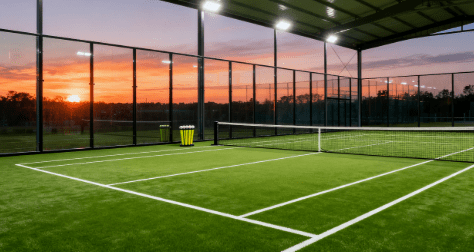
The court should be convenient for students while remaining compatible with classrooms, residences, neighbours, and existing sports activities.
Connect It to the Sports Department
Where possible, locate the court near:
- Sports halls
- Changing rooms
- Equipment stores
- Staff offices
- First-aid facilities
- Existing outdoor courts
This can simplify supervision and reduce the need to duplicate support facilities.
Protect Teaching Areas
Ball impacts, player communication, gates, and spectators can produce noticeable sound.
Avoid placing the court directly beside libraries, examination rooms, music rooms, laboratories, or classrooms requiring quiet conditions.
Consider Student Movement
The route between school buildings and the court should be clear and safe.
Students should not need to cross delivery yards, busy roads, parking entrances, or construction areas to attend a lesson.
Plan Safe Student Access and Supervision
Control Entry
Schools should be able to prevent unsupervised access outside approved periods.
Depending on the operating model, access may be managed through:
- Locked gates
- Staff keys
- Student cards
- Timed access codes
- Booking-system permissions
- Reception control
Emergency exit arrangements must remain compatible with local safety requirements.
Maintain Clear Sightlines
Teachers and coaches should be able to observe the playing area, entrances, and nearby waiting zones.
Avoid placing storage cabinets, solid advertising boards, or landscaping where they obstruct supervision.
Separate Waiting Students
A class may contain more students than can play at one time.
Provide a safe waiting or instruction area where students can watch, complete warm-ups, or practise basic skills without blocking court gates.
Avoid Gate Congestion
Sports bags, benches, ball baskets, and waiting students should remain clear of the entrance.
Court changeovers become safer and faster when each activity has a designated position.
Organize Padel Lessons for Different Group Sizes
One doubles court accommodates four active players, so teachers need a lesson structure for larger classes.
Rotation-Based Lessons
Students can rotate between:
- Court play
- Racket-control drills
- Footwork activities
- Rules instruction
- Fitness stations
- Match observation
- Scoring practice
Short rotations keep more students involved and reduce standing time.
Skill-Based Groups
Teachers can group students according to experience rather than age alone.
Beginners may work on serving and ball control, while more experienced players practise positioning, volleys, wall rebounds, and match tactics.
Use Modified Rules
For introductory lessons, teachers may use:
- Slower balls
- Shorter rallies
- Simplified scoring
- Controlled serves
- Smaller target zones
- Coach-fed balls
These modifications can make learning more manageable without changing the permanent court.
Prepare Equipment and Storage
Schools need enough equipment to support complete classes rather than four individual players.
Basic Equipment List
Consider providing:
- Student rackets
- Balls
- Ball baskets
- Training cones
- Court markers
- First-aid supplies
- Cleaning tools
- Spare nets
- Replacement grips
Rackets should be available in sizes and weights suitable for the intended student groups.
Secure Storage
Equipment storage should be close enough for staff to access but protected from unauthorized use.
Separate Sports and Maintenance Equipment
Rackets and balls should not be stored with chemicals, electrical equipment, sharp tools, or turf-maintenance machines.
A divided storage system can reduce damage and make inventory checks easier.
Review the Playing Surface and Materials
A school court may receive frequent use from students with different skill levels.
Buyers should review the durability, maintenance needs, and replaceability of each component.
Artificial Turf
Ask the supplier for:
- Fibre type
- Pile height
- Backing system
- Drainage data
- Infill requirements
- Cleaning instructions
- Seam details
- Replacement procedure
Steel and Glass
The court should include clearly specified steel profiles, corrosion protection, tempered glass, fencing, fasteners, and gate hardware.
The Padel Court materials guide discusses material selection for schools, clubs, hotels, contractors, and other commercial buyers.
Plan Lighting and Operating Hours
Lighting may be required for evening training, university clubs, staff sessions, or community bookings.
Match Lighting to Actual Use
A school using the court only during daytime may have different requirements from a university operating until late evening.
The design should consider:
- Playing level
- Uniformity
- Glare
- Energy consumption
- Independent controls
- Light spill
- Maintenance access
Use Separate Court Controls
Where several courts are installed, each one should ideally have independent lighting control.
This avoids operating every fixture when only one court is in use.
Open the Padel Court to the Community
A school court may remain unused during evenings, weekends, or holidays.
Community bookings can increase utilization and create additional value, but they require a clear operating plan.
Possible Community Programmes
The institution may offer:
- Evening club bookings
- Beginner coaching
- Family sessions
- Staff leagues
- Junior holiday camps
- Local competitions
- Corporate activities
UNESCO’s Fit for Life initiative promotes sport and physical education within schools, universities, and communities as tools for skills, resilience, inclusion, and participation.
Separate Public and Student Access
External users should not need unrestricted access to classrooms, dormitories, offices, or student-only areas.
A community-use plan may require:
- Separate entrance
- External toilets
- Controlled parking
- Digital booking
- Security staff
- Clear closing procedures
Calculate Whole-Life Project Value
Educational procurement should consider more than the initial court price.
Cost Categories
A complete project may include:
- Site survey
- Permits
- Foundation
- Drainage
- Court equipment
- Lighting
- Electrical work
- Shipping
- Installation
- Storage
- Equipment
- Staff training
- Maintenance
- Future turf replacement
Value Categories
The facility may create value through:
- More varied physical education
- Student clubs
- Increased campus activity
- Staff wellness
- Community partnerships
- External bookings
- Holiday programmes
- School marketing
Do Not Rely on Unverified Revenue Claims
Community income depends on local demand, pricing, opening hours, staffing, competition, and booking management.
Schools should create projections using realistic campus and local-market information.
School Padel Court Procurement Checklist
Before placing an order, confirm:
- Intended student age groups
- Expected weekly usage
- Court type
- Site dimensions
- Foundation responsibility
- Drainage design
- Lighting requirements
- Gate and access system
- Equipment storage
- Student waiting area
- Teacher supervision points
- Maintenance schedule
- Spare-parts availability
- Installation plan
- Warranty coverage
- Community-use policy
Request approved drawings and technical specifications before production begins.
Conclusion
A Padel Court can help schools and universities expand physical education, recreational sport, student clubs, community programmes, and campus activity.
The strongest projects begin by defining who will use the court, how lessons will operate, where students will wait, how access will be controlled, and which support facilities already exist.
Court type, materials, lighting, drainage, storage, supervision, community use, and maintenance should be planned as one complete educational facility.
SRSC supplies classic, panoramic, super panoramic, indoor, outdoor, single, and roofed court systems. Educational buyers can explore the full Padel Court range, review sports venue applications, or contact SRSC with the campus plan, student age groups, court quantity, and operating requirements.
FAQ
Is padel suitable for school students?
Padel can be adapted for different ages and skill levels through suitable equipment, coaching, lesson rotations, and modified activities.
How can a teacher manage a large class on one court?
Use short rotations between play, drills, fitness, rules, observation, and scoring activities.
Should a school choose an indoor or outdoor court?
The decision depends on climate, available buildings, operating schedule, budget, noise, lighting, and year-round demand.
Can the public use a school Padel Court?
Yes, provided the institution creates suitable access, booking, security, supervision, insurance, and safeguarding procedures.
Is a classic or panoramic court better for a school?
A classic court may suit regular teaching and controlled budgets. A panoramic design may be preferred when visibility, events, and campus presentation are important.
What should be stored near the court?
Rackets, balls, cones, training aids, cleaning tools, first-aid items, and selected spare parts should have designated storage.
When should the supplier join the planning process?
The supplier should review the site layout, access, court quantity, climate, intended use, and technical requirements before final drawings are approved.