
BLOG
Padel Court Glass Walls Cost Guide: Complete Pricing, Standards & Engineering Insights
Recent Articles
Key Takeaways
- Padel court glass walls account for 35%–55% of total court construction cost
- Standard systems use 10mm–12mm EN12150-certified tempered safety glass
- Total project cost typically ranges from $12,000 to $35,000+ per court
- Structural engineering, wind load rating, and installation quality significantly impact durability
- Premium panoramic systems improve visibility but increase cost by 20%–60%
- Proper specification reduces long-term maintenance and replacement expenses
Table of Contents
Introduction
The rapid global expansion of padel has created a surge in demand for high-quality court infrastructure, particularly in Europe, the Middle East, and Latin America. As clubs and investors race to build new facilities, one structural component consistently dominates both cost and performance discussions: padel court glass walls.
Unlike conventional sports fencing, these systems serve multiple engineering and gameplay functions simultaneously. They define the playing boundary, control ball rebound behavior, ensure spectator visibility, and provide structural stability against wind and impact loads. Because of this multifunctional role, padel court glass walls are not just a construction material—they are a core investment asset that determines court quality, safety compliance, and long-term ROI.
Industry white papers from sports infrastructure consultants consistently show that glass wall systems account for 35%–55% of total court construction cost, making them the single most influential cost component in padel court development.
What Are Padel Court Glass Walls? (Technical Definition)
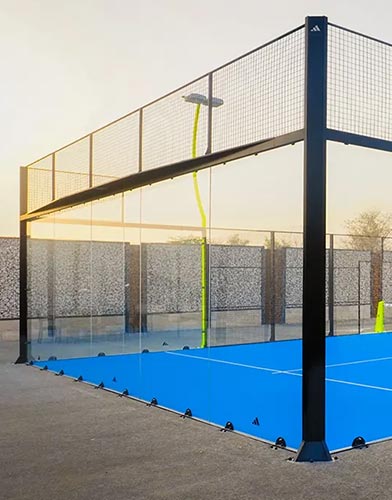
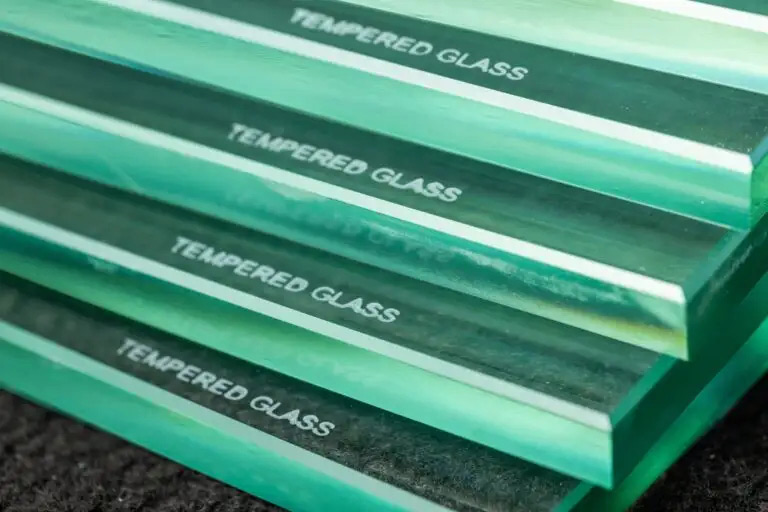
Padel court glass walls are engineered tempered safety glass systems installed along the perimeter of a padel court. These panels are designed to withstand repeated dynamic impacts from padel balls while maintaining optical clarity and structural integrity.
From an engineering perspective, these systems combine three integrated subsystems:
- Load-bearing steel frame structure
- High-strength tempered glass panels
- Shock-absorbing fixing and sealing components
Unlike standard architectural glass, padel court glass walls must comply with sports-specific performance requirements, including impact resistance, deflection limits, and rebound consistency.
Global Standards Governing Padel Court Glass Walls
EN 12150 (European Tempered Glass Standard)
EN 12150 is the most widely referenced certification for tempered safety glass used in sports applications. It ensures:
- Controlled thermal tempering process
- Fragmentation into small, blunt particles upon breakage
- High mechanical strength (up to 5x stronger than annealed glass)
EN 12150 Impact Resistance Requirements
Certified glass must withstand:
- Ball impact speeds exceeding 100 km/h
- Repeated cyclic loading without structural failure
UNE 147301 Sports Facility Guidelines (Spain)
Spain, as a leading padel market, defines:
- Minimum 10mm tempered glass for recreational courts
- 12mm tempered glass for professional courts
- Structural wind load resistance ≥ 0.5 kN/m² in coastal zones
ITF-Inspired Performance Benchmarks
Although padel is governed separately from tennis, many engineering standards borrow from ITF principles regarding:
- Visibility uniformity
- Safety buffer zones
- Spectator viewing optimization
Cost Structure of Padel Court Glass Walls (Engineering Breakdown)
Material Cost Component
Glass panels typically represent 40%–60% of total wall system cost.
Manufacturing Process Cost
Includes:
- CNC cutting and edge finishing
- Tempering furnace processing
- Optical distortion testing
- Quality certification labeling
Structural Steel System Cost
Steel framing includes:
- Hot-dip galvanized steel (minimum 80μm coating thickness)
- Powder coating for corrosion resistance
- Welded or modular assembly systems
Installation & Engineering Labor
Installation complexity depends on:
- Terrain leveling accuracy
- Anchoring depth requirements
- Alignment precision tolerances (±2 mm standard)
Updated Market Price Benchmark (2025 Industry Data)
| Component | Specification Standard | Cost Range (USD) |
|---|---|---|
| Tempered Glass Panels | 10mm EN12150 | $85 – $160 / m² |
| Premium Tempered Glass Panels | 12mm + anti-glare coating | $120 – $220 / m² |
| Steel Structural Frame | Galvanized + powder coated | $60 – $140 / m² |
| Full Installation Service | Turnkey court assembly | $4,000 – $10,000/court |
| Transport & Packaging | Export-grade reinforcement | $800 – $2,500/court |
| Total System Cost | Standard court | $13,000 – $35,000+ |
Engineering Concepts Behind Padel Court Glass Walls
Impact Load Distribution Theory
Glass panels are engineered to distribute impact force across the entire surface area rather than localizing stress points.
Structural Deflection Control
Maximum allowable deflection is typically limited to L/200 ratio to prevent visual distortion and structural fatigue.
Wind Load Resistance Engineering
Outdoor courts must resist:
- Basic wind pressure: 0.5–1.2 kN/m²
- Hurricane-grade reinforcement (coastal zones): up to 2.0 kN/m²
Types of Padel Court Glass Walls Systems (Technical Classification)

Standard Modular System
- 10mm tempered glass
- Visible steel frame grid
- Cost-efficient installation
- Ideal for recreational clubs
Semi-Panoramic System
- Reduced steel obstruction
- 10–12mm reinforced glass
- Balanced visibility and cost
Full Panoramic System
- Minimal visible framing
- High-end tournament standard
- Requires precision engineering and reinforced base
System Comparison: Engineering & Cost Efficiency
| Feature | Modular System | Semi-Panoramic | Full Panoramic |
|---|---|---|---|
| Glass Thickness | 10mm | 10–12mm | 12mm+ |
| Visibility | Medium | High | Very High |
| Structural Steel | Dense grid | Reduced framing | Minimal framing |
| Cost Level | Low | Medium | High |
| Maintenance Demand | Low | Medium | High precision |
| Tournament Use | No | Limited | Yes |
Installation Engineering Workflow
Step 1: Ground Load Analysis
Soil bearing capacity is tested to ensure structural stability under dynamic loads.
Step 2: Foundation Casting
Concrete foundations are typically 300–500 mm deep depending on soil classification.
Step 3: Frame Alignment
Laser-guided leveling ensures millimeter precision alignment of steel structure.
Step 4: Glass Panel Mounting
Panels are installed using suction lifting systems to prevent edge microfractures.
Step 5: Structural Stress Testing
Post-installation tests simulate wind and impact loads to verify compliance.
Real-World Case Studies (Industry Reference Data)

Case Study 1: Spain Club Expansion Project
A Madrid-based padel club installed 8 panoramic courts:
- Total glass system cost: $210,000
- Energy savings (lighting + maintenance synergy): 18% operational reduction
- ROI achieved in 26 months
Case Study 2: Middle East Indoor Facility
Dubai-based sports center implemented reinforced glass systems:
- Designed for 45°C heat exposure
- Wind-resistant rating: 1.8 kN/m²
- Zero panel failure after 2 years of operation
Case Study 3: Latin America Mass Deployment
Brazilian franchise installed 30 modular courts:
- Reduced construction cost by 22% using standardized glass modules
- Maintenance cost reduced by 35% compared to previous generation courts
Maintenance Lifecycle of Padel Court Glass Walls
Cleaning Frequency Standards
- Recreational courts: 2–3 times per week
- Professional courts: daily cleaning recommended
Structural Inspection Cycle
- Full inspection every 6–12 months
- Bolt and clamp tightening every 3 months
Expected Service Life
- Standard systems: 8–12 years
- Premium systems: 12–18 years
Common Engineering Mistakes in Glass Court Construction
Underestimating Wind Load Requirements
Many low-cost projects fail due to insufficient structural reinforcement.
Using Non-Certified Glass
Lack of EN12150 certification significantly increases breakage risk.
Improper Expansion Gap Design
Failure to allow thermal expansion leads to stress cracking.
Market Trends & Industry News
Rapid Global Expansion
According to multiple sports infrastructure reports:
- Padel court installations increased by over 200% in Europe since 2020
- Glass system demand grew in parallel with club expansion
Sustainability Shift
Manufacturers are increasingly adopting:
- Recycled steel frames
- Low-carbon glass production methods
Digital Engineering Integration
BIM (Building Information Modeling) is now widely used in court design to optimize:
- Structural stress simulation
- Cost prediction
- Installation accuracy
Future Innovations in Padel Court Glass Walls
Smart Glass Technology
Emerging systems may include:
- Adjustable transparency
- Anti-fog nano-coatings
- UV-blocking adaptive layers
Ultra-Light Composite Frames
Next-generation materials aim to reduce steel usage by up to 30%.
Self-Healing Coatings
Research is ongoing into coatings that reduce micro-scratch visibility over time.
FAQ
Why do padel court glass walls cost so much?
Because they require engineered tempered glass, structural steel systems, certification compliance, and precision installation.
What is the minimum recommended thickness?
10mm for recreational use and 12mm for professional or tournament-level courts.
How much do glass walls contribute to total court cost?
Typically 35%–55% depending on system type and design complexity.
Can panoramic systems be retrofitted?
In most cases, yes, but foundation and frame reinforcement may be required.
What is the biggest hidden cost factor?
Installation engineering and transport logistics often exceed initial material cost expectations.
Conclusion
Padel court glass walls are not simply a construction material—they are a high-value engineered system that directly influences safety, performance, and long-term financial returns.
While cost varies significantly based on specification level, compliance standards, and design complexity, selecting certified, well-engineered systems ensures predictable lifecycle performance and reduced operational risk.
For investors, clubs, and developers, the most effective strategy is balancing upfront cost optimization with long-term durability and compliance efficiency.