
BLOG
Panoramic Padel Court vs Standard Court: Which Is Better?
Recent Articles
Choosing between a Panoramic Padel Court and a standard padel court is not only about appearance. The court structure can affect visibility, installation cost, wind resistance, maintenance, spectator experience, and the commercial value of a sports facility.
Key points covered in this guide:
- The structural differences between panoramic and standard courts
- The advantages and limitations of each design
- Important glass, steel, turf, lighting, and foundation concepts
- Suitable court options for clubs, resorts, schools, and tournaments
- Questions buyers should ask before placing an order
Understanding the Two Court Designs
Both court types provide the enclosed playing environment required for padel. Their main differences are found in structural framing, viewing experience, engineering requirements, and commercial positioning.
What Is a Panoramic Padel Court?
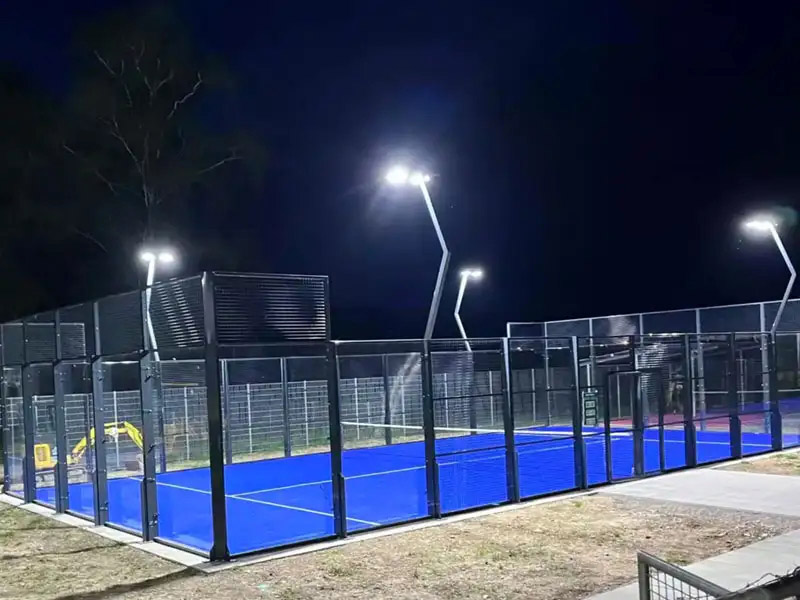
A Panoramic Padel Court uses large tempered-glass panels with fewer visible steel posts around the main viewing areas. This creates clearer sightlines for players, spectators, coaches, photographers, and cameras.
The design is commonly selected for professional clubs, hotels, resorts, tournament venues, and premium sports developments. It can function as both a playing facility and a visual centerpiece.
Panoramic glass layout
The panoramic layout reduces structural obstructions without removing the support needed for the glass walls. Because the glass forms part of the playing area, it must provide reliable rebound, impact resistance, and structural stability.
Best applications
A Panoramic Padel Court is particularly suitable for:
- Professional padel clubs
- Tournament show courts
- Hotels and luxury resorts
- Residential developments
- Match recording and live streaming
- Sponsored or corporate sports events
What Is a Standard Padel Court?
A standard court normally uses more steel posts around the glass and mesh sections. Its frame is more visible, but the additional support points can provide a practical and economical solution.
Standard courts are widely used by schools, training centers, community facilities, and clubs that prioritize playing capacity over premium presentation.
A practical commercial option
A standard court may cost less to manufacture and install. The remaining project budget can then be used for drainage, lighting, roofing, spectator seating, or additional courts.
Buyers can review SRSC’s complete padel court solutions before choosing between panoramic, super panoramic, indoor, outdoor, and roofed models.
Panoramic Padel Court vs Standard Court
The best choice depends on how the facility will operate. A tournament venue will have different priorities from a school or community training center.
Quick comparison
| Comparison factor | Panoramic Padel Court | Standard padel court |
|---|---|---|
| Visibility | Wide view with fewer obstructions | Posts may block some viewing angles |
| Appearance | Modern and premium | Traditional and practical |
| Initial cost | Usually higher | Usually more economical |
| Installation | Requires accurate alignment | Often more straightforward |
| Video production | Cleaner camera views | Posts may appear in recordings |
| Best application | Clubs, resorts, show courts | Schools and training facilities |
| Commercial position | Premium customer experience | Cost-effective playing capacity |
Which court should you choose?
Choose a Panoramic Padel Court when spectator visibility, professional presentation, events, video production, and branding are important.
Choose a standard court when budget control, straightforward installation, and reliable playing capacity are the main priorities.
A mixed configuration
A multi-court club does not have to use the same structure for every court. One practical solution is to install one panoramic show court for tournaments and promotional activities, together with standard courts for training and general bookings.
Why Choose a Panoramic Padel Court?
The value of panoramic construction comes from visibility, appearance, media potential, and commercial positioning.
Better spectator visibility
Large glass viewing areas allow spectators to follow matches without multiple steel posts interrupting the view. This can improve the atmosphere during tournaments, exhibitions, and club events.
Facilities requiring an even wider viewing field can also consider a Super Panoramic Padel Court.
Improved video and photography
Clubs increasingly use match recordings, coaching videos, live streaming, and social media content to attract customers. Panoramic construction creates cleaner camera angles and a more professional background.
Better visual content can support membership promotion, sponsored events, coaching services, and tournament marketing.
Stronger commercial image
A modern court can influence how customers evaluate the entire facility. Players may associate a panoramic design with professional management, quality equipment, and a premium sports experience.
However, appearance should never replace engineering quality. Glass, steel, fasteners, foundations, and structural calculations must work as one complete system.
Important Technical Factors
Buyers should compare technical specifications rather than making a decision based only on product photos or price.
Tempered glass
Tempered glass provides the transparent enclosure used during play. It affects safety, visibility, ball rebound, maintenance, and replacement costs.
Glass thickness alone does not determine quality. Panel dimensions, edge processing, drilled holes, fasteners, support points, and installation procedures are also important.
Buyers can review this padel court glass wall cost guide for additional purchasing considerations.
Is thicker glass always better?
Not necessarily. A thicker panel cannot compensate for damaged edges, unsuitable hardware, poor alignment, or an incorrectly designed frame.
The glass specification should match the complete court design and actual project conditions.
Wind load and steel structure
Wind load is the pressure applied to the glass, mesh, steel frame, and connections. It varies according to location, terrain, nearby buildings, court orientation, and local weather.
For an outdoor padel court, the structure should be evaluated for local wind and corrosion conditions before production.
What information should buyers provide?
Provide the supplier with:
- Project country and city
- Indoor or outdoor application
- Distance from the coast
- Court quantity and layout
- Surrounding buildings or open terrain
- Expected installation schedule
This information helps the supplier recommend a more appropriate frame, coating, foundation, and court configuration.
Artificial turf
Artificial turf affects ball speed, bounce, drainage, traction, and player comfort. Turf systems can vary in fiber structure, pile height, density, backing, sand requirements, and intended playing level.
Commercial operators should select turf according to usage frequency, climate, player level, and available maintenance resources.
Padel court lighting
Lighting should provide uniform visibility without creating excessive glare for players, spectators, or cameras. Fixture wattage alone does not determine lighting quality.
Mounting height, beam angle, fixture position, color temperature, and lighting uniformity should also be considered. More information is available in this guide to LED padel court lighting systems.
Foundation accuracy
An uneven or incorrectly sized foundation can make installation difficult even when the court is manufactured correctly. Dimensions, surface level, drainage direction, anchor positions, and electrical conduits should be confirmed before concrete work begins.
The manufacturer’s foundation drawings should be reviewed by the civil contractor before construction.
Which Court Fits Your Project?
Different projects have different operational and commercial requirements.
Professional clubs and tournaments
A Panoramic Padel Court is a strong option for a main competition or show court. It supports spectator viewing, match recording, sponsorship exposure, and premium positioning.
Tournament buyers should also review the official Rules of Padel, which cover court dimensions, enclosures, surfaces, access, and lighting.
Hotels and resorts
Hotels often use sports facilities to improve the guest experience. A panoramic court can complement modern architecture and create attractive images for websites and promotional materials.
Operators should also consider noise, lighting direction, landscaping, drainage, and proximity to guest rooms.
Schools and training centers
Standard courts may be more suitable when coaching capacity, durability, and budget control are the main priorities. Available funds can then be used for additional courts or covered training areas.
Indoor facilities
An indoor padel court can provide consistent playing conditions in regions with frequent rain, extreme temperatures, or strong winds.
The building must still provide adequate clear height, ventilation, lighting, access, and safety compliance.
Cost and Supplier Selection
Court cost depends on the frame, glass, turf, lighting, surface treatment, customization, packaging, and shipping. Buyers must also budget for foundations, drainage, electrical work, unloading, and local installation.
What should a complete quotation include?
A professional quotation should identify:
- Court dimensions and structural configuration
- Steel and glass specifications
- Artificial turf and lighting
- Surface treatment and fasteners
- Doors, nets, and accessories
- Packaging and shipping details
- Installation support
- Warranty and spare parts
Avoid incomplete price comparisons
A low quotation may exclude important components or use different specifications. Buyers should compare the complete package rather than the final price alone.
Before construction, review the padel court installation process and coordinate the foundation, drainage, electrical work, unloading, and lifting equipment.
Frequently Asked Questions
Is a Panoramic Padel Court worth the extra cost?
It may be worthwhile for clubs, resorts, and tournament venues that value unobstructed viewing, professional video, branding, and premium presentation.
Can a panoramic court be installed outdoors?
Yes, but its structure, glass supports, anchors, coating, and foundation must be suitable for local wind, weather, drainage, and corrosion conditions.
Which court is best for a new padel club?
A practical option is to install one panoramic show court with several standard courts for daily bookings. This balances presentation, playing capacity, and investment.
Does a panoramic court need more maintenance?
Not necessarily. Both designs require inspections of glass, fasteners, steel coatings, mesh, turf, drainage, lighting, doors, and nets.
This padel court maintenance guide explains the main components that owners should inspect regularly.
Can the court color and logo be customized?
Many court systems support custom frame colors, turf colors, entrance signs, glass logos, and sponsor panels. Custom details should be confirmed on drawings before production.
Final Decision
A Panoramic Padel Court is generally suitable for premium clubs, resorts, tournaments, and facilities that depend on visual presentation. A standard court remains a practical option for schools, training centers, and projects that require cost-effective playing capacity.
The final choice should consider structural design, glass quality, steel treatment, turf, lighting, foundations, installation support, local conditions, and long-term maintenance.
Contact our padel court specialists with your project location, required court quantity, indoor or outdoor application, and installation schedule to receive a suitable configuration and quotation.