
BLOG
Solar-Powered Outdoor Gym: A Planning Guide for Public Fitness Projects
Recent Articles
Table of Contents
A Solar-Powered Outdoor Gym combines outdoor exercise equipment with photovoltaic panels, energy storage, LED lighting, digital displays, fitness testing, and smart data functions.
Compared with conventional outdoor fitness equipment, a solar-powered system can operate digital features without relying entirely on a nearby building. This makes it attractive for parks, residential communities, schools, public-health projects, resorts, and municipal smart-city developments.
However, buyers still need to consider sunlight, battery capacity, electrical loads, drainage, foundations, connectivity, maintenance, and local climate before selecting a system.
Key Takeaways
- Solar panels can support lighting, screens, sensors, and data systems.
- Solar power does not remove the need for battery and electrical planning.
- The complete energy load should be calculated before equipment production.
- Shade structures can improve user comfort but also increase structural loads.
- Batteries, controllers, wiring, displays, and sensors require maintenance.
- A Solar-Powered Outdoor Gym should include balanced exercise functions.
- Foundations and underground conduits should be planned before paving.
- Buyers should request a complete electrical and structural specification.
What Is a Solar-Powered Outdoor Gym?
A Solar-Powered Outdoor Gym is an outdoor fitness facility that uses photovoltaic panels to generate electricity for integrated smart features.
Solar electricity may support:
- LED lighting
- Workout displays
- Fitness-testing systems
- Voice guidance
- Wireless data transmission
- Charging functions
- Sensors
- Control systems
A photovoltaic system converts sunlight into electricity through solar panels and supporting electrical components.
More Than Outdoor Exercise Equipment
The project should be evaluated as a combination of:
fitness equipment + solar power + energy storage + smart technology + outdoor structure
This makes planning more complex than installing traditional mechanical fitness machines.
How Does the Solar Power System Work?
A basic outdoor solar system normally includes:
- Solar panels
- A charge controller
- A battery
- Electrical wiring
- Connected lights, screens, or sensors
Solar Panels
Panels collect solar energy during daylight hours.
Battery Storage
The electricity is stored so that the gym can continue powering displays or lights when sunlight is limited.
General information about rechargeable storage systems is available in Wikipedia’s overview of the lithium-ion battery.
Charge Controller
The controller manages electricity moving between the solar panels, battery, and equipment.
Complete Energy Balance
The system should generate and store enough electricity for the expected daily consumption.
More panels do not automatically solve poor battery sizing or excessive energy demand.
SRSC Outdoor Intelligent Gym Configuration
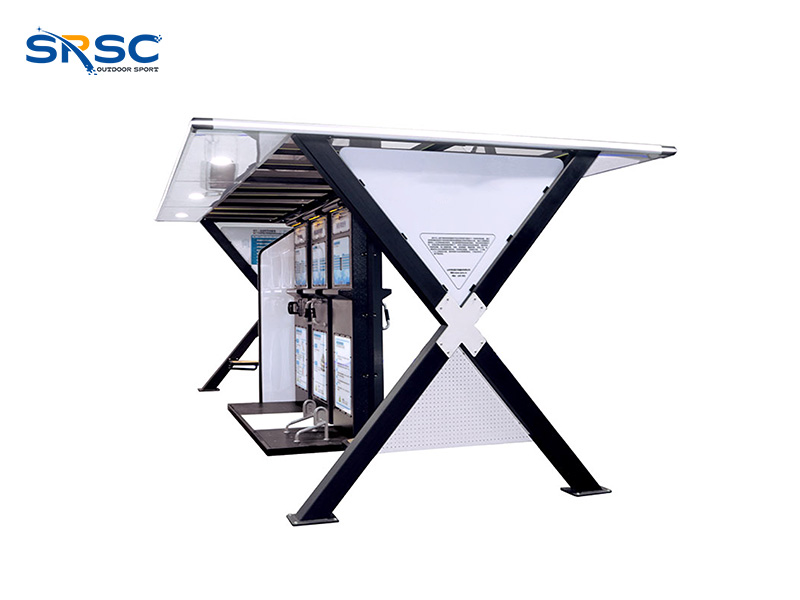
The Outdoor Intelligent Gym combines fitness-testing stations, exercise functions, solar panels, battery storage, displays, voice guidance, wireless data transmission, lighting, and a sunshade structure.
The current product specification includes two 120 W polycrystalline solar panels, DC 12 V operation and six 20 W LED lights.
Fitness-Testing Functions
Depending on the selected configuration, the system can support functions such as:
- Grip-strength testing
- Height measurement
- Body measurements
- Balance tests
- Reaction tests
- Sit-ups
- Push-ups
- Exercise-time recording
Maximum User Capacity
The integrated system provides multiple stations, allowing several people to use different exercise functions within one structure.
Solar-Powered vs Conventional Outdoor Gym
| Factor | Solar-Powered Outdoor Gym | Conventional Outdoor Gym |
|---|---|---|
| Power generation | Solar panels | Usually none |
| Digital displays | Available | Usually unavailable |
| Night lighting | Can be integrated | Separate system required |
| Workout data | Available by configuration | Limited |
| Electrical maintenance | Required | Minimal |
| Initial complexity | Higher | Lower |
| User interaction | High | Simple |
| Best application | Smart parks and flagship projects | General public fitness |
When Is Solar Power More Suitable?
Solar-powered systems are particularly useful when:
- The project requires smart displays.
- Nighttime lighting is needed.
- The site has good sunlight exposure.
- Running mains electricity is difficult.
- The municipality wants measurable equipment use.
- The project needs a recognizable smart-sports landmark.
When Is Traditional Equipment Better?
Traditional machines may be more practical when:
- Digital data is not required.
- Maintenance resources are limited.
- The site receives little direct sunlight.
- The main priority is low-cost public exercise.
- The equipment is installed in a remote location.
Does a Solar Outdoor Gym Work on Cloudy Days?
Solar panels can still produce electricity under some cloudy conditions, but output is normally lower than under strong sunlight.
The battery should therefore be sized according to:
- Local solar conditions
- Daily electricity use
- Nighttime lighting hours
- Screen operating time
- Seasonal weather
- Required backup duration
Do Not Use One Specification Everywhere
A solar configuration designed for a sunny region may not provide the same performance in a cloudy northern climate.
The buyer should provide the exact installation city so that local solar conditions can be considered.
What Equipment Should the Gym Include?
Smart technology should not replace balanced exercise planning.
A complete Solar-Powered Outdoor Gym can combine aerobic, pushing, pulling, lower-body, and testing functions.
Aerobic Equipment
The Intelligent Two-Position Air Walker provides a simple walking-style movement for two users.
Pulling Equipment
The Intelligent Double-Position Rower adds a seated pulling movement.
Pushing Equipment
The Intelligent Dual Position Chest Press supports upper-body pushing exercise.
Lower-Body Equipment
The Seated Leg Curl Trainer provides seated leg movement with adjustable resistance and digital exercise feedback.
Balanced Equipment Mix
A good project should not use several machines that all provide nearly identical movements.
Each station should have a defined role.
Why a Sunshade Structure Is Useful
A roof or sunshade can improve comfort during hot and sunny conditions.
It may also support:
- Solar panels
- LED lights
- Display systems
- Signs
- Rest areas
Structural Requirements
The sunshade is still an outdoor structure.
It may need to resist:
- Wind
- Rain
- Snow
- Panel weight
- Lighting loads
- Local environmental conditions
The SRSC Outdoor Intelligent Gym uses a roof supported by two X-shaped main columns and incorporates tempered-glass panels and integrated lighting.
Local Engineering
A generic foundation should not automatically be used for every project.
Wind, soil, frost, and seismic requirements vary by location.
Power and Electrical Planning
Before construction, buyers should confirm:
- Operating voltage
- Solar-panel output
- Battery type
- Battery capacity
- Controller specification
- LED power
- Display consumption
- Sensor consumption
- Cable routes
- Grounding
- Isolation switches
- Replacement-part availability
Underground Conduits
Even when solar panels provide the electricity, cables still need to connect the panels, controller, battery, lighting, screens, and exercise stations.
Conduit routes should be planned before foundations and paving are completed.
Smart Data and Connectivity
Smart outdoor equipment can display or transmit workout information.
This concept relates to the Internet of Things, in which physical devices use sensors and communication systems to exchange data.
Possible Smart Functions
- Exercise duration
- Repetition counting
- Fitness-test results
- Equipment rankings
- Instructional videos
- Smart-terminal access
- Remote usage statistics
Does the Gym Need Internet Access?
Not every function requires permanent internet access.
Basic displays may work locally, while centralized data storage or mobile applications may require wireless connectivity.
Data Privacy
When users create accounts or save personal fitness data, the operator should confirm what information is collected, where it is stored, and who can access it.
Site Selection
A Solar-Powered Outdoor Gym should be installed where sunlight, access, drainage, and circulation are suitable.
Avoid Heavy Shade
Trees and surrounding buildings may reduce solar exposure.
Check Future Development
A sunny site can become shaded if another building is constructed nearby.
Consider User Comfort
The area should also include:
- Clear pathways
- Rest seating
- Drinking water
- Lighting
- Signage
- Accessible entrances
- Good drainage
Foundations and Drainage
The structure and exercise equipment require stable foundations.
Embedded Installation
The SRSC system uses an embedded mounting method, so foundation positions need to be coordinated with the exact product drawings.
Drainage
Water should not collect around:
- Main columns
- Batteries
- Electrical cabinets
- Exercise stations
- Seats
- Pathways
Good drainage reduces moisture exposure and improves access after rainfall.
Maintenance Requirements
A solar-powered smart gym requires both mechanical and electrical maintenance.
| Component | Inspection Focus |
| Solar panels | Dirt, cracks and shading |
| Battery | Charge condition and enclosure |
| Controller | Electrical operation |
| LED lights | Damage and illumination |
| Displays | Screen and data function |
| Wiring | Loose or exposed cables |
| Exercise equipment | Bearings and moving parts |
| Steel structure | Coating and corrosion |
| Foundations | Cracks or movement |
| Drainage | Blockage and standing water |
Solar-Panel Cleaning
Dust, leaves, bird droppings, and other contamination can reduce panel performance.
Cleaning frequency depends on the local environment.
Battery Replacement
Rechargeable batteries have a limited service life.
Buyers should confirm replacement specifications, access procedures, expected availability, and warranty terms.
Common Buying Mistakes
Comparing Only Solar-Panel Wattage
Battery capacity and daily energy use are equally important.
Ignoring Seasonal Sunlight
Winter and rainy-season output may differ from summer performance.
Installing the System Under Trees
Shade can reduce energy generation and increase cleaning requirements.
Forgetting Electrical Spare Parts
Controllers, displays, batteries, lights, and sensors may eventually need replacement.
Buying Technology Without a Purpose
Smart functions should support a real user or management requirement.
Ignoring Structural Loads
A solar-panel roof needs appropriate structural and foundation design.
Buyer Checklist
Before ordering, confirm:
- Exact installation location
- Target users
- Required exercise stations
- Solar-panel output
- Battery capacity
- Backup operating time
- Lighting requirements
- Display functions
- Data functions
- Connectivity
- Foundation drawings
- Wind and snow conditions
- Drainage
- Electrical protection
- Spare parts
- Software support
- Installation supervision
- Maintenance plan
- Warranty
FAQ About Solar-Powered Outdoor Gyms
What is a Solar-Powered Outdoor Gym?
It is an outdoor fitness facility using solar panels and battery storage to power lighting, displays, sensors, testing equipment, or other smart functions.
Can it operate at night?
Yes, when the battery stores enough energy to power the required lighting and smart systems.
Actual operating time depends on battery capacity and electricity consumption.
Does it work without an electrical grid?
Some systems can operate independently using solar panels and batteries.
The exact configuration should be confirmed with the supplier.
How many solar panels are required?
The number depends on panel output, local sunlight, daily energy use, battery capacity, and required backup time.
Does the equipment need internet access?
Basic functions may operate offline, while apps, remote data, rankings, or centralized management may require connectivity.
Is solar-powered outdoor equipment maintenance-free?
No.
Solar panels, batteries, controllers, displays, wiring, exercise components, coatings, and foundations all require inspection.
What documents should buyers request?
Request the product specification, electrical diagram, solar and battery details, structural drawing, foundation plan, installation guide, data-function description, maintenance instructions, spare-parts list, and warranty.
Conclusion
A Solar-Powered Outdoor Gym can combine public exercise, renewable energy, lighting, smart displays, fitness testing, and data functions within one integrated facility.
It is most suitable for projects that have clear objectives for user engagement, nighttime operation, smart-city development, or measurable public fitness activity.
For B2B buyers, the correct planning sequence is:
define the functions → calculate the power demand → review local sunlight → select the battery → design the structure → prepare foundations and drainage → plan maintenance
SRSC’s Outdoor Intelligent Gym can be combined with smart air walkers, rowers, chest presses, and leg-training equipment to create a balanced outdoor fitness facility.
The final system should be selected according to local climate, users, operating hours, technical support, and long-term maintenance capacity rather than solar-panel appearance alone.