
BLOG
Sustainable Padel Court Guide: Reduce Energy and Lifecycle Costs
Recent Articles
Table of Contents
Key points covered in this guide:
- How to evaluate a Padel Court through its complete service life
- Why durable materials can be more sustainable than low-cost alternatives
- How modular structures support repair, replacement, and future relocation
- How LED lighting controls can reduce unnecessary energy consumption
- How turf, drainage, cleaning, and water use affect daily operation
- What environmental information buyers should request from suppliers
- How packaging and shipping plans can reduce waste and damage
- How preventive maintenance can extend the useful life of court components
A sustainable Padel Court is not simply a court that uses one recycled material or installs several solar panels. Sustainability involves the complete project, including manufacturing, transportation, construction, energy use, maintenance, component replacement, and eventual disassembly.
For commercial clubs, these decisions also influence operating costs. Efficient lighting, replaceable parts, durable coatings, suitable drainage, and planned maintenance can reduce avoidable expenses throughout the court’s service life.
Buyers should therefore compare court systems by long-term performance rather than initial price alone.
What Makes a Padel Court Sustainable?
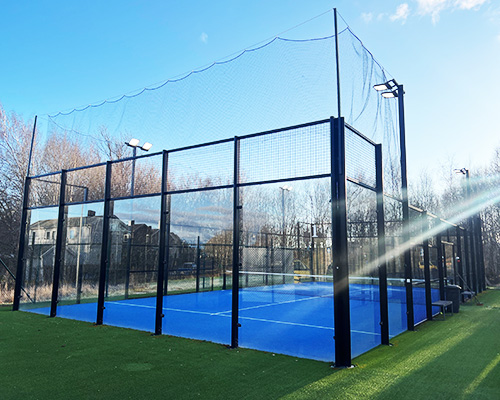
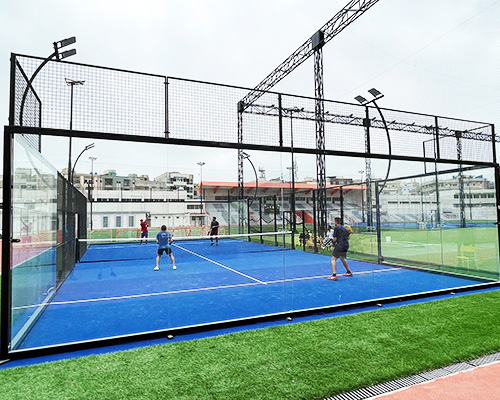
A sustainable court should use resources efficiently while maintaining player safety, structural reliability, and consistent playing conditions.
Long Service Life
Replacing a complete court frequently creates more material use, transportation, labour, and waste than maintaining a durable system.
Steel quality, corrosion protection, glass processing, turf construction, hardware, and installation accuracy can all affect service life.
Concept: Lifecycle Cost
Lifecycle cost includes the expenses incurred from purchase to final replacement.
It may include equipment, shipping, civil work, energy, cleaning, repairs, spare parts, labour, turf replacement, lighting replacement, and disposal.
A lower purchase price does not always produce a lower lifecycle cost.
Repairable Components
A court is easier to maintain when individual parts can be removed and replaced without dismantling the entire structure.
Buyers should ask whether the supplier can provide replacement:
- Glass panels
- Mesh sections
- LED drivers
- Lighting fixtures
- Door hardware
- Fasteners
- Nets and posts
- Turf rolls
- Protective gaskets
Modular replacement can reduce downtime and unnecessary material disposal.
Compare Materials by Durability and Maintenance
The environmental performance of a court depends partly on how long its main materials remain usable.
| Court Component | Sustainability Priority | Questions for the Supplier |
|---|---|---|
| Steel structure | Corrosion resistance and repairability | What steel grade and coating system are used? |
| Tempered glass | Safe processing and replaceable panels | Can individual panels be reordered? |
| Metal fencing | Durable welding and surface finish | Can damaged sections be replaced separately? |
| Artificial turf | Service life and maintenance needs | What cleaning and replacement schedule is expected? |
| LED lighting | Efficiency and replaceable drivers | Are fixtures and drivers separately serviceable? |
| Fasteners | Corrosion protection and availability | Are spare bolts and fittings included? |
| Packaging | Protection with limited unnecessary material | Can racks or crates be reused? |
| Foundation | Accurate design and long-term stability | Can the base support future court replacement? |
Steel Structure
Steel can provide a strong and durable frame when it is properly designed and protected.
For outdoor projects, request details about galvanizing, powder coating, surface preparation, coating thickness, repair procedures, and suitability for the local environment.
Coastal Conditions
Salt, humidity, and wind can accelerate corrosion. Coastal projects may require stronger protection for the main structure, bolts, hinges, clamps, and damaged coating areas.
Selecting the correct protection system at the beginning can reduce repeated repair and premature component replacement.
Tempered Glass
Glass panels should be accurately processed, packaged, installed, and isolated from direct metal contact.
A sustainable purchasing decision should consider whether replacement panels remain available. When one panel is damaged, the club should not need to replace an entire glass system.
Artificial Turf
Artificial turf affects playing speed, traction, drainage, maintenance, and replacement frequency.
Ask the supplier for:
- Fiber composition
- Pile height
- Backing system
- Drainage performance
- Infill requirements
- Cleaning instructions
- Expected maintenance
- Replacement method
The Padel Court materials guide provides additional information about turf, steel, glass, lighting, and base-system selection.
Reduce Padel Court Lighting Energy Use
Lighting is one of the most visible sources of electricity consumption in an indoor or evening-operated club.
Select Efficient LED Fixtures
Fixture selection should consider more than wattage. Buyers should review:
- Lighting efficiency
- Court illumination
- Uniformity
- Glare control
- Driver quality
- Heat management
- Fixture lifetime
- Replacement-part availability
- Outdoor protection rating
The U.S. Department of Energy provides procurement guidance for energy-efficient commercial and industrial LED luminaires through its Federal Energy Management Program.
Connect Lighting to the Booking System
Lights do not need to operate at full output when courts are empty.
A booking-based control system can:
- Activate lights before play
- Turn lights off after bookings
- Reduce output during cleaning
- Control each court separately
- Record operating hours
- Alert staff to unusual energy use
Concept: Zoning
Lighting zoning means controlling separate areas independently.
A club with six courts should not need to illuminate every court when only one is booked.
Use Appropriate Light Levels
More light is not always better. Excessive lighting can increase energy consumption, glare, light spill, and equipment costs.
The lighting design should match the required level of recreational, coaching, commercial, or tournament use.
Plan Water and Drainage Efficiently
A Padel Court does not normally require the intensive watering associated with natural grass, but water management remains important.
Design Effective Drainage
Standing water can lead to longer closures, contaminated infill, algae, turf problems, and corrosion near structural bases.
The drainage system should coordinate:
- Surface levels
- Turf permeability
- Base construction
- Perimeter channels
- Underground pipes
- Final discharge
- Surrounding landscaping
A well-designed system can reduce repeated pumping, emergency repairs, and premature surface replacement.
Control Cleaning Water
Glass and surrounding surfaces should be cleaned using an appropriate amount of water and compatible products.
Staff should avoid excessive washing that moves sand, cleaning chemicals, or debris into drains.
Targeted Cleaning
Clean areas according to actual condition rather than automatically washing the entire facility.
High-contact glass sections, entrance areas, shaded turf, and drainage channels may require more attention than clean and protected areas.
Use Modular Padel Court Construction
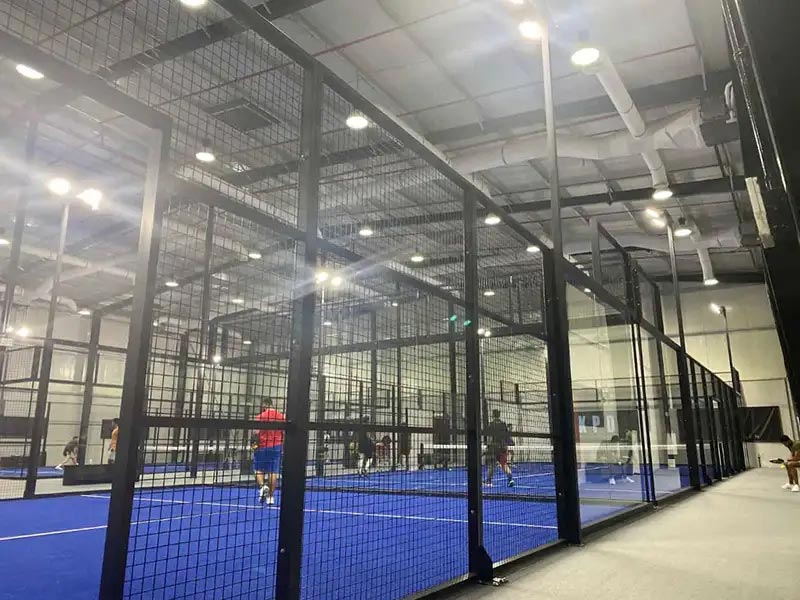
A modular court is assembled from manufactured sections using defined connections.
This approach can support faster installation, controlled production, and future component replacement.
Easier Repairs
When posts, mesh panels, glass, doors, and lighting components are clearly identified, individual parts can be reordered more accurately.
The supplier should provide:
- Component drawings
- Package numbers
- Parts list
- Installation manual
- Maintenance guide
- Spare-parts references
Possible Relocation
Some modular courts may be dismantled and reinstalled at another suitable location, subject to structural inspection and local engineering requirements.
This can be valuable for temporary venues, leased properties, events, or clubs that expect future expansion.
A relocated court will still require a suitable foundation, drainage, permits, electrical work, and professional reinstallation.
Reduce Construction and Packaging Waste
Construction projects generate waste through damaged materials, inaccurate ordering, temporary packaging, cut-offs, and demolition.
The European Commission identifies construction and demolition waste as a major material stream and promotes improved recovery, reuse, and environmentally responsible management through its construction and demolition waste guidance.
Request a Detailed Bill of Materials
Accurate component quantities can reduce over-ordering and missing-part shipments.
The bill of materials should identify:
- Steel members
- Glass panels
- Mesh panels
- Turf rolls
- Lighting fixtures
- Fasteners
- Gaskets
- Nets
- Accessories
Improve Packaging Planning
Packaging must protect components without creating avoidable waste.
Ask the supplier whether:
- Steel racks can be reused
- Glass frames can be returned or repurposed
- Packages use recyclable materials
- Plastic wrapping can be reduced
- Small parts are grouped efficiently
- Package labels support correct installation
Preventing Damage Is Sustainable
Reducing packaging is useful only when the products remain protected.
A broken glass panel or scratched structural bundle may require remanufacturing and additional transportation. Packaging should balance material reduction with effective protection.
Plan Preventive Padel Court Maintenance
Maintenance is an important part of sustainable operation because it helps components reach their intended service life.
Create an Inspection Schedule
The club should regularly inspect:
- Turf condition
- Sand distribution
- Glass edges
- Steel coating
- Bolts and connections
- Door operation
- Lighting fixtures
- Electrical controls
- Drainage channels
- Nets and posts
Repair Small Problems Early
A small coating chip can become a larger corrosion area. A loose mesh panel can damage its connections. A blocked drain can create repeated water accumulation.
Early repair usually requires fewer materials and less labour than delayed replacement.
The Padel Court maintenance guide provides a useful starting point for routine cleaning and inspection.
Record Maintenance History
Keep a record of inspections, cleaning, repairs, replacements, and energy consumption.
This information helps operators identify repeated problems and make better purchasing decisions when components eventually require replacement.
Ask Suppliers for Environmental Information
Sustainability claims should be supported by specific information.
Useful Documentation
Depending on the project and market, buyers may request:
- Material specifications
- Coating information
- Product test reports
- Packaging descriptions
- Maintenance instructions
- Expected replacement intervals
- Spare-parts availability
- Repair procedures
- Recycled-content information
- Environmental product documentation
Not every supplier will have every document. Buyers should focus on information that can genuinely support project decisions.
Avoid Vague Green Claims
Terms such as “eco-friendly,” “green,” and “sustainable” are difficult to evaluate without an explanation.
Ask what specific feature supports the claim. It may involve durability, recycled content, lower energy use, reduced packaging, repairability, or material recovery.
Concept: Verifiable Claim
A verifiable claim is supported by measurable specifications, documentation, testing, or a clearly defined method.
It is more useful than a general marketing statement without evidence.
Common Sustainable Padel Court Mistakes
Selecting Materials Only by Initial Price
Low-cost components may need more frequent repair or replacement.
Running All Lights Together
Independent court controls can prevent unnecessary energy use during quiet periods.
Ignoring Spare-Part Availability
A court is more difficult to maintain when simple fittings cannot be reordered.
Replacing Instead of Repairing
Some damaged components can be repaired or replaced separately when the system is designed for serviceability.
Using Sustainability Only for Marketing
Environmental claims should influence specifications, operations, maintenance, and supplier selection—not only promotional materials.
Conclusion
A sustainable Padel Court combines durable construction with efficient operation and planned maintenance.
Buyers should evaluate the complete lifecycle of the steel, glass, turf, lighting, packaging, foundations, and replaceable components. Energy controls, effective drainage, accurate material planning, and preventive inspections can reduce both environmental impact and long-term operating costs.
SRSC provides modular classic, panoramic, super panoramic, indoor, outdoor, single, and roofed court solutions. Buyers can review the complete Padel Court range, explore custom project services, or contact SRSC with the project location, court quantity, operating schedule, and sustainability requirements.
FAQ
What is the most sustainable Padel Court material?
There is no single material that determines the sustainability of the entire court. Durability, repairability, maintenance, transport, energy use, and end-of-life options should be considered together.
Can a Padel Court use solar power?
Solar power may support lighting, access control, or clubhouse electricity when site conditions and local regulations are suitable. The system should be designed by qualified electrical professionals.
How can a club reduce lighting costs?
Use efficient LED fixtures, separate court controls, booking-based activation, suitable illumination levels, and regular maintenance.
Is artificial turf environmentally friendly?
Its impact depends on material composition, service life, infill, maintenance, replacement, and disposal options. Buyers should request technical and environmental information from suppliers.
Can a Padel Court be relocated?
Some modular structures may be dismantled and reinstalled, but all components should be inspected and the new site must have suitable engineering, foundations, drainage, and permits.
How does maintenance support sustainability?
Regular maintenance can extend component life, reduce premature replacement, prevent water damage, and keep energy-consuming equipment operating correctly.
What should buyers ask a Padel Court supplier?
Ask about material specifications, corrosion protection, lighting efficiency, packaging, repair procedures, spare parts, maintenance, and replacement availability.