
مدونة
Outdoor Strength Training Equipment Guide: How to Build a Balanced Fitness Zone
المقالات الأخيرة
جدول المحتويات
Selecting معدات تدريب القوة الخارجية is not simply a matter of placing several machines in an open space. A successful fitness zone should provide balanced upper-body, lower-body, pulling, pushing, core, and mobility functions while remaining safe, durable, accessible, and practical to maintain.
A park containing five machines that all train similar muscle groups may look complete but provide limited exercise variety. By contrast, a smaller facility with a carefully selected mix of equipment can support more balanced training and serve a wider range of users.
For municipalities, schools, residential developments, parks, universities, hotels, and commercial recreation projects, the equipment mix should be planned around users and exercise functions before products are ordered.
Key Takeaways
- Outdoor fitness zones should include pushing, pulling, lower-body, and core-focused equipment.
- Equipment quantity is less important than balanced exercise coverage.
- Adjustable counterweight systems can serve users with different strength levels.
- Seated machines offer controlled movement and clear body positioning.
- Standing machines may require larger movement and safety areas.
- Equipment dimensions should be evaluated together with the surrounding use zone.
- Drainage, foundations, coatings, bearings, and fasteners influence outdoor service life.
- Buyers should avoid selecting several machines that train nearly identical movements.
- Maintenance and replacement-part availability should be considered before purchasing.
- A well-planned equipment circuit can improve both user experience and site efficiency.
What Is Outdoor Strength Training Equipment?

معدات تدريب القوة الخارجية refers to weather-resistant exercise machines designed to develop muscular strength, endurance, coordination, and controlled joint movement in outdoor environments.
Unlike simple air walkers or waist twisters, strength-focused machines usually apply resistance through:
- Counterweights
- Levers
- Hydraulic systems
- Electromagnetic systems
- Body weight
- Mechanical movement arms
Resistance Training
Resistance training involves working muscles against an external force.
In an outdoor fitness area, this resistance may come from a counterweight stack or a machine’s mechanical structure rather than free weights.
Guided Movement
Many outdoor machines guide the user through a defined movement path.
This can make the equipment easier to understand in public environments where professional trainers are not always present.
Concept: Balanced Training
Balanced training means providing equipment for several major movement categories rather than concentrating only on one muscle group.
A basic outdoor strength zone should normally consider:
push + pull + squat or leg drive + knee extension or flexion + core
Why Equipment Mix Matters More Than Machine Quantity
Public-space buyers often begin with a question such as:
“How many machines should we install?”
A better starting point is:
“Which movement patterns should the site support?”
Repeated Equipment Functions
A park may install a high pull trainer, dual arm trainer, and backpull trainer without realizing that all three involve variations of pulling.
These machines can still be useful, but the overall site may lack pushing and lower-body options.
Balanced Exercise Coverage
A stronger equipment mix might include:
- One upper-body push station
- One upper-body pull station
- One squat or leg-drive station
- One knee-extension station
- One posterior-leg station
- One core-focused station
More Variety from Fewer Machines
Six complementary machines can provide more training value than ten machines with similar movement patterns.
This is particularly important where land, foundations, or project budgets are limited.
Main Categories of Outdoor Strength Training Equipment
Outdoor strength machines can be organized according to movement rather than product appearance.
| Exercise Category | Main Movement | Example Equipment |
|---|---|---|
| Upper-body push | Pushing away from body | مدرب الدفع |
| Vertical pull | Pulling downward | مدرب السحب العالي |
| Horizontal pull | Pulling toward body | مدرب الذراع المزدوج |
| Shoulder movement | Moving arms outward | مدرب اختطاف الطرف العلوي |
| Squat pattern | Extending hips and knees | مدرب القرفصاء |
| Knee extension | Straightening lower legs | مدرب الركلة الجالس |
| Knee flexion | Pulling lower legs backward | جهاز تدريب الساق بالخطاف الجالس |
| Core and waist | Controlled trunk movement | مدرب السحب الخلفي |
Push Equipment
Push machines mainly train upper-body pressing movements.
They help balance fitness areas that already contain several pulling stations.
Pull Equipment
Pulling equipment can target the back, arms, and shoulder-related movement patterns.
A complete site may include both vertical and horizontal pulling options.
Lower-Body Equipment
Squat, leg-extension, and leg-flexion machines help prevent the fitness area from becoming overly focused on the upper body.
Whole-Body Facility Planning
A public fitness zone should support the entire body rather than behaving like a small outdoor arm-training area.
Upper-Body Push Equipment
Pushing movements are an important part of balanced strength training.
مدرب الدفع
ال مدرب الدفع SS-006 uses a seated forward-pushing movement and adjustable resistance. Its intended training focus includes the shoulders, arms, and upper-body pushing pattern.
Why Include a Push Station?
A push station complements high-pull and rowing-style equipment.
Without one, users may have several ways to pull handles toward the body but no equivalent pressing movement.
Buyer Considerations
When comparing push equipment, check:
- Seat support
- Handle height
- Resistance-adjustment method
- Starting position
- Movement-arm clearance
- Maximum user space
- Protective stops
- Accessibility around the seat
Vertical Pull vs Horizontal Pull Equipment
Not every pulling machine provides the same movement.
Vertical Pulling
A vertical pull generally moves handles downward from a higher starting position.
ال جهاز تدريب السحب العالي SS-003 is designed around a seated downward pulling action, with adjustable counterweight resistance.
Horizontal or Rearward Pulling
A horizontal pull moves the handles toward or behind the user.
ال جهاز تدريب ثنائي الذراع SS-005 uses a seated rearward pulling movement intended to engage the arms and back.
| Factor | مدرب السحب العالي | مدرب الذراع المزدوج |
| Main movement | Downward pull | Rearward pull |
| User position | Seated | Seated |
| Exercise direction | Vertical | Horizontal |
| Resistance | Adjustable counterweight | Adjustable counterweight |
| Facility role | Vertical pulling station | Rowing-style pulling station |
Do You Need Both?
A larger fitness area can include both because they provide different movement directions.
A smaller site may select one based on the desired training circuit.
Avoid Product Duplication
Do not order two pulling machines simply because they have different appearances.
Compare the actual exercise path first.
Squat Equipment for Lower-Body Training
The squat is one of the most familiar lower-body movement patterns.
General background on the movement is available in Wikipedia’s overview of the squat exercise.
مدرب القرفصاء
ال جهاز تدريب القرفصاء SS-002 uses a supported standing squat-up movement with adjustable counterweights. The product is designed to focus on leg strength and controlled hip and knee movement.
Why Squat Equipment Is Valuable
A squat station can train several lower-body movement functions within one exercise.
It is particularly useful in outdoor circuits where space does not allow multiple specialized leg machines.
Standing Equipment Needs Clear Space
Because the user enters, stands, holds the handles, and moves vertically, the surrounding area should remain free from:
- Benches
- Bins
- Signposts
- Landscaping
- Other machine movement zones
- Raised drainage elements
Sitting Kick Trainer for Knee Extension
Knee-extension equipment uses a controlled seated movement in which the lower legs move upward or forward.
Main Application
ال جهاز تدريب الركلة الجالسة SS-007 provides an adjustable-resistance leg-extension movement from a seated position.
Why Use a Seated Machine?
A seated structure gives the user a clearly defined starting position.
This can make operation easier to understand than an open, unsupported movement.
Placement Considerations
Allow enough space in front of the machine for the moving legs and equipment arm.
Do not calculate the installation footprint using only the steel frame dimensions.
The functional use zone is larger than the product itself.
Sitting Hook Leg Trainer for Posterior-Leg Training
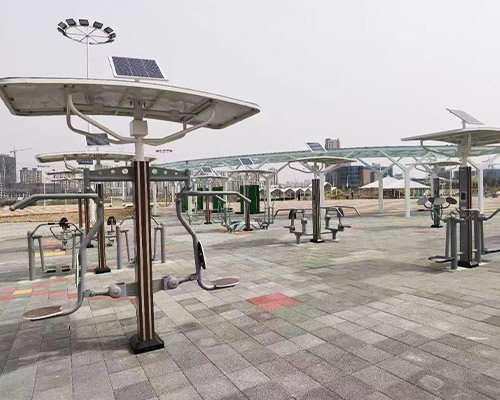
A balanced lower-body area should not focus only on knee extension and forward leg movement.
Knee-Flexion Movement
ال جهاز تدريب الساق SS-008 بخطاف الجلوس uses a seated leg-hook movement and adjustable resistance. It is intended to train the posterior leg through a different motion from the Sitting Kick Trainer.
Sitting Kick vs Sitting Hook Leg
| Factor | مدرب الركلة الجالس | جهاز تدريب الساق بالخطاف الجالس |
| Movement | Leg extension | Leg flexion or hook |
| User position | Seated | Seated |
| Main equipment role | Front-leg training | Posterior-leg training |
| Resistance | Adjustable | Adjustable |
| Best layout use | Lower-body circuit | Complements extension station |
Should a Park Install Both?
A large strength-training zone can benefit from both movements.
A small park may choose one leg station plus a squat machine to provide broader lower-body coverage.
Complementary Selection
The goal is not to collect every available machine.
It is to avoid leaving major movement categories completely uncovered.
Core-Focused Outdoor Strength Equipment
Core training in a public fitness zone should use controlled and understandable movement.
مدرب السحب الخلفي
ال جهاز تدريب السحب الخلفي SS-001 uses a seated pulling movement with adjustable counterweights and is positioned for waist and abdominal training.
Core Equipment vs Waist Twisters
A resistance-based core machine is different from a freely rotating waist twister.
| Factor | مدرب السحب الخلفي | Waist Twister |
| Resistance | Adjustable counterweight | Usually body-driven rotation |
| User position | Seated | Standing |
| Movement control | Guided | Freer rotation |
| Main role | Strength-focused core station | Mobility and light activity |
| Technical complexity | Higher | Lower |
Which One Is Better?
The two machines serve different objectives.
A strength-focused zone may prioritize a Backpull Trainer, while a general community fitness area may combine it with lighter mobility equipment.
Shoulder Training Equipment
Shoulder movement deserves careful equipment selection because users have different mobility levels.
مدرب اختطاف الطرف العلوي
ال جهاز تدريب اختطاف الطرف العلوي SS-004 uses a seated outward arm movement with adjustable resistance.
Controlled Movement Path
The machine guides the user through an outward movement rather than requiring free weights.
This can make it suitable for structured public exercise zones.
Avoid Medical Claims
Outdoor strength equipment can support general exercise, but it should not be promoted as treating shoulder injuries or replacing professional rehabilitation equipment.
Project descriptions should remain focused on general fitness and controlled movement.
Counterweight Equipment vs Bodyweight Equipment
Outdoor equipment may use adjustable external resistance or the user’s own body weight.
Counterweight Machines
Counterweight systems allow the resistance to be increased or reduced.
This supports the general training concept of progressive overload, where exercise demands increase gradually over time.
Bodyweight Machines
Bodyweight equipment uses the user’s mass and machine geometry as resistance.
It often has fewer moving adjustment components.
| Factor | Counterweight Equipment | Bodyweight Equipment |
| Resistance adjustment | Available | محدود |
| User progression | Easier to control | Depends on body weight |
| Mechanical complexity | Higher | Lower |
| صيانة | More components | Usually simpler |
| Public usability | Requires clear instructions | Often intuitive |
| Purchase cost | Generally higher | Generally lower |
Which Is Better for Public Parks?
Counterweight systems are useful when the project aims to provide more gym-like strength training.
Bodyweight equipment may be better where low maintenance and simple operation are the highest priorities.
Adjustable Resistance for Different Users
Public equipment serves people with different strength levels.
A fixed load may be too demanding for some users and too light for others.
Beginner Users
Lower resistance supports learning the movement before increasing intensity.
Experienced Users
Higher resistance provides a more challenging strength-training option.
Progressive Use
Users can increase the counterweight as they become familiar with the equipment.
Clear Adjustment Instructions
Resistance selectors should be easy to understand.
Instruction panels should explain:
- How to change the resistance
- Whether adjustment should occur before sitting
- The permitted weight range
- Correct starting position
- Controlled return movement
- Basic safety warnings
How to Create a Balanced Outdoor Strength Circuit
A circuit should follow a logical order and provide several exercise categories.
Six-Station Example
A balanced six-station layout could include:
- جهاز تدريب القرفصاء SS-002
- جهاز تدريب السحب العالي SS-003
- مدرب الدفع SS-006
- جهاز تدريب الركلة الجالسة SS-007
- جهاز تدريب الساق SS-008 بخطاف الجلوس
- جهاز تدريب السحب الخلفي SS-001
Compact Four-Station Example
For a smaller site:
- مدرب القرفصاء
- مدرب السحب العالي
- مدرب الدفع
- مدرب السحب الخلفي
Upper-Body-Focused Zone
For a training area beside an existing running trail:
- مدرب السحب العالي
- مدرب الذراع المزدوج
- مدرب الدفع
- مدرب اختطاف الطرف العلوي
Do Not Copy One Layout Everywhere
A school, senior-friendly park, residential development, and sports-training center may need different equipment combinations.
Outdoor Strength Equipment for Parks
Public parks typically serve the broadest range of users.
Main Priorities
Park projects often prioritize:
- Intuitive operation
- High durability
- Clear signage
- Moderate resistance range
- Low maintenance
- Safe circulation
- Shade and seating
Equipment Variety
A park should combine strength machines with mobility, aerobic, and balance equipment.
Strength Zone Within a Larger Park
Outdoor Strength Training Equipment does not need to occupy the entire fitness area.
A complete park may use separate zones for:
- Strength
- Cardio
- Mobility
- Senior exercise
- Children’s activity
- Rest and recovery
Outdoor Strength Equipment for Schools
Schools need equipment appropriate for the age, height, and supervision level of students.
Age Suitability
Adult dimensions and resistance settings may not suit younger children.
Teacher Supervision
Strength machines should be located where staff can observe several stations.
Class Organization
A circuit layout can help divide students into small groups.
Avoid Overcrowding
The number of machines should reflect class size and available supervision.
Placing too many students around one machine can create waiting and circulation problems.
Outdoor Strength Equipment for Residential Developments
Fitness equipment can increase the practical value of shared outdoor space.
Resident Profile
Consider whether the development mainly serves:
- Young professionals
- Families
- Older residents
- Mixed-age users
- Student housing
Noise and Location
Counterweights and moving arms can create mechanical sounds.
Avoid placing the strength zone directly beside bedroom windows where possible.
Visual Design
Equipment colors and finishes can coordinate with the landscape and architecture.
Property-Management Responsibilities
The management team should receive:
- Inspection instructions
- Lubrication guidance
- Spare-part lists
- Warranty details
- Resistance-system information
- Surface-repair procedures
Outdoor Strength Equipment for Universities
Universities may use outdoor gyms to complement indoor fitness centers.
High User Volume
Campus equipment can receive frequent use throughout the day.
Exercise Variety
Students may expect more challenging equipment than simple recreational park stations.
Training Routes
Strength stations can be positioned along walking or running routes.
Equipment Placement
Avoid separating complementary machines too widely.
Users should be able to move through the circuit without crossing roads, cycling paths, or heavily trafficked pedestrian areas.
Site Planning for Outdoor Strength Training Equipment
Equipment selection and site planning should happen together.
Product Footprint
The frame dimensions indicate how much physical space the machine occupies.
Functional Use Zone
The use zone includes:
- Moving arms
- Leg movement
- User entry
- User exit
- Adjustment access
- Maintenance access
Circulation
Users should be able to pass around one machine without entering the movement area of another.
Footprint Is Not Safety Space
A product measuring approximately 1.5 meters wide may require substantially more total site space once movement and circulation are included.
Request layout drawings for the exact selected models.
Surface Options Under Outdoor Strength Equipment
The ground surface affects accessibility, drainage, cleaning, and user safety.
Rubber Surfacing
Rubber surfaces can provide a continuous finished area and clear visual zoning.
عشب صناعي
Artificial turf can create a softer visual appearance but requires drainage and maintenance planning.
Concrete or Paving
Hard surfaces may be durable and easy to clean but should be evaluated for slip resistance and fall conditions.
Engineered Safety Surface
Some projects may require impact-attenuating surfaces according to local standards and equipment design.
Local Requirements
The correct surface depends on:
- Equipment movement
- Fall height
- User group
- Local regulations
- Accessibility
- Drainage
- Maintenance resources
The supplier and local project professionals should confirm the appropriate system.
Foundation and Anchorage

Strength equipment creates repeated dynamic loads during use.
The foundation must prevent unacceptable movement.
Embedded Installation
Structural posts may be embedded into concrete according to a supplied drawing.
Base-Plate Installation
Other products may use anchor bolts and steel base plates.
Soil Conditions
Weak, filled, or poorly drained ground can require additional preparation.
Use the Exact Foundation Drawing
Do not construct one generic concrete foundation for every machine.
Equipment dimensions, load direction, post positions, and anchoring methods may differ.
Drainage Around Outdoor Fitness Equipment
Water should not remain around seats, moving components, foundations, or access paths.
Site Slope
The surrounding surface should direct water toward appropriate drainage points.
Foundation Interface
Avoid depressions around steel posts or base plates.
Under-Seat Areas
Seats and platforms can create shaded zones that dry more slowly.
Drainage Supports Maintenance
Good drainage cannot replace corrosion protection, but it can reduce unnecessary moisture exposure around steel and moving components.
Corrosion Protection and Surface Coating
Outdoor steel requires a suitable protection system.
Surface Preparation
Coating quality depends on how the metal is cleaned and prepared.
طلاء المسحوق
A durable outdoor coating provides color and a barrier between steel and the environment.
Galvanizing
Depending on the specification, galvanized components can provide additional corrosion protection.
Ask More Than “Is It Weatherproof?”
Buyers should ask:
- Which parts are galvanized?
- What surface preparation is used?
- What coating system is applied?
- How are welds protected?
- Are fasteners corrosion-resistant?
- Is a coastal specification available?
- How should scratches be repaired?
Moving Components and Maintenance
Strength machines contain more moving components than simple static fitness stations.
Pivot Points
Inspect movement arms and pivot areas for looseness or unusual play.
Bearings
Bearings should move smoothly without excessive noise.
Counterweights
Check cables, guide systems, selectors, covers, and retaining components.
Seats and Handles
Inspect for cracks, looseness, sharp edges, and surface wear.
Preventive Inspection
Small mechanical issues are easier to correct before they affect several connected components.
Facility operators should keep a written inspection record.
Maintenance Schedule
| Frequency | Recommended Checks |
| Routine | Remove litter, dirt and standing water |
| Weekly | Check seats, handles and visible damage |
| Monthly | Inspect bolts, selectors and moving arms |
| Quarterly | Review bearings, pivots, cables and coatings |
| After severe weather | Check movement, foundations and corrosion damage |
| Annually | Complete detailed mechanical and structural inspection |
The actual maintenance schedule should follow the manufacturer’s instructions and local usage conditions.
High-Use Locations
School campuses and busy urban parks may require more frequent checks.
Coastal Locations
Salt exposure may justify more frequent cleaning and coating inspection.
How to Compare Outdoor Strength Equipment Suppliers
Use a technical comparison sheet rather than selecting only by appearance.
| Buyer Check | Information to Request |
| Main steel | Section sizes and wall thickness |
| Resistance | Counterweight type and range |
| Movement | Exercise direction and stops |
| Bearings | Type and replacement method |
| مقعد | Material, drainage and replacement |
| Handles | Grip and outdoor durability |
| Surface treatment | Preparation and coating |
| Foundation | Drawing and anchoring method |
| Product dimensions | Equipment footprint |
| Use zone | Required operational clearance |
| Instructions | User and safety signage |
| Spare parts | Availability and lead time |
| Customization | Colors and logos |
| Warranty | Coverage and exclusions |
| صيانة | Required frequency and procedures |
Request the Exercise Function of Every Product
Do not select equipment using only names such as “arm trainer” or “leg trainer.”
Ask for the exact:
- Starting position
- Movement direction
- Resistance method
- Intended exercise category
- Required user clearance
- Adjustment process
Common Outdoor Strength Equipment Buying Mistakes
Selecting Too Many Pulling Machines
A fitness area needs pushing and lower-body movements too.
Comparing Only Steel Thickness
Structure, bearings, resistance, coating, foundations, and movement design also matter.
Ignoring the Use Zone
Moving equipment needs more space than its static footprint.
Choosing the Highest Resistance
Public equipment must serve more than advanced users.
Forgetting Spare Parts
Selectors, bearings, seats, cables, and handles may eventually require replacement.
Using Generic Foundations
Each model should follow its correct installation drawing.
Ignoring Drainage
Standing water increases maintenance and accessibility problems.
Treating Equipment as Medical Devices
General public fitness machines should not be promoted as medical treatment without appropriate evidence and approvals.
Outdoor Strength Training Equipment Buyer Checklist
Before ordering, confirm:
- Target user group
- Site type
- Expected daily usage
- Available space
- Push equipment
- Pull equipment
- Lower-body equipment
- Core equipment
- Resistance range
- Resistance adjustment
- Seat dimensions
- Handle positions
- Equipment footprint
- Functional use zone
- Foundation method
- Surface system
- Drainage
- Steel specification
- Coating system
- Moving components
- Bearings
- Counterweights
- Instruction signs
- Accessibility
- Custom colors
- Spare parts
- Installation support
- Maintenance plan
- Warranty
FAQ About Outdoor Strength Training Equipment
What Outdoor Strength Training Equipment should a park include?
A balanced park should normally include at least one push station, one pull station, one lower-body station, and one core-focused station.
Larger sites can add separate vertical-pull, horizontal-pull, knee-extension, and knee-flexion equipment.
Is counterweight equipment better than bodyweight equipment?
Not universally.
Counterweight machines provide adjustable resistance, while bodyweight equipment normally has a simpler mechanical structure. The best choice depends on target users and maintenance capacity.
Which equipment trains the lower body?
Options include the مدرب القرفصاء, مدرب الركلة الجالس، و جهاز تدريب الساق بالخطاف الجالس.
These machines provide different lower-body movement patterns.
What is the difference between a High Pull Trainer and Dual Arm Trainer?
The High Pull Trainer uses a downward pulling movement, while the Dual Arm Trainer uses a rearward or horizontal pulling action.
They can complement each other in a larger fitness zone.
Is Outdoor Strength Training Equipment suitable for beginners?
Adjustable-resistance equipment can serve beginners when lower resistance settings, clear instructions, and controlled movements are available.
Users should select resistance appropriate to their ability.
Can seniors use outdoor strength machines?
Some machines may be suitable for older adults when dimensions, resistance, access, movement range, and instructions are appropriate.
Equipment should be selected according to the actual user group rather than using one specification for every park.
How much space is needed between machines?
Spacing depends on the product movement, use zone, local standards, and circulation plan.
Do not calculate spacing from the steel frame dimensions alone.
What surface is best under outdoor fitness equipment?
Rubber, engineered safety surfacing, artificial turf, concrete, and paving may all be possible depending on equipment design and local requirements.
Drainage, accessibility, fall conditions, and maintenance should guide the choice.
Does Outdoor Strength Training Equipment need concrete foundations?
Many permanent machines require concrete foundations or structural anchoring.
Use the foundation drawing supplied for the exact model.
How often should outdoor fitness equipment be inspected?
Inspection frequency depends on user volume, climate, equipment complexity, and local requirements.
Busy public sites should conduct frequent visual checks and scheduled detailed inspections.
Can the equipment colors be customized?
Many manufacturers offer customized colors or branding.
Buyers should confirm coating specifications and color availability before production.
What documents should I request from the supplier?
Request:
- Product specification
- Section and material details
- Equipment dimensions
- Use-zone drawing
- Foundation drawing
- Resistance information
- Installation instructions
- Maintenance guidance
- Spare-parts list
- Warranty terms
- Relevant test or compliance documents
خاتمة
Choosing معدات تدريب القوة الخارجية is a facility-planning decision rather than a simple product-selection exercise.
The strongest outdoor fitness zones provide a balanced combination of pushing, pulling, lower-body, and core movements. They also account for user ability, resistance adjustment, foundations, drainage, surface materials, maintenance access, and long-term spare-part availability.
A practical purchasing sequence is:
define the users → identify movement categories → select complementary machines → plan the site → verify foundations and surfaces → compare suppliers → organize maintenance
Avoid filling the site with several machines that provide nearly identical exercises.
Instead, create a circuit in which each product has a clear role.
SRSC provides multiple Outdoor Strength Training Equipment options for parks, schools, residential developments, universities, public recreation areas, and commercial fitness projects, including:
- جهاز تدريب السحب الخلفي SS-001
- جهاز تدريب القرفصاء SS-002
- جهاز تدريب السحب العالي SS-003
- جهاز تدريب اختطاف الطرف العلوي SS-004
- جهاز تدريب ثنائي الذراع SS-005
- مدرب الدفع SS-006
- جهاز تدريب الركلة الجالسة SS-007
- جهاز تدريب الساق SS-008 بخطاف الجلوس
By selecting equipment according to movement function rather than appearance alone, buyers can create a more balanced, usable, and maintainable outdoor strength-training area.